Best Masonry Paint: Revitalize Your Brick, Stucco, and Concrete
Painting masonry is fundamentally unlike painting any other surface in or around your home. While wood siding and interior drywall are relatively forgiving substrates, brick, poured concrete, and stucco are complex, highly porous materials that interact with environmental moisture in incredibly dynamic ways. Choose the wrong type of paint—specifically, an exterior formula that seals the masonry surface too tightly—and you will not simply be dealing with peeling paint next spring; you might suffer the catastrophic failure of the brick face popping off entirely, a structural nightmare in the masonry trade known as spalling.
Whether you are undertaking a massive project to brighten up a dated, monolithic red brick fireplace, desperately trying to protect a crumbling basement foundation wall from relentless hydrostatic water pressure, or giving your home’s exterior a sleek, modern facelift to increase curb appeal, the specific chemical composition of the coating you choose matters infinitely more than the color swatch.
In this comprehensive guide, we review the best masonry paints currently dominating the market. We break down the science of breathability (perm ratings), elastomeric durability, waterproofing capabilities, and ease of DIY application—and we cover every surface type, every paint chemistry category, and every application scenario from basement foundations to chimney stacks to pool decks.
📋 Table of Contents
- Quick Comparison Table
- The Science of Masonry Paint: Breathability vs. Waterproofing
- All Five Paint Chemistry Types Explained
- Know Your Surface: Brick, Stucco, CMU, EIFS, and Concrete
- The Permanence Question: Can You Paint Over Painted Brick?
- Deep Dive Reviews: The 5 Best Masonry Paints
- Painting a Chimney Stack: Special Considerations
- Fireplace Surround and Firebox Interior: Heat-Rated Coatings
- Color Trends for Painted Brick
- Coverage Rates, Sheen Levels, and VOCs Compared
- Step-by-Step: How to Paint Masonry Like a Professional
- Application Tools: Roller, Brush, or Sprayer?
- Weather Windows: Temperature and Rain Rules
- Post-Paint Maintenance
- Frequently Asked Questions
Quick Comparison: Top Rated Masonry Paints at a Glance
Use this comparison chart to quickly identify which product category fits your specific project needs. Swipe horizontally on mobile devices to see the full table.
| Product | Best Application | Chemistry | Finish | Breathability | Waterproofing |
|---|---|---|---|---|---|
| Romabio Classico Limewash | Exterior/Interior Brick & Stone | Mineral / Slaked Lime | Flat / Antique | Very High | Moderate |
| KILZ Basement & Masonry | Basement Walls, Foundations | Acrylic Resin | Flat / Smooth | Low (Barrier) | Excellent |
| INSL-X TuffCrete | Concrete Floors, Patios, Garages | Waterborne Acrylic Stain | Satin / Matte | Medium | Medium |
| Prestige Exterior Paint | Siding, Hard Brick, Stucco | 100% Acrylic Latex | Flat / Satin | Medium | Good |
| Drylok Extreme | Cinder Block, Below-Grade Walls | Latex / Ceramic Fortified | Smooth | Low (Hydrophobic) | Excellent |
The Science of Masonry Paint: Breathability vs. Waterproofing
Before diving into product reviews, it is critical to understand the underlying mechanics of masonry. You cannot simply slap leftover exterior house paint on your chimney, foundation, or patio and expect it to survive a single winter.
🔬 The Critical Factor: The “Perm” Rating
Masonry is a living, breathing material. Brick, block, and mortar constantly absorb moisture from the ground (rising damp), the humid air, and driving rain. It must then release that moisture back into the atmosphere through evaporation. The ability of a material to let water vapor pass through it is measured by its perm rating — higher perm means more breathable.
If you apply a standard, high-gloss exterior acrylic latex paint to a brick wall, you effectively shrink-wrap the house in a plastic film. Moisture from inside the home or drawn up from the foundation gets trapped behind this impermeable film. During winter, when the temperature drops below freezing, that trapped liquid water freezes and expands by 9%. This immense hydraulic pressure pushes outward, causing the paint to blister, peel, and in severe cases, shear off the protective outer face of the brick entirely — what the masonry trade calls spalling. You must use a highly breathable paint on historic or soft brick.
This scientific reality is especially critical for exposed structures like chimneys, which endure extreme thermal shock — heat from the fire inside, freezing temperatures outside. If you are currently dealing with a water leak in your masonry, you must address the structural issue before opening a can of paint. Check our extensive guide on how to diagnose and fix a leaky chimney. Painting over an active structural water problem will only accelerate the decay hidden beneath.
The Breathability Spectrum: Where Each Paint Type Falls
| Paint Type | Perm Rating (approx.) | Safe for Old/Soft Brick? | Best Surface Context |
|---|---|---|---|
| Mineral / Limewash | Very High (100+) | Yes — ideal | Historic brick, stone, old structures |
| Silicate / Potassium Silicate | Very High | Yes — ideal | Historic preservation, modern hard brick |
| Acrylic Masonry (quality) | Medium (5–15) | Modern hard brick only | Stucco, hard exterior brick, CMU above grade |
| Elastomeric | Low–Medium (1–5)* | No — avoid on soft/old brick | Stucco, modern concrete, EIFS *some breathable formulas exist |
| Waterproofing Coatings (KILZ, Drylok) | Very Low (<1) | No | Below-grade, basements, foundations only |
All Five Masonry Paint Chemistry Types Explained
Most buying guides describe only two or three paint types. In reality, there are five distinct chemistry categories for masonry coatings, each with fundamentally different performance characteristics. Understanding which category is right for your surface is the most important decision you will make before your project begins.
Mineral & Limewash
Made from slaked lime or potassium silicate. Does not form a film — instead, chemically bonds into the masonry pores. Fully breathable, never peels. The historic preservation gold standard. Zero VOCs.
Potassium Silicate (Mineral)
An advanced mineral coating that reacts with the silica in masonry to form a permanent silicate bond. Brands like Keim Mineral Paints are considered the premium end of this category. Extraordinarily durable — some applications last 30+ years.
Elastomeric
A thick, rubber-like coating that can stretch 300–600% before breaking. Ideal for crack-bridging on stucco and modern concrete. Two to three times the thickness of standard paint (80–100 sq ft per gallon vs. 300+). Most are low-breathability — use only on surfaces where water cannot enter behind the paint.
Acrylic Latex Masonry
The most versatile everyday choice. Quality formulas are alkali-resistant (critical for fresh concrete and mortar), medium-breathability, and appropriate for most above-grade modern masonry. Available in the widest color range.
Waterproof / Dampproofing
Thick acrylic or latex-based coatings engineered specifically to resist hydrostatic pressure. Low breathability by design — correct application is below-grade, never above-grade on soft historic brick. Includes KILZ, Drylok, Thoroseal.
Elastomeric Paint: The Deep Dive Most Guides Skip
Elastomeric paint deserves a deeper explanation because it is frequently recommended without adequate context, and misapplication creates expensive problems. Here is what you need to know:
- Elongation: Elastomeric paint can stretch 300–600% before breaking. Benjamin Moore UltraSpec Elastomeric, for example, is rated at 300% elongation. This means it can bridge hairline cracks up to approximately 1/16 inch wide — a genuine, valuable feature for stucco walls that naturally develop fine surface crazing over time.
- Thickness and coverage penalty: A typical exterior acrylic covers 300–400 square feet per gallon. A thick elastomeric covers only 80–100 square feet per gallon — roughly one-third of the area. Budget accordingly; what looks like a cheaper paint per gallon can cost three times as much per square foot to apply.
- Re-coat timing: Most elastomeric products dry to the touch in 2 hours but require 24 hours before re-coat. This makes two-coat projects a two-day minimum, which affects labor scheduling.
- Temperature requirements: Many elastomeric formulas (like Sherlastic by Sherwin-Williams) require surface temperatures above 50°F for 24 hours during and after application. This limits their fall/spring application window in cold climates.
- Breathability warning: Most elastomeric coatings are intentionally low-breathability. They are excellent when moisture comes from outside (rain, driving moisture). They are catastrophic when moisture is present behind the wall — it has nowhere to escape and causes blistering failure. Never use non-breathable elastomeric on soft historic brick, below-grade applications, or any wall where water enters from inside or from the ground.
- Breathable elastomeric exception: Some formulas are specifically engineered for breathability — Benjamin Moore’s UltraSpec Elastomeric is the most widely cited example. If you want the crack-bridging benefits with reduced moisture-trap risk, specifically request a breathable elastomeric and verify the perm rating on the technical data sheet.
Know Your Surface: Brick, Stucco, CMU, EIFS, and Concrete
Different masonry surface types have meaningfully different painting requirements. Matching the right coating to the right substrate is just as important as selecting a quality brand.
🧱 Soft / Historic Brick
Pre-1930s brick; highly porous; easily damaged by trapped moisture. Requires maximum breathability. Mineral limewash or silicate paint only. Acrylic latex acceptable only on genuinely hard, modern-fired brick.
🏠 Traditional Stucco
Textured cement-based finish that naturally cracks over time. Needs a flexible coating that moves with the surface. Best choices: breathable elastomeric or high-quality acrylic masonry. Allow new stucco to cure 30 days before painting.
🏗️ CMU / Cinder Block
Concrete Masonry Units have extremely high porosity and an uneven surface texture. Requires a block filler coat before topcoat application to seal the large pores. Below-grade CMU walls need a dedicated waterproofing product.
🏢 EIFS (Synthetic Stucco)
Exterior Insulation and Finish System — a foam-based synthetic stucco. Requires breathable coatings specifically. Water trapped behind EIFS is a very serious structural risk. Use Loxon XP or a breathable acrylic masonry product. Never use non-breathable elastomeric.
⬜ Smooth Concrete / Tilt-Up
Low porosity; adhesion is the challenge rather than breathability. Requires acid etching or mechanical grinding before paint application. Use specialized masonry acrylic or concrete stain rather than wall paint.
🏊 Horizontal Concrete (Floors, Decks)
Requires traffic-rated coating — standard wall paint will fail immediately. Use a concrete stain like INSL-X TuffCrete. Anti-slip aggregate additive is essential for pool decks and wet areas.
The Block Filler Step: Critical for CMU and Cinder Block
Concrete masonry units (CMU) and older cinder blocks have an extremely open, porous surface texture that standard paint cannot adequately bridge. If you apply acrylic masonry paint or elastomeric directly to raw CMU without a block filler, the paint will soak into the pores unevenly and require excessive material to achieve coverage, and the finish will show every void and surface irregularity as a pit in the final surface.
A dedicated block filler (also called a masonry surfacer or block conditioner) is a thick, heavy-bodied primer specifically designed to fill CMU surface voids in one coat, creating a smooth, uniform substrate for the topcoat. Apply block filler by brush or heavy-nap roller and allow to cure fully before topcoating. For below-grade CMU walls where waterproofing is the goal, KILZ or Drylok products function as both block conditioner and topcoat simultaneously.
New Concrete and Stucco: The 30-Day Rule
Never apply any coating — primer, paint, or waterproofer — to newly poured concrete or freshly applied stucco before it has fully cured. Fresh concrete and stucco have an extremely high alkaline pH (often pH 12–13) and contain moisture that is actively outgassing during the curing process. Painting over uncured masonry causes two problems simultaneously: the alkalinity will chemically degrade acrylic paint binders (a process called saponification), and the escaping moisture vapor will blister any coating applied over it. Always wait a minimum of 30 days before painting new concrete or stucco.
The Permanence Question: Can You Paint Over Painted Brick, and Can You Undo It?
This is one of the most emotionally loaded questions in masonry — and one of the most important to answer honestly before you begin any brick painting project.
Can You Paint Over Already-Painted Brick?
Yes — painting over previously painted masonry is routine. The key requirements are that the existing paint must be firmly adhered (no peeling or bubbling), the surface must be properly cleaned and primed where needed, and you must use a compatible topcoat. If the existing paint is peeling or flaking, those areas must be stripped and spot-primed before recoating.
⚠️ Critical Limitation: Romabio and Limewash Only Work on Bare Masonry
Mineral limewash products like Romabio Classico work through a chemical calcification process that requires direct contact with the masonry pores. If you apply limewash over existing acrylic paint, the lime cannot penetrate and will not bond — it will simply sit on the surface and fail within months. If you want the limewash aesthetic on previously painted brick, the paint must be completely stripped first, which is an extremely labor-intensive process. Plan your choice carefully before committing.
Can You Remove Paint from Brick Once Applied?
This is the hardest truth in masonry painting. Once you paint brick with an acrylic or latex product, removal is extraordinarily difficult, expensive, and often damaging to the brick itself. Paint removal methods include:
- Chemical paint strippers: Gel-based masonry paint removers can dissolve acrylic films, but multiple applications over several days are typically needed, and residues must be neutralized and thoroughly rinsed. This is highly effective on smooth brick but nearly impossible to fully execute on rough, porous brick.
- Soda blasting: A gentler alternative to sandblasting that uses sodium bicarbonate (baking soda) as the abrasive media. Less damaging to soft brick than sand. Still a specialized professional service, typically costing $2–$5 per square foot.
- Sandblasting: The most aggressive removal method and genuinely dangerous to old, soft, historic brick. Sandblasting can and does remove the protective vitrified outer skin of brick permanently, leaving the softer interior face exposed to accelerated weathering. Only appropriate for hard, modern industrial brick with an experienced operator.
The practical takeaway for homeowners considering painting their brick: treat it as a permanent decision. If you are not fully committed to painted brick for the long term, the limewash approach is a better aesthetic choice, because it wears gracefully and can be reapplied, while a peeling acrylic paint job creates a maintenance trap. If you want the option to revert to natural brick someday, do not paint it at all.
Deep Dive Reviews: The 5 Best Masonry Paints
1. Romabio Classico Limewash
The Authentic, Breathable Choice for a “Chip and Peel Free” Lifetime Finish
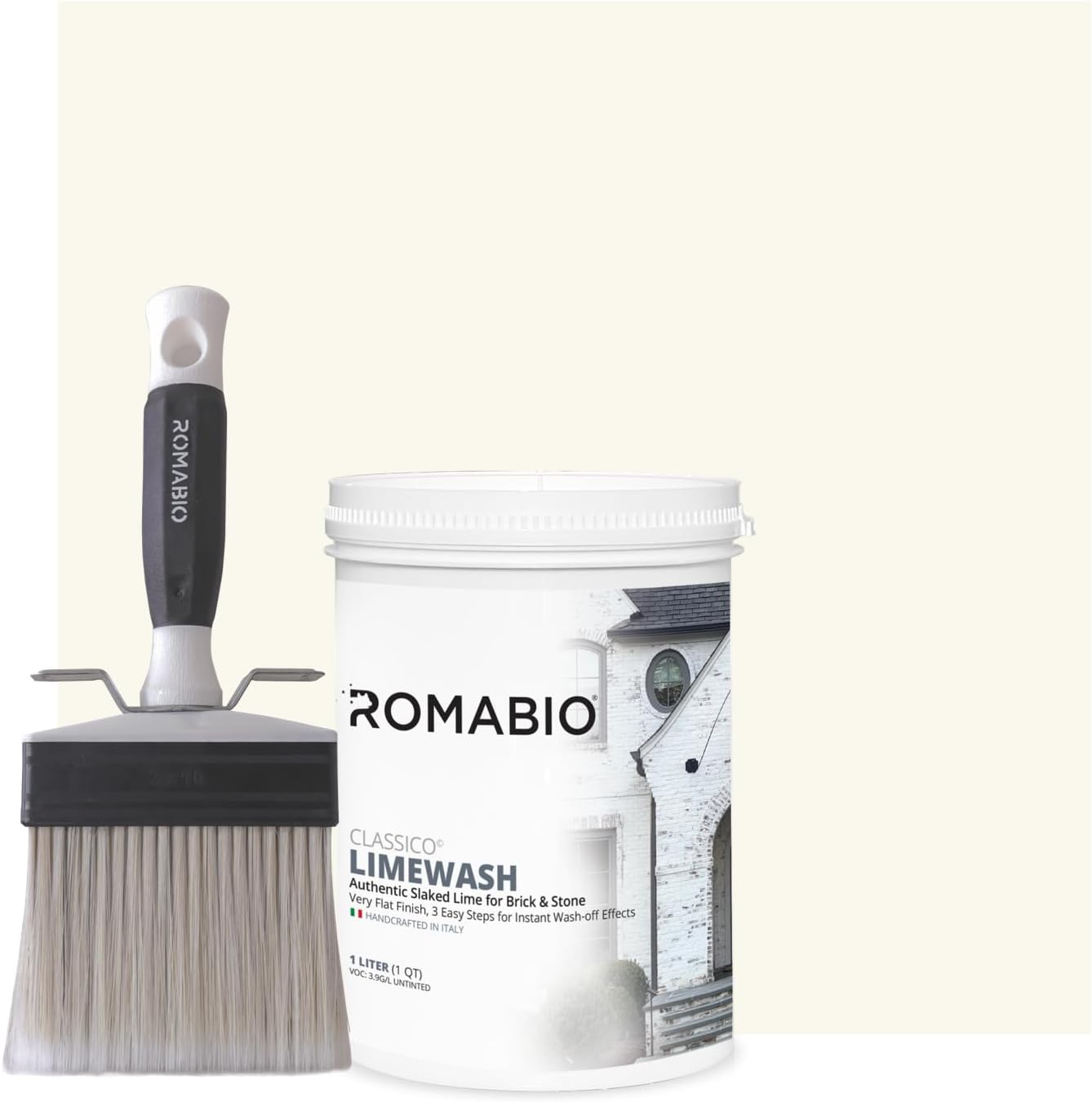
If you have seen those stunning, old-world style, perfectly white-washed brick houses on Pinterest or Instagram remodeling shows, they are almost certainly using Romabio. Romabio is not technically “paint” in the modern, synthetic sense; it is an authentic slaked lime wash sourced from the Dolomite mountains in Northern Italy — the same limestone formation that has supplied building lime for over 2,000 years.
The magic of Romabio lies in its application process and its chemical reaction. You apply it to a wet brick wall. Instead of drying like a plastic skin, the slaked lime reacts with the air and the masonry to calcify, forming a permanent, microscopic rock-hard bond with the brick. Because it does not form a film, it will never peel, chip, blister, or flake off. It is the ultimate solution for homeowners who want to change the color of their brick without entering the endless maintenance cycle required by standard latex paint.
Romabio is also naturally high-alkalinity — which is a powerful, built-in deterrent against mold, mildew, and algae growth on shaded exterior walls, a genuine advantage for north-facing or heavily shaded walls where biological growth is a persistent maintenance problem.
- Forms a permanent chemical bond; guaranteed not to peel or blister.
- Allows masonry to breathe naturally, preventing trapped moisture and spalling.
- Naturally resists mold, mildew, and bacterial growth.
- Unique 5-day “wash-off” window: hose it down intentionally for a custom distressed antique finish.
- Zero VOCs — completely natural and environmentally safe.
- Approved for historic preservation projects by many local landmark boards.
- Only works on unpainted, highly porous brick or stone — will not bond over existing acrylic paint.
- Higher upfront cost per gallon than standard acrylic latex.
- Limited color palette (whites, creams, light greys, warm earth tones).
- Application technique requires practice — patchy results common for first-time users without test area trial.
Expert Note for Chimneys: Because limewash is a mineral coating, it does not burn or emit toxic fumes when exposed to high heat. This makes it the recommended exterior treatment for chimney stacks — it withstands the extreme thermal expansion and contraction of a chimney far better than plastic-based acrylics. See our full guide on the best paint for chimney brick for a complete comparison of chimney-specific options.
2. KILZ Basement & Masonry Waterproofer
The Heavy-Duty, Impermeable Barrier for Wet Basements and Retaining Walls

While a product like Romabio is entirely focused on aesthetic beauty and high breathability, KILZ Basement & Masonry Waterproofer is engineered purely for defense. This is a thick waterproofing coating that doubles as an interior/exterior paint, utilizing an advanced nanotechnology-based acrylic resin formula designed to form a highly impermeable barrier.
When applied correctly in two thick coats, KILZ can hold back significant hydrostatic pressure — the force of groundwater physically pushing through porous concrete foundation walls. It is the heavy-duty solution for sealing damp basement walls, porous cinder block garages, and exterior concrete retaining walls that hold back wet soil.
- Resists hydrostatic water pressure up to 12 PSI.
- Highly alkali-resistant — can be applied to newer, unpainted concrete without separate primer.
- Can be tinted to a range of pastel and light colors at most hardware stores.
- Low odor; easy cleanup with warm soapy water.
- Dries to touch in roughly one hour.
- Very thick consistency — physically demanding to roll over large, rough surfaces.
- Not suitable for horizontal floor applications (will scuff and peel under foot traffic).
- Intentionally low breathability — never use above-grade on soft historic brick.
- Must be applied to dry walls — painting over saturated masonry causes failure.
If you are dealing with severe moisture in a basement, applying paint is only step two. First, ensure proper exterior drainage and investigate the roofline. If water is running down from above, explore chimney waterproofing methods to confirm the leak source isn’t originating higher in the structure.
3. INSL-X TuffCrete Waterborne Acrylic Concrete Stain
The High-Traffic, Durable Solution for Garage Floors and Pool Decks

Painting horizontal surfaces is notoriously difficult — most standard masonry paints and exterior house paints peel, scratch, or fail almost immediately if walked upon or driven over. INSL-X (a premium Benjamin Moore brand) formulated TuffCrete specifically to survive the brutal abuse of horizontal concrete applications.
TuffCrete is technically a waterborne acrylic opaque stain rather than a traditional paint. This means it penetrates deeply into the microscopic pores of the concrete for superior adhesion while still leaving a durable, uniform color film on top. It is formulated to resist hot tire pickup, chemical oil spills, detergents, and winter road salt — exactly the conditions a garage floor experiences daily.
💡 Anti-Slip Additive: Don’t Skip This Step for Pool Decks
The smooth satin finish of TuffCrete becomes very slippery when wet — a significant safety hazard around pools, hot tubs, and exterior patios in wet climates. When mixing your TuffCrete for any application where wet foot traffic is expected, add a commercially available anti-slip aggregate (typically fine silica sand or aluminum oxide grit) according to the manufacturer’s recommendation. This simple additive maintains traction without noticeably altering the appearance.
- Highly resistant to abrasion, scuffing, and heavy foot traffic.
- Resists hot tire pickup — safe for garage floor use.
- Resists UV fading and chalking on exterior patios.
- Can be applied in a single coat (two recommended for durability).
- Rapid return to service — drivable in 24–48 hours.
- Unforgiving prep requirements — concrete must be acid-etched or mechanically ground for adhesion.
- Smooth finish becomes slippery when wet; anti-slip additive is essential near water.
- Not a wall product — do not use on vertical surfaces.
4. Prestige Exterior Paint & Primer In One
The Smooth Operator for Siding, Hardiplank, and Painted Stucco

If you are tackling a large exterior project — repainting previously painted stucco, updating Hardiplank siding, or refreshing modern hard-fired exterior brick — and you need a fresh, modern color without breaking the bank, Prestige Exterior Paint is a highly cost-effective 100% acrylic latex option. The paint-and-primer-in-one formulation saves significant time and money for DIYers painting over a previously coated surface in reasonable condition.
While Prestige lacks the specialized hydrostatic waterproofing of KILZ or the unique calcification properties of Romabio, it compensates by offering the widest range of custom colors and a beautifully smooth, consistent finish. It is highly flexible, handling the natural thermal expansion and contraction of siding and stucco in extreme weather without cracking or flaking.
- Massive color selection for precise matching.
- Smooth, consistent application by sprayer, roller, or brush.
- Excellent mildew and dirt resistance on shaded exterior walls.
- Highly cost-effective for large exterior square footage.
- Still requires a separate dedicated primer on raw, unpainted brick or new stucco despite the “primer in one” claim.
- Not formulated for below-grade applications or high-hydrostatic-pressure environments.
- Not suitable for soft historic brick without primer assessment.
5. Drylok Extreme Masonry Waterproofer
The Toughest Below-Grade Barrier for Block Foundations and Retaining Walls
Drylok Extreme is the market-leading below-grade masonry waterproofer and the direct heavy-duty competitor to KILZ Basement. Where standard Drylok handles typical basement dampness, Drylok Extreme is the upgraded formulation with ceramic particles blended into the acrylic resin. This ceramic fortification creates a harder, more abrasion-resistant finish and provides improved resistance against hydrostatic pressure — rated to withstand up to 15 PSI of water pressure when properly applied.
Drylok Extreme is particularly well-suited for bare cinder block and CMU walls because its thick body and high solids content penetrate the large surface voids without requiring a separate block filler step for most applications. For extremely porous or rough block, a separate block filler still provides the best foundation. The formula is also suitable for poured concrete, stucco below grade, and mortar joints. It can be applied by brush (preferred for working the product into block voids), roller, or sprayer.
- Rated to resist up to 15 PSI hydrostatic pressure — higher than standard KILZ.
- Ceramic-fortified formula creates a harder, more abrasion-resistant film.
- Can be applied directly to bare cinder block in most cases without separate block filler.
- Paintable with latex paint once fully cured if color variety is desired.
- Available in white and also tintable to light colors.
- Very thick; stiff brush application is physically demanding over large areas.
- Intentionally non-breathable — never use above-grade on soft brick or any surface where interior moisture must escape.
- Only for vertical walls, not floors.
- Like all waterproofers, it treats symptoms — not a substitute for fixing the water entry source.
Painting a Chimney Stack: Special Considerations
A chimney stack is one of the most demanding masonry painting applications in residential construction. It faces conditions that no other wall on the house experiences simultaneously: intense radiant heat from the flue, extreme freeze-thaw cycling from cold exterior air, acid exposure from flue gases that permeate through the liner, ultraviolet degradation from direct sun exposure on all faces, and wind-driven rain from every direction. Choosing the wrong coating is not just an aesthetic failure — it actively accelerates the structural deterioration of the stack.
Why Breathability Matters Even More on Chimneys
A chimney is heated from inside during use and cooled rapidly from outside in cold weather. This thermal cycling drives moisture outward through the masonry every time the fire dies down. If that moisture movement is blocked by a low-breathability acrylic coat, pressure builds rapidly inside the brick — more rapidly than on a standard exterior wall, because of the heat differential. Spalling risk on painted chimneys with poor-breathability coatings is significantly higher than on standard wall applications. For chimney stacks, mineral limewash or a high-quality breathable silicate paint is strongly preferred over standard acrylic.
Chimney Paint Color: The Rust Stain Problem
If you paint your chimney white or a light color — an increasingly popular design choice — you must protect it with a rust-proof stainless steel or copper chimney cap. A cheap galvanized metal cap will develop surface rust within a single season, and every rainstorm will deposit orange rust streaks straight down your beautiful freshly painted white brickwork. Check our comprehensive reviews on the best chimney rain caps for drainage and performance to protect your investment against both water entry and rust staining.
Safety First: Chimney Height and Scaffolding
Chimney stacks on two-story homes are typically 25–35 feet above ground level. Painting a full chimney stack safely requires proper scaffolding — not an extension ladder leaned against the chimney. Leaning a ladder against a chimney is a fall hazard and can damage the cap, crown, and flashing. For full chimney painting projects, consider consulting a professional who already has scaffolding and the appropriate safety equipment. Our guide on how to choose trusted chimney sweep repair services can help you find professionals who handle masonry work safely.
Fireplace Surround and Firebox Interior: Heat-Rated Coatings
The masonry around your fireplace — the surround, the hearth, and the firebox interior — involves two very different painting scenarios with very different requirements. Treating them the same way is a common and potentially dangerous mistake.
Fireplace Surround (Exterior Face — Not Heat-Exposed)
The brick or stone surround on the exterior face of the fireplace — the decorative visible area that faces into the room — does not experience significant direct heat. Temperatures on this surface rarely exceed 150°F even during vigorous fires. Standard masonry coatings are appropriate here:
- Romabio Limewash is an excellent choice for the surround and will not off-gas in room temperatures.
- High-quality acrylic latex masonry paint works well here and offers the widest color selection for interior matching.
- Chalk paint has also become popular for decorative fireplace surrounds and adheres well to clean, dry brick in low-heat applications.
Firebox Interior (Direct Heat Exposure)
The firebox interior — the inside of the firebox where the fire actually burns — is an entirely different situation. Standard masonry paint, acrylic latex, or limewash in the firebox interior is dangerous and will burn, degrade, and potentially release toxic fumes when exposed to direct fire temperatures of 700–1,400°F.
⚠️ Firebox Interior: Only Use High-Temperature Rated Coatings
If you need to coat the firebox interior (for example, to freshen up a smoke-stained interior or recoat refractory panels), use only products specifically formulated and rated for continuous high-temperature exposure. Products like Rust-Oleum High Heat Paint (rated to 1,200°F) or Stove Bright High Temperature Paint are appropriate for firebox interiors. Standard masonry paint — no matter the brand — is not.
Most properly functioning fireplaces should not need interior painting at all — the refractory brick and cement used in firebox construction is designed to be left uncoated. If the firebox interior looks significantly discolored or damaged, this may indicate a structural issue worth inspecting rather than a cosmetic problem to paint over.
Color Trends for Painted Brick: What’s Popular and What Lasts
Painted brick has undergone a remarkable transformation in design culture over the past decade, moving from a choice associated with covering up damaged or dated brick to a deliberate, high-end design statement embraced by architects and interior designers worldwide.
White and Off-White Brick
The classic painted brick look. Whether achieved with Romabio’s antique whites and creams (which give a softer, European-inspired appearance) or a bright, clean acrylic white, white painted brick remains the most popular overall choice for both exterior and interior applications. It reads as clean, timeless, and maximally versatile with other design elements. For exterior applications, Romabio’s Avorio (warm ivory), Bianco Antico, and Melograno white are among the most searched shades.
Gray and Charcoal Brick
Medium warm grays — reminiscent of traditional English and European gray limestone — have become enormously popular as a sophisticated alternative to stark white. Darker charcoal and near-black painted brick is trending on modern and contemporary architecture, particularly on chimneys and feature walls. For very dark colors, limewash’s translucency creates a beautifully nuanced depth that flat acrylic paint cannot replicate.
German Smear and Mortar Wash
German smear (also called mortar wash or “schmierfarbentechnik”) is a technique related to but distinct from limewash. Rather than a thinned liquid application, a stiff mortar mixture is smeared directly over the brick surface and partially wiped back while wet, deliberately leaving the mortar in the joints and in the rough texture of the brick face while revealing the brick color through the thin wiped areas. The result is a heavily textured, old-world cottage appearance. It is a permanent structural application rather than a paint — once applied, it essentially cannot be removed.
Whitewash vs. Limewash: What Is the Difference?
These terms are often used interchangeably in home design content but they refer to technically different products. Traditional whitewash is simply diluted white latex paint (typically 1 part paint to 1–3 parts water) brushed onto brick and partially wiped back for a translucent, rustic effect. It is inexpensive and achievable with any leftover white latex paint. However, because it uses acrylic latex rather than mineral lime, it does not chemically bond to the brick — it sits as a very thin film and will eventually peel and require recoating. Limewash (like Romabio) uses actual slaked lime and creates a permanent chemical bond — it is both more durable and far more breathable than diluted latex whitewash.
Coverage Rates, Sheen Levels, and VOCs: The Practical Comparison
Coverage Rate by Paint Type
| Paint Type | Coverage (sq ft / gallon) | Coats Needed | Actual Sq Ft per Gallon Purchased |
|---|---|---|---|
| Limewash (Romabio) | 100–150 (diluted) | 1–3 (layered) | ~100 finished |
| Elastomeric (non-breathable) | 80–100 | 2 | ~45–50 finished |
| Acrylic Masonry (standard) | 200–300 | 2 | ~125–150 finished |
| Basement Waterproofer (KILZ/Drylok) | 75–125 | 2 | ~60–75 finished |
| Concrete Floor Stain (TuffCrete) | 200–300 | 1–2 | ~150–200 finished |
Sheen Level Guide: Which Finish for Which Application?
Masonry paint is available in multiple sheen levels, and the choice affects both appearance and performance:
- Flat / Matte: The most breathable finish; conceals surface irregularities best; ideal for exterior rough brick, stucco, and historic masonry. Not washable — marks cannot be scrubbed away.
- Satin: A subtle low-sheen finish that is slightly more washable than flat. A good compromise for exterior walls that will see some weathering and require occasional cleaning.
- Semi-gloss or Gloss: Highly washable and moisture-resistant. Rarely used on masonry exterior walls (looks plasticky on textured surfaces); more appropriate for interior masonry in kitchens, laundries, or bathrooms where cleaning is frequent.
For most exterior brick and stucco applications, flat or satin is the correct choice. High-sheen finishes on exterior masonry actually amplify surface defects under raking light and appear visibly artificial — they are also more likely to trap moisture than flat finishes on rough, porous substrates.
VOCs: What You Need to Know
Volatile Organic Compounds are chemical solvents that evaporate into the air during paint application and drying. High-VOC paints contribute to indoor air quality problems and outdoor smog formation. The industry has shifted substantially toward low-VOC and zero-VOC formulations in recent decades. For masonry painting specifically:
- Mineral limewash products like Romabio are genuinely zero VOC — completely safe for interior and enclosed exterior application.
- Quality modern water-based acrylic masonry paints are typically low VOC (under 50 g/L) — safe for use with normal ventilation.
- Older oil-based masonry sealers and some solvent-based concrete stains may still be high VOC — check the product safety data sheet and ensure adequate ventilation and respiratory protection.
Step-by-Step: How to Paint Masonry Like a Professional
Masonry painting is famously 80% preparation and 20% actual painting. If you rush or skip the prep work, even the most expensive premium paint will fail, blister, or peel within a single year.
Aggressive Cleaning
Use a pressure washer with a wide-fan tip (not a zero-degree pinpoint tip, which will blast mortar from joints) or a stiff-bristled brush with TSP (Trisodium Phosphate) solution to strip all dirt, grease, bird droppings, and moss. For heavy black soot stains on a chimney exterior, use a dedicated chemical soot cleaner. Check for uninvited residents — if you suspect birds in the chimney or abandoned nests behind loose brickwork, clear them out before sealing the structure.
Treat Efflorescence
That white, chalky, powdery substance on your brick is efflorescence — crystallized salt deposits carried to the surface by moisture. Paint applied directly over efflorescence will never adhere; it will bubble and pop off. Scrub it off with a specialized acidic masonry cleaner or white vinegar solution, rinse thoroughly, and let the wall dry completely (several warm days minimum). Once you have resolved the efflorescence cosmetically, investigate the underlying moisture source causing it to recur.
Repair Cracks and Joints
Paint is a cosmetic coating, not a structural filler. Painting over a crack without repairing it first means the crack will telegraph through the new paint within weeks or months as the masonry moves seasonally. Use a high-quality masonry caulk for hairline cracks, or consult our guide to the best chimney mortar mixes for tuckpointing deep or crumbling joints before painting.
Apply Block Filler (CMU Only)
If you are painting cinder block or CMU, apply a heavy-body block filler coat and allow it to cure completely before topcoating. This step dramatically improves topcoat adhesion and reduces paint consumption on highly porous block surfaces.
Acid Etch Concrete (Smooth Concrete Only)
Smooth poured concrete has very low surface porosity and resists paint adhesion. Before painting a smooth concrete floor, walkway, or tilt-up wall, apply a dilute muriatic acid etch solution (typically 1 part acid to 10 parts water), allow it to react and bubble, then rinse completely and neutralize with a baking soda solution. The etching creates microscopic tooth for paint to grip. Alternatively, mechanical grinding with a concrete grinder achieves the same result without chemical handling.
Prime (Crucial for Acrylics)
For limewash application, wet the raw brick with water first to help the lime absorb. For all acrylic or latex topcoats, apply a dedicated masonry primer to bind loose chalky surface dust, seal the alkaline pH of mortar, and create a uniform absorption base. Without primer, thirsty raw brick will suck the moisture out of your expensive topcoat too quickly, causing premature failure.
Apply Topcoat Using the Back-Rolling Technique
For textured brick and stucco, use a high-nap roller (¾ to 1 inch thick) to physically force paint deep into mortar joint crevices and the pitted brick texture. If using an airless sprayer to save time on large surfaces, use the professional back-rolling technique: one person sprays the paint onto the wall, and a second person immediately follows with a dry roller to push the sprayed paint deep into the masonry pores. Without back-rolling, spray-applied masonry paint sits on the surface peaks and fails to penetrate the pores — it will delaminate rapidly.
Application Tools: Roller Nap, Brush, or Sprayer?
Roller Nap Selection Guide
The roller nap (pile thickness) is one of the most frequently underestimated decisions in masonry painting. Using the wrong nap thickness either leaves voids in the mortar joints or applies too little material to rough surfaces.
| Surface Texture | Recommended Nap | Notes |
|---|---|---|
| Smooth concrete, plaster | ¼ – ⅜ inch | Fine finishes; minimal stippling |
| Previously painted smooth brick | ½ inch | Standard nap for previously coated surfaces |
| Medium-texture stucco | ¾ inch | Reaches into texture valleys |
| Rough/raw brick, CMU | ¾ – 1 inch | Essential for forcing paint into mortar joints and pores |
| Heavy rough stucco / pebble dash | 1 – 1½ inch | Maximum nap; high material consumption |
Brush Application
A stiff-bristle masonry brush (not a standard paint brush — masonry brushes are stiffer and have more bristle body) is the preferred tool for scrubbing waterproofing products like KILZ and Drylok into highly porous cinder block. The scrubbing action physically works the thick coating into the block voids in a way that rolling alone cannot replicate. For limewash application on brick, a large, thick natural-bristle brush is traditional and effective, giving control over the wash intensity and allowing deliberate variation in thickness for a more antique, hand-applied appearance.
Airless Sprayer
An airless sprayer dramatically reduces labor time on large surfaces — exterior house painting, chimney stacks, and large retaining walls. Always combine spraying with back-rolling for masonry work. Without back-rolling, sprayed masonry paint has inadequate penetration and will fail prematurely. Use a minimum of a 0.021-inch spray tip for most masonry paints, and a 0.025–0.029-inch tip for heavy elastomeric or waterproofer formulas. Protective sheeting for windows, doors, and landscaping is non-negotiable when spraying exteriors.
Weather Windows: Temperature and Rain Rules for Masonry Painting
Temperature Requirements
Cold temperatures have a dramatic impact on paint performance. The binders in acrylic and latex masonry paints do not coalesce (form a continuous film) correctly below certain temperatures:
- Most acrylic masonry paints: Surface temperature must be at or above 50°F (10°C) during application and for at least 48 hours after.
- Elastomeric paints: Many formulas, including Sherlastic, require temperatures above 50°F for 24 continuous hours both during and after application. Some restrict application above 90°F as well — heat causes rapid surface drying that traps moisture underneath.
- Limewash (Romabio): Should not be applied below 40°F (4°C). High heat and direct sun are also problematic — on very hot days, pre-wet the wall more aggressively and work in shade where possible to extend the working window.
- Waterproofers (KILZ, Drylok): Most require 50°F minimum surface temperature; some professional-grade products allow as low as 35°F in emergency situations.
Rain and Humidity
Never apply masonry paint to a wet or damp surface, and never paint when rain is expected within 4–6 hours. Moisture on the surface prevents paint adhesion and causes immediate failure. For exterior work, the surface should have been dry for a minimum of 24–48 hours after any rain. In humid climates (above 85% relative humidity), allow extra drying time between coats. Some premium formulas — notably Valspar’s elastomeric — include Rain Ready® Technology that accelerates surface set enough to resist light rain within as little as one hour of application, but these are exceptions. When in doubt, check the product’s specific technical data sheet for humidity limits.
Protecting Your Investment: Post-Paint Maintenance
Once your masonry painting project is complete, protecting the finish for the long term requires ongoing attention to the same threats that motivated the painting in the first place — water.
Ensure your home’s gutters are clean and effectively routing water away from newly painted foundation walls. If you painted a chimney stack, ensure the concrete chimney crown at the top is sealed and crack-free. If you utilize a wood-burning fireplace, ensure your damper is functioning correctly to prevent internal condensation and moisture buildup that degrades the brick from the inside out. (If you’re experiencing strong cold drafts when the fire is out, see our guide on diagnosing fireplace smoke entry and flue draft problems.)
Inspect your painted masonry annually, ideally in early spring after the freeze-thaw season. Look for: new cracks that have opened and need caulking before water enters; bubbling or peeling paint areas that indicate moisture entry has resumed; staining patterns that reveal active leaks from gutters, crown, or flashing; and any efflorescence re-emergence through the painted surface. Addressing these promptly when they are minor is dramatically less expensive than allowing a small moisture problem to become a structural failure over several seasons.
Frequently Asked Questions About Masonry Paint
For acrylic or latex paint, yes, absolutely. Raw brick and mortar are highly porous and often coated in microscopic chalky dust. A masonry primer chemically bonds these loose particles together and prevents the thirsty brick from pulling all the moisture from your topcoat too quickly — which causes premature peeling. For authentic mineral limewash (like Romabio), no primer is needed; simply wet the brick with water to help the lime absorb. For waterproofers like KILZ on bare CMU, the product functions as its own primer and topcoat simultaneously.
No. Paint is a cosmetic coating, not a structural fix. If brick faces are crumbling and popping off (spalling), you must physically repair, tuckpoint, or replace those bricks before painting. Painting over spalling brick traps more moisture inside the wall and significantly accelerates deterioration. Consult a professional to address the root cause of the water damage first.
True masonry paint is formulated to be alkali-resistant — concrete, stucco, and fresh mortar have very high alkaline pH levels that literally degrade the binders in standard exterior wood paint. Masonry paints are also engineered for higher breathability (higher perm rating) to allow moisture vapor to escape the brick, and they contain stronger fungicides to resist mildew on textured, shaded surfaces.
With proper cleaning, repair, and priming, a high-quality acrylic masonry paint job can last 10–15 years on vertical exterior surfaces before needing touch-up. Authentic mineral limewash (like Romabio) can last 20+ years or even decades because it physically calcifies into the stone rather than sitting as a film on top. Concrete floor paints take severe horizontal abuse and typically need recoating every 3–5 years even with quality products like TuffCrete.
You can paint over previously painted brick, provided the existing paint is firmly adhered and the surface is clean and primed where necessary. However, removal of acrylic or latex paint from brick is extraordinarily difficult, labor-intensive, and often damaging to the brick surface — methods include chemical strippers (multiple applications over days), soda blasting, or sandblasting (which risks permanently damaging soft, historic brick). Treat painting brick as a long-term commitment. If you want future flexibility to restore natural brick, do not paint it.
Only with a paint specifically rated for continuous high-temperature exposure — such as Rust-Oleum High Heat Paint (rated to 1,200°F) or Stove Bright High Temperature Paint. Standard masonry paint, limewash, or exterior acrylic will burn, degrade, and potentially release toxic fumes at firebox temperatures. For the exterior fireplace surround (the decorative face that does not directly experience fire), standard masonry coatings or limewash are appropriate.
Whitewash is diluted white latex paint (typically 1 part paint to 1–3 parts water) — inexpensive and achievable with leftover paint, but it sits as a thin acrylic film that will eventually peel and require recoating. Limewash (like Romabio) uses actual slaked lime that chemically bonds into the masonry pores, creating a permanent finish that will not peel or chip. Limewash is also fully breathable; diluted latex whitewash is not.
EIFS (Exterior Insulation and Finish System) is a synthetic stucco system in which a thin finish layer is applied over foam insulation panels. Unlike traditional cement stucco, EIFS manages moisture entirely through breathability — any trapped moisture behind the finish layer is catastrophic because the foam substrate cannot dry out. Only breathable coatings (specifically breathable acrylics like Loxon XP or breathable elastomeric formulas) should ever be used on EIFS. Standard elastomeric or waterproofing coatings that block vapor transmission should never be applied to EIFS.
Final Verdict: Which Paint Should You Choose?
Choosing the best masonry paint comes down entirely to the specific material you are covering, the environmental demands it will face, and the aesthetic outcome you want:
- For historic soft brick, chimneys, and European aesthetics: Romabio Classico Limewash is the breathable, permanent, maintenance-free choice. Nothing else compares for soft or historic brick — it is the only product that actively preserves the long-term health of the masonry while transforming its appearance.
- For wet basements fighting hydrostatic pressure: KILZ Basement & Masonry Waterproofer or Drylok Extreme provide the impermeable barrier you need. Pair with proper drainage solutions for comprehensive protection.
- For garage floors, pool decks, and patios: INSL-X TuffCrete is purpose-built for horizontal abuse — hot tires, foot traffic, UV, and chemical spills. Add anti-slip aggregate for wet areas.
- For large exterior stucco or previously painted brick: Prestige Exterior Paint delivers a wide color range and beautiful finish at a cost-effective price point for large surfaces.
A fresh, high-quality coat of the right paint doesn’t just transform your home’s curb appeal — when chosen correctly and applied with proper preparation, it acts as a vital layer of structural protection against moisture, freeze-thaw damage, and biological growth. Take the time to understand what you’re painting and what the surface truly needs, and your masonry will repay you with decades of durability.
Ready to Transform Your Home’s Exterior?
Browse the highest-rated masonry paints, primers, and application tools to get the job done right the first time.
Explore All Top Masonry Paints on Amazon