How to Waterproof a Brick Chimney: Prep, Repairs & Application
By Chimney Insight Editorial Team
Posted on November 23, 2025
Disclosure: This page contains affiliate links. We may earn a commission from qualifying purchases at no extra cost to you. As an Amazon Associate I earn from qualifying purchases.
Looking for products? See our comparison of water-repellent sealers for chimney brick and masonry.
The Quick Verdict
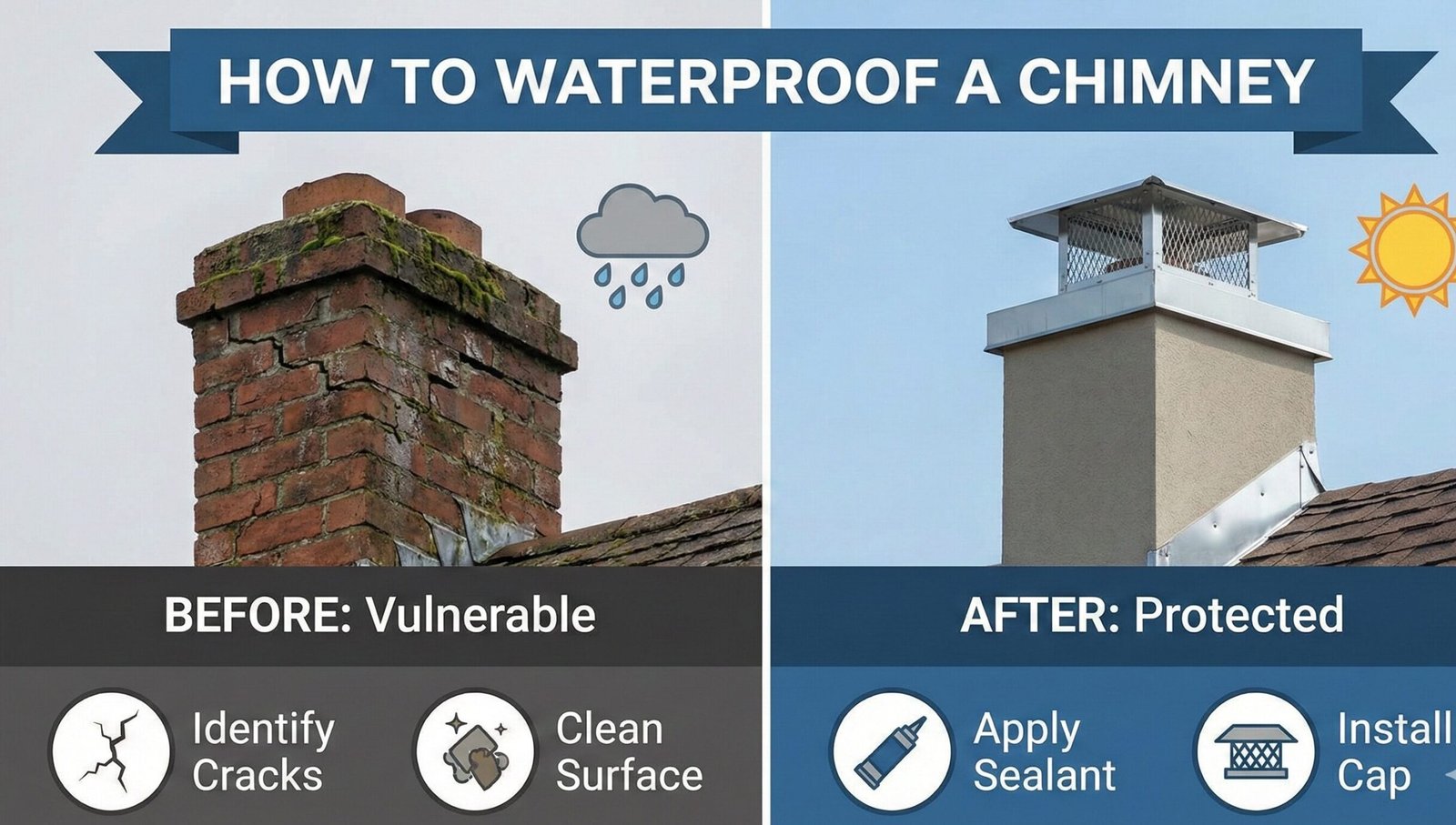
To waterproof a chimney effectively, you must address three zones: the Cap, the Crown, and the Masonry. Start by repairing mortar joints and installing a full-coverage chimney cap. Finally, apply a breathable, siloxane-based water repellent — not a silicone sealer — to the bricks. This allows trapped moisture to escape while blocking rain from entering.
Water is the single most destructive force against masonry. While homeowners often worry about how often they should clean a chimney to prevent fires, they frequently overlook the silent destroyer: moisture. A waterlogged chimney leads to spalling bricks, rusted dampers, rotted roof decking, deteriorated mortar, and — left unchecked — catastrophic structural failure. These are not slow, gradual problems. Each freeze-thaw cycle accelerates the damage exponentially.
If you have noticed fireplace smoke coming into the house or damp smells during summer, water entry might be interfering with your draft. This guide covers the complete professional approach to sealing your chimney — not just the basic steps, but the full science, the common mistakes that make things worse, the best products on the market, and the long-term maintenance strategy that keeps your chimney dry for decades.
Why Water Destroys Masonry — The Science Explained
To understand why chimney waterproofing matters so deeply, you need to understand what water actually does to masonry on a microscopic level. Brick and mortar are porous materials — they contain millions of tiny capillary channels that draw liquid water inward through a process called capillary suction. This happens at every exposed surface, even when rain is not falling directly on it; high humidity alone can drive moisture absorption in highly porous masonry.
Once inside the masonry pores, liquid water becomes a weapon during cold weather. When water freezes, it expands by approximately 9% in volume. In the confined space of a masonry pore, this expansion generates internal pressures exceeding 2,000 pounds per square inch — far greater than the tensile strength of brick or mortar. The result is microcracking on the first freeze-thaw cycle, followed by progressive crack propagation and eventually the physical spalling (delamination) of the brick face on subsequent cycles.
This process is not visible until significant internal damage has already occurred. By the time you see the first flake of brick face pop off, the interior masonry has typically already undergone many freeze-thaw cycles of microcracking. This is why proactive waterproofing — applied before visible damage occurs — is so much more effective and economical than reactive repair.
The Freeze-Thaw Cycle in Detail
In a typical cold-climate winter, a chimney may experience 30–50 freeze-thaw cycles. Each cycle is cumulative — the cracks from the previous cycle accept more water than before, leading to more damage in the next cycle. This exponential damage progression is why a chimney that looked fine one spring can show alarming deterioration by the following fall.
| Cycle Stage | What Happens | Visible Sign |
|---|---|---|
| Water absorption | Capillary action draws moisture into brick and mortar pores | None (invisible) |
| Freeze | Water expands ~9%; pressure exceeds 2,000 psi inside pores | None (invisible) |
| Microcracking | Pore walls fracture; crack surface area increases | None initially |
| Thaw | Ice melts; wider cracks accept more water next cycle | Hairline cracks appear |
| Repeated cycling | Cracks propagate to the brick face; face separates | Spalling, flaking face |
| Advanced damage | Structural integrity of brick compromised; mortar erodes | Missing brick faces, crumbling joints |
Efflorescence: The White Stain That Tells You Water Is Moving
Efflorescence — the white, chalky or crystalline deposits that appear on chimney brick surfaces — is not harmful in itself, but it is one of the most reliable early warning systems available. It forms when water moves through masonry, dissolves naturally occurring soluble salts (sulfates, carbonates, and chlorides), and carries them to the surface where they crystallize as the water evaporates. If you see efflorescence, liquid water is actively moving through your masonry, and waterproofing treatment is urgently needed.
To remove efflorescence before waterproofing, use a stiff dry brush first to remove the loose crystals, then apply a diluted masonry cleaner or a 10% solution of muriatic acid (with full PPE — gloves, goggles, respirator) followed by a thorough water rinse. Never waterproof over existing efflorescence — the salts beneath the sealant will continue to crystallize and will push the sealant off the surface from the inside.
Secondary Water Damage Effects
Beyond spalling and structural deterioration, chimney moisture causes a cascade of secondary damage across the entire home system:
- Rusted damper and firebox hardware: Iron and steel components corrode rapidly in a persistently damp environment, eventually seizing or failing entirely.
- Deteriorated flue liner: Terra cotta tile liners absorb moisture and can crack or delaminate, creating a serious chimney fire and carbon monoxide hazard.
- Mold and rot in adjacent framing: Water infiltrating through the chimney masonry or flashing migrates into adjacent wood framing and roof decking, causing structural rot and mold growth that can spread into living spaces.
- Stained interior finishes: Water staining on ceilings and walls adjacent to the chimney breast is often the first homeowner-visible symptom of long-running moisture infiltration.
- Degraded insulation: Attic insulation adjacent to a leaking chimney becomes saturated, losing its thermal resistance and becoming a mold substrate.
- Draft problems: As the masonry deteriorates, air infiltration paths through the chimney walls change, often creating negative pressure effects that cause smoke to back-draft into the house.
Warning Signs Your Chimney Needs Waterproofing Now
Many homeowners wait until they see visible damage before taking action. By that point, the repair bill is typically 5–10 times what proactive waterproofing would have cost. Learn to recognize the early warning signs and respond before structural damage occurs.
Urgent Warning Signs
- Brick faces flaking or falling off (spalling)
- Large cracks in the crown (wider than 1/8 inch)
- Water pooling in the firebox after rain
- Visible mortar joint erosion deeper than 1/4 inch
- Ceiling stains near the chimney
- Actively deteriorating flashing
- Mold odor from the fireplace in summer
Early Warning Signs
- White efflorescence deposits on brick
- Hairline crown cracks (less than 1/8 inch)
- Slightly rough or pitted mortar surface
- Faint damp smell from the fireplace
- Minor rust staining on the damper
- Brickwork that darkens when wet and dries slowly
- Paint bubbling on walls adjacent to chimney
The Water-Bead Test
The simplest diagnostic test for whether your chimney needs re-waterproofing: on a dry day, splash a cup of water on the brick face at different heights. If the water beads up and runs off — the siloxane treatment is still active. If the water is absorbed immediately, darkening the brick surface — the treatment has expired and re-application is needed. This test takes 30 seconds and should be performed annually as part of your chimney maintenance routine.
reathable vs. Film-Forming Sealants — A Critical Distinction
This is the most important technical concept in chimney waterproofing, and getting it wrong is the single most common and costly mistake homeowners make. The difference between a breathable (vapor-permeable) water repellent and a film-forming (non-breathable) sealer is not a minor technical detail — it is the difference between protecting your chimney and destroying it faster.
| Property | Breathable Siloxane Repellent ✓ | Film-Forming Sealer ✗ |
|---|---|---|
| How it works | Penetrates pores; coats individual particles without bridging pore openings | Forms a continuous film on the masonry surface |
| Liquid water entry | Blocked — treated surfaces have very low surface energy; water beads off | Blocked initially |
| Vapor transmission | Allowed — moisture vapor from inside escapes freely | Blocked — vapor trapped inside masonry |
| What happens when vapor is trapped | N/A — vapor exits harmlessly | Vapor pressure builds; sealant delaminates or masonry spalls |
| Freeze-thaw performance | Excellent — prevents water entry; allows vapor release | Can accelerate damage if applied over damp masonry |
| Appropriate for chimneys | Yes — the only correct choice | No — never use on active masonry chimneys |
| Examples | ChimneySaver, RadonSeal, Siloxirane | Thompson’s WaterSeal, standard silicone sealers, exterior latex paint |
Never Use These Products on Chimney Masonry: Thompson’s WaterSeal, standard hardware store silicone sealers, exterior latex or elastomeric paint (on the brick body — crowns can be coated with elastomeric products), clear concrete sealers, or any product that advertises a “protective film” or “waterproof coating.” These products will trap moisture, cause delamination, and accelerate the spalling damage they are meant to prevent.
Why Siloxane Chemistry Works
Silane-siloxane (siloxane) water repellents work through a chemical bonding process, not a physical coating. When applied, the silane molecules penetrate deep into the masonry capillaries (silane is small enough to enter pores that siloxane cannot). Inside the capillaries, silane molecules hydrolyze in the presence of moisture and bond covalently to the mineral surface — essentially becoming part of the masonry structure rather than sitting on top of it. The bonded molecule presents an outward-facing hydrophobic (water-repelling) surface that prevents liquid water adhesion.
The critical point is that this treatment happens at the molecular level, inside the pore. The pore opening itself remains physically open — vapor molecules (which are gaseous, much smaller than liquid water droplets) can still pass through freely. This is the mechanism of vapor permeability, and it is the reason silane-siloxane chemistry is the only appropriate approach for masonry that must manage both external water and internal moisture vapor simultaneously.
Step 1: The Inspection — Diagnose Before You Treat
You cannot waterproof a dirty or damaged chimney. Sealing over cracks just traps moisture inside, accelerating the freeze-thaw damage cycle. Every waterproofing project must begin with a thorough inspection that identifies all damage requiring repair before any sealant is applied.
What to Look For
- Efflorescence: White, powdery stains on the brick indicate active water movement through the masonry.
- Cracked Crown: The concrete slab at the top often cracks first from UV and thermal cycling.
- Missing Mortar: If the joints are crumbling, you need the best mortar for chimney repair before applying water repellent.
- Flashing Gaps: Check where the chimney meets the roof. See our review on the best chimney flashing sealant.
- Spalled brick faces: Individual brick faces that have delaminated must be replaced before waterproofing.
- Staining patterns: The location and shape of staining tells you the primary water entry point.
- Cap condition: A missing, rusted, or undersized cap is an emergency — address it first.
Performing a Ground-Level to Rooftop Inspection
1
Ground-level binocular survey
Before climbing anything, scan the full chimney height from ground level using binoculars. Look for missing cap, visible crown cracks, brick spalling, white efflorescence streaks, and vegetation (moss or ivy) growing on the masonry.
2
Attic inspection
Enter the attic and examine the chimney penetration and adjacent roof decking for water staining, mold, rot, or daylight gaps. Active staining is the most reliable indicator of an ongoing flashing or crown leak.
3
Firebox and flue inspection
Shine a powerful flashlight up the flue from the firebox. Look for water on the smoke shelf, rust on the damper, staining on the flue walls, and cracks in the terra cotta liner tiles. A cracked liner is a safety emergency — do not use the appliance until repaired.
4
Roof and crown inspection
From the roof (with proper fall protection), examine the crown for cracks and eroded edges. Check all four sides of the flashing for gaps, rust, and lifted edges. Probe mortar joints with a screwdriver — if mortar crumbles or is recessed more than 1/4 inch, tuckpointing is needed before waterproofing.
5
Document with photos
Photograph every defect from multiple angles before starting any repair. This documentation is essential for insurance claims involving storm damage, and it gives you a clear before-and-after reference for your repair work.
Safety First: Before climbing any roof, ensure you have proper fall protection — roof anchors, a safety harness, and non-slip footwear. If the pitch is steep or you are uncomfortable with heights, check our list of best chimney services to find a CSIA-certified professional.
Step 2: Install or Replace the Chimney Cap
Think of the cap as the umbrella for your chimney. Without one, you have an open hole in your roof inviting rain, snow, and critters directly into the flue. No amount of masonry waterproofing can compensate for an open flue top — you will simply be allowing water to bypass all of your masonry treatment and enter the system at the most direct point possible.
A good cap also prevents animals from nesting. If you have ever wondered how to get a bird out of your chimney, you know prevention is better than the cure. We highly recommend stainless steel over galvanized metal, as it resists rust and pairs well with the best chimney brush for stainless steel liners during cleaning.
Choosing the Right Cap for Your Chimney
| Cap Type | Best For | Material | Estimated Life |
|---|---|---|---|
| Single-flue cap | Single liner; most common residential use | 304 or 316 stainless | 20+ years |
| Multi-flue (full-width) cap | Covers full chimney top; multiple liners or open masonry | Copper or heavy stainless | 25–50 years |
| Top-mount damper cap | Replaces throat damper + cap; superior energy seal | Cast aluminum / stainless | 15–20 years |
| Wind-directional cap | Persistent downdraft problems from prevailing winds | Galvanized or stainless | 10–15 years |
Recommendation: Read our detailed breakdown of the best chimney caps for rain before purchasing. Sizing is critical — an undersized cap allows rain to blow in from the sides, while an oversized cap can restrict draft.
Installing the Cap Correctly
Many caps are simply slid over the flue liner top and tightened with set screws. But the seal between the cap base plate and the crown is just as important as the cap itself. Apply a generous bead of high-temperature silicone (600°F-rated RTV) around the full perimeter of the cap base plate before tightening the set screws. This prevents the most common cap failure mode — water wicking down between the cap plate and the crown surface.
Step 3: Repair the Crown and Flashing
The crown is the cement “lid” that surrounds the flue liner and sheds water away from the masonry below. If it has hairline cracks, water will seep in and freeze, splitting the crown apart within a few seasons. A cracked crown is the gateway to structural chimney damage because it allows water to enter at the very top of the system, where it can travel the full height of the chimney interior before exiting — saturating every brick and mortar joint along the way.
For small to medium hairline cracks, use a brushable elastomeric crown repair sealant — it flexes with the thermal expansion and contraction of the crown rather than cracking again like rigid mortar. For structural cracks wider than 1/4 inch, fill with a flexible caulk first (such as Sashco Mor-Flexx), embed fiberglass mesh tape while wet, then apply the elastomeric top coat.
ChimneyRx Brushable Crown Repair

Flexible waterproof coating that bridges cracks on the chimney crown. Cures into a rubber-like membrane that moves with thermal cycling and prevents water intrusion.
FlashSeal Elastomeric Flashing Sealant

Reinforced with fabric, this fixes leaks where the chimney meets the roof shingles. The two-coat fabric-reinforced system is far more durable than standard caulk for flashing repair.
Crown Reconstruction: When Repair Is Not Enough
If the crown is mortar-based (soft, sandy texture) rather than portland cement, or if damage has progressed to the point where large sections are missing, a full crown reconstruction is required. This is not a quick repair — it involves removing all existing crown material, building a form around the flue liner, casting a new crown from a 3:1 sand-to-portland cement mix with appropriate reinforcement, and curing it slowly (misting for 3–7 days) before applying the elastomeric coating. A properly built portland cement crown with a 2-inch drip edge overhang is essentially maintenance-free for 15–25 years when coated with a quality elastomeric product.
Step 4: Tuckpointing and Mortar Joint Repair
Mortar joints are the designated weak point in masonry — deliberately softer than the brick so they crack and erode first, protecting the brick face. But when the joints erode to the point of failure, they become a primary water infiltration pathway that no surface waterproofing treatment can seal. A garden-hose stream of water aimed at an open mortar joint will penetrate directly through the chimney wall regardless of how well the brick face is treated.
All deteriorated mortar joints must be raked out and repointed before any waterproofing treatment is applied. There is no exception to this rule — waterproofing over open or crumbling joints seals the water entry path into the wall and massively accelerates internal damage.
Mortar Type Selection — Getting This Wrong Is Expensive
The mortar type must be appropriate for chimneys and must not be harder than the surrounding brick. Using an overly hard mortar (such as Type M or pure portland cement) will cause the brick face to crack and spall rather than the mortar — the opposite of the intended design. For standard modern brick chimneys, Type S mortar is the correct specification. For soft historic brick (pre-1920 structures), a lime-based Type O mortar is appropriate; consult a masonry specialist.
| Mortar Type | Compressive Strength | Application | Chimney Appropriate? |
|---|---|---|---|
| Type M | Very high (2,500+ psi) | Below-grade, heavy load bearing | No — too hard; cracks adjacent brick |
| Type S | High (1,800 psi) | Above-grade exposed masonry, chimneys | Yes — correct choice for most chimneys |
| Type N | Medium (750 psi) | Interior, non-load-bearing | Marginal — too weak for freeze-thaw exposure |
| Type O | Low (350 psi) | Soft historic brick (pre-1920) | Yes — only for soft brick applications |
Color Matching: Mortar color after curing differs from its wet color. Always test a small patch and allow it to cure fully before committing to a large repointing job. Mismatched mortar color is immediately visible and detracts significantly from the chimney’s appearance. Pigment additives are available to achieve a better match to aged mortar.
Step 5: Cleaning the Masonry Before Treatment
Siloxane water repellents penetrate masonry by moving through the existing water in the capillary pores. For this process to work correctly, the pores must be open and unobstructed by dirt, biological growth, efflorescence, or previous failed sealant. Applying a siloxane treatment to a dirty surface dramatically reduces its penetration depth and effective service life.
Cleaning Method by Soil Type
1
General dirt and dust
A stiff-bristle masonry brush combined with a garden hose rinse is sufficient for normal atmospheric soiling. Work from top to bottom to prevent dirty rinse water from contaminating already-cleaned areas below.
2
Efflorescence
Dry-brush loose crystals first with a stiff bristle brush. Apply a 10% muriatic acid solution (or dedicated efflorescence remover) with a nylon brush, allow 3–5 minutes of dwell time, and rinse thoroughly with water. Wear full PPE. Neutralize with a dilute baking soda solution if desired.
3
Biological growth (moss, algae, lichen)
Apply a biocidal masonry cleaner containing quaternary ammonium compounds or sodium hypochlorite. Allow the recommended dwell time (typically 15–30 minutes), then scrub with a stiff brush and rinse. Do not use a pressure washer on mortar joints — it erodes mortar aggressively.
4
Old failed sealant
Existing silicone or film-forming sealants must be removed before applying a siloxane product. Use a chemical paint stripper rated for masonry, follow the manufacturer’s instructions, and rinse thoroughly. Allow the masonry to dry completely (at least 48 hours of dry weather) after cleaning before applying the new treatment.
5
Soot and carbon deposits
For soot staining visible on the exterior of the chimney, a trisodium phosphate (TSP) cleaner solution is highly effective. Apply, scrub with a stiff brush, and rinse thoroughly. Consult our guide on cleaning agents for chimneys for additional options.
Moisture Timing: Siloxane water repellents are most effective when applied to slightly damp masonry — the residual moisture in the capillary pores assists with penetration and the hydrolysis reaction. However, “slightly damp” means surface-dry but internally moist, not saturated or visibly wet. After cleaning and rinsing, allow the surface to dry for 4–24 hours depending on temperature and sun exposure before applying the water repellent.
Step 6: Applying the Water Repellent
This is the main event. Unlike standard paint, which traps moisture, a siloxane/silane water repellent penetrates deep into the masonry pores and creates a hydrophobic barrier at the molecular level — one that allows the chimney to “breathe” out internal moisture while blocking external rain. Applied correctly, it is the most effective single moisture management intervention available for masonry chimneys.
Environmental Conditions for Application
- Temperature: 40–90°F (4–32°C). Below 40°F, the siloxane curing reaction slows dramatically and the product may not bond properly. Above 90°F, the product may skin over before penetrating adequately.
- No rain: Avoid application if rain is forecast within 4–8 hours. Water on the surface during the curing window can wash the product from the pores before bonding is complete.
- No direct sun: Applying to a sun-heated surface causes the carrier solvent to evaporate too quickly. Apply in morning shade or on an overcast day.
- Wind: Low to moderate wind is acceptable. High wind creates overspray hazards and uneven application.
The Application Process: Step by Step
1
Protect adjacent surfaces
Cover roofing shingles, flashing, windows, and any painted woodwork with drop cloths or plastic sheeting. Siloxane repellents will stain asphalt shingles and can etch glass if not rinsed off immediately. Tape plastic sheeting to the chimney sides where you want a clean edge.
2
Load the garden sprayer
Use a dedicated sprayer for this application — do not reuse a sprayer that has contained herbicide or fertilizer. A pump-up garden sprayer with a fan-tip nozzle provides the best coverage. Follow the manufacturer’s instructions on dilution — some products are ready-to-use, others are concentrated.
3
Apply from bottom to top (first coat)
Starting at the base of the chimney, apply a generous saturating coat moving upward. The bottom-to-top direction prevents “dry area” contamination from the carrier dripping onto untreated masonry below. Keep a wet edge — overlapping each pass while the previous pass is still wet prevents application lines.
4
Apply the second coat wet-on-wet
The second coat must be applied before the first coat has dried — typically within 5 minutes on warm days, up to 20 minutes in cool, shaded conditions. The wet-on-wet technique is essential: it ensures the second coat merges with the first and drives combined penetration far deeper into the masonry than either coat alone. Wait until the milky white appearance begins to clear (indicating absorption) and immediately apply the second coat.
5
Check for runs and holidays
Inspect the treated surface from multiple angles for runs (heavy drips of product on the surface) and holidays (missed areas). Use a brush to spread runs before they skin over. Touch up holidays immediately. Runs left to cure will create a visible gloss streak on the masonry surface.
6
Allow to cure
The product is rain-resistant within 2–4 hours of application but does not reach full performance for 24–48 hours. Avoid any water contact (including dew) during the first 4 hours if at all possible.
Note: Do not use standard exterior paint unless you are seeking a specific aesthetic. If you must paint, ensure it is a masonry-specific vapor-permeable formula. Read our comparison of the best paint for chimney brick.
Top Pick: ChimneySaver Water Repellent

The industry standard. Up to 10-year protection, 100% vapor permeable, and prevents spalling and freeze-thaw damage. Used by CSIA-certified chimney professionals nationwide. One gallon covers approximately 75–100 square feet of chimney surface with the two-coat wet-on-wet application method.
Waterproofing by Chimney Type
Not all chimneys are waterproofed the same way. The type of chimney determines which zones are most vulnerable to water intrusion and which products and techniques are most appropriate. Understanding your specific chimney type before purchasing any materials will prevent wasted effort and product incompatibility.
Traditional Brick and Mortar Masonry Chimneys
The full siloxane waterproofing system described in the steps above is designed primarily for traditional brick masonry chimneys. All four zones — cap, crown, flashing, and masonry — are addressable with available DIY products. Priority areas are the crown (highest exposure), the mortar joints (highest absorption rate), and the brick face above the roofline (most freeze-thaw exposure).
Below the roofline, the chimney masonry is partially protected by the roof overhang and benefits from less severe temperature swings. However, if the chimney breast extends above the exterior wall on three sides, the full height of the exposed masonry benefits from waterproofing treatment.
Natural Stone Chimneys
Natural stone chimneys — fieldstone, limestone, granite, or brownstone — are waterproofed using the same siloxane chemistry, but the application rate and surface preparation differ. Stone is generally less porous than brick (granite being almost impermeable), but the mortar joints are often the dominant water pathway. Limestone and brownstone are particularly vulnerable because they are chemically reactive with acidic water (which includes rainwater containing dissolved CO₂). For limestone chimneys, muriatic acid cleaning is not appropriate — use a non-acidic masonry cleaner instead.
Factory-Built (Prefabricated) Metal Chimney Systems
Factory-built chimneys enclosed in a framed wood chase have different waterproofing priorities. There is no masonry to treat on the chimney itself. The priorities are: the metal chase cover at the top (should be stainless or aluminum, not galvanized), the flashing where the chase meets the roof, and the exterior cladding of the chase (often vinyl siding or wood that needs its own moisture management strategy). The chase cover is the component most frequently overlooked — a galvanized cover that has corroded through allows water directly into the chase cavity, saturating the insulation and eventually rotting the framing.
Stucco-Faced Chimneys
Many chimneys are faced with stucco rather than exposed brick. Stucco is a cementitious plaster applied directly to the masonry and painted or left with a textured finish. Stucco chimneys are waterproofed differently: the stucco surface itself should be treated with a siloxane penetrating water repellent (the same chemistry works for both brick and stucco), but hairline cracks in the stucco must be filled with a flexible, paintable elastomeric caulk before treatment. Large stucco cracks (more than 1/4 inch wide) indicate that the stucco is separating from the substrate and require professional evaluation — the stucco may need to be removed and re-applied before waterproofing is worthwhile.
Painted Brick Chimneys
Painted brick presents a particular challenge. If the paint is in good condition and is a breathable, masonry-specific formula, a siloxane treatment can often be applied over it (check with the manufacturer). If the paint is failing — peeling, bubbling, or blistering — it must be removed before any water repellent treatment. Paint that is peeling on a chimney is almost always a symptom of moisture vapor pressure from inside the masonry pushing outward, which confirms that the underlying masonry already has a moisture problem requiring diagnosis and repair, not just re-coating.
Interior Chimney Waterproofing — What Works and What Doesn’t
The question “can I waterproof my chimney from the inside?” comes up frequently, and the answer is almost always no — at least not as a standalone solution. Here is why interior treatments fail, and the limited circumstances where interior products do have a legitimate role.
Why Interior Waterproofing Fails
Interior masonry sealers applied inside the flue or firebox face an immediate physical problem: the source of water is on the exterior, and the hydrostatic pressure of the water is pushing inward. When you apply a sealer from the inside, you are applying it against the direction of water pressure. Any penetrating sealer applied from the interior will be pushed off the pore walls by the positive water pressure from outside — the exact opposite of the exterior application scenario where the sealer and the water pressure work in the same direction (both pushing inward, with the sealer already bonded in place).
Interior paints and coatings applied to the firebox interior similarly trap moisture inside the masonry wall, accelerating the same freeze-thaw damage they are meant to prevent.
When Interior Products Are Appropriate
- Hydraulic cement for active crack sealing: Hydraulic cement (such as Drylok Hydraulic Cement or Quikrete Hydraulic Water-Stop) can stop active water flow through a specific crack while exterior repairs are being arranged. This is a temporary emergency measure, not a permanent waterproofing solution.
- Firebox refractory paint: The interior of the firebox can be treated with a specialized refractory coating or paint rated for high temperatures. This prevents surface rust on the firebox steel components and can improve the appearance of a stained firebox, but it has no bearing on structural moisture management.
- Flue liner repair coatings: Products like HeatShield and Armor Flue are applied inside the flue to repair hairline cracks in the flue liner and restore the smooth surface that promotes efficient draft. These are legitimate structural repair products for the liner — distinct from masonry waterproofing — and require professional application.
Flashing Waterproofing in Depth
Flashing is statistically the most common source of chimney-related water infiltration, and yet it is the component most homeowners give the least attention to in their waterproofing efforts. A comprehensive chimney waterproofing project is incomplete without addressing the flashing in detail.
The Three-Layer Flashing System
A fully correct chimney flashing installation consists of three distinct layers that work together:
- Base flashing: Individual L-shaped pieces integrated into the shingle courses at each side of the chimney. Directs water off the roof deck and away from the chimney-roof junction.
- Counter flashing: Strips embedded in the mortar joints of the chimney that lap down over the base flashing. The primary weather seal at the masonry-to-roof interface.
- Saddle or cricket: A peaked metal structure built behind (upslope of) the chimney that diverts water around it. Required when chimney width exceeds 30 inches in most building codes. A missing saddle on a wide chimney is one of the most common causes of persistent, difficult-to-diagnose chimney leaks.
Waterproofing the Flashing Without Replacement
When the flashing metal is still structurally sound but has developed gaps at the masonry interface, a fabric-reinforced sealant system extends the service life without requiring the cost and disruption of full flashing replacement. The key is using the correct product — a flexible, fabric-reinforced flashing sealant that accommodates the thermal movement between the metal flashing and the masonry — and applying it correctly with the fabric reinforcing layer embedded between two full coats.
This repair approach is appropriate when gaps are less than 3/8 inch and the flashing metal itself is not corroded through. For galvanized flashing that is developing rust spots, the repair is worth doing, but plan for full replacement within the next several seasons — treat the repair as a bridge solution.
Flashing Inspection After Every Major Storm: High-wind events can lift the embedded edge of counter flashing out of the mortar joint without causing any other visible damage. A simple squeeze of the counter flashing edge by hand will reveal if it has pulled free. Re-embed and re-caulk immediately — an open counter flashing joint is one of the most direct water entry paths in any chimney system.
Product Comparison — Choosing the Right Sealant
The market contains many products marketed for chimney waterproofing, but the quality, chemistry, and appropriate application vary widely. The following comparison focuses on the leading products in each category so you can make an informed purchase decision.
| Product | Category | Vapor Permeable? | Coverage | Reapplication Interval | Best For |
|---|---|---|---|---|---|
| ChimneySaver Water Repellent | Siloxane penetrating | Yes ✓ | 75–100 sq ft/gal | 10 years | Full masonry treatment — industry standard |
| RadonSeal Penetrating Concrete & Masonry Sealer | Silicate/siloxane | Yes ✓ | 100–200 sq ft/gal | 10–15 years | Dense concrete crowns; double-block construction |
| ChimneyRx Brushable Crown Repair | Elastomeric coating | Partially | Varies (by coverage area) | 5–7 years | Crown sealing — not for brick faces |
| Henry FlashSeal | Fabric-reinforced sealant | No (exterior metal) | Linear foot coverage | 7–10 years | Flashing seals at masonry interface |
| Thompson’s WaterSeal | Film-forming | No ✗ | — | — | Not appropriate for chimney masonry |
Bottom Line: For brick and mortar masonry, ChimneySaver is the professional standard and the most reliable choice for DIY application. For crown sealing, ChimneyRx is purpose-built and significantly outperforms generic elastomeric products. For flashing, Henry FlashSeal or equivalent fabric-reinforced systems are far superior to any standard caulk. Do not try to substitute general-purpose products — chimney-specific products are formulated for the thermal cycling and UV exposure conditions that generic products cannot withstand.
DIY vs. Professional Waterproofing
Chimney waterproofing spans a wide spectrum from genuinely straightforward DIY projects to work that should only be performed by licensed professionals. Understanding which category your project falls into before starting saves time, money, and potentially your safety.
Good DIY Projects
- Applying siloxane water repellent to accessible masonry
- Brushing on crown elastomeric coating
- Caulking counter flashing gaps (fabric system)
- Installing or replacing a single-flue chimney cap
- Minor tuckpointing on ground-accessible sections
- Performing the water-bead test and visual inspection
- Cleaning efflorescence and biological growth
Hire a Professional For
- Crown reconstruction (formwork and portland cement pouring)
- Full tuckpointing on tall or steep-access chimneys
- Full flashing replacement involving shingle removal
- Saddle/cricket installation
- Structural brick replacement at height
- Any work on steeply pitched or high roofs
- Flue liner repair or replacement
When hiring a professional chimney waterproofing contractor, look for CSIA (Chimney Safety Institute of America) certification or a licensed masonry contractor with demonstrable chimney-specific experience. Ask for the specific products they plan to use — if they propose using silicone or Thompson’s WaterSeal, they lack the specialized knowledge required for this work. A qualified contractor should be able to name specific siloxane products and explain the breathability requirement without prompting.
Seasonal Waterproofing Checklist
Effective chimney moisture management is a year-round commitment, not a one-time project. Each season presents distinct risks and maintenance opportunities. This checklist keeps your chimney dry and your waterproofing system performing at its peak.
Fall
- Annual visual inspection
- Water-bead test on brick
- Crown condition check
- Cap screen cleaning
- Flashing caulk inspection
- Damper operation test
Winter
- Remove snow accumulation from crown (if >6 in.)
- Monitor for ice dam formation near chimney
- Note any new staining after thaw events
- Check attic for new moisture after major storms
Spring
- Post-freeze-thaw brick and mortar inspection
- Flashing inspection for frost-heave movement
- Efflorescence check (new deposits?)
- Crown recoat if water-bead test fails
- Schedule professional sweep if not done in fall
Summer
- Ideal season for masonry repairs (warm/dry cure conditions)
- Tuckpointing work if identified in spring
- Siloxane re-treatment if overdue
- Cap replacement or upgrade if needed
- Saddle/cricket inspection while accessible
Long-Term Maintenance Timeline
| Task | Frequency | DIY or Pro | Estimated DIY Cost |
|---|---|---|---|
| Visual inspection + water-bead test | Annually | DIY | $0 |
| Cap screen cleaning and inspection | Annually | DIY | $0 |
| Flashing caulk touch-up | Every 2–3 years | DIY | $15–$40 |
| Crown elastomeric recoat | Every 5–7 years | DIY | $35–$70 |
| Siloxane masonry re-treatment | Every 8–10 years | DIY | $50–$120 |
| Mortar joint inspection + tuckpointing | Every 5–10 years | DIY / Pro | $25–$75 materials |
| Full Level 2 professional inspection | Every 5–10 years or after events | Pro | $200–$500 |
| Cap replacement (stainless) | 20+ years or on failure | DIY | $50–$300 |
Cost Breakdown
Understanding the full cost of chimney waterproofing helps you budget accurately and appreciate the return on investment. Compare these costs against the cost of repairing the damage caused by neglected waterproofing — a single crown rebuild runs $800–$3,000, and extensive spalling brick repair can exceed $5,000 on a tall chimney.
$50–$120
Siloxane repellent (full DIY)
$35–$70
Crown elastomeric coat (DIY)
$50–$300
Stainless cap replacement
$25–$75
Tuckpointing materials
$300–$800
Full professional waterproofing
$800–$3,000
Crown rebuild (if neglected)
| Service / Product | DIY Material Cost | Professional Total | Notes |
|---|---|---|---|
| Siloxane repellent application (full chimney) | $50–$120 | $200–$500 | Reapply every 8–10 years |
| Crown elastomeric coat (hairline cracks) | $35–$70 | $150–$400 | Reapply every 5–7 years |
| Crown reconstruction (portland cement) | $50–$120 materials | $800–$3,000 | Requires scaffold; pro recommended |
| Chimney cap (stainless, single flue) | $50–$250 | $100–$400 installed | 25+ year life expectancy |
| Flashing fabric-reinforced sealant repair | $20–$50 | $200–$500 | Every 7–10 years |
| Tuckpointing — minor (one face, accessible) | $20–$50 materials | $300–$800 | Type S mortar; color match carefully |
| Full waterproofing package (cap + crown + masonry) | $140–$440 DIY | $600–$1,500 pro | Most cost-effective combined approach |
ROI Perspective: A complete DIY waterproofing treatment — cap, crown coat, and siloxane masonry treatment — costs $140–$440 in materials and provides 8–10 years of protection. A single crown rebuild, triggered by neglecting the $35 crown coating, costs $800–$3,000. The return on investment for proactive waterproofing is among the highest of any home maintenance intervention.
Frequently Asked Questions
How often should I waterproof my chimney?
If you use a high-quality siloxane repellent applied correctly with the wet-on-wet two-coat method, expect 8–10 years of effective protection under normal conditions. In particularly harsh climates — heavy annual rainfall, severe freeze-thaw cycling, or exposure to salt air — plan for re-treatment at the 6–8 year mark. Use the water-bead test annually to confirm the treatment is still active, and reapply as soon as it fails rather than waiting for a fixed schedule. You should inspect the crown and cap annually as part of your winter home comfort prep routine.
Can I use Thompson’s Water Seal on my chimney?
We strongly advise against it for chimneys. Thompson’s WaterSeal is typically silicone-based or paraffin-based, and it forms a surface film that traps moisture vapor inside the brick. As moisture vapor pressure builds behind the film — particularly during the heating season when warm air from inside the house drives vapor outward through the chimney masonry — it either delaminates the sealer or forces liquid water into a freeze-thaw cycle under the sealed surface. The result is accelerated spalling — the exact damage you were trying to prevent. Always use a breathable, penetrating siloxane repellent specifically rated for masonry chimneys.
Does homeowners insurance cover chimney waterproofing or moisture damage?
Typically, insurance covers “sudden and accidental” damage — such as a lightning strike, a windstorm that destroys the cap, or a hailstorm that cracks the crown. They routinely deny claims related to “maintenance neglect,” which includes slow water infiltration from a failure to maintain the waterproofing treatment, crown, or flashing. Preventive waterproofing is not covered as a maintenance service, but damage from a specific weather event that you can document may be. For more details, read: Does Homeowners Insurance Cover Chimney Repair? Keeping a maintenance log with dated photographs significantly strengthens any insurance claim.
Can I waterproof a chimney in winter?
Siloxane water repellents require a minimum application temperature of approximately 40°F (4°C) for the chemical bonding reaction to proceed correctly. Below this temperature, the product will not cure properly and the treatment will fail quickly. Crown elastomeric coatings similarly require temperatures above 40°F. Tuckpointing mortar must not freeze within 7 days of application. For homeowners in cold climates who discover a moisture problem in winter, the practical options are: install a temporary waterproof tarp over the chimney top to prevent additional water entry, address the problem in spring as a priority, or schedule a professional assessment and temporary repair. Do not attempt to apply permanent waterproofing products in freezing conditions.
How do I know if my waterproofing treatment has failed?
The simplest test: on a dry day, splash a cup of water on the brick face at different heights. If the water beads up and runs off — the treatment is still active. If the water is immediately absorbed and darkens the brick — the treatment has expired and re-application is needed. Additional indicators of failed waterproofing include new efflorescence deposits appearing on previously clean brick, a damp or musty smell from the fireplace during humid weather, fresh mortar joint erosion in areas that were recently repointed, and any new water staining visible on adjacent interior walls or the attic ceiling.
What is the difference between a chimney sealant and a chimney liner?
A chimney sealant or water repellent addresses the exterior masonry — the brick, mortar, crown, and flashing. It prevents rainwater from entering through the outside surfaces. A chimney liner is the internal flue component — either terra cotta tile, flexible stainless steel, or rigid aluminum — that contains and directs combustion gases up and out of the home. These are two completely separate systems addressing different issues. A chimney with a perfect exterior waterproofing treatment can still have a failing liner with structural cracks, and a chimney with a new liner can still have serious exterior water infiltration issues. Both require attention, and neglecting either one creates distinct hazards.
Do gas fireplaces also need chimney waterproofing?
Yes — the masonry waterproofing need is identical regardless of fuel type. The exterior masonry of any chimney is subject to the same rain absorption, freeze-thaw cycling, and mortar erosion whether the chimney serves a wood-burning fireplace, a gas insert, an oil furnace, or a gas boiler. In fact, gas appliances introduce an additional moisture concern: the combustion of natural gas produces significant water vapor that condenses inside a cold, uninsulated flue — making liner condensation management a greater priority for gas chimneys than for wood-burning ones. See our guide on whether a gas fireplace needs a chimney for more detail on gas appliance venting requirements.
Can I paint my chimney to waterproof it?
Standard exterior house paint — whether latex, oil-based, or elastomeric — is a film-forming product that blocks vapor transmission and is not appropriate for chimney masonry waterproofing. If you want to change the color of your chimney brick, you must use a masonry-specific breathable paint or mineral silicate paint that maintains vapor permeability. These products are more expensive than standard house paint but are the only acceptable option for painted masonry chimneys. Read our detailed comparison of the best paint for chimney brick to understand your options before committing to a paint application.
How do I stop draft problems related to chimney moisture?
Moisture infiltration can affect draft by creating negative pressure zones around damaged masonry, by allowing cold air to infiltrate through cracks in the crown or flashing (which cools the flue and weakens draft), and by causing firebox odors in summer from dampness interacting with creosote residue. If you are experiencing fireplace draft problems and you have identified moisture damage, address the water infiltration first — eliminating the moisture source often resolves draft issues that appeared unrelated. A comprehensive waterproofing treatment that includes cap replacement, crown sealing, and masonry treatment is frequently the most effective draft improvement intervention available for older chimneys.