Masonry Fireplace vs. Prefabricated: The Ultimate Hearth Showdown
The fireplace has long been the centerpiece of the home — a gathering spot for warmth, comfort, and ambiance. But for modern homeowners, builders, and renovators, the terminology can be confusing. When you envision a fireplace, are you picturing a massive brick structure built by a skilled mason, or a sleek, factory-engineered metal firebox installed into a framed wall?
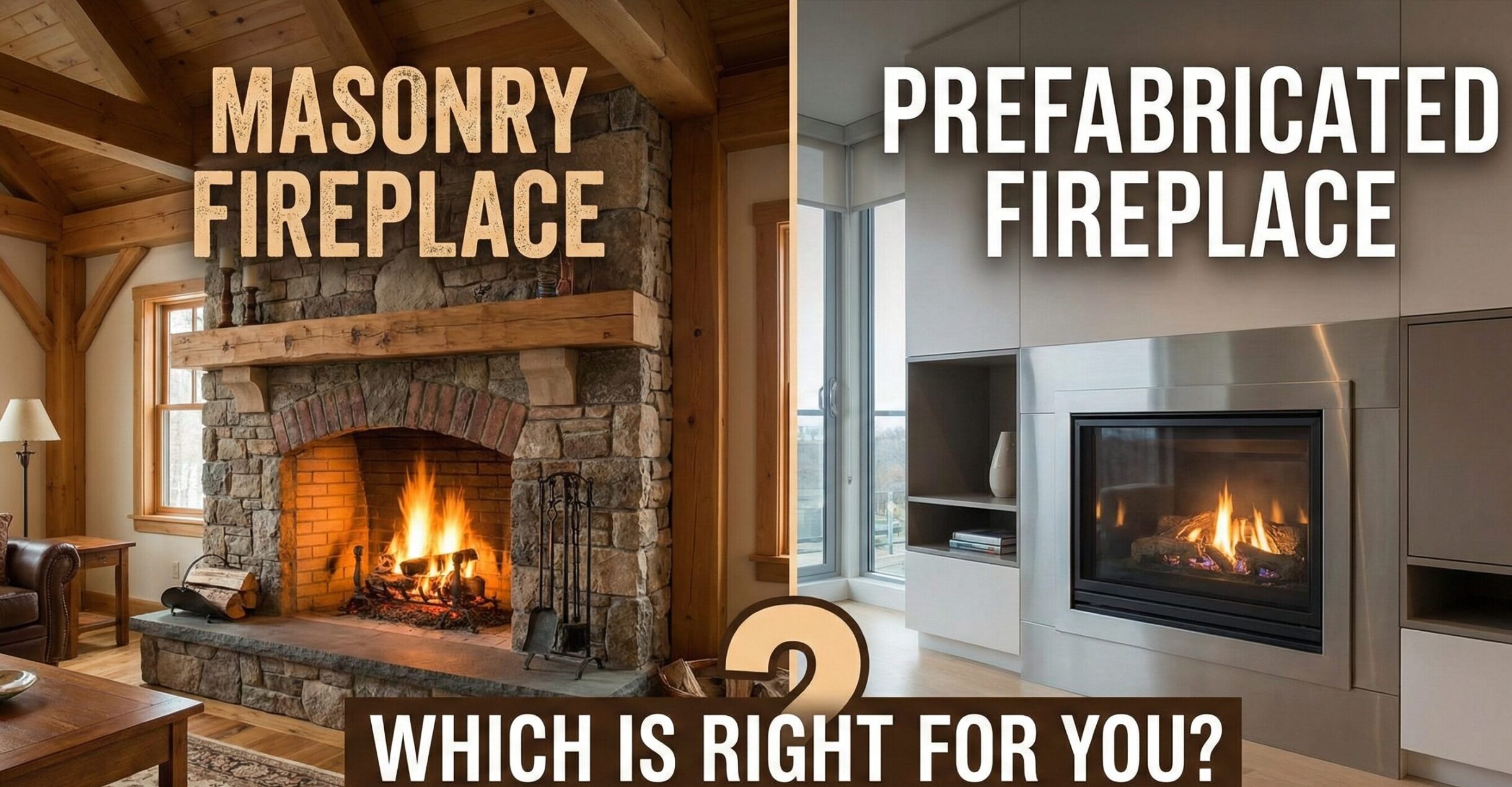
This distinction — Masonry Fireplace vs. Prefabricated Fireplace — is the single most important factor determining the cost, maintenance, efficiency, and longevity of your entire heating system. Choosing the wrong one for your situation can lead to draft problems, astronomical repair bills, inadequate heat output, or a replacement project that requires demolishing half a wall.
In this comprehensive guide, we go far beyond the surface comparison. We explore structural differences in depth, analyze heating efficiency with real numbers, break down every fireplace subtype you will encounter, walk through permit and building code requirements, examine what each type actually does to your home’s resale value, and provide a complete buyer’s decision framework. Whether you are planning new construction, a renovation, or simply trying to understand what you already have, this is your starting point.
📋 Table of Contents
- At a Glance: Quick Comparison
- How to Tell Which Type You Have
- What is a Masonry Fireplace?
- Masonry Subtypes Explained
- What is a Prefabricated Fireplace?
- Prefab Subtypes: Zero-Clearance, Direct-Vent & More
- Heating Efficiency: Real Numbers
- Full Cost Breakdown
- Home Resale Value Impact
- Head-to-Head Comparison
- The Middle Ground: Fireplace Inserts
- Firebox Sizing Guide
- Fireplace Doors: Masonry vs. Prefab
- Refractory Panels: What They Are
- Permits, Codes & Inspections
- Regional Considerations
- Tuckpointing: The Masonry Maintenance You Can’t Skip
- Full Pros & Cons Summary
- Your Decision Framework
- Cleaning & Fuel Considerations
- Frequently Asked Questions
- Final Verdict
At a Glance: The Quick Comparison
Before diving into detailed mechanics, here is the high-level scorecard between these two systems.
| Feature | Masonry Fireplace | Prefabricated (Zero-Clearance) |
|---|---|---|
| Construction Material | Brick, Stone, Mortar, Clay Tile | Sheet Metal, Cast Iron, Refractory Panels |
| Installation Cost | $$$$ ($10,000–$30,000+) | $$ ($2,000–$8,000) |
| Lifespan | Generations (50–100+ years) | Limited (15–30 years) |
| Foundation Required | Yes — heavy concrete footing | No — standard floor framing |
| Heat Efficiency | Poor (–10% to 15%) | Good to High (up to 70–80% with blowers) |
| Maintenance | Tuckpointing, waterproofing, liner inspection | Panel replacement, rust prevention, cap inspection |
| Customization | Unlimited — any size, material, shape | Limited to factory dimensions and OEM parts |
| Resale Value Added | High — $5,000–$12,000+ premium | Moderate — $1,000–$4,000 premium |
| UL/Safety Listing | No listing — meets local building code | UL Listed (UL 127) — factory-tested standard |
How to Tell Which Type of Fireplace You Have
One of the most common sources of confusion is that many prefabricated fireplaces are deliberately designed to look like masonry. Stone surrounds, brick veneers, and decorative facing are frequently applied to factory-built units — making the exterior appearance a completely unreliable indicator of what type of firebox is inside the wall. What matters is the interior construction, not the decorative cladding.
- Firebox back and side walls are individual real firebrick (small, yellowish bricks with visible mortar joints)
- Looking up past the damper reveals a pyramid-shaped smoke shelf built of brick
- The chimney above the roofline is solid brick or stone with square cross-section
- The firebox dimensions are slightly irregular — each masonry fireplace is hand-built
- Damper operates via a cast-iron rotary handle or a flat-plate poker mechanism
- Ash dump in the floor of the firebox leads to a brick ash pit below
- Built prior to the 1980s significantly increases masonry probability
- Firebox walls are cast refractory panels — large, identical slabs that simulate brick texture
- Looking up past the damper reveals a round metal flue pipe, not brick
- Metal is visible around the firebox opening — the trim ring and surround are metal
- Firebox dimensions are perfectly square — factory-machined, not hand-built
- Air vents may be visible above and below the opening (circulation vents)
- The firebox floor may have a raised metal grate that is integral to the unit
- The chimney above the roofline may be round metal pipe inside a framed chase with siding
What is a Masonry Fireplace?
A masonry fireplace is constructed entirely on-site by a skilled mason using bricks, concrete blocks, or natural stone, held together by mortar. It is not an appliance you purchase from a manufacturer — it is a structural element built as a permanent part of your home’s architecture, subject to local building codes, and requiring a structural foundation to support its weight.
The weight alone distinguishes masonry from every alternative. A complete masonry fireplace and chimney assembly typically weighs between 6 and 10 tons — roughly the same as two full-grown African elephants. This mass is why a reinforced concrete footing, typically 12–18 inches thick and extending below the frost line, is a non-negotiable requirement before the first brick is ever laid.
The internal anatomy of a masonry fireplace includes the firebox (built of firebrick rated to withstand temperatures exceeding 2,000°F), the smoke shelf (a horizontal ledge above the firebox that prevents downdrafts from pushing smoke into the room), the smoke chamber (the angled zone that funnels combustion gases into the flue), the damper (a cast-iron plate that seals the flue when not in use), and the flue itself — typically clay tile sections stacked within the brick chimney structure. Each of these components is built on-site and custom-dimensioned to the specific fireplace design.
A properly designed masonry fireplace remains the visual and emotional standard against which every other hearth option is measured. When real estate listings describe a fireplace as a premium feature, they are almost invariably referring to masonry construction. The material permanence and craftsmanship visible in a well-built masonry fireplace communicates something that a prefab unit — however well-designed — simply cannot replicate.
Masonry Subtypes: Not All Brick Fireplaces Are the Same
Within masonry construction, there are several distinct design traditions that differ significantly in proportions, efficiency, and historical origin. Understanding these subtypes helps you appreciate the range of the category — and recognize why the Rumford design, in particular, deserves considerably more attention than it typically receives in modern construction guides.
The most common type. Deep firebox, parallel side walls, relatively inefficient. What most homeowners picture when they say “brick fireplace.” Historically dominant since the late 1800s.
The most efficient masonry design ever created. Tall, shallow firebox with angled side walls that reflect heat into the room. Designed by Count Rumford in 1796. Experiences a major resurgence in high-end custom homes.
Traditional masonry firebox fitted with a steel circulator insert that draws cool room air, heats it against the firebox walls, and returns it to the room. Dramatically improves efficiency over standard masonry design.
Massive soapstone masonry heater that stores heat in 1,000+ lbs of stone. Burns very hot and fast (2–4 hours), then radiates stored heat for 12–24 hours. Extremely efficient but very expensive ($10,000–$30,000+).
The Rumford: The Forgotten Engineering Masterpiece
The Rumford fireplace deserves special attention because it represents the most significant engineering improvement ever made to the traditional masonry fireplace — and yet it remains largely unknown to most homeowners. Designed by Benjamin Thompson (Count Rumford) at the end of the 18th century, the Rumford design solved the two fundamental problems of standard fireplaces: smoky operation and poor heat output.
The Rumford’s firebox is tall and very shallow (the depth is roughly one-third the width, compared to roughly one-half for a standard design). The side walls angle sharply toward the back, creating a narrow throat with a streamlined smoke chamber. This geometry creates a powerful upward draft that eliminates smoking, while the shallow firebox reflects radiant heat directly into the room rather than allowing it to convect up the flue. For those who want genuine masonry construction but cannot accept a standard fireplace’s dismal efficiency, the Rumford is the answer — achieving efficiencies roughly 3–4 times better than a conventional deep firebox.

Upgrade Your Masonry Hearth
Improve airflow and combustion in your traditional firebox with a heavy-duty steel grate.
Check Price on AmazonWhat is a Prefabricated Fireplace?
A prefabricated (or “prefab”) fireplace is a complete heating appliance manufactured in a factory and installed as a unit. Unlike masonry construction, which is site-built from individual materials, a prefab arrives at your home as an engineered assembly — a metal firebox with proprietary chimney components, an outer casing, and integrated air circulation provisions. These systems are tested and listed under Underwriters Laboratories Standard UL 127, which sets minimum performance and safety requirements for all factory-built fireplaces sold in North America.
If your home was built after approximately 1980, the probability that you have a prefabricated unit is very high. The economics of residential construction shifted dramatically in this era — the rising cost of skilled masonry labor, combined with dramatically improved factory-built units, made prefab the standard choice for production builders. Today, the vast majority of fireplaces installed in new homes across North America are prefabricated units.
Identifying a prefab is almost always possible by examining the firebox interior. Refractory panels — large, identical cast concrete slabs that simulate individual brick texture — line the walls and back of the firebox rather than genuine individual firebrick. Looking up past the damper reveals a round metal flue pipe rather than the pyramid-shaped brick smoke chamber of masonry construction. Metal trim is almost always visible around the firebox opening.
Prefab Subtypes: Zero-Clearance, Direct-Vent, and More
The term “prefab fireplace” covers a range of distinct product categories that differ significantly in how they are vented, where they can be installed, and what fuel they accept. Using the wrong terminology when ordering parts, chimney components, or accessories is a common source of expensive mistakes.
The most common type. Can be installed directly adjacent to combustible framing because its insulated casing keeps exterior surfaces cool. Accepts a dedicated air-cooled metal chimney system. Burns wood or gas depending on model.
Uses a sealed, dual-pipe system — one pipe draws outside combustion air in, the other exhausts combustion gases out. Can vent horizontally through a wall (no chimney needed). Most common in gas fireplaces. Very efficient; sealed glass front.
Uses room air for combustion; vents through a standard B-vent pipe system (double-wall metal pipe). Less efficient than direct-vent but less expensive. Gas only. Requires a vertical chimney above the roofline.
Burns gas without any flue — 100% of heat stays in the room. Extremely efficient but controversial due to moisture and air quality concerns. Banned in several states and many municipalities. Always check local codes before installing.
Heating Efficiency: The Real Numbers
Efficiency is where the gap between masonry and prefab fireplaces is most stark — and most misunderstood. Most homeowners grossly overestimate the heat contribution of a traditional masonry fireplace, while underestimating how dramatically a well-designed prefab unit can improve on it.
The negative efficiency of an open masonry fireplace is not a myth or an exaggeration. A traditional open masonry firebox requires a continuous column of warm indoor air flowing up the flue to maintain draft. During a fire, it draws warm conditioned air from the room at a rate that often exceeds the radiant heat it delivers — particularly in well-sealed modern homes with lower natural infiltration rates. The net result can be that your furnace works harder while the fireplace is in use, resulting in higher overall heating bills during the fire.
The solution for masonry fireplace owners is almost invariably a fireplace insert — an EPA-certified firebox that slides into the existing masonry opening and converts it into an efficient, sealed heating appliance. This is discussed in more detail in the insert section below.
Full Cost Breakdown: What You Are Actually Paying For
Installation costs for fireplaces vary enormously by region, project complexity, and design specification. These ranges reflect typical residential projects in the continental United States.
Masonry Fireplace Cost Components
| Component | Cost Range | Notes |
|---|---|---|
| Concrete Footing & Foundation | $1,500–$4,000 | Required before any masonry work begins |
| Firebox Construction (Brick) | $3,000–$8,000 | Materials plus skilled mason labor |
| Clay Tile Flue Liner | $800–$2,500 | Per linear foot for multi-story chimneys |
| Brick Chimney Exterior | $3,000–$10,000+ | Depends on height, material choice |
| Damper, Cap, Flashing | $400–$1,200 | Functional components; do not cut corners |
| Surround, Hearth, Mantel | $500–$5,000+ | Wide range based on material and design |
| Total Range (New Build) | $10,000–$30,000+ | Premium stone and custom design push toward upper end |
Prefabricated Fireplace Cost Components
| Component | Cost Range | Notes |
|---|---|---|
| Factory-Built Firebox Unit | $800–$3,500 | Price varies dramatically by brand and BTU output |
| Metal Chimney Pipe System | $500–$2,000 | Must match firebox brand and UL listing |
| Chase Construction (Framing) | $500–$1,500 | Labor to frame the chimney chase |
| Chase Cover & Cap | $150–$600 | Stainless steel strongly recommended over galvanized |
| Surround, Hearth, Mantel | $300–$3,000 | Often combined with framing labor |
| Labor (Installation) | $500–$1,500 | Typically 1–2 days for experienced crew |
| Total Range (Installed) | $2,500–$8,000 | High-end brands with elaborate surrounds reach $10,000 |
Home Resale Value: What Each Fireplace Type Actually Adds
Real estate professionals consistently identify fireplaces as a value-adding feature in residential listings — but the degree of premium depends heavily on whether the fireplace is genuine masonry construction or a factory-built unit. This distinction matters to informed buyers, particularly in the luxury and premium residential market segments.
National Association of Realtors surveys have found that fireplaces are consistently among the top features buyers desire in a home, with many respondents indicating willingness to pay a premium specifically for this feature. However, the critical nuance is that buyer perception of a fireplace’s value tracks closely with its apparent authenticity and quality of construction.
| Fireplace Type | Estimated Value Added | Best Market Segment |
|---|---|---|
| Custom Masonry (Natural Stone) | $8,000–$15,000+ | Luxury homes, historic districts, high-end renovations |
| Standard Brick Masonry | $5,000–$10,000 | All residential markets; strongest in colder climates |
| Premium Prefab (Quality Brand) | $2,000–$4,000 | Entry/mid-level homes; buyer often does not distinguish |
| Standard Prefab (Builder Grade) | $1,000–$2,500 | Spec homes; buyers value presence over quality |
| Gas Insert in Masonry | $3,000–$6,000 | Buyers who want the masonry look with gas convenience |
An important caveat: a masonry fireplace that is visibly damaged, has cracked mortar joints, an unlisted or deteriorated liner, or obvious water staining can actually reduce a home’s sale price by flagging an expensive repair obligation. A masonry fireplace is only a value asset when it is in demonstrably sound condition with a documented recent inspection. Buyers and their home inspectors are increasingly sophisticated about evaluating chimney condition.
Head-to-Head Comparison: The Detailed Breakdown
| Category | Masonry | Prefabricated | Winner |
|---|---|---|---|
| Heat Efficiency | –10% to 15% (open); up to 35% (Rumford) | 40–80% (wood); up to 88% (gas direct-vent) | Prefab |
| Lifespan | 50–100+ years with maintenance | 15–30 years average | Masonry |
| Upfront Cost | $10,000–$30,000+ | $2,500–$8,000 | Prefab |
| Resale Value | $5,000–$15,000+ added | $1,000–$4,000 added | Masonry |
| Aesthetic Prestige | Unmatched — custom, timeless | Functional; factory appearance | Masonry |
| Water Resistance | Porous brick absorbs water; requires waterproofing | Metal flue better sealed; chase cover is weak point | Tie |
| Safety (Maintained) | Safe if liner is intact and mortar sound | Safe if panels, pipes, and cap are serviceable | Tie |
| Installation Speed | Weeks of skilled labor | 1–3 days installation | Prefab |
| Retrofit into Existing Home | Extremely difficult — needs new foundation | Manageable — framing and pipe only | Prefab |
| Repairability | Repairable indefinitely — mortar, brick, liner | Limited by OEM part availability | Masonry |
| Log Capacity | Large — accepts 24″+ logs | Restricted — typically 16–20″ max | Masonry |
| UL Safety Certification | No listing — meets building code | UL 127 listed — independently tested | Prefab |
1. Safety and Chimney Fires
Both systems are safe when properly maintained — the failure modes are simply different. Masonry fireplaces become dangerous when the clay tile liner cracks or spalls, allowing combustion heat and gases to contact the wood framing behind the chimney structure. This is particularly insidious because the damage is invisible from the exterior and can develop gradually over years of use. Annual liner inspection — ideally with a chimney camera — is the only reliable way to detect this before it becomes a fire hazard.
Prefab units become dangerous when the metal chimney pipes separate at joints (allowing combustion gases to vent into the wall cavity), when the chase cover rusts through (allowing water to saturate and rot the wood framing of the chase), or when refractory panels crack severely enough to allow heat to contact the metal firebox shell. The proprietary OEM parts requirement means that a prefab unit whose manufacturer has discontinued that line may become irreparable — at which point full replacement is the only safe option.
Regardless of type, keeping a fire extinguisher rated for Class A fires near the hearth and knowing the chimney fire signs are non-negotiable safety practices. Understanding how to put out a chimney fire before you ever need to act on it is equally important.
2. Water Damage and Maintenance
Water is the primary enemy of both fireplace systems, but it attacks each differently. Brick and mortar are porous — they absorb water through their surface and through the mortar joints. Freeze-thaw cycling causes this absorbed water to expand and contract, gradually cracking and deteriorating mortar joints, spalling brick faces, and potentially fracturing the clay tile liner. Understanding how to waterproof a chimney using penetrating silane-siloxane sealants (which allow the brick to breathe while blocking bulk water entry) is essential annual maintenance for masonry owners. The best chimney flashing sealant applied to the metal flashing where the chimney meets the roofline is equally critical.
For prefab units, water entry typically occurs at two failure points: the chase cover (the flat metal plate that caps the framed chimney chase) and the chimney cap over the metal flue pipe. Galvanized steel chase covers are a false economy — they rust through in 5–10 years in most climates. Stainless steel chase covers and caps are the correct long-term investment. Checking best chimney caps for rain for both systems is a quick annual task that prevents enormously expensive water damage to framing and firebox components.
The Middle Ground: Fireplace Inserts (The Efficiency Upgrade Path)
If you have a masonry fireplace with poor efficiency — which describes virtually every open masonry fireplace installed before modern insert technology — a fireplace insert represents the most cost-effective upgrade path available. An insert is an EPA-certified firebox (wood-burning, gas, or pellet) designed to slide into an existing masonry firebox opening, connected to the existing chimney with a dedicated liner.
The transformation that an insert achieves in masonry fireplace performance is dramatic. A masonry fireplace that previously delivered negative net heat to the room — literally making the house colder by drawing warm conditioned air up the flue — can become an 80%+ efficient heating appliance capable of zone-heating a significant floor area. The difference in BTU output, firewood consumption, and comfort is immediately and obviously apparent.
For a detailed comparison of the options, the guide on fireplace vs insert covers the decision framework comprehensively. The short summary is: if you have a masonry fireplace that you want to burn wood in efficiently, a certified wood-burning insert is almost certainly the best investment you can make in that fireplace. If you want gas convenience, a gas insert is the cleanest upgrade path.
Firebox Sizing Guide: What Size Do You Actually Need?
Firebox size directly affects both heat output and aesthetic proportion — and the common assumption that “bigger is better” is incorrect for both masonry and prefab applications. An oversized masonry firebox for a small room creates a draft-robbing, heat-stealing void. An undersized prefab unit in a large open-plan living area will heat ineffectively regardless of blower efficiency.
| Room Size | Recommended Firebox Opening Width | Masonry Option | Prefab Option |
|---|---|---|---|
| Small (up to 300 sq ft) | 24″–30″ width | Standard or Rumford small | Most 24″ prefab units |
| Medium (300–600 sq ft) | 30″–36″ width | Standard masonry, mid-size | 36″ zero-clearance — most common residential size |
| Large (600–1,000 sq ft) | 36″–42″ width | Large masonry; Heatilator insert for efficiency | 42″ premium prefab with high-output blower |
| Great Room (1,000+ sq ft) | 42″–60″ width | Large masonry or Tulikivi soapstone heater | Multiple units or high-BTU gas appliance |
For masonry fireplaces, the classical proportioning rule (developed from Rumford’s and later Orton’s research) specifies that the firebox height should equal the opening width, and the depth should be roughly one-third of the width. These proportions optimize the ratio of firebox opening to flue area, which is the primary determinant of smoke-free draft performance. Deviating from these proportions — particularly by making the firebox too deep relative to the flue area — is the single most common design error in custom masonry fireplaces.
Fireplace Doors: Masonry vs. Prefab — They Are Not Interchangeable
Fireplace doors are perhaps the most frequently misunderstood area of fireplace accessories. Doors designed for masonry fireplaces are completely non-interchangeable with doors designed for zero-clearance prefab units — and using the wrong type is a genuine safety violation, not merely an aesthetic issue.
Masonry fireplace doors are designed to overlap or sit inside the firebox opening and seal tightly against the masonry surround. They can be made from steel or aluminum in virtually any custom size or shape because masonry openings are custom-dimensioned. The seal is tight because masonry fireplaces use room air for combustion — closing the doors reduces the amount of warm room air lost up the flue when the fire is dying down.
Zero-clearance prefab doors are engineered with intentional gaps in the frame — visible as venting slots or mesh gaps around the perimeter. This is not a manufacturing defect; it is a safety requirement specified by the firebox manufacturer. Prefab units are cooled by ambient air circulation around the metal firebox. If you seal this air path with masonry-style tight-fitting doors, the firebox overheats, potentially warping the metal shell and damaging the surrounding framing. Factory-specific doors are the only safe replacement for prefab units.
Refractory Panels: What They Are and When to Replace Them
Refractory panels are the cast concrete slabs that line the interior walls and back of a prefabricated firebox. They are engineered to withstand the intense heat of regular wood fires, and they serve two critical functions simultaneously: thermal protection (insulating the metal firebox shell from direct flame contact) and aesthetic function (creating the appearance of a brick-lined firebox).
Over time and repeated heating and cooling cycles, refractory panels develop hairline cracks — this is completely normal and generally not a concern. The critical threshold is when cracks reach approximately 1/4 inch wide or when panels begin to break into separate pieces. At this point, the thermal protection function is compromised and replacement is necessary before continued use.

Protect Your Investment
Keep rain, raccoons, and birds out with a premium stainless steel chimney cap — works on both masonry and prefab systems.
Check Price on AmazonPermits, Building Codes, and Inspections
Both masonry and prefabricated fireplace installations require building permits in virtually every jurisdiction in the United States and Canada. Proceeding without permits creates significant liability — unpermitted fireplaces are frequently flagged during home sales, and may void your homeowner’s insurance coverage if a fire-related claim is filed on an unpermitted installation.
Masonry Fireplace Code Requirements
Masonry fireplaces are regulated by local building codes that typically incorporate or reference NFPA 211 (Standard for Chimneys, Fireplaces, Vents, and Solid Fuel-Burning Appliances) and the International Residential Code (IRC). Key requirements include: minimum fireback thickness (typically 8 inches of solid masonry or 4 inches plus firebrick), minimum chimney height above the roofline (2 feet above any point within 10 feet horizontally — the “10-2-3 rule”), minimum flue size relative to firebox opening area (typically 1:12 to 1:10 ratio), and concrete footing specifications that account for local frost depth and soil bearing capacity.
Masonry work requires an inspection at multiple stages: footing inspection before pouring concrete, rough inspection at a specified height of the structure, and final inspection of the completed system. Many jurisdictions also require a UL-listed smoke detector and CO detector within specified distances of the hearth.
Prefabricated Fireplace Code Requirements
Prefab installations are simpler from a code perspective because the factory-built unit itself carries a UL 127 listing that has already validated its safety performance. The permit and inspection process focuses primarily on verifying that the installation follows the manufacturer’s instructions and the listing requirements — correct chimney pipe brand and model, correct clearances to combustibles, correct framing of the chase, and correct flashing and cap installation.
One critical code note: when a prefab unit reaches end of life and requires replacement, the replacement must be either the identical model (if still available) or a model with equivalent UL listing. You cannot simply install any similarly-sized prefab into an existing chase without verifying that the chimney pipe system in place is compatible with and listed for the replacement unit.
Regional Considerations: Climate and Location Matter
The optimal choice between masonry and prefab is influenced by regional climate, seismic conditions, and environmental factors that can dramatically affect the performance and longevity of each system.
Masonry’s thermal mass — its ability to store and slowly release heat — is most valuable in extremely cold climates where continuous heating is needed. A massive masonry heater (Tulikivi style) burns very hot for 2 hours and releases stored heat for 18–24 hours, dramatically reducing firewood consumption compared to continuous-burn systems.
Masonry’s porosity is a particular liability in high-rainfall and high-humidity regions. Freeze-thaw cycling in northern humid climates is particularly destructive to mortar joints. Annual waterproofing treatment is not optional — it is mandatory maintenance. Prefab units with stainless steel chases are more resistant but still require vigilant cap and cover maintenance.
Unreinforced masonry chimneys are notoriously vulnerable to earthquake damage — they were among the most common sources of severe property damage in every major West Coast earthquake. Building codes in high seismic zones now require masonry chimneys to meet strict reinforcement standards. Prefab units in framed chases perform dramatically better in seismic events.
Salt air accelerates corrosion of all metal components dramatically — chimney caps, chase covers, and prefab firebox components are all vulnerable. In coastal environments, stainless steel components are mandatory rather than merely recommended, and annual inspection of all metal surfaces is critical. Masonry fares better overall in marine exposure but still requires diligent mortar maintenance.
Tuckpointing: The Masonry Maintenance You Cannot Skip
Tuckpointing is the process of removing deteriorated mortar from the joints between bricks and replacing it with fresh mortar. It is the single most important maintenance task for masonry fireplace and chimney owners — and the one most frequently deferred until the deterioration has progressed to the point of expensive structural repair.
Mortar is a sacrificial material in masonry construction. It is intentionally softer than the bricks it bonds, so that when thermal expansion, freeze-thaw cycling, and water infiltration stress the assembly, the mortar joint fails before the brick face does. A failed mortar joint can be repaired relatively inexpensively. A spalled brick face or a cracked flue tile — which occurs when mortar failure has progressed to the point of allowing water to reach these deeper components — is far more expensive to address.
Mortar joints should be inspected visually each season. Look for joints that appear recessed (more than 1/4 inch below the brick face), crumbling, or discolored. A mortar joint that can be scratched away easily with a key or screwdriver has failed and requires prompt attention. Using the best mortar for chimney repair — specifically a heat-rated refractory mortar rated for chimney applications — ensures the repair will survive the thermal cycling that destroys standard construction mortar within a single heating season.
Summary: Full Pros & Cons
- Lasts 50–100+ years with proper maintenance
- Adds significant home resale value ($5,000–$15,000+)
- Unlimited aesthetic customization — any size, stone, design
- Can handle hotter fires and larger logs (24″+)
- Repairable indefinitely — mortar, brick, liner all replaceable
- Thermal mass stores and radiates heat over time
- Compatible with fireplaces inserts for efficiency upgrade
- No proprietary parts dependency
- Extremely high installation cost ($10,000–$30,000+)
- Requires heavy concrete foundation — impossible to add later
- Poor heating efficiency when open (often negative net heat)
- Porous brick requires annual waterproofing maintenance
- Mortar joints require periodic tuckpointing
- Weeks of skilled labor to build — no fast installation
- High seismic vulnerability unless properly reinforced
- Much more affordable to install ($2,500–$8,000)
- Quick installation — 1–3 days in most cases
- Higher heating efficiency (40–80%+ with blowers)
- No heavy foundation required — standard framing
- UL 127 safety listing — independently tested performance
- Manageable to add to existing homes as a retrofit
- Excellent seismic performance in framed chase
- Lifespan of 15–30 years — replacement is expensive and disruptive
- Metal components rust, warp, and fail over time
- Proprietary OEM parts only — discontinued models become unrepairable
- Cannot use custom doors or non-listed accessories
- Smaller firebox — typically 16–20″ maximum log length
- Lower perceived prestige — buyers know the difference
- Chase cover rust is a silent but serious water damage risk
Your Decision Framework: A Step-by-Step Guide
Still not sure which type is right for your situation? Work through these decision steps in sequence.
-
Is this a new build or a retrofit?
New construction gives you both options. Retrofitting a fireplace into an existing home almost always means prefab — the structural and cost requirements of masonry make it impractical in most existing homes. Only continue to step 2 if you are in new construction or a major gut renovation with foundation access.
-
What is your total budget for the fireplace project?
Under $8,000 total installed means prefab is your only realistic option. Over $15,000 budget opens the masonry conversation. Between $8,000–$15,000 is a gray zone where a simpler masonry design may be achievable or a premium prefab with quality surround is the better value.
-
Is this your long-term home or an investment property?
Long-term primary residences benefit from masonry’s superior longevity and resale value addition. Investment properties and homes you plan to sell within 10 years favor the prefab’s lower upfront cost and reasonable buyer appeal.
-
What is the primary purpose of the fireplace?
Pure ambiance with occasional use: either works, with prefab being more cost-effective. Primary supplemental heating: strongly favor prefab (or masonry + insert) for efficiency. Architectural centerpiece of a custom home: masonry is worth every dollar.
-
Do you live in a seismically active zone?
If you are on the West Coast, the Pacific Northwest, or other high seismic risk area, a prefab unit in a framed chase is almost always the safer and more code-compliant choice. Masonry chimneys in seismic zones require engineering review and substantial reinforcement.
-
Do you want wood-burning or gas?
Both types support both fuels. However, gas direct-vent prefab units reach efficiency levels (85–90%+) that masonry gas installations cannot match. If gas efficiency is the priority, a direct-vent prefab is the obvious winner. If the appeal is a genuine wood fire, masonry with a quality insert or a premium wood-burning prefab are both excellent choices.
Cleaning and Fuel Considerations
Regardless of which fireplace type you choose, the fuel rules are universal. You must burn properly seasoned hardwood — wood dried to at or below 20% moisture content. Burning wet or green wood creates creosote at a dramatically accelerated rate. Creosote is the primary cause of chimney fires, and its formation is entirely a function of combustion temperature — wet wood burns cold, incomplete, and dirty. Always understand the difference between seasoned vs unseasoned firewood before your first fire of the season.
Sweeping: The Method Differs by System
Annual chimney sweeping is non-negotiable for either system. The technique and equipment, however, differ significantly between them.
Masonry chimneys require stiff steel wire brushes that scrape the clay tile liner surface to remove creosote deposits. The brush diameter must match the flue tile dimensions precisely — an undersized brush slides past deposits; an oversized one jams. For heavy glazed creosote deposits, chemical treatment before mechanical sweeping is often required.
Prefab metal flue systems must be swept with poly (plastic) brushes, not steel. A steel brush on a stainless steel metal liner will scratch through the corrosion-resistant surface layer, creating bare metal spots that rust rapidly and dramatically shorten the liner’s service life. If you are selecting brushes for DIY sweeping, the best chimney brush for stainless steel liner guide covers the correct specifications. For information on cleaning frequency, how often should you clean a chimney provides the full recommendation framework.
The Best Wood for Each System
Dense hardwoods — oak, maple, hickory, ash — are the optimal fuel for both masonry and prefab wood-burning fireplaces. They burn hotter, longer, and produce significantly less creosote per cord than softwoods. Softwoods (pine, fir, spruce) are acceptable as kindling and fire-starting material but should not constitute the primary fuel in either a masonry or prefab firebox due to their high resin content and faster creosote generation. See our breakdown of hardwood vs softwood firewood for specific species guidance.
Ready to Start Your Fireplace Journey?
Find the best tools, screens, and maintenance kits to keep your hearth safe and warm all season long.
Browse Fireplace Accessories on AmazonFrequently Asked Questions
Technically yes, but the structural and financial requirements make it impractical in most situations. You would need to pour a new reinforced concrete footing below the first floor — which means cutting through existing flooring and excavating. The existing framing would also need modification to accommodate the massive weight of masonry. In most cases, the total project cost approaches or exceeds building a masonry fireplace in new construction, making replacement with a premium prefab or a masonry insert the far more practical path.
This is typically a draft issue caused by one of several factors: a cold flue (common for chimneys on exterior walls in cold weather — warm the flue with a lit piece of newspaper held near the open damper before lighting the main fire), negative air pressure in the house (common in tight, well-sealed modern homes — open a window near the fireplace slightly to equalize pressure), an undersized or blocked flue, or a fireplace opening that is too large relative to the flue area. Check our detailed guide on fireplace smoke coming into house for a comprehensive diagnosis framework.
Technically possible, but the location above a fireplace is the worst possible environment for electronics. Heat rises, and the zone directly above a working fireplace consistently receives the hottest air in the room. Prefab units are zero-clearance to combustibles, but that refers to the framing — not to sensitive electronics several feet above. Sustained heat exposure shortens the life of LCD panels, motherboards, and hard drives dramatically. If you insist on the aesthetic, keep the fireplace use minimal, install a mantel shelf that deflects rising heat outward, and verify the manufacturer’s maximum ambient temperature rating for your television before mounting it.
Look at the firebox interior walls. Individual firebrick with mortar joints that vary slightly in alignment indicates masonry. Large, identical cast panels that simulate brick texture indicate prefab. Look up past the damper — brick smoke chamber means masonry; round metal pipe means prefab. Measure the firebox opening in three places horizontally — perfectly consistent measurements indicate factory-built prefab; slight variations indicate hand-built masonry. Finally, examine the chimney exterior above the roofline — solid brick or stone exterior is masonry; a framed chase with siding or brick veneer containing a round metal pipe is prefab.
Homeowner’s insurance typically covers sudden, unexpected damage — a lightning strike to the chimney, damage caused by a chimney fire, or structural damage from a covered peril. It does not cover gradual deterioration, wear and tear, or maintenance issues. If your prefab firebox rusts out over time, that is a maintenance issue and will not be covered. If your masonry mortar erodes from years of weather exposure, that is also excluded. For a detailed breakdown of what is and is not covered, see does homeowners insurance cover chimney repair.
Dense hardwoods — white oak, sugar maple, hickory, ash — are the universal best choice for both masonry and prefab wood-burning fireplaces. They burn hot and long, produce minimal smoke, and generate far less creosote per cord than softwoods. Wood should be seasoned to below 20% moisture content regardless of species — green wood of any species burns dirty, produces excessive creosote, and delivers a fraction of its potential BTU output. See our guide on hardwood vs softwood firewood for detailed species guidance.
Absolutely — this is one of the most common misconceptions about factory-built fireplaces. The metal flue pipe of a prefab system accumulates creosote at the same rate as any wood-burning system, and a chimney fire in a metal flue is particularly damaging because the high temperatures can warp and separate the pipe sections, rendering the system unsafe and requiring full replacement. Annual sweeping and inspection is required for all wood-burning fireplace systems regardless of construction type. Use a poly brush specifically rated for metal liners to avoid damaging the stainless steel surface.
Yes. Installing gas logs or a gas insert into an existing masonry firebox is a common and effective upgrade. For gas logs (decorative, not primarily heating-focused), the existing masonry flue works well, but the damper must be permanently clamped open or replaced with a glass-front system to prevent CO buildup. For a gas insert, a new smaller stainless liner is typically run down the existing flue to match the insert’s requirements. You will need to review available gas fireplace venting options and potentially have the liner re-sized by a professional before installation.
First identify the entry point: is water coming through the chimney cap (most common), the flashing where the chimney meets the roof, through the masonry face, or through a deteriorated chase cover? Each has a different repair approach. For masonry, the repair sequence is typically: apply new flashing sealant, repoint any deteriorated mortar joints, repair or replace the chimney cap, and then apply a penetrating waterproofing sealant to the brick surface. For prefab, focus on the chase cover and cap condition. See the complete walkthrough in how to fix a leaky chimney.
A properly fitted chimney cap with a steel mesh surround is the only reliable method for both masonry and prefab systems. The mesh prevents birds from nesting in the flue during spring and summer, and prevents raccoons from entering during winter. Do not use an undersized cap or one with excessively coarse mesh — a determined raccoon can push past a poorly fitted cap, and bird-sized mesh is required to stop sparrows and chimney swifts. If you are already dealing with an animal in the flue, the guide on how do I get a raccoon out of my chimney covers safe removal options.
The Final Verdict: Which One Should You Choose?
The choice between a masonry fireplace and a prefabricated unit ultimately comes down to budget, build context, and longevity goals. Neither type is universally superior — each is the clear right answer in specific situations.
Choose masonry if you are building your forever home, have the budget for a genuine architectural feature, want an investment that adds substantial resale value, and are prepared to maintain it properly with annual waterproofing and periodic tuckpointing. Add a Rumford design for dramatically improved efficiency over a standard deep firebox, or plan for a certified wood insert if heating performance is a priority. The best paint for chimney brick and regular mortar maintenance will keep it looking pristine for generations.
Choose prefab if you are retrofitting a fireplace into an existing home, building a multi-story project where a masonry foundation is impractical, prioritizing heating efficiency, working within a tighter budget, or building in a seismic zone. Choose a UL 127-listed unit from a brand with documented parts availability, invest in stainless steel chimney components throughout, and plan for replacement in 20–25 years. Pair it with the best firewood for your region for maximum performance and minimum creosote.
Whichever you choose, remember: fire is an element that demands ongoing respect. Annual inspections by a CSIA-certified chimney professional, diligent selection of dry seasoned hardwood, and a working smoke and CO detector system are non-negotiable regardless of your firebox type. From selecting the best firewood for fireplace use to scheduling the best chimney services for your annual inspection, the safety and longevity of your hearth depend entirely on the diligence you bring to maintaining it.