Direct Vent vs Ventless Gas Fireplace Efficiency Comparison
By Chimney Insight Editorial Team
Posted on December 6, 2025
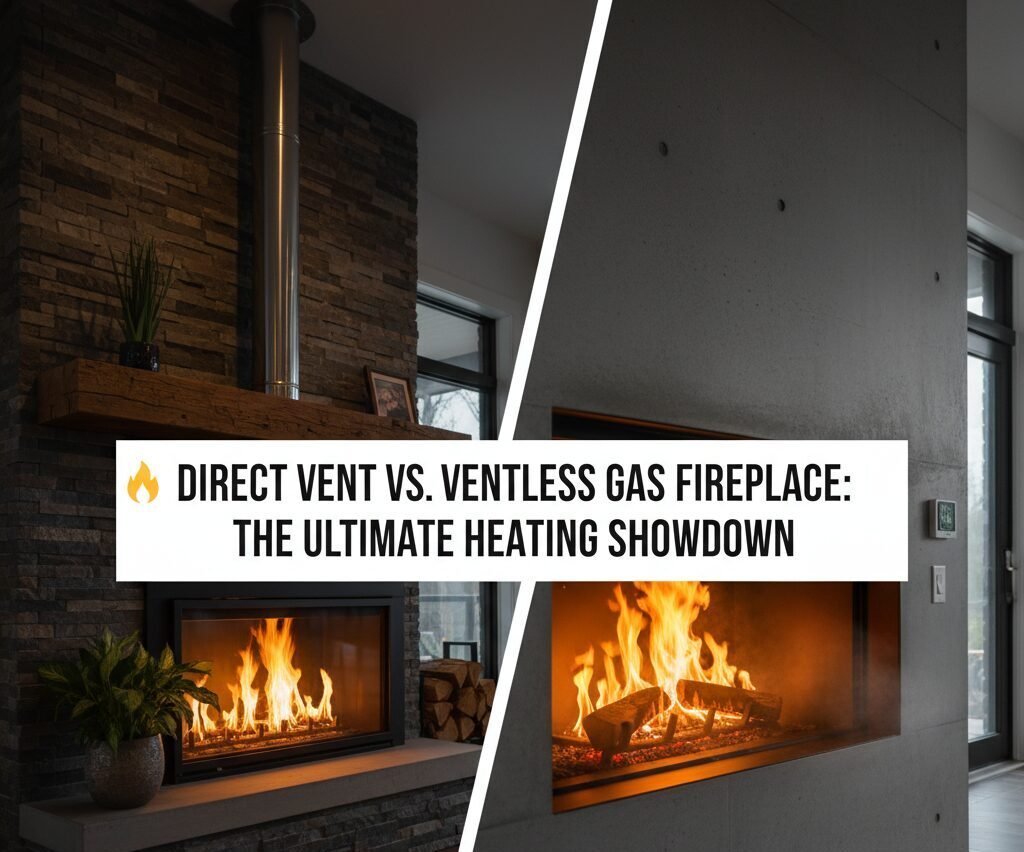
Topic: Gas Fireplace Types
Sections: 20+
Winner: Direct Vent (for most homeowners)
When winter arrives, the allure of a flickering flame is undeniable. For decades, homeowners relied on traditional masonry setups, dealing with the hassle of chopping wood and maintaining flues. The modern hearth industry has evolved dramatically. Today, gas fireplaces dominate the new installation market, offering instant heat with the flip of a switch — or the tap of a smartphone. But if you are in the market for a gas unit, you will inevitably hit a fork in the road: Direct Vent vs. Ventless.
This is not just a choice about aesthetics or convenience. It is a critical decision involving safety, indoor air quality, heating efficiency, building code compliance, fuel costs, and the long-term health of everyone in your home. While one option promises 99% heating efficiency and effortless installation, the other offers a sealed combustion system with superior air quality and a more realistic flame. Both represent genuine engineering achievements — and both have situations where they are clearly the right choice.
In this comprehensive guide, we go far beyond the basic comparison. We cover every gas fireplace venting type, dissect the science of combustion byproducts, provide a complete BTU sizing guide, walk through detailed installation cost breakdowns, explain the legal landscape of ventless restrictions, and give you a complete annual maintenance schedule for both systems. Whether you are planning a new installation or evaluating what you already have, this is the guide you need. For broader winter home comfort tips, we have you covered there too.
At a Glance: The Quick Comparison
Short on time? Here is the high-level breakdown of how these two systems stack up across the most important dimensions.
| Feature | Direct Vent Gas Fireplace | Ventless (Vent-Free) Gas Fireplace |
|---|---|---|
| Venting System | Coaxial sealed dual pipes | None — vents into room |
| Efficiency | 70% – 85% | 99% – 99.9% |
| Air Quality Impact | Excellent — no indoor byproducts | Moderate — CO₂, moisture, trace CO |
| Flame Aesthetics | Tall, yellow, highly realistic | Smaller, blue-yellow mix, fixed height |
| Safety Rating | Highest — fully sealed system | Good with ODS — not sealed |
| Installation Cost | $2,500 – $5,500+ installed | $1,000 – $3,000 installed |
| Legal Restrictions | Minimal — permitted virtually everywhere | Banned in CA; restricted in several states |
| Humidity Added | None | Significant — gallons per day |
| Best For | Primary living spaces, bedrooms | Large open spaces, supplemental heat |
All Gas Fireplace Vent Types Explained
The “direct vent vs. ventless” framing, while common, misses one important category: the B-Vent fireplace. Understanding all three venting types gives you the complete picture of what the market actually offers — and prevents costly mistakes when shopping, ordering parts, or hiring installers.
Direct Vent (Sealed)
Dual coaxial pipes draw outside air in and exhaust combustion gases out. Fully sealed glass front. Most versatile and safest for residential use. Can vent horizontally or vertically.
Ventless / Vent-Free
No external venting. Uses room air for combustion and releases all byproducts back into the room. Maximum efficiency but controversial air quality implications. Banned in some states.
B-Vent (Natural Draft)
Uses indoor room air for combustion; exhausts through a vertical B-vent pipe that must terminate above the roofline. Gas-only. Least efficient of the three but produces realistic tall flames.
Vented Gas Logs
Decorative burner placed in an existing wood-burning fireplace with the damper open. Maximum flame realism but lowest efficiency — heat exits up the flue. Not a heat source, primarily decorative.
The B-Vent is frequently overlooked in comparison guides. It draws combustion air from inside the room (like ventless) but exhausts all byproducts outside through a vertical pipe (like direct vent). Its primary advantage is a very realistic, tall yellow flame that many buyers prefer aesthetically. Its disadvantages include mandatory vertical termination above the roofline, lower efficiency than direct vent, and cold-air backdraft risk on windy days. It occupies a middle position in the market that makes it a niche choice for specific applications.
What is a Direct Vent Fireplace?
A direct vent fireplace is a completely sealed combustion system. It does not use any indoor air for combustion. Instead, it employs a “coaxial” venting design — a pipe within a pipe — where the outer annular space draws fresh outside air into the combustion chamber, while the inner pipe simultaneously exhausts combustion gases, carbon monoxide, and water vapor directly outdoors. Because the entire combustion process occurs behind a sealed glass panel, your home’s air quality is completely unaffected by the burning process.
This sealed architecture means a direct vent fireplace functions more like a furnace or boiler than a traditional open fireplace. The combustion chamber is a closed system, invisible from inside the home, operating independently of your home’s air supply and pressure. This eliminates the draft-dependency problems that affect all open systems — including cold backdraft on windy days, negative pressure problems in tight modern homes, and the need to crack a window for makeup air.
If you have wondered does a gas fireplace need a chimney, the direct vent answer is: it needs a venting system, but not a traditional masonry chimney. The venting can go horizontally through an exterior wall — the most common installation — or vertically through a roof if needed by the room’s location. This flexibility is one of direct vent’s most significant practical advantages over B-vent systems.
Because the glass front is sealed and gets extremely hot during operation — typically reaching 200–400°F on the glass surface — direct vent units are required to include a protective safety screen in front of the glass. This is not decorative; it is a mandatory safety feature to prevent contact burns, particularly for children and pets.
Direct Vent Venting Configurations Explained
One of direct vent’s greatest practical advantages is the range of installation configurations it supports. Understanding these options before buying prevents the common frustration of selecting a unit that cannot be vented in your specific installation location.
| Configuration | How It Works | Best For | Limitation |
|---|---|---|---|
| Horizontal (Through Wall) | Pipe exits through the exterior wall directly behind or beside the unit | Most residential installs — fastest, cheapest | Requires exterior wall access within ~3 feet |
| Vertical (Through Roof) | Pipe runs upward and terminates above the roofline | Interior rooms, upper floors, basement units | More complex; costs more than horizontal |
| Co-Linear (Two Pipes) | Two separate pipes run parallel in an existing chimney | Converting a masonry fireplace to gas direct vent | Requires adequate existing flue diameter |
| Power Vent (Fan Assisted) | Electric fan forces exhaust through longer horizontal runs | When the unit is far from the exterior wall | Requires power; fan noise; electricity dependency |
Vent Cap Clearance Requirements
The exterior vent cap for a direct vent horizontal installation must be located at least 12 inches above grade, 12 inches from any opening (windows, doors, vents), and away from any area prone to snow drifts that could block the intake. Check our guide on best chimney caps for rain — the same clearance logic applies. Blocked intake vents cause improper combustion, soot production, and potential flame rollout.
What is a Ventless (Vent-Free) Fireplace?
A ventless gas fireplace operates without any external venting system. It pulls oxygen from the room, burns gas through a precision-engineered burner assembly, and releases all of the combustion byproducts — heat, water vapor, carbon dioxide, and trace amounts of other gases — back into the living space. Because no heat is lost through a venting system, the unit operates at near-perfect efficiency: virtually 100% of the gas energy is converted to heat that stays in the room.
This efficiency is genuinely remarkable from an engineering standpoint. A ventless fireplace rated at 30,000 BTU/hour delivers almost all 30,000 BTUs directly to the room — versus a direct vent unit of the same BTU rating that delivers approximately 22,000–25,000 BTUs after venting losses. For pure heating power in a situation where installation flexibility or cost is a driving constraint, ventless units have a real performance advantage.
The engineering challenge — and the controversy — lies in managing what the combustion process produces. Natural gas combustion produces carbon dioxide (CO₂), water vapor, small amounts of carbon monoxide (CO), nitrogen dioxide (NO₂), and other trace combustion products. In a direct vent system, all of these exit through the sealed venting pipe. In a ventless system, they accumulate in your room. The ventless burner is engineered to minimize CO production to levels specified by ANSI Z21.11.2 (the governing standard for vent-free appliances), but the water vapor production is an inherent chemical reality that cannot be engineered away — it is a fundamental product of hydrocarbon combustion.
Because you may have questions about fireplace smoke coming into the house if you are evaluating ventless units, the critical distinction is that ventless units do not produce “smoke” in the visible sense when operating correctly. The concern is invisible combustion byproducts, primarily excess moisture and CO₂, not particulate smoke.

Looking for a high-efficiency heating solution?
The ODS Sensor: How It Works and Its Limitations
Every ventless gas appliance sold in the United States is required to include an Oxygen Depletion Sensor (ODS). Understanding how the ODS actually functions — and, critically, what it does not protect against — is essential knowledge for anyone considering a ventless unit.
The ODS is a small pilot flame assembly positioned precisely near the main burner. Its flame geometry is calibrated so that as ambient oxygen levels fall, the flame changes character in a way that reduces the thermocouple voltage feeding the gas valve. When oxygen drops to approximately 18% (from the normal atmospheric level of approximately 20.9%), the reduced thermocouple signal causes the gas valve to close, extinguishing the burner. The ODS is a genuinely clever piece of engineering and it works reliably for its stated purpose.
What the ODS Does Not Protect Against
The ODS protects against oxygen depletion — specifically, the risk that the fire could exhaust the room’s oxygen to the point of suffocation or extreme CO₂ concentration. However, the ODS does not protect against several other ventless hazards:
- Excessive CO₂ buildup — CO₂ concentration can rise to uncomfortable or mildly harmful levels (above 1,000–2,000 ppm) well before oxygen drops to the 18% shutdown threshold. Headache, fatigue, and reduced cognitive performance are associated with elevated CO₂ concentrations that would not trigger the ODS.
- Moisture accumulation — The ODS has no moisture-sensing function. Water vapor produced by combustion continues to accumulate in the room regardless of ODS operation.
- Nitrogen dioxide (NO₂) — Combustion also produces NO₂, a respiratory irritant that has no ODS sensing. Sensitive individuals and those with asthma may experience irritation at NO₂ concentrations well below levels that affect oxygen percentage.
- Odors and trace hydrocarbons — Incomplete combustion products and gas odorant compounds that do not affect oxygen levels are not sensed by the ODS.
The ODS Is Not a CO Detector
The ODS shuts off a ventless appliance based on oxygen level, not CO concentration. A CO detector installed in the room is a mandatory companion to any ventless appliance — it is the only device that alerts you to CO buildup. Never operate a ventless fireplace without a functioning CO detector in the room and adjacent spaces. Do not rely on the ODS as your sole safety device.
Combustion Byproducts: The Real Numbers
The chemistry of natural gas combustion is well-established and the numbers are worth understanding clearly before making a ventless installation decision. These figures apply specifically to natural gas (methane) combustion; propane combustion produces similar byproducts at slightly different absolute quantities.
| Byproduct | Ventless (Stays in Room) | Direct Vent (Exhausted Outside) | Health Significance |
|---|---|---|---|
| Water Vapor | ~1 gallon / 100,000 BTU burned | 100% exhausted outside | Condensation, mold risk in tight homes |
| Carbon Dioxide (CO₂) | Significant — room accumulation | Exhausted — no indoor buildup | Fatigue, headaches above 1,000+ ppm |
| Carbon Monoxide (CO) | Trace — must meet ANSI Z21.11.2 | Exhausted — no indoor buildup | Toxic; detector mandatory with ventless |
| Nitrogen Dioxide (NO₂) | Present — cannot be eliminated | Exhausted — no indoor buildup | Respiratory irritant, asthma trigger |
| Particulates | Negligible when operating correctly | Negligible | Minimal concern for either type |
The water vapor production figure deserves specific attention. A ventless fireplace burning at 30,000 BTU/hour produces approximately 0.3 gallons of water vapor per hour. An extended four-hour evening fire session produces over a gallon of water vapor — entirely contained in your home. In a drafty older house with natural air infiltration, this may not cause perceptible problems. In a modern, energy-efficient home with tight construction (the type of home where ventless is most appealing as a supplemental heat source), this moisture load can cause visible condensation on windows, wallboard, and eventually, mold growth in wall cavities.
Carbon Monoxide Detector Placement Guide
Proper CO detector placement is critical for both ventless and direct vent systems — though the urgency is significantly higher for ventless installations. CO is colorless, odorless, and tasteless. Without a detector, you will not know it is accumulating until symptoms appear — and by then, the concentration may already be dangerously elevated.

Fireplace Room
Primary detector. Install within 15 feet of the ventless unit. Mandatory for all ventless installations.

Each Bedroom
Required by most building codes. Sleeping areas must have CO detection regardless of fireplace type.

Each Floor Level
CO disperses throughout the home. One detector per level, placed on the ceiling or high on the wall (CO is lighter than air).

Mounting Height
Install near ceiling or at head height — CO is slightly lighter than air and accumulates toward the ceiling in enclosed spaces.
Test Monthly, Replace Every 5–7 Years
CO detectors have electrochemical sensors that degrade over time. Test your detectors monthly using the built-in test button. Replace them every 5–7 years regardless of apparent function — degraded sensors may not respond to actual CO concentrations at safe trigger levels. Write the installation date on the detector with a permanent marker so you know when to replace it.
Head-to-Head: Direct Vent vs. Ventless — Detailed Analysis
1. Safety and Indoor Air Quality
Direct vent fireplaces hold an unambiguous advantage in safety and indoor air quality. The sealed combustion architecture means no combustion byproducts, no added moisture, no CO, and no NO₂ ever enter your home’s air supply. For households with asthmatic members, young children, elderly residents, or anyone with respiratory sensitivities, this distinction is not a comfort preference — it is a health consideration.
Ventless fireplaces are equipped with an Oxygen Depletion Sensor (ODS) that cuts off the gas supply if room oxygen drops below approximately 18%. While effective for its stated purpose, the ODS does not address moisture accumulation, CO₂ buildup, or NO₂ — all of which occur at lower concentrations than would trigger an ODS shutdown. If you have ever had concerns about combustion products in your living space, these are the real concerns with ventless operation.
2. Heating Efficiency — The True Picture
The common statement that ventless fireplaces are “99% efficient” is technically accurate but requires important context. Yes, virtually all the BTU output from a ventless unit stays in the room — nothing is lost up a vent. However, this 99% efficiency figure includes the energy content of the water vapor produced by combustion. Water vapor in warm indoor air is absorbed into the home’s thermal mass — walls, furniture, occupants — contributing to perceived warmth but also to humidity. The actual sensible heat (the heat that raises temperature) delivered by a ventless unit is somewhat lower than the raw BTU rating suggests, because a portion of the energy goes into water vapor that doesn’t raise temperature.
Direct vent units, at 70–85% efficiency, do lose heat through the exhaust. However, this efficiency difference is comparable to the debate between a wood stove vs fireplace heating — where sealed appliances consistently outperform open ones. For primary heating duty, both types are dramatically more efficient than traditional open masonry fireplaces. The efficiency gap between direct vent and ventless is real but narrower in practice than the marketing figures suggest.
3. Installation Flexibility
Ventless wins clearly on installation flexibility. Connect a gas line, set the unit in position, and the installation is complete. The unit can be placed on any interior wall, mounted in a bookcase, installed in a basement with no exterior wall access, or centered in a large room. No exterior penetration, no flashing, no specialized venting materials — just gas piping, which is standard plumbing work.
Direct vent units require exterior venting — either a horizontal penetration through an exterior wall or a vertical run through the roof. This requirement is manageable in most homes but adds complexity, cost, and physical constraints on placement. Check gas fireplace venting options for the full configuration breakdown. The exterior vent cap also requires proper sealing, and using the best chimney flashing sealant where the vent penetrates the wall or roof is essential to prevent water infiltration.
4. Moisture and Condensation
This is the most practically significant — and most underappreciated — difference between the two systems. Direct vent exhausts all combustion moisture outside. Ventless keeps it all inside. Burning natural gas produces approximately one pound of water vapor per 100,000 BTU of gas burned. At a typical ventless fireplace output of 25,000–40,000 BTU/hour, an extended evening of use can introduce 2–4 pounds (roughly a quarter to half a gallon) of additional water vapor into your home’s air.
In older, leaky construction this may not be perceptible. In modern well-sealed homes — which are disproportionately the homes that consider ventless installation because the lack of exterior access makes venting awkward — this moisture load can create visible condensation on windows and cold walls, and eventually contribute to mold in wall cavities and around window frames. For anyone who has dealt with moisture problems in their home, adding a ventless fireplace without understanding this dynamic is a real risk.
5. Flame Appearance and Aesthetics
Direct vent fireplaces consistently produce more realistic, visually impressive flames. Because the burner operates in a sealed chamber with controlled combustion air, the flame temperature and character can be optimized for visual effect rather than constrained by safety requirements. Direct vent flames tend to be taller, more yellow-orange, and show the natural movement and dance of wood fire. Many top-tier direct vent models include ceramic log sets indistinguishable from real wood at a casual viewing distance.
Ventless flames are engineered to burn completely at high temperatures in order to minimize CO and residual byproducts. This high-temperature requirement constrains the flame character — ventless flames tend to be more blue at the base, shorter in height, and more visually homogeneous than direct vent equivalents. They have improved significantly in visual quality over the past decade, but the aesthetic gap remains apparent when comparing equivalent-priced units from both categories.
BTU Sizing Guide: What Output Do You Actually Need?
Selecting the correct BTU output for your space is one of the most consequential decisions in the buying process — and one of the most frequently under-discussed. Oversized units cycle on and off constantly, creating uncomfortable temperature swings and wasting gas. Undersized units run continuously at maximum output and still fail to adequately heat the space.
The standard rule of thumb is approximately 20 BTUs per square foot for a well-insulated room in a moderate climate, with adjustments for ceiling height, insulation quality, and climate severity.
200 sq ft room ~ 8,000 BTU
400 sq ft room ~ 15,000 BTU
600 sq ft room ~ 22,000 BTU
800 sq ft room ~ 30,000 BTU
1,200 sq ft great room ~ 40,000+ BTU
Ventless BTU Restrictions by Room Size
ANSI Z21.11.2 — the standard governing ventless appliances — mandates minimum room volume requirements for each BTU output level. A 30,000 BTU ventless unit requires a minimum room volume of approximately 11,250 cubic feet (roughly a 20×25×22 foot great room). This is not a suggestion — it is a safety requirement to ensure adequate oxygen supply. Always verify that your installation room meets the minimum volume requirement for the ventless unit’s rated BTU output before purchasing.
Natural Gas vs. Propane: Which Fuel for Your System?
Both direct vent and ventless fireplaces are available in natural gas (NG) and liquid propane (LP) versions. This is not a minor detail — the burner orifices, pressure regulators, and BTU ratings differ between the two fuels. Never run a natural-gas-rated appliance on propane or vice versa without a proper conversion kit; doing so will result in dangerous sooting, incomplete combustion, or appliance damage.

Natural Gas
Available where municipal gas utility service exists. Lower cost per BTU in most markets. Requires connection to the utility’s distribution network — impossible in rural areas without service. Metered and billed monthly with no storage required. Most common choice for suburban and urban installations.

Liquid Propane (LP)
Available anywhere via tank delivery — ideal for rural homes without natural gas service. Higher BTU content per cubic foot than natural gas (2,500 BTU/cf vs 1,020 BTU/cf for NG). Requires on-site tank storage (typically 100–500 gallon tanks). Price per BTU is typically 30–50% higher than natural gas. Burns slightly cleaner than natural gas per unit of heat produced.
One important practical note: many manufacturers offer “convertible” models that ship configured for natural gas but include a conversion kit for LP installation. If you are in an area without natural gas service and plan to use propane, verify that the specific model you are considering either ships in LP configuration or has an available, manufacturer-supplied conversion kit. Field-fabricated orifice conversions using non-OEM components are not safe and typically void the appliance warranty and UL listing.
Flame Styles and Firebox Designs
The gas fireplace market has expanded dramatically beyond the traditional rectangular single-sided firebox. Understanding the full range of available designs helps you match the right product to your architectural vision — while being realistic about which options work with each venting type.
| Design | Description | Direct Vent? | Ventless? |
|---|---|---|---|
| Traditional Single-Sided | Classic rectangular firebox with logs and yellow flames | Yes | Yes |
| Linear / Contemporary | Wide, low horizontal format with modern glass media (crystals, stones) | Yes | Yes |
| See-Through (Double-Sided) | Flames visible from two rooms — dramatic room divider effect | Yes | Limited |
| Corner (Angled) | Firebox designed for 45° or 90° corner installation | Yes | Yes |
| Three-Sided / Bay | Flames visible from front and two sides — panoramic view | Yes | Limited |
| Outdoor / Outdoor-Rated | Designed for covered outdoor spaces — patios, pergolas | Yes | Never outdoors |
The linear fireplace format has become the dominant design choice in contemporary and transitional home design. Wide, shallow, and dramatic, linear fireplaces — often running 48–72 inches in width — are typically filled with glass beads, river rocks, or driftwood media rather than traditional logs, creating a visually striking modern aesthetic. Most linear models are available in direct vent configuration; ventless linear models exist but face the same room-volume requirements as any other ventless unit.
Gas Log Types: Vented vs. Unvented — Not the Same as the Fireplace Type
A common source of confusion in gas fireplace shopping is the distinction between the fireplace type (direct vent vs. ventless) and the gas log type (vented vs. unvented). These are related but distinct categories that do not map one-to-one onto each other.
Vented gas logs are designed for use in an existing wood-burning masonry or prefab fireplace with the damper open. They produce tall, dramatically realistic yellow flames because they burn with a rich fuel mixture that intentionally creates some soot and visible combustion byproducts — just as a wood fire would. Because the damper must remain open, heat escapes up the flue. Vented gas logs are primarily a decorative product, not an efficient heating appliance. They cannot be used in a sealed direct vent firebox.
Unvented (ventless) gas logs are burner assemblies designed for use in an existing firebox that can function without the damper open, or in a dedicated ventless appliance. They burn cleanly enough that all byproducts can safely remain in the room (subject to the room volume and CO detector requirements discussed above). The flame appearance is less realistic than vented gas logs due to the clean-burning requirement. These can be retrofitted into existing masonry fireplaces but require a specific damper clamp arrangement and CO detector installation.
Never Use Vented Gas Logs in a Sealed Firebox
Vented gas logs require an open damper and are designed to exhaust byproducts up the flue. Installing them in a sealed direct vent firebox is a serious safety violation — the sealed system will not exhaust the byproducts, and CO will accumulate in the room. Always verify compatibility between gas log type and firebox type before purchasing.
Installation Cost Breakdown: What You Are Actually Paying For
Understanding the components of installation cost for both systems helps you evaluate quotes accurately, identify where cost reductions are realistic, and avoid the false economy of cutting corners on the wrong items.
Direct Vent Installation Costs
| Component | Cost Range | Notes |
|---|---|---|
| Direct Vent Fireplace Unit | $800 – $3,500 | Wide range — entry-level to premium with blower |
| Venting Kit (Pipe + Cap) | $200 – $600 | Must match manufacturer’s listed pipe system |
| Gas Line Installation | $300 – $800 | Depends on distance from existing line |
| Exterior Wall Penetration | $150 – $400 | Framing, fire-stopping, exterior patching |
| Surround, Hearth, Mantel | $200 – $2,000+ | Wide range based on material |
| Installation Labor | $400 – $1,000 | Typically 4–8 hours for experienced installer |
| Total Range | $2,000 – $7,500+ | Premium units with elaborate surrounds push upper end |
Ventless Installation Costs
| Component | Cost Range | Notes |
|---|---|---|
| Ventless Fireplace Unit | $400 – $2,000 | Generally less expensive than direct vent equivalents |
| Gas Line Installation | $300 – $800 | Same requirement as direct vent |
| Surround, Hearth, Mantel | $200 – $2,000+ | Same design options available |
| CO Detector(s) | $30 – $120 | Mandatory safety addition — multiple units recommended |
| Installation Labor | $250 – $600 | No exterior penetration work required |
| Total Range | $1,000 – $4,500+ | Significantly lower than direct vent in most installations |
Building Codes and State Restrictions
The legal landscape for ventless gas appliances is one of the most important — and most frequently overlooked — aspects of this decision. Ventless fireplaces face restrictions that direct vent units simply do not encounter.
| Jurisdiction / Rule | Ventless Status | Direct Vent Status |
|---|---|---|
| California | Banned statewide | Permitted |
| Massachusetts | Heavily restricted, permit required | Permitted |
| Most US States | Permitted with room volume, BTU limits | Permitted |
| Bedrooms (Virtually All US) | Prohibited by code | Permitted (follow clearances) |
| Bathrooms (Virtually All US) | Prohibited by code | Some models approved |
| Canada | Prohibited in some provinces | Permitted |
| High Altitude (5,500+ ft) | Special considerations — ODS affected | Minimal altitude impact |
The Altitude Problem for Ventless Units
High-altitude installations present a specific risk for ventless fireplaces that most buyers are unaware of. At elevations above 4,500–5,500 feet, the reduced atmospheric oxygen concentration means the room’s oxygen percentage is already lower than at sea level before the fireplace is ever ignited. This reduced baseline oxygen level means the ODS sensor will trigger at a higher absolute oxygen concentration than at sea level — cutting off the unit more quickly and potentially creating a false sense of limitation. More importantly, the reduced oxygen at altitude also increases the likelihood of incomplete combustion and elevated CO production even in units functioning correctly. Ventless manufacturers have specific altitude ratings — always verify that your installation altitude is within the approved range for the specific unit you are purchasing.
If you are converting an older masonry fireplace to gas — which affects both direct vent and ventless options — review the complete gas fireplace venting options discussion to understand which route best suits your existing structure.
Converting a Wood-Burning Fireplace to Gas
Converting an existing wood-burning masonry or prefab fireplace to gas is one of the most common installation scenarios — and a situation where the direct vent vs. ventless choice has specific structural implications.
For a masonry fireplace conversion, the most common approach for direct vent is a co-linear liner installation: two flexible stainless steel liner tubes are run down the existing masonry flue — one for exhaust, one for combustion air intake. This preserves the masonry’s exterior appearance while providing the direct vent system’s sealed combustion benefits. The masonry firebox itself must be in good repair — cracked or severely deteriorated firebrick should be addressed before the gas insert is installed.
A ventless insert in a masonry fireplace bypasses the flue entirely — the existing chimney is simply not used. This creates the simplest possible installation scenario. However, it requires permanently closing the damper (or removing it) and installing a decorative glass door panel to seal the opening aesthetically, since the open masonry throat above the firebox is now not part of the combustion system. Most importantly, even with the damper closed, the masonry chimney above is now unused and open to weather — the chimney cap becomes critical to prevent water entry, animal intrusion, and heat loss up the unused flue. Using the best chimney flashing sealant and a quality cap on the unused flue is essential maintenance for this configuration.
The masonry surround around an existing fireplace still needs attention regardless of which gas system you choose. Check the mortar for deterioration, and consider whether the surround’s finish needs updating — the best paint for chimney brick can modernize the appearance without expensive reconstruction.
Ignition Systems and Power Outage Operation
Modern gas fireplaces use one of three ignition systems, and the type determines whether the fireplace works during a power outage — a question of genuine practical importance in regions prone to winter storms.
| Ignition Type | How It Works | Power Outage Operation | Efficiency |
|---|---|---|---|
| Standing Pilot (Traditional) | Small flame burns continuously 24/7 to light main burner on demand | Yes — pilot burns without power | Lower — wastes gas continuously |
| Intermittent Pilot (IPI) | Electronic ignition lights pilot only when heat is called for | Battery backup on most models | Better — no continuous pilot waste |
| Millivolt System | Standing pilot generates its own electrical power via thermocouple for valve operation | Yes — fully self-powered by pilot thermocouple | Lower — standing pilot always burning |
For homeowners who want their gas fireplace to function as an emergency heat source during power outages, a millivolt ignition system or a standing pilot system is the correct choice. These systems generate their own electrical power from the pilot flame’s thermocouple and require no external electricity for valve operation. Many IPI (electronic ignition) systems include a battery backup module that allows operation during outages — always verify this capability at the time of purchase if emergency heating is a priority use case.
Smart Controls, Thermostats, and Remote Operation
The control systems available for gas fireplaces have evolved substantially, and the right choice depends significantly on how you intend to use the fireplace and how deeply you want it integrated into your home’s automation ecosystem.
Manual controls (wall switches or manual knobs) are the most reliable and least expensive option. They are appropriate for supplemental-use fireplaces where scheduled operation is not needed and where the operational simplicity is valued.
Remote controls and thermostats allow the fireplace to be operated from across the room and, in thermostat-controlled configurations, to maintain a target room temperature automatically by cycling the burner on and off. Thermostat control is particularly valuable for ventless units used as primary supplemental heat sources, as it prevents the continuous operation that would otherwise maximize moisture production and CO₂ accumulation in tight homes.
Smart home integration (Z-Wave, Zigbee, or Wi-Fi-based systems) allows the fireplace to be controlled through Amazon Alexa, Google Home, Apple HomeKit, or dedicated manufacturer apps. Many premium direct vent and ventless units now include or offer optional smart control modules. Beyond convenience, smart scheduling is a meaningful energy management tool — programming the fireplace to heat specific zones only during occupied hours can reduce operating costs measurably.
One critical operational note for ventless smart-home control: automated operation of ventless fireplaces requires equally automated ventilation management. If your ventless fireplace is programmed to run on a schedule without occupant awareness, the resulting moisture and CO₂ accumulation can occur without anyone noticing or acting on it. Smart control of ventless units should be paired with smart CO and humidity monitoring to close this feedback loop.

Upgrade your existing fireplace with a realistic gas log set.
Annual Maintenance Schedule for Gas Fireplaces
Gas fireplaces are dramatically lower maintenance than wood-burning systems — there is no creosote, no ash, and no heavy sweeping involved. However, “lower maintenance” does not mean “no maintenance.” A neglected gas fireplace can develop hazards that are far less visible and therefore more dangerous than the obvious soot and creosote buildup of a wood system.
- Monthly: Test all CO detectors in the home using the test button. Verify battery status. Inspect the glass panel of direct vent units for unusual soot deposits or discoloration (indicates incomplete combustion or a damaged seal).
- Seasonal: Vacuum the ceramic log set and burner ports before the heating season begins. Dust and debris on burner ports impair combustion efficiency. Inspect the glass panel of the direct vent unit for cracks, chips, or damaged seals — a compromised glass seal is a safety issue requiring immediate professional repair.
- Annual professional inspection and service: verify gas valve operation and leak-test all connections, inspect ODS function on ventless units, clean and check ignition components (pilot, thermocouple, thermopile), verify blower operation if equipped, and confirm that all clearance distances remain correct after any room modifications.
- Annual: For direct vent units: inspect the exterior vent cap for debris blockage, pest nesting, or corrosion. Verify that the termination clearances remain compliant (no new construction, plant growth, or additions that have reduced required clearances). Check the cap condition and replace if corroded.
- Annual: For ventless units: verify room volume has not been reduced by new construction or furniture arrangement that would reduce effective air volume. Confirm that CO and humidity detector placement is still appropriate for the room configuration.
- Per Season: Replace CO detector batteries at the start of each heating season regardless of the battery level indicator. The modest cost of fresh batteries is trivial compared to the risk of a failed detector during active fireplace use. Also review how often you should check maintenance items for both gas systems via the guide on how often should you clean a chimney.
Full Pros and Cons Analysis
Direct Vent Fireplaces
pros
- Sealed combustion — zero indoor air quality impact
- No moisture added to indoor air — no condensation risk
- Permitted in bedrooms, bathrooms, and all rooms
- Tall, realistic, yellow-orange flames
- Works with wide range of log sets and media
- Multiple venting configurations (horizontal, vertical, power vent)
- Many models include blower for improved heat distribution
- Safe for asthmatics and respiratory-sensitive occupants
cons
- Higher purchase and installation cost
- Requires exterior wall or roof access for venting
- 70–85% efficiency vs. ventless’s 99%+
- Sealed glass front gets very hot — requires safety screen
- Vent cap clearance requirements limit some placements
Ventless Fireplaces
pros
- 99%+ efficiency — virtually no heat loss
- Lower unit cost and dramatically simpler installation
- No exterior wall required — maximum placement flexibility
- Higher BTU output stays in the room for faster warming
- No chimney or flue to waterproof or maintain
cons
- 99%+ efficiency — virtually no heat loss
- Lower unit cost and dramatically simpler installation
- No exterior wall required — maximum placement flexibility
- Higher BTU output stays in the room for faster warming
- No chimney or flue to waterproof or maintain
Final Buying Guide: Which One Should You Choose?
Choose Direct Vent If:
- Safety and indoor air quality are priorities
- You live in a well-sealed, energy-efficient home
- You want the fireplace in a bedroom or bathroom
- Anyone in the home has respiratory sensitivities or asthma
- You want the most realistic flame appearance
- You live in California or another restricted jurisdiction
- The installation location has exterior wall access
- Long-term home value matters — direct vent adds more resale appeal
Choose Ventless Only If:
- Maximum heat output in a large open space is the priority
- Budget for installation is severely limited
- No exterior wall access is available in the installation location
- The home is older with significant natural air infiltration
- The space meets minimum room volume requirements
- It is legal in your specific jurisdiction
- No respiratory-sensitive occupants are in the home
- You are committed to installing and maintaining CO detectors
Regardless of which system you choose, gas fireplace maintenance matters. While you will not need a chimney sweep vacuum for creosote, you will need annual professional service for both types to verify gas connections, ignition components, and safety systems. Understanding how often you should service a gas fireplace is the foundation of safe long-term operation.
Frequently Asked Questions
Can I put a TV above a direct vent fireplace?
Technically possible, but the zone directly above any working fireplace is the hottest area in the room — and sustained heat exposure is the primary killer of flat-panel electronics. Direct vent fireplaces generate significant heat from the sealed glass front, which can exceed 400°F at the glass surface. Heat rising from the unit creates a convective column that regularly exceeds the operating temperature rating of most consumer televisions.
If you want the aesthetic of a TV above the fireplace, install a deep projecting mantel shelf that deflects the rising heat outward before it reaches the TV’s mounting location. Verify the manufacturer’s clearance requirements for the specific fireplace model and confirm the ambient temperature at the TV mounting height before permanent installation. Many homeowners regret not doing this calculation before their first season of use.
Do ventless fireplaces really cause mold?
They can, under the right conditions — specifically in modern, well-sealed homes where the added moisture has nowhere to escape. Natural gas combustion produces approximately one pound of water vapor per 100,000 BTU of gas burned. An evening of ventless fireplace use at 30,000 BTU/hour can add 0.3 pounds of water vapor per hour to your indoor air — over a 3-4 hour session, that approaches a full pound of moisture.
In drafty older homes with constant air infiltration and exfiltration, this moisture is continuously diluted and removed. In tight modern construction — the homes that disproportionately attract ventless installations due to the difficulty of exterior venting — this moisture accumulates. The visible sign is condensation on windows and exterior walls. The invisible risk is moisture accumulating in wall cavities behind cold exterior surfaces, creating conditions favorable for mold growth over months and years of regular use.
Does a direct vent fireplace need a chimney?
No masonry chimney is required. Direct vent fireplaces use a proprietary two-pipe venting system (the coaxial “pipe within a pipe” design) that can exit horizontally through an exterior wall or vertically through a roof. The exterior wall termination is the most common installation — the vent cap is simply a small, low-profile fitting on the exterior wall, indistinguishable at a distance from a dryer vent or bathroom exhaust vent. The entire venting system is typically 4–6 inches in diameter and runs entirely within the framed wall cavity. No special structural support, masonry, or above-roofline termination is required for horizontal installations. Check our guide on best chimney services for installation and servicing help.
Can I convert a ventless fireplace to direct vent?
Generally, no — not by modifying the existing unit. Ventless and direct vent fireboxes are fundamentally different engineering designs: the direct vent firebox is a sealed combustion chamber specifically designed to function with the coaxial venting system. A ventless firebox is designed to operate without any exhaust path. Adding venting to a ventless unit would disrupt the combustion air/fuel ratio the burner is calibrated for and could create hazardous operating conditions. The correct approach is to remove the existing ventless unit entirely and install a new direct vent fireplace in the same location — provided exterior wall access is available. In some cases, a direct vent insert can be installed into the existing surround if the dimensions are compatible.
Do gas fireplaces work during a power outage?
It depends entirely on the ignition system. Gas fireplaces with millivolt ignition or traditional standing pilot systems operate without any external electrical power — the pilot flame’s thermocouple generates the small voltage needed to hold the gas valve open. These units light and operate normally during power outages. Gas fireplaces with electronic IPI (Intermittent Pilot Ignition) systems require power for the ignition electronics; however, most modern IPI units include a battery backup module that allows operation for many hours during an outage. Check your specific unit’s documentation or the unit itself for a battery backup compartment. If power-outage heating capability is important to your household, this specification should be confirmed before purchase.
Are ventless fireplaces safe in bedrooms?
No — virtually every building code in the United States prohibits ventless gas appliances in bedrooms. The reason is straightforward: bedrooms are small enclosed spaces, often closed during sleep, with minimal air exchange. The room volume per occupant is at its minimum, and the occupant’s ability to notice symptoms of oxygen depletion or CO₂ accumulation is impaired during sleep. The ODS sensor that ventless units depend on for oxygen monitoring is not a reliable substitute for active ventilation in this environment. Direct vent fireplaces, which exhaust all combustion byproducts to the exterior, are permitted in bedrooms in most jurisdictions provided that manufacturer clearance requirements are followed. Direct vent is the only safe gas fireplace option for bedroom installation.
Does homeowners insurance cover gas fireplace damage or issues?
Coverage depends on your specific policy terms and the cause of the damage. Sudden, accidental, covered events — such as a gas explosion, fire resulting from a covered peril, or storm damage to the venting system — may be covered. Gradual wear and maintenance issues — a rusted vent cap, deteriorated glass seal, failed ignition components — are typically excluded as maintenance items. One important nuance: if your unit was improperly installed (wrong pipe brand, inadequate clearances, unpermitted work), a claim resulting from that installation issue may be disputed. Working with licensed professionals and obtaining proper permits protects your insurance position. See more details at does homeowners insurance cover chimney repair.
How does Santa get in without a chimney?
A completely valid concern for families making the switch to a gas fireplace! If your home has a direct vent or ventless unit where the traditional chimney no longer functions, you may wonder how does Santa get in without a chimney? As it turns out, magic keys and chimney-independent entry methods have been thoroughly documented in the holiday literature. Your children will not be disappointed — and your air quality will be considerably better than if Santa came down a soot-filled flue.
Verdict: Direct Vent Wins for Most Homeowners
In the battle between direct vent and ventless gas fireplaces, the direct vent is the clear recommendation for the majority of modern homeowners. The 15–30% efficiency advantage of ventless is a genuinely meaningful number — but it is a narrow trade-off against superior safety, zero indoor air quality impact, no moisture accumulation, and the freedom to install in any room including bedrooms. For tight, well-insulated modern homes, the ventless moisture problem alone often eliminates it from consideration.
Ventless units retain a real use case: large, drafty older homes where supplemental heat is the only goal, exterior wall access is genuinely unavailable, and the homeowner is committed to proper CO monitoring. In these specific circumstances, the efficiency advantage and installation simplicity are legitimate benefits worth the trade-offs.
Whatever you choose, hire a licensed professional for the gas line installation and have the unit professionally serviced annually. Unlike the old days of wood fires, you won’t have to worry about birds in the chimney or what wood not to burn — you simply set your thermostat, press a button, and enjoy reliable, clean warmth on demand.