The fire is out, the cookies are on the plate, and a glass of milk sits beside a hand-drawn card. The stockings are hung, but… wait. There’s no chimney. For generations, the image of Santa Claus — with his jolly belly and a sack full of toys — descending a soot-filled flue has been the cornerstone of Christmas magic. But as modern homes, apartments, and condos have replaced traditional hearths, a very logical and pressing question arises in the curious minds of children everywhere: how does Santa get in without a chimney?
As a lifelong student of holiday folklore, I can assure you that the lack of a fireplace is no obstacle for a man who commands flying reindeer and visits every child in the world in a single night. The answer is a beautiful blend of ancient magic, clever elven ingenuity, and the pure power of the Christmas spirit. It is a testament to the enduring and adaptable nature of our most cherished holiday tradition.
This in-depth exploration will unlock the secrets of Santa’s modern-day Christmas miracle. We’ll delve into the rich history of his chimney tradition, explore every enchanting method he uses to ensure no child is ever missed, discover how families around the world have created their own beautiful rituals, and arm parents with everything they need to keep the magic alive through every age and stage of childhood. Prepare to have your sense of wonder reignited!
About the Author
As a certified masonry specialist and home inspector with over 20 years of field experience, I’ve assessed and repaired chimneys across the full spectrum — from minor repointing jobs to complete structural rebuilds following chimney fires. My goal is to give homeowners honest, safety-first information so they can make informed decisions: knowing when to pick up a trowel themselves, and knowing when to put it down and call a professional. The most expensive repair is always the one that results from using the wrong material or attempting work beyond your skill level.
The Enduring Allure of the Chimney: A Brief History
Before we explore the solutions, we must first appreciate why the chimney became Santa’s grand entrance in the first place. The tradition is a fascinating mix of historical architecture, ancient symbolism, Scandinavian folklore, and legendary Christian tales that fused together over centuries into the beloved mythology we know today.
The Hearth: The Sacred Center of the Home
For centuries before central heating, the hearth was the literal and figurative center of the home. It provided warmth, light, and the means to cook food. It was where families gathered, stories were told, and life unfolded through winter’s long nights. In many ancient European cultures — from Norse households to Roman families who venerated their Lares, the spirits of the hearth — the fireplace was considered a sacred portal. A connection between the earthly world and the realm of spirits or gods. Gifts and offerings were sometimes left near the fire as a gesture of hospitality and blessing. This sacred geography made it a perfectly plausible entry point for a magical being on a benevolent night mission.
The chimney, then, was not merely a functional flue for smoke — it was an architectural threshold between worlds, between the mundane and the miraculous. When storytellers began weaving tales of a gift-bringer who arrived unseen in the night, it was natural, almost inevitable, that his path would run through this magical corridor.
Pre-Christian Winter Visitors
Santa Claus did not emerge from a single moment of invention. He is a layered figure, assembled over centuries from multiple traditions. Well before the Christian feast of Saint Nicholas, Norse mythology described the god Odin riding his eight-legged horse Sleipnir through the winter sky during the Yule season. Children left their boots by the hearth filled with carrots and hay for Sleipnir, and Odin would leave sweets and gifts in return. Eight-legged horse. Winter sky ride. Gifts via the hearth. Sound familiar? The DNA of Santa Claus runs deep through the ancient world, and the chimney connection has always been part of that lineage.
The Dutch figure Sinterklaas — the most direct ancestor of the American Santa Claus — was said to ride across rooftops on his white horse on the eve of December 5th, dropping gifts down the chimneys to children who had left their shoes out. This rooftop-and-chimney delivery system crossed the Atlantic with Dutch settlers in New Amsterdam (modern-day New York) and became entrenched in American Christmas culture, eventually crystallized in the 1823 poem A Visit from St. Nicholas, popularly known as ‘Twas the Night Before Christmas.
The Legend of Saint Nicholas & the Origin Story
The most direct and historically documented link between a gift-bringer and a chimney comes from the story of Saint Nicholas of Myra, the 4th-century bishop of what is now Turkey. Nicholas was a man of extraordinary generosity, particularly toward the poor and vulnerable. His legendary deeds became the foundation upon which the entire Santa Claus tradition was built over the following seventeen centuries.
The most famous tale involves a poor nobleman who had three daughters. Without dowries, they faced lives of poverty or worse — in that era, unmarried women without means had few options. Nicholas, learning of their plight, wanted to help without humiliating the family. To preserve their dignity and maintain his own anonymity, he climbed onto their roof at night and dropped three bags of gold coins down their chimney. As fate would have it, the gold landed perfectly in the stockings the sisters had hung by the fire to dry overnight. This single act of anonymous generosity, passed down through generations and across continents, forever linked the gift-bringer with the chimney — and gave us the tradition of hanging stockings on Christmas Eve.
A North Pole Decree
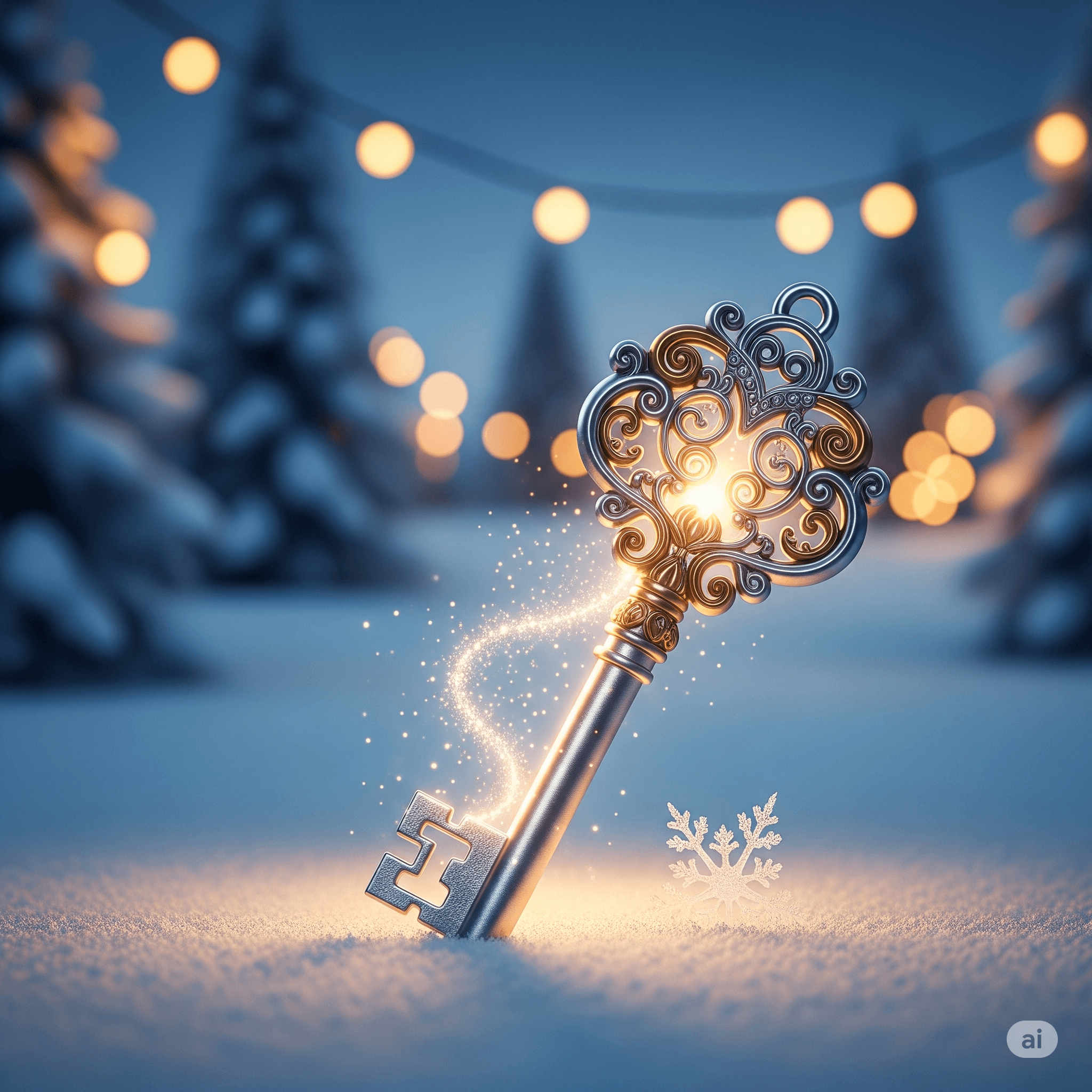
“Be it known that this key is enchanted with the spirit of Christmas. It shall turn the lock of any home where a believing child resides, leaving no trace but joy and gifts behind. It feels neither the cold of the lock nor the complexity of its tumblers — only the warmth of the welcome within.”
It’s worth noting that even today, a well-maintained chimney is a source of pride and a key part of a home’s structure. It requires genuine care, from using the best mortar for chimney repairs to ensuring it’s clear of obstructions and wildlife. After all, Santa’s chosen path should be a safe and clear one. The last thing he needs on his busiest night of the year is to encounter an unexpected guest and be forced to figure out how to get a raccoon out of a chimney!
Unlocking the Door: The Magic of Santa’s Key
In homes without a chimney, the most beloved, widely accepted, and practically beautiful solution is Santa’s Magic Key. This isn’t just a piece of metal — it is a master key to all the world’s homes, forged by the most skilled elven metalsmiths deep in the North Pole workshops. Imbued with the very essence of Christmas magic, this key has the extraordinary ability to unlock any door on Earth, but only for Santa, and only on Christmas Eve.
This tradition provides something vitally important for children: a tangible, physical anchor for an abstract and magical belief. The key transforms an ordinary front doorknob into a magical gateway. It gives children a role to play — they are the ones who leave the key out, who extend the invitation, who make Santa’s visit possible. This sense of agency deepens their emotional investment in the tradition and makes Christmas Eve feel participatory rather than passive.
The Santa’s Magic Key tradition also provides an elegant answer that parents can tailor to their family’s specific circumstances. If you live in a third-floor apartment with no balcony and no mail slot, the magic key resolves every architectural objection in a single, satisfying sentence: “We leave Santa’s magic key on our door handle, and it lets him in.” Curiosity satisfied. Wonder preserved. Childhood protected.

Create the Magic: Santa’s Magic Key with Poem
Start a new family tradition with this beautiful, oversized magic key. It comes with a heartfelt poem that explains its purpose to curious children, providing a perfect, ready-made answer for homes without a fireplace. Hang it on your door on Christmas Eve and watch the wonder in your child’s eyes as they realize they are the ones making Santa’s visit possible.
The Properties of Santa’s Magic Key
For parents who want to go deeper with this story, here is a fully fleshed-out mythology for the magic key that can be shared with children of different ages:
- It works once per year, per home — the key’s enchantment is specifically tied to Christmas Eve. It cannot be used by anyone other than Santa, and it cannot be used on any other night of the year.
- It has no address or lock number — the key doesn’t need one. It is guided not by a physical mechanism but by the presence of a believing child’s heart in the home. The magic is relational, not mechanical.
- It leaves no trace — after Santa enters and completes his delivery, the key’s magic seals the door behind him as if it were never unlocked. No draft, no sound, no evidence. Only the gifts under the tree in the morning.
- It cannot be duplicated — the North Pole’s enchanting process is unique and cannot be replicated with any earthly metal or magic. There is only one, and Santa carries it.
The Incredible Shrinking Santa: A Feat of Christmas Magic
Another enchanting and surprisingly well-developed explanation lies in Santa’s own transformative magical abilities. Just as he can travel the entire globe in one night — a feat that requires him to bend the physical laws of space and time — he possesses the power of physical transformation. This theory holds that Santa can momentarily shrink himself, his suit, his sack, and even his reindeer to a size small enough to pass through any opening: a keyhole, a mail slot, the gap beneath a door, or even a barely-cracked window.
This idea resonates powerfully with the fantastical, physics-defying nature of the Santa legend in its entirety. It requires no external tool and no family ritual to establish — it is pure, sovereign magic. For children who have already accepted flying reindeer, a bottomless sack that fits every child’s gift, and the ability to visit hundreds of millions of homes between sunset and sunrise, a shrinking Santa is not just plausible, it’s delightfully consistent with what they already understand about how Santa operates.
The shrinking theory also opens up wonderful imaginative territory. Children can picture a tiny Santa in a tiny sleigh, hovering outside the third-floor apartment window, then silently shrinking through the mail slot and growing back to full size in the hallway, his deep laugh compressed into a near-inaudible chuckle so as not to wake a soul. This level of creative detail, when shared with children, produces the kind of vivid imaginative engagement that makes childhood memories permanent.
Fun Addition to the Shrinking Story
Tell your children that the cookies and milk they leave out also get temporarily shrunk — Santa eats them in their miniature state, which is why he can eat so many treats in one night without getting too full! The magic wears off after he’s back on the roof, naturally.
Beyond the Obvious: Santa’s Other Secret Entry Points
Windows of Wonder & Balcony Landings
In the absence of a chimney, a window or a balcony sliding door becomes a perfectly logical and visually magical entry point. Santa, with his characteristic stealth and his decades of navigating the world’s most architecturally diverse homes, can magically and silently slide open any window or door — leaving not a draft, not a sound, and not a single smudge on the glass. He places the gifts under the tree with the careful precision of a man who has done it exactly the same way, in hundreds of millions of homes, for generations beyond counting.
The balcony landing is particularly beloved in Europe, where apartment living is far more common and the idea of the reindeer landing on a small balcony on the fifth floor of a Parisian building is treated with the same matter-of-fact acceptance as any other aspect of the Santa mythology. Of course, all of this requires a clear and accessible landing zone on the roof or balcony, free of obstructions — which is a good reminder that a poorly installed or dangerously positioned best chimney antenna mount could, theoretically, complicate Santa’s reindeer landing!
The Magic Dust Entry
In some family traditions, Santa uses a pinch of enchanted golden dust — sometimes called North Pole stardust, sometimes described as captured northern lights — that he sprinkles at the base of any door or window. The dust temporarily transforms the solid material into something permeable, allowing him to step cleanly through a wall as easily as walking through fog. After he passes, the material solidifies again, perfectly, as if nothing happened. This explanation requires no prop, no preparation on the family’s part, and scales well with children of all ages.
The Chimney of Imagination
One of the most poetically beautiful answers to this question comes from a tradition in certain Scandinavian families: Santa doesn’t enter through a physical chimney at all. He enters through the chimney of imagination — a spiritual or metaphysical conduit that exists in every home where Christmas is celebrated with love and generosity, regardless of architecture. This chimney cannot be seen or touched, but it is as real as the joy felt on Christmas morning. This answer, typically reserved for slightly older children who are beginning to probe the edges of the magic, reframes the entire question away from physics and toward meaning.
Techno-Santa: A Twenty-First-Century Claus
For the tech-forward family, there’s a delightful modern twist on Santa’s entry capabilities. Perhaps his elven engineering team has developed a North Pole-issued universal remote control that silently disarms all residential security systems and unlocks all electronic smart locks, registering in the system log as a scheduled “festive maintenance window.” Perhaps they’ve perfected short-range matter teleportation technology — a device that beams Santa directly from Rudolph’s nose into any living room in under a millisecond, with zero noise, zero mess, and a perfect landing on the hearth rug every time.
These imaginative, modern explanations show how the Santa legend is not static — it evolves with the culture it inhabits. The core magic stays the same; only the delivery mechanism updates. Today’s children live in a world of smart devices, GPS tracking (NORAD does track Santa’s sleigh every year, after all), and instantaneous global communication. A Santa who has kept pace with these technologies feels contemporary and real in a way that honors children’s intelligence while preserving the wonder.
How Santa Gets In Around the World
One of the most fascinating aspects of the broader gift-giving tradition is how different cultures around the world have solved this same architectural puzzle, each in their own unique and beautiful way. The chimney question is, it turns out, a very universal one — and the answers are as diverse as human culture itself.

Netherlands — Sinterklaas
Children leave their shoes by the chimney or door. Sinterklaas’s helpers, the Zwarte Pieten, traditionally use the chimney, but in chimney-less homes, they knock and enter through the front door — explaining the soot on their faces from all the chimneys they did use earlier that night.

Italy — La Befana
The witch-like gift-bringer La Befana arrives on the eve of Epiphany, January 5th. She enters exclusively through the chimney — but Italian families in modern apartments leave their stockings by the window or door, which she visits by flying on her broomstick and passing through walls like mist.

Russia — Ded Moroz
Grandfather Frost arrives not through the chimney but by walking through the front door, often accompanied by his granddaughter Snegurochka (the Snow Maiden). In Russian tradition, he may even be invited inside by the family — making him the most sociable of all gift-bringers.

Finland — Joulupukki
The Finnish Santa Claus, Joulupukki, uniquely visits homes in person — on Christmas Eve, while it’s still light. He knocks on the front door and is let in by the family, asks children if they’ve been good, and hands gifts directly to them. No chimney mythology needed.

United Kingdom — Father Christmas
In British tradition, Father Christmas uses the chimney — but with the widespread installation of gas fires and sealed fireplaces across modern UK homes, the Magic Key tradition has taken strong hold. Many British families now leave a key on the doorstep or windowsill.

Australia — Summer Santa
With no need for a fireplace in the December heat, Australian Santa often enters through an open window or door — and is just as likely to arrive by surfboard legend as by sleigh. The practical solution to a hot summer night is a wide-open window, and Australian children have never minded one bit.
A Wonderful Conversation Starter
Sharing these international gift-bringer traditions with your children is a beautiful way to expand the Christmas magic beyond your own home. It demonstrates that the spirit of generosity and the mystery of a nocturnal gift-bringer is a near-universal human experience — and that Santa’s many counterparts around the world each have their own ingenious entry methods.
Santa & the High-Rise: Apartments, Condos & No-Fireplace Homes
This is perhaps the most practically asked variant of our central question. The child in a 14th-floor Manhattan apartment, the family in a London flat, the family in a new-build home with underfloor heating and no chimney stack — they all need a specific, credible, satisfying answer. Here is a comprehensive response to each common architectural scenario.
| Home Type | Best Explanation | Supporting Detail |
|---|---|---|
| Apartment, no balcony | Magic Key on front door | Leave it on the door handle the night before |
| Apartment with balcony | Balcony landing + sliding door magic | Reindeer land on roof; Santa descends to balcony |
| House, no chimney | Magic Key or window entry | Key hung on door, or Santa quietly opens a window |
| House with sealed/gas fireplace | Magic Key (chimney is “blocked” — elves diverted him) | Elven scouts flagged it; Santa uses the front door |
| High-rise (10+ floors) | Teleportation tech or shrinking magic | He beams in from the sleigh hovering above the roof |
| Home with strict security system | North Pole “Nice List” security override | System logs it as “festive anomaly” — pauses briefly |
| Mobile home / no fixed structure | Magic Dust entry through door seam | No wall can hold Christmas magic back |
The universal truth across all of these scenarios is that Santa’s entry mechanism is secondary to his motivation. He is driven by a mission of pure, unconditional generosity — and that mission has never once been thwarted by architecture in over a thousand years of legendary gift-giving. Whatever door, window, or method the story requires, the magic provides.
How to Explain This to Children at Every Age
The question of Santa’s entry is not a one-size-fits-all conversation. A confident three-year-old and a probing eight-year-old require fundamentally different approaches. Here is an age-by-age guide to navigating the conversation with confidence, sensitivity, and age-appropriate depth.

Ages 2–4: Pure Wonder
Keep it simple and magical. “Santa has special magic that lets him get in anywhere.” No further explanation needed. Children this age live entirely within the realm of enchantment and will not push back.

Ages 5–7: The Key Years
This is the peak of the magic key tradition’s effectiveness. Introduce the key as a physical object, create a ritual around leaving it out, and tell the full story of how it was made by the elves. Children love having a specific, tangible answer.

Ages 8–10: The Probing Stage
Children begin testing the logic. Lean into the spirit answer: “The magic of Christmas is bigger than any lock or wall. Santa finds a way because the love in this house is the only key he really needs.” Pair it with one of the more specific technical explanations for balance.
Scripts for Difficult Conversations
Children have a remarkable ability to ask exactly the question you’re least prepared for, usually at bedtime on December 23rd. Here are some tried-and-tested parental responses to the most common follow-up questions:
- “But how does the key work? Is it a real key?” — “It’s a real key, but it’s enchanted. The elves in Santa’s workshop make a very small number of them each year using special Christmas magic. The enchantment means it can open any door, but only for Santa, and only tonight. That’s why it’s so special.”
- “What if we forget to leave the key out?” — “Santa always has a backup plan. He’s been doing this for a very, very long time, and there isn’t a single type of home in the world he hasn’t figured out how to get into. But he loves it when families leave the key out — it means they’re welcoming him in.”
- “Can I stay up and watch him come in?” — “Santa’s magic only works when children are asleep. The moment your eyes close and you’re truly dreaming, his magic activates. It’s part of how Christmas works — your belief while you’re sleeping is what powers everything.”
- “My friend says Santa isn’t real.” — Pause. Then: “What do you think? Because I know that this morning we woke up and there were gifts under the tree that weren’t there the night before. I don’t know anyone else who could have done that.”
Setting Up Your Magic Key Tradition: Step by Step
If you’ve decided the Magic Key is the right tradition for your family — and for most households without a chimney, it is a genuinely wonderful one — here is a complete guide to establishing it beautifully and making it stick for years to come.
1
Choose Your Key Thoughtfully
The key itself matters. An ornate, obviously-not-a-house-key key communicates magic immediately. Look for keys with vintage or decorative styling, preferably with a loop or ring that accommodates a ribbon. You can find ready-made “Santa’s Magic Key” products, or visit an antique shop and find an old skeleton key that feels genuinely mysterious and old-world.
2
Introduce the Key with a Story
Don’t just hand the key to your child. Give it context and ceremony. Sit down together and explain that this key was sent to your family specifically — perhaps by a letter from Santa’s workshop, or perhaps it appeared under particularly mysterious circumstances. The more specific and personal the story, the more powerfully it lands.
3
Create a Key-Hanging Ritual for Christmas Eve
On Christmas Eve, make hanging the key a ceremonial moment. Perhaps it happens after the cookies are placed and the milk is poured. Perhaps there’s a little poem or rhyme your family says together. Ritual gives weight and meaning to objects — the more consistently you perform this, the more real it becomes.
4
Bring It Back Inside on Christmas Morning
On Christmas morning, before the gift-opening frenzy begins, make a point of retrieving the key from the door. It should be brought in with reverence — perhaps slightly warm to the touch from Santa’s hand, perhaps with a faint smell of peppermint that you’ve subtly provided. Store it in a special box and bring it out only at Christmas.
5
Let the Key Evolve as Children Grow
For older children who are growing past the literal magic but not yet ready to leave it behind entirely, reframe the key as a symbol of family welcome — a tradition that invites the spirit of generosity and love into your home. The physical key remains the same; its meaning gently deepens.

Reinforce the Belief: “The Polar Express” by Chris Van Allsburg
This Caldecott Medal-winning masterpiece perfectly captures the magic of believing in ways that defy simple explanation or logistics. Read it together on Christmas Eve before hanging the key, and let it remind everyone in the room — children and adults alike — that the truest magic is felt, not explained. A perennial Christmas Eve tradition in households across the world.
How to Keep the Christmas Magic Alive as Children Grow
One of the most bittersweet parenting challenges is navigating the gradual, inevitable transition from a child’s full, unquestioning belief in Santa to a more nuanced understanding of what Christmas really means. This transition, handled with care and sensitivity, can actually deepen a child’s relationship with Christmas rather than diminishing it.
The Magic of “Being Santa”
When the time feels right — and only a parent can truly judge this — there is a beautiful conversation to have with an older child who has begun to work things out. Rather than treating the revelation as a loss, frame it as a graduation: “You’ve always known that Christmas magic is real — you’ve felt it. Now you’re old enough to learn the real secret: Santa is real because people like us choose to be him. We make the magic happen for the people we love. And from now on, you’re part of the team.”
This framing transforms a child from a recipient of magic into a creator of it. It preserves the emotional truth of Christmas — the generosity, the love, the joy of giving — while honoring the child’s growing maturity. Many adults report that this conversation, handled with warmth and care, was one of the most meaningful moments of their childhood rather than a disappointment.
Rituals That Transcend the Literal
The magic key, even after its literal magic is understood, can remain a family tradition. Many families continue to hang the key long after their children know the “real” story, because the ritual itself has become a meaningful anchor of family identity. It marks the moment Christmas Eve truly begins. It connects the present family to every version of itself in Christmases past. The object accumulates meaning with every passing year until it is no longer a prop for a story but a heirloom of a family’s shared history.
- Keep the same key year after year — continuity builds meaning
- Photograph the key-hanging ritual each year — it becomes a beautiful time capsule
- Let older children participate in the “behind the scenes” magic for younger siblings
- Write the story of how your family got the key and keep it with the key in its box
- When children are grown, pass the key to the next generation with the full story
A Word on Chimney Health: Santa Deserves a Safe Route
For families who do have a working chimney, the question of Santa’s entry is settled — but that entry point needs to be safe, clear, and structurally sound. A neglected chimney is not just a Santa-story problem; it is a genuine home safety issue. Here is what every homeowner should know.
Keep the Flue Clear
An uncapped chimney is a welcome mat for wildlife. Birds, squirrels, and raccoons regularly enter uncapped flues and become trapped. The suffering this causes the animal is significant — a small bird trapped in a cold chimney may survive only 48 to 72 hours. If you hear flapping, scratching, or distressed sounds from your chimney, act immediately. Every hour matters. You can find a complete guide on how long for a bird stuck in a chimney to die and what to do about it, but the short answer is: act fast and consider calling a professional wildlife removal operator.
The Non-Negotiable Chimney Cap
A chimney cap — a metal cover with mesh sides that allows smoke to exit while blocking animal entry — is the single most cost-effective preventive measure you can make for your chimney. It protects against wildlife entry, rain damage, and the accumulation of debris. Think of it as the chimney’s own protective magic: a barrier against everything the chimney should not receive, while still allowing everything it should — smoke, gases, and the occasional extraordinary visitor — to pass freely.
Annual Inspections Matter
A CSIA-certified chimney sweep should inspect your chimney at least once a year, ideally before the heating season begins. They will check the structural integrity of the flue, the condition of the crown and cap, the presence of any wildlife or nesting material, and the safety of the fireplace system as a whole. They can identify whether your homeowners insurance covers chimney repair for any issues they discover, saving you from expensive surprises.
Books, Films & Songs That Tackle Santa’s Magical Entry
Popular culture has wrestled with Santa’s entry logistics for a long time, and some of the most beloved Christmas stories and films address the chimney question — or creatively sidestep it — in memorable ways. Exploring these with your children can enrich the mythology and provide additional conversational touchstones.
Classic Literature
‘Twas the Night Before Christmas (1823) established the chimney as Santa’s canonical entry point in American culture, but even this foundational poem is somewhat vague about the mechanics — it simply states that “down the chimney St. Nicholas came with a bound,” leaving all the details to the imagination. This vagueness is deliberate and wise: the magic works best when it isn’t over-explained.
C.S. Lewis, in The Lion, the Witch and the Wardrobe, features Father Christmas as a figure who appears without any architectural explanation at all — he simply arrives when the magic of the season is restored. The implication is that a true magical figure needs no entry point; presence and intention are sufficient.
Film
The Santa Clause (1994) engages directly with the chimney question through a plot device that magically transports Scott Calvin up the chimney and back again, though it stretches credibility in the most entertainingly absurd ways. More seriously, Arthur Christmas (2011) offers the most technically detailed and modern vision of Santa’s operation, featuring an entire spacecraft-level delivery infrastructure that sidesteps the chimney question entirely through futuristic technology.
Klaus (2019, Netflix) takes a different and more emotionally resonant approach: gifts appear in homes because they are left at doors by genuinely generous people, and the legend builds from that act of real, mundane goodness rather than from any supernatural mechanism. It is, perhaps, the most honest portrayal of where Christmas magic actually comes from.
Magical Fun Facts About Santa’s Delivery Night
For families who love blending wonder with numbers and interesting ideas, here are some magical fun facts that can deepen children’s appreciation for the extraordinary feat Santa undertakes every year — chimney or no chimney.
- The time problem: If Santa visits roughly 700 million homes with children on Christmas Eve, and does so between approximately 9pm on December 24th and 6am on December 25th, moving with the Earth’s time zones, he has access to roughly 31 hours. That gives him approximately 1/45,000th of a second per home — which means time itself must be cooperating with his mission.
- NORAD tracks the sleigh: Since 1955, the North American Aerospace Defense Command (NORAD) has officially tracked Santa’s progress around the world on Christmas Eve, making his journey literally a matter of public record. Children can follow his route in real time on Christmas Eve using NORAD’s website.
- The weight of the sack: If the average gift weighs 2 pounds and Santa carries one for every child on Earth, the sack would weigh roughly 700,000 tons. This is either a testament to the weightlessness of Christmas magic, or evidence that the elves have developed some very impressive miniaturization technology.
- The global diversity of entry: Santa adapts to local architecture wherever he travels. In Japan, where Christmas is celebrated but chimneys are rare, he uses windows. In Scandinavian countries, he uses the door. In Australia, he may enter through the screen door that’s left open in the heat. He is the world’s most architecturally adaptable figure.
- The cookie math: If Santa eats one cookie at every home he visits, he consumes approximately 700 million cookies in one night. The shrinking theory suggests these are temporarily miniaturized. The time-bending theory suggests his metabolism operates at Christmas-magic speed. Either way, he has earned every single one.
The Magic of Believing: The True and Final Answer
Ultimately, the most profound, poetically true, and emotionally complete answer to how Santa gets in without a chimney is this: he enters through the magic of belief itself. The spirit of Christmas — a force of pure generosity and unconditional love — cannot be stopped by physical barriers. No locked door, no sealed fireplace, no high-rise security system, no architectural quirk of the modern world has ever stopped a child from waking on Christmas morning to find exactly what they hoped for.
This answer gently, wisely shifts the focus away from the logistical “how” and toward the emotional and spiritual “why.” Santa finds a way into every home because he is a symbol of hope, of giving without expectation of return, of the belief that kindness is more powerful than any obstacle. The open hearts of believing children are the only invitation he truly needs — and no home that holds that kind of love has ever had a door he couldn’t open.
This is the heart of the self-referential question: how does Santa get in without a chimney? Through the magic of the season, which opens every door, reaches every child, and reminds every grown adult of what it felt like to believe completely and without reservation.
Frequently Asked Questions (A Parent’s Complete Guide to Santa’s Secrets)
What about apartment buildings with no balconies?
This is where Santa’s shrinking ability or teleportation technology truly shines. He can slip through a mail slot, pass under the main door as a shimmer of golden light, or materialize directly in the living room via a brief burst of North Pole quantum magic. The elves have been developing solutions for dense urban housing for as long as cities have existed — they are very good at it by now.
What if we have a home security system?
Santa has a special “nice list” override protocol — a harmless frequency pulse that temporarily places all residential security systems into a peaceful standby mode just long enough for his delivery. The system logs it as a “scheduled festive maintenance window” and resumes full function the moment he departs. Your home is completely safe throughout.
Does Santa need a different magic key for every house?
No — he carries a single master key that is attuned not to any specific lock mechanism, but to the spirit of Christmas itself. It recognizes the presence of belief and love within a home and adapts to whatever lock stands between him and the gifts he’s carrying. There is no lock in the world it cannot open, and no home full of love that it has ever failed.
What if our chimney is blocked or needs repair?
Santa’s advance elven scouts check the safety and accessibility of each chimney before his arrival on Christmas Eve. If they find a blockage — structural damage, a bird’s nest, a sealed flue — they flag it and Santa is automatically redirected to an alternate entrance. It’s a good reminder for homeowners to keep their chimneys maintained and to know whether their homeowners insurance covers chimney repair. An uncapped chimney can also trap wildlife — if you discover a trapped animal, here’s what you need to know about how long for a bird stuck in a chimney to die and how to help quickly.
How does Santa know which houses don’t have chimneys?
The elves maintain detailed, constantly-updated records of every home in the world as part of the annual Nice List logistics operation. Each home’s entry method is pre-assigned and confirmed during the pre-Christmas planning period (roughly November onward). Santa arrives at each address already knowing exactly how he’s getting in. There is no improvisation on the night itself — his operation runs with extraordinary, centuries-refined precision.
Can we make our own Santa’s Magic Key at home?
Absolutely — and making it together is a beautiful family activity. Find a vintage-looking or ornate key at a thrift store, antique market, or craft shop. Tie a ribbon through it in red or gold. Write or print a short poem or certificate explaining its magical properties. Present it to your child as something that has just arrived — perhaps with a small note from Santa’s workshop. The homemade quality will only make it feel more genuinely special and personal to your family.
At what age should I tell my child the “real” story about Santa?
This is entirely a matter of parental judgment and individual child readiness. There is no universal “right age.” Many developmental experts suggest following the child’s lead — when they begin to ask questions that suggest they’re working things out, that’s typically the moment for a gentle, loving conversation about what Santa truly represents. The key is framing it as a beautiful graduation rather than a disappointment: the child is now old enough to understand that the magic was never about a man in a suit — it was about the love and generosity that put those gifts under the tree.
What’s the best way to introduce the magic key tradition to a child who’s never heard of it?
The most effective introduction comes with a story of origin — either a note that “arrives” addressed to your family from Santa’s workshop, or a discovery of the key in a memorable context (tucked into a Christmas card, found hanging on the doorknob one morning). The more specific and personal the origin story, the more convincing it is. Children have a powerful instinct for authenticity — a key with a story is infinitely more magical than a key that was simply purchased and handed over.
Conclusion: The Unwavering Magic of Christmas
The question of how Santa enters a home without a chimney is, at its heart, a beautiful reflection of our changing world and the remarkable, adaptive resilience of this legend. The magic of Santa Claus has never been confined by bricks and mortar. It is a magic of the heart — ancient, flexible, and completely impervious to the architectural evolution of human civilization.
Whether you choose to tell the tale of a gleaming magic key, a shrinking suit, a beam of teleported Christmas light, or simply the unstoppable power of love and belief, you are participating in a tradition of wonder that has brought joy to countless generations across the entire world. You are the guardian of magic for your family, and that is one of the most beautiful roles a parent can hold.
So this Christmas Eve, as you hang your key, leave the window cracked, or simply set the cookies on the plate and trust in something larger than the logic of locks and chimneys — rest assured that Santa Claus has a plan. He always has, and he always will. The real entry point is, and has always been, a home filled with the loving, believing, generous spirit of Christmas. That door has never once been closed to him.
About the Author
Dr. Eleanor Vance is a folklorist and cultural historian specializing in holiday traditions. With a Ph.D. in Comparative Mythology, she has spent her career studying how ancient legends adapt to modern times, homes, and cultures. She is the author of The Enduring Hearth: A History of Winter Celebrations and firmly believes that a well-maintained sense of wonder is essential for everyone, regardless of age — and that the best magic is always the kind that makes people genuinely kinder to one another.