What Wood Not to Burn in Your Fireplace: The Ultimate Safety List
Expert Guide | Safety & Maintenance
The fireplace is the heart of the home during winter. But unlike a gas furnace, a wood-burning system relies entirely on the quality of the fuel you feed it. Many homeowners mistakenly believe that “wood is wood.” This misconception leads to thousands of structural fires every year.
In this guide, we will detail exactly what wood not to burn in a fireplace, the science behind why, and the safe alternatives to keep your home warm and secure. We also cover keyword topics that most guides skip entirely: poison wood species, rotten and moldy firewood, invasive pest risks, wood identification tips, how creosote forms chemically, environmental regulations on wood burning, and much more.
📖 Table of Contents (Click to Expand)
- 1. The “Never Burn” Toxic List
- 2. Dangerous Plants & Poison Wood Species
- 3. The Danger of Green (Wet) Wood
- 4. Rotten, Moldy & Fungus-Infected Wood
- 5. The Softwood vs. Hardwood Debate
- 6. Best Hardwoods to Burn (Species Guide)
- 7. The Science of Creosote Formation
- 8. Invasive Pests & Moving Firewood Risks
- 9. How to Identify Safe Firewood
- 10. How to Season Firewood Properly
- 11. Wood Stove vs. Fireplace: Different Rules?
- 12. Environmental Regulations & Burning Bans
- 13. Consequences & Maintenance
- 14. Essential Tools
- 15. Frequently Asked Questions
🛑 The “Never Burn” List: Toxic & Dangerous
These materials should never enter your firebox under any circumstance. They release toxic chemicals, heavy metals, or burn at temperatures that can damage your masonry and contaminate your indoor air for hours after the fire goes out.
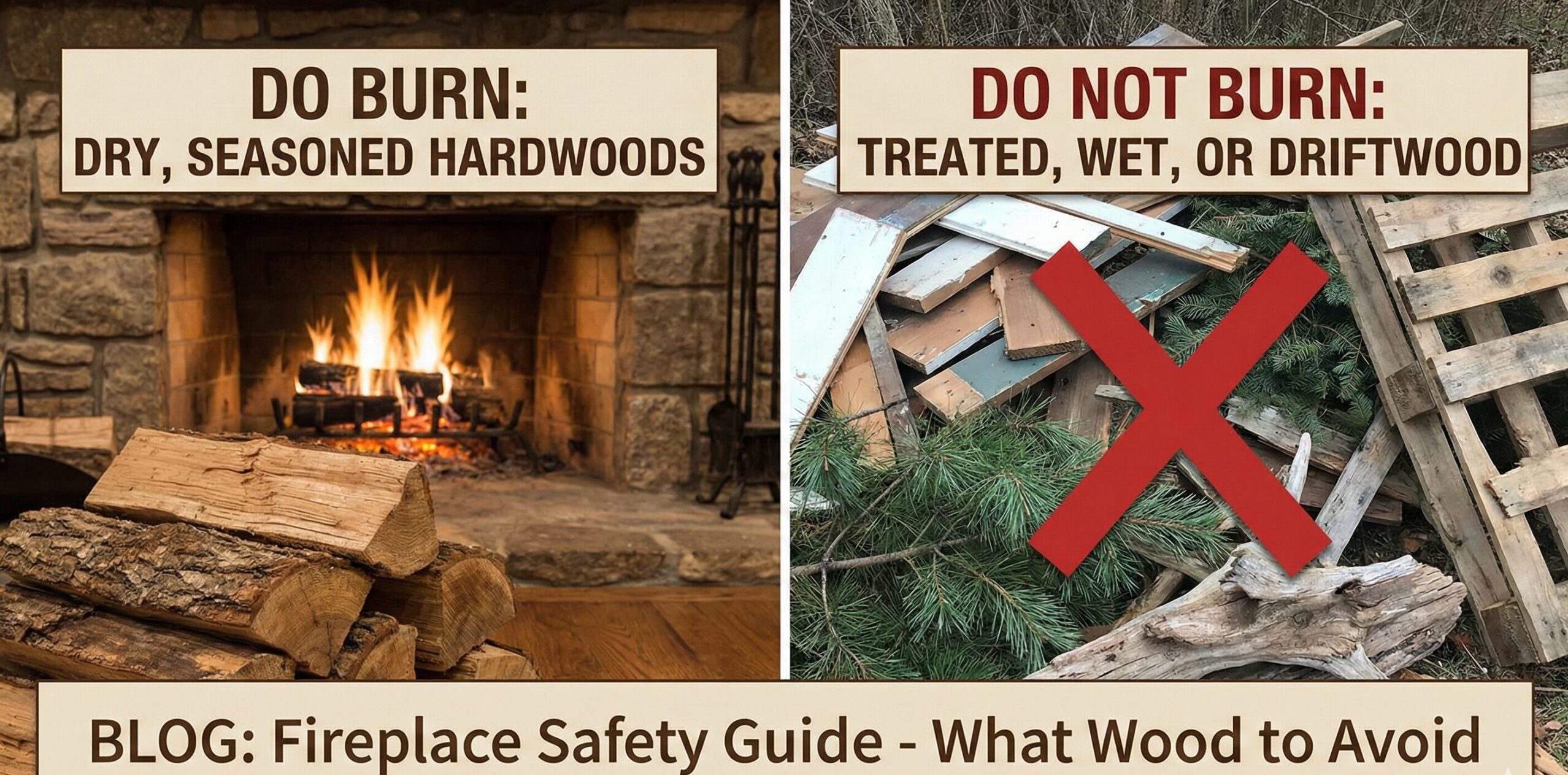
Lumber treated for outdoor use — decking, fence posts, playground equipment — is infused with preservative chemicals. Older treatments used chromated copper arsenate (CCA), which releases arsenic when burned. Newer treatments use alkaline copper quaternary (ACQ), which is less toxic but still dangerous. Burning either type releases heavy metal fumes into your home and the surrounding neighborhood. Ash from this wood is classified as hazardous waste and should not go near a garden. Look for a green or brown tint and a slightly oily texture as warning signs.
Old paint may contain lead, especially in homes built before 1978. Varnish, lacquer, polyurethane, and stains release volatile organic compounds (VOCs), benzene, and toluene when they combust. These gases do not fully combust in a normal fireplace fire, meaning they enter your living space. If you are remodeling, place old trim and painted wood directly into a dumpster. Never burn it. Even a thin coat of paint on an otherwise dry piece of hardwood makes it a hazardous fuel.
Wood found on the beach is saturated with sodium chloride (salt). When burned, the salt converts to hydrochloric acid gases, which aggressively corrode metal dampers, flue liners, and fireplace inserts. Beyond equipment damage, burning driftwood releases dioxins — classified carcinogens — at significantly higher concentrations than land wood. Ocean driftwood poses a greater risk than freshwater driftwood due to higher salinity, but both should be avoided in enclosed fireplaces. See our guide on fixing leaky chimneys if prior driftwood burning has caused damage.
These engineered wood products are held together with urea-formaldehyde or phenol-formaldehyde resin adhesives. Burning them releases formaldehyde, which is a known human carcinogen, as well as acrolein and other respiratory irritants. Particle board (often used in furniture, cabinetry, and cheap flooring) is especially dense with adhesives. OSB (oriented strand board) used in construction carries similar risks. Dispose of these at a proper waste facility — never in your firebox.
While a tightly-twisted newspaper sheet can help start a fire, burning large amounts of paper or cardboard is genuinely dangerous. These materials produce lightweight, combustible embers that float while still hot. If they travel up the flue and exit the chimney cap, they can land on your roof or in nearby dry vegetation. Pizza boxes are especially problematic — they contain grease residue, which smokes excessively and attracts wildlife including raccoons. Use newspaper sparingly as a fire starter, nothing more.
Burning plastics — whether packaging, bags, foam insulation, or synthetic fabrics — produces some of the most toxic combustion products known, including polycyclic aromatic hydrocarbons (PAHs), dioxins, and furans. Styrofoam (expanded polystyrene) produces black sooty smoke packed with styrene monomer, a possible carcinogen. Beyond health risks, plastic burning coats the interior of your chimney with a sticky, extremely flammable residue. This residue is far harder to remove than standard creosote and significantly elevates chimney fire risk.
What About Pallets?
Wood pallets are a common temptation because they are free, plentiful, and seem like “just wood.” The reality is more complicated. Pallets fall into three categories based on their treatment markings, which are stamped on the wood:
- HT (Heat Treated): Safe to burn if dry. These were treated with heat only to kill insects and fungal pathogens. No chemicals were used.
- MB (Methyl Bromide): Never burn these. Methyl bromide is a toxic fumigant and its combustion products are extremely hazardous. This marking has been phased out internationally but older pallets may still carry it.
- DB (Debarked): Generally safe, though unmarked pallets should always be treated as suspect.
- No Marking: Avoid burning. Unknown treatment history means unknown chemical content.
Additionally, many pallets have been used to transport industrial chemicals, pesticides, or other hazardous materials. Even if the pallet itself is “HT,” residual contamination from cargo is invisible and potentially toxic when burned.
Christmas Trees: A Seasonal Hazard
Every holiday season, thousands of homeowners attempt to dispose of their Christmas trees by burning them in the fireplace. This is a significant fire hazard. A typical cut Christmas tree has been in the home for several weeks but still retains enough resin and moisture in its needles to combust rapidly and unpredictably. The fine, dry needles act as tinder and can produce a flash-fire effect in the firebox, potentially igniting the surrounding surround, mantel, and nearby decorations in seconds. Dispose of your tree through municipal pickup, composting, or chipping programs instead.
☠ Dangerous Plants & Poison Wood Species
This is one of the most underrepresented topics in fireplace safety guides, yet it is critically important — especially for homeowners who gather firewood from their own land. Some plants produce smoke that is actively dangerous to breathe, and in some cases, a single prolonged exposure can cause hospitalization.
All three plants contain urushiol, the compound responsible for contact dermatitis. When burned, urushiol becomes aerosolized and enters the respiratory tract. Inhalation of urushiol smoke causes severe bronchial inflammation, throat swelling, and in extreme cases, anaphylaxis requiring emergency medical intervention. This is not merely uncomfortable — it can be life-threatening. Even dead, seemingly dried-out poison ivy vines retain urushiol for years.
Oleander (Nerium oleander) is a common ornamental shrub in warm climates. Every part of the plant contains cardiac glycosides (oleandrin and neriine) — potent toxins that affect the heart. Burning oleander wood or branches and inhaling the smoke has caused documented fatalities. Do not burn any part of this plant. Even using its branches as skewers for campfire cooking has caused severe poisoning.
These ornamental plants produce smoke rich in grayanotoxins and taxine alkaloids. Burning yew in an enclosed space like a living room creates a smoky environment that can cause dizziness, nausea, and cardiovascular symptoms. Rhododendron and azalea smoke has similar effects due to grayanotoxin. While yew wood can technically be used for outdoor bonfires in a well-ventilated area, it should never be burned in an indoor fireplace.
In Florida and other warm coastal states, Brazilian peppertree (Schinus terebinthifolia) and poisonwood (Metopium toxiferum) are common landscape and wild plants. Both are related to poison ivy and produce urushiol-related compounds. Burning either species produces irritating smoke that causes respiratory distress and skin reactions. Poisonwood is particularly aggressive — its sap causes blistering on contact, and the smoke is correspondingly harsh.
How to Identify Potentially Toxic Wood Before Burning
If you collect firewood from your own land or from wooded areas, visual identification is your primary defense. Key warning signs include:
- Milky or colored sap when bark is cut (can indicate toxic compounds)
- Distinctive berry clusters or fruit remnants near the wood pile (oleander, holly)
- Leaflets of three on vines wrapped around logs (poison ivy: “leaves of three, let it be”)
- White or grayish waxy bark (poison sumac)
- Strong, unusual odor when the bark is scratched
- Visible blistering or rash on your hands after handling
When collecting downed wood in forested areas, be especially careful with mixed wood piles. A single log of poison oak mixed with a cord of oak firewood can contaminate the entire batch. Always wear gloves when handling unknown wood species.
💧 The Danger of Green (Wet) Wood
The most common mistake homeowners make is burning “green” wood — wood that has been freshly cut and hasn’t had time to dry (season). It looks like perfectly good firewood. It smells like wood. But inside, it is loaded with moisture that makes it nearly as dangerous as some of the chemically treated options above.
Fresh wood can contain up to 50% water by weight. When you throw this on a fire, the majority of the fire’s energy is wasted boiling off that moisture instead of heating your room. This produces a cool, smoldering fire that generates dense, particulate-heavy smoke. That smoke condenses inside your cooler-than-normal flue as creosote — the dark, tar-like substance responsible for nearly all chimney fires.
How to Tell If Wood Is Green
You do not always need a moisture meter to detect green wood. Several physical characteristics give it away:
Signs of Green (Wet) Wood
- Bark is tight and hard to peel
- Wood feels heavy for its size
- Cut ends show moisture when pressed
- Logs do not produce a sharp crack when struck together
- Sap may be visible at cut surfaces
- Light, pale color at the cut end with no checking (cracks)
Signs of Properly Seasoned Wood
- Bark is loose or pulls away easily
- Wood is noticeably lighter than freshly cut pieces
- Cut ends are grayish with visible radial cracking (checks)
- Produces a sharp, resonant “clunk” when two pieces are struck together
- No visible sap; dry to the touch
- Splits easily and cleanly with an axe
Creosote Buildup from Wet Wood: The Numbers
The relationship between wood moisture and creosote is not linear — it is exponential at higher moisture levels. A fire burning wood at 30% moisture content produces roughly twice the creosote of a fire burning wood at 20%. Wood at 40% moisture can produce four to five times more creosote. This is why a single burning season with green wood can create enough third-degree creosote (a thick, tar-like glaze) to require a professional chemical treatment rather than a standard brush sweep.
If you have burned wet wood recently, you need to assess the damage. Read our detailed guide on what to burn to clean a chimney for the next steps.
🦔 Rotten, Moldy & Fungus-Infected Wood
Rotten and moldy wood are often overlooked in safety discussions because they seem like a minor quality issue rather than a safety hazard. In reality, both present genuine risks that go beyond simply getting a poor fire.
Why Rotten Wood Is a Problem
Wood rots when moisture enables fungal decomposition to break down the wood’s cellular structure. This process — called wood decay or wood rot — dramatically reduces the wood’s density. Since heat output when burning wood is directly proportional to its density and dry weight, rotten wood produces far less BTU output than solid seasoned wood of the same species. You burn more wood, generate more smoke, produce more ash, and get substantially less heat.
Beyond the efficiency issue, rotten wood almost always has elevated moisture content due to the conditions that caused the decay. This means it carries the same creosote risks as green wood. A log that appears dry on the outside but has internal rot may have core moisture levels exceeding 40%.
Mold on Firewood: A Real Health Concern
Mold spores are present on virtually all outdoor wood. When conditions are right — moisture, warmth, organic material — those spores colonize the wood surface and begin producing visible mold patches. Common colors include green, black, white, and orange, depending on the mold species.
When moldy wood is burned in an enclosed living space, the heat volatilizes mycotoxins — compounds produced by certain mold species — and drives mold spores into the room before combustion fully destroys them. For individuals with mold sensitivities, asthma, or compromised immune systems, this can trigger serious respiratory episodes. Even healthy individuals may experience throat irritation, coughing, and headaches from prolonged exposure to mold smoke.
Insect-Infested Wood
Wood that has been tunneled by wood-boring beetles, carpenter ants, or termites is structurally compromised in similar ways to rotten wood — it burns poorly and produces excess smoke and ash. Beyond the fire quality issue, bringing infested wood inside your home (even briefly before burning) risks establishing a colony indoors. Always inspect firewood for signs of active infestation: small circular exit holes, fine sawdust (frass) beneath the stack, visible insects, or a hollow sound when tapped. Heavily infested wood should be removed from the property, not burned indoors.
🌳 Softwoods: Handle with Caution
Trees like Pine, Fir, Spruce, Cedar, and Larch are softwoods. They are not inherently “toxic,” but they are problematic as primary fuel sources because of their high resin (sap) content. Understanding the difference between softwoods and hardwoods is fundamental to safe fireplace use.
The Science Behind Softwood Problems
Softwood trees — all conifers — produce resin as a natural defense mechanism against insects and pathogens. This resin is stored in specialized resin canals throughout the wood tissue. When the wood burns, that resin vaporizes and partially combusts. The incompletely burned resin compounds condense on cool flue surfaces as a particularly problematic form of creosote that is sticky, difficult to remove, and highly flammable.
Additionally, softwoods are less dense than comparable hardwoods, meaning they contain less fuel mass per unit volume. They burn faster, produce shorter-duration fires, and require constant reloading to maintain a consistent heat output. This means more fires, more smoke, and more frequent creosote accumulation.
Can You Burn Softwood at All?
In many parts of the world — particularly the Pacific Northwest, Scandinavia, and mountainous regions — softwood is the predominant available species. Homeowners in these areas burn it successfully with proper technique:
- Season it thoroughly: Softwood needs at least 12 months of seasoning to reduce resin mobility and moisture content to acceptable levels.
- Burn it hot: A slow, smoldering softwood fire maximizes creosote. Keep the damper fully open and maintain a vigorous, hot fire when burning conifer species.
- Mix with hardwood: Using softwood as kindling and transitioning to dense hardwood as the fire establishes is the safest approach.
- Sweep more frequently: If softwood is part of your regular fuel, plan for chimney inspections and sweeps twice per season rather than once.
For a sustained, efficient fire with minimal maintenance, always opt for dense hardwoods like Oak, Maple, or Hickory. Compare the heating values in our wood stove vs fireplace heating analysis.
🔥 Best Hardwoods to Burn: Species-by-Species Guide
Knowing what not to burn is only half the equation. Understanding the best firewood species allows you to optimize your fires for heat, burn duration, and minimal chimney impact. Not all hardwoods are created equal — density, BTU output, ease of splitting, and fragrance vary considerably by species.
| Species | BTU Rating | Ease of Splitting | Seasoning Time | Special Notes |
|---|---|---|---|---|
| Oak (White) | Very High | Moderate | 18–24 months | Dense, long-burning, excellent heat retention |
| Hickory | Very High | Moderate–Hard | 12–18 months | Hottest burning common species; great for cold nights |
| Ash | High | Easy | 6–12 months | Burns well even slightly green; very easy to split |
| Maple (Hard) | High | Moderate | 12–18 months | Clean burn, subtle sweet fragrance |
| Beech | High | Moderate | 12–18 months | Excellent heat; must be fully seasoned |
| Cherry | Medium–High | Easy | 12 months | Pleasant fragrance; popular for ambiance fires |
| Birch | Medium | Easy | 6–12 months | Burns faster than oak; appealing scent; good kindling |
| Apple / Fruitwood | Medium–High | Easy–Moderate | 12 months | Excellent fragrance; slow, steady burn |
| Elm | Medium | Very Hard | 18–24 months | Interlocked grain makes splitting difficult; needs long seasoning |
| Pine (Seasoned) | Medium | Easy | 12+ months | Use as kindling only; high creosote risk as primary fuel |
| Cedar | Medium–Low | Easy | 12 months | Fragrant, lots of sparks; use with screen; kindling only |
| Willow / Alder | Low | Easy | 12 months | High moisture, low density; poor heat output; not recommended |
| Chestnut | Low–Medium | Easy | 12 months | Excessive smoke and spitting; avoid in open fireplaces |
Buying Firewood: What to Look For
When purchasing firewood rather than cutting your own, follow these guidelines to ensure you receive quality, genuinely seasoned wood:
- Ask for species by name. A reputable seller should be able to tell you exactly what species they are selling. “Hardwood mix” from an unknown supplier is a gamble — it may include elm, willow, or other poorly burning species mixed with premium oak.
- Test moisture before buying large quantities. If possible, bring a moisture meter when purchasing. A reading above 25% on delivered wood means it needs additional seasoning time before burning.
- Buy local firewood. The USDA recommends purchasing firewood within the area where you plan to burn it. Moving wood across county or state lines risks transporting destructive invasive insects, which we cover in detail in Section 8.
- Inspect the wood pile. Look for visible checking (radial cracks) at the log ends, loose bark, and a grayish color rather than fresh white or cream tones at the cut face. Heavy logs with no visible checks are likely still green.
- Avoid suspiciously cheap wood. Properly seasoned, quality hardwood has real value. Extremely cheap “firewood” may be unseasoned green wood, low-BTU species, or wood from unknown treated sources.
🧪 The Science of Creosote Formation
Creosote is not a single substance — it is a complex mixture of organic compounds formed during incomplete wood combustion. Understanding how it forms helps you make smarter decisions about what you burn and how you burn it.
The Three Degrees of Creosote
Chimney professionals classify creosote into three degrees, each progressively more dangerous and difficult to remove:
Light, dry, flaky deposits that resemble soot or ash. Easily removed with a standard chimney brush during annual sweeping. Common when burning well-seasoned hardwood with adequate draft. This is the “acceptable” level if kept thin.
A harder, shiniercoating that adheres to the flue liner. Looks like dried tar or black paint. Often forms when softwood or slightly wet wood is burned, or when the fire is frequently smoldered down. Requires professional-grade rotary tools or chemical treatments to remove.
The most dangerous form. A thick, rock-hard glaze or dripping tar that coats the flue heavily. Extremely high ignition risk — a single chimney fire can reach 2,000°F within this material. May require complete flue liner replacement. Chemical treatments are only partially effective. Immediate professional attention is critical.
What Causes Each Degree to Form
First-degree creosote forms under all wood-burning conditions to some extent. The transition to second and third-degree deposits is driven by specific factors:
- Low flue temperatures: When the chimney runs cool (from short fires, an undersized fireplace, or cold exterior temperatures), smoke condenses before it exits. The optimal flue gas temperature to prevent condensation is above 250°F.
- Oversized flue: A flue that is too large for the fireplace insert moves gases slowly, allowing more condensation time.
- Wet wood: Produces cooler, smoke-denser combustion gases.
- Restricted air supply: Closing the damper too much produces a smoldering, oxygen-starved fire that volatilizes more unburned hydrocarbons into the flue.
- Resinous softwood: Pine, fir, and spruce resin produces particularly sticky, high-adhesion creosote deposits.
🍎 Invasive Pests & the Risks of Moving Firewood
This topic is often completely absent from fireplace safety guides, yet it has caused billions of dollars in forestry damage and is considered one of the greatest threats to North American forests. Moving firewood from one location to another is the primary way destructive invasive insects spread to new regions.
The Most Dangerous Hitchhikers
Several invasive forest pests have devastated tree populations across North America, and virtually all of them spread primarily through infested firewood transport:
- Emerald Ash Borer (EAB): An Asian beetle that has killed hundreds of millions of ash trees across 35+ states. EAB larvae bore beneath the bark and disrupt nutrient transport, killing the tree in 2–4 years. Moving ash firewood out of quarantine zones is federally illegal in many states.
- Spotted Lanternfly: An invasive planthopper from Asia that attacks over 70 plant species including grapes, apples, and hardwood trees. Egg masses are laid on flat surfaces — including firewood logs — and are essentially invisible to the untrained eye.
- Asian Longhorned Beetle: Bores into the heartwood of maple, birch, elm, ash, and other hardwoods. The larvae can complete an entire lifecycle inside firewood that is moved to a new location before being burned.
- Spongy Moth (formerly Gypsy Moth): A defoliating caterpillar that can strip entire forests bare. Egg masses, laid in clusters on bark, survive transport on firewood.
Signs of Infested Firewood
When inspecting firewood before purchase or burning, look for:
- D-shaped or circular exit holes in the bark or wood surface
- Winding galleries or tunnels just beneath the bark
- Fine sawdust-like frass at the base of the wood pile or in bark crevices
- Unusual bark discoloration, weeping sap, or “blonding” (patches of freshly exposed wood)
- Egg masses — look for putty-colored, spongy masses (spongy moth) or tan, seed-like deposits in bark crevices (spotted lanternfly)
If you suspect invasive insects in your firewood, contact your state’s Department of Agriculture or forestry service. Do not attempt to move the wood further or burn it in the open.
🔍 How to Identify Safe Firewood
If you gather firewood from your own property or from wooded areas (where legally permitted), wood identification is a crucial skill. Burning the wrong species is not just an efficiency issue — as the poison wood section demonstrates, some species pose real health risks. Here are the primary identification methods available to homeowners.
Bark Identification
Bark texture, color, and pattern are the most reliable field identifiers for most common tree species:
Deep, rough, gray-brown bark with wide ridges and furrows. White oak has lighter bark; red oak has darker bark with shiny inner ridges at the top of the tree.
Diamond-shaped ridges forming an interlocking pattern. Gray-brown. Mature ash has very distinctive criss-cross pattern that looks almost woven.
Shaggy, plated bark that appears to peel away from the tree in long strips. Older trees have tight, interlocking ridges. Very distinctive appearance.
Brilliant white, papery bark that peels in horizontal strips. Very easy to identify. Burns well as kindling; too fast-burning for primary fuel.
Smooth gray bark on stems. Compound leaves with 7–13 leaflets. White berries in drooping clusters. Often found in wet, swampy areas.
Smooth gray-green bark on shrub-like stems. Long, narrow, dark green leathery leaves. Showy flowers in white, pink, or red. Common in warm climates as a hedge.
Using Wood Identification Apps
Modern plant identification apps (such as iNaturalist, LeafSnap, or PictureThis) can identify trees from photographs of bark, leaves, or fruit with reasonable accuracy. While not 100% reliable, they are a valuable supplemental tool when you are uncertain about a species. Take photos of bark, any attached leaves, fruit, or nuts, and surrounding context. For firewood that has already been cut and stacked, look for attached twigs with leaves if possible — bark alone can be difficult for apps to identify accurately.
When to Call an Expert
If you have a large quantity of wood from an unknown source and cannot confidently identify the species, consulting with a local arborist, forestry service, or agricultural extension office is worth the effort. This is especially important if you live in an area with large populations of poison ivy, oleander, or other toxic species, or if the wood came from a property that has not been managed.
☀️ How to Season Firewood Properly
Seasoning is the process of drying freshly cut wood to reduce its moisture content to the safe burning threshold of 20% or below. It is the single most impactful thing a homeowner can do to improve fire quality, reduce creosote, and extend the life of their chimney system. Done correctly, it is simple and costs nothing beyond time and storage space.
Step-by-Step Seasoning Process
- Cut and split in early spring. Wood cut in winter or early spring benefits from the full warm season to dry. Splitting logs exposes the inner wood to air and dramatically accelerates moisture loss compared to leaving rounds whole. Split to your final burning size immediately after cutting.
- Stack off the ground. Use a firewood rack, pallets, or pressure-treated rails to keep the wood at least 4–6 inches off the ground. Ground contact traps moisture and promotes mold, rot, and insect infestation. Face the cut ends outward to maximize airflow to the drying surfaces.
- Choose a sunny, windy location. Direct sun and wind are the primary seasoning agents. Stacking in a sheltered, shaded area significantly slows drying. Ideally, orient your wood stack so the prevailing wind blows through it, not against it.
- Cover the top only. Use a tarp, metal roofing panel, or purpose-built firewood cover over the top of the stack to shed rain and snow. Never wrap the entire stack in plastic — this traps moisture against the wood and causes mold. The sides must remain open and exposed to airflow.
- Allow adequate time. Minimum seasoning times vary by species: softwoods need 6–12 months; most hardwoods need 12–18 months; dense species like oak, hickory, and beech may need 18–24 months. Check with a moisture meter before committing to burning.
- Bring inside shortly before use. Store your burning supply indoors (a dedicated log store, garage, or covered area near the door) for a week before use. This eliminates surface moisture from rain or snow and brings the wood to indoor temperature, improving ignition.
🔥 Wood Stove vs. Fireplace: Do the Rules Differ?
The short answer is: the rules about what not to burn are the same. Toxic woods are toxic regardless of the appliance. Wet wood causes creosote in both systems. Treated lumber produces poisonous gases whether combusted in a stove or an open fireplace.
However, there are important operational differences that affect how each system performs with marginal fuels like softwood or slightly damp wood:
Open Fireplace
- Lower combustion efficiency (10–15% typical)
- Large firebox with open front dilutes combustion air
- Higher draft means smoke exits faster but flue runs cooler
- More forgiving of small amounts of softwood if burned hot
- Easier to add and adjust fuel
- Creosote tends to form lower in the flue due to faster temperature drop
Wood Stove / Insert
- Much higher combustion efficiency (60–80% typical)
- Controlled air supply via adjustable vents
- Higher sustained firebox temperatures
- EPA-certified models have catalytic combustors or secondary burn chambers
- More sensitive to fuel quality — wet wood significantly reduces efficiency
- Produces less creosote with correct fuel due to hotter, cleaner burn
Modern EPA-certified wood stoves are significantly better for air quality and chimney health than traditional open fireplaces, primarily because their controlled combustion environment achieves more complete combustion. However, this also means they are more sensitive to fuel choice — a batch of green wood that merely smolders in an open fireplace can actually cause a stove to run in an overly cool, dirty mode for extended periods, building up creosote faster than an equivalent open fire might. Read our full analysis in the wood stove vs fireplace heating comparison guide.
🌿 Environmental Regulations & Burning Bans
What you burn is not only a personal safety matter — it is increasingly a legal and environmental compliance issue. Many regions across the United States, United Kingdom, Europe, and Australia have enacted regulations governing what can be burned in residential wood-burning appliances, and violations can result in significant fines.
Spare the Air and Burn Bans
In areas with known air quality challenges — California’s Bay Area and Central Valley, the Pacific Northwest, Denver, and many eastern US metro areas — air quality management districts issue “Spare the Air” advisories or “burn bans” on days when atmospheric conditions trap particulate pollution near ground level. On these days, burning wood in residential fireplaces is either strongly discouraged or outright prohibited, regardless of the fuel type. Violations can result in fines ranging from $100 to $1,000 in some jurisdictions.
UK Smoke Control Areas
In the United Kingdom, the Clean Air Act and subsequent legislation designates “Smoke Control Areas” in urban and suburban regions. In these areas, only “Defra-approved” smokeless fuels or “Defra-exempted” wood-burning appliances (which meet strict emissions standards) may be used. Burning wet or unseasoned wood in a smoke control area carries fines up to £300 under UK law. The UK also introduced “Ready to Burn” accreditation for seasoned firewood — look for this certification when purchasing wood in Britain.
EPA New Source Performance Standards (NSPS)
In the United States, the EPA’s New Source Performance Standards (Step 2 standards, effective May 2020) set strict particulate matter emission limits for new wood heaters sold at retail. Many older, non-certified stoves are being phased out of use through voluntary and mandatory replacement programs. While these standards govern appliance efficiency rather than fuel choice directly, they reflect the regulatory trend toward cleaner burning — which depends fundamentally on burning dry, quality hardwood.
Environmental Impact of Burning the Wrong Wood
Beyond personal safety, burning wet wood, trash, or treated lumber releases significantly higher levels of fine particulate matter (PM2.5), carbon monoxide, polycyclic aromatic hydrocarbons (PAHs), and other air toxics than burning dry, seasoned hardwood. PM2.5 particles are small enough to penetrate deep into lung tissue and are associated with cardiovascular disease, respiratory disease, and premature mortality. Choosing the right firewood is genuinely a neighborhood air quality issue, not only a personal health choice.
🔧 Consequences of Bad Wood & Essential Maintenance
Burning the wrong materials leads to rapid deterioration of your entire chimney system. The corrosive and thermal effects can damage mortar joints, crack flue tiles, warp metal liners, and compromise the structural integrity of the chimney stack itself. The corrosive effects can damage the mortar joints, requiring the best mortar for chimney repair to fix.
If you have burned wet wood, softwood as a primary fuel, or any of the toxic materials listed above, here is your maintenance action plan:
1. Check Your Cap
Soot and tar buildup often begins at the spark arrestor screen of the chimney cap. This buildup can restrict the draft, causing smoke to back-draft into your living space, and creates a concentrated ignition point for embers. Ensure you have the best chimney caps for rain installed, and inspect the screen seasonally for clogging.
2. Schedule a Professional Sweep
How often should you clean a chimney? The standard recommendation is annually, but if you have been burning pine, wet wood, or burning heavily (more than three fires per week), you may need sweeping twice per season. You can arrange this through the best chimney services, or if you are handy and have a stage 1 (flaky) deposit, pick up the best chimney brush for stainless steel liners and tackle it yourself. Stage 2 and stage 3 creosote always require a professional.
3. Inspect for Structural Damage
Excessive heat from chemical fires or chimney fires can warp flashing, crack masonry, and fracture terracotta flue tiles. Check if you need chimney flashing sealant or if you need to waterproof your chimney brickwork to prevent moisture infiltration that worsens over freeze-thaw cycles.
4. Consider a Camera Inspection
A Level 2 chimney inspection, which involves passing a video camera through the full length of the flue, is the only way to assess damage to the flue liner interior that cannot be seen from above or below. If you have had a chimney fire — even a small one you may not have noticed — a Level 2 inspection is considered the minimum response by the National Fire Protection Association (NFPA 211). Signs of a minor chimney fire include: cracked or collapsed flue tiles visible from the firebox, a strong smoky odor that lingers in the home, excessive amounts of flaky black creosote in the firebox, or a puffy texture to chimney mortar.
🔧 Essential Tools for Safe Burning
To ensure you are only burning safe, dry wood, these tools are indispensable for any serious homeowner. Each solves a specific problem in the fuel quality chain — from buying wood to maintaining the ashes safely.
1. Digital Wood Moisture Meter
The only reliable way to know if your wood is “green” or “seasoned.” Insert the pins into the cut end of a split log for the most accurate reading. Aim for below 20%. Takes the guesswork — and the risk — out of fuel selection entirely. A moisture meter pays for itself in reduced sweeping costs within a single season.
Check Price on AmazonMove your seasoned wood from the shed to the hearth without the mess. A good log carrier keeps bark, debris, and wood chips off your floors and eliminates multiple trips. Essential for maintaining winter comfort without creating a housekeeping burden.
View on Amazon →
Safe disposal of ash is critical. Fireplace ash retains live embers for up to 72 hours after a fire goes out. Never put hot ash in plastic bags, cardboard boxes, or combustible containers. A metal ash bucket with a tight-fitting lid is the safe standard.
View on Amazon →
Using the right tools pairs perfectly with the best chimney starters to get your fire going cleanly without needing dangerous accelerants like lighter fluid, which can cause sudden flare-ups in enclosed fireboxes. A proper fire starting routine — newspaper, kindling, small hardwood, then full logs — eliminates the need for any liquid accelerant entirely.
Additional Safety Equipment Worth Having
Beyond tools specific to firewood quality, every home with a wood-burning fireplace or stove should have:
- Carbon monoxide detector: Placed within 15 feet of the fireplace. CO is odorless and colorless — it cannot be detected without a sensor. Back-drafting from a blocked or poorly drawing chimney can produce life-threatening CO concentrations indoors.
- Smoke detector: Ensure the detector in your main living area is working. Test monthly.
- Fireplace screen: Prevents sparks and embers from reaching carpets, furniture, and flooring. Particularly important when burning softwood, which pops and spits more than hardwood.
- Fire extinguisher: A 5-lb ABC dry chemical extinguisher should be within reach of any room with a fireplace. Know how to use it before you need it.
- Fireplace gloves: Heat-resistant gloves for loading logs, adjusting the grate, and operating the damper handle without burns.
❓ Frequently Asked Questions
Can I burn cardboard or pizza boxes?
It is not recommended. Cardboard burns very fast and the ashes are light, often floating up the chimney while still hot. Pizza boxes also contain grease and food residue which create unpleasant odors, produce dark smoke, and attract pests. Grease residue can also contribute to sticky chimney deposits. Use newspaper sparingly as a fire starter — one or two sheets only — and avoid cardboard entirely.
Is it okay to burn wood with nails in it?
Small nails in pallet wood generally do not meaningfully affect the fire itself — the metal simply remains in the ash. However, sharp nails in the ash bed can damage your ash vacuum or injure you during cleanout. More importantly, the presence of nails often indicates construction lumber, which may be pressure-treated or painted. Avoid wood with nails unless you are certain it is untreated.
Does a gas fireplace need the same maintenance?
Gas units are cleaner burning but still require periodic inspection of the burner assembly, pilot system, and venting. Flue blockages from bird nests or debris affect gas appliances as seriously as wood-burning ones — carbon monoxide buildup from a blocked gas flue is a genuine danger. See our guide: Does a gas fireplace need a chimney?
What if I have a chimney fire?
If you suspect a chimney fire — indicated by a roaring or rushing sound, extremely hot walls, orange flames at the chimney cap, or heavy dark smoke entering the room — evacuate the building immediately and call 911. Do not attempt to fight a chimney fire yourself. Once safe, read our emergency guide on how to put out a chimney fire for the full protocol and post-fire inspection requirements.
How do I know if my wood is seasoned enough without a moisture meter?
Look for these physical signs: ends show radial cracking (checks); bark is loose or peels easily; wood is noticeably lighter than fresh-cut wood; two pieces produce a sharp “clunk” (not a dull thud) when struck together; the cut surface is grayish rather than white or creamy. These tests are less reliable than a meter but a useful field guide. When in doubt, wait another month and recheck.
Is it safe to burn eucalyptus in a fireplace?
Eucalyptus is a hot-burning hardwood, but it presents specific challenges. It has very high oil content that causes it to pop and spit significantly — always use a fireplace screen. It also seasons slowly (18–24 months) and produces a distinctive, aromatic smoke that some find pleasant but others find overwhelming in an enclosed space. Eucalyptus wood with attached bark burns particularly spitty. Fully seasoned, screened eucalyptus is usable but is not an ideal primary fireplace wood.
Can I burn bamboo in a fireplace?
Bamboo is technically a grass, not a wood, but it shares some characteristics with softwood: it is hollow, burns very hot initially, pops loudly (always use a screen), and burns out quickly. Dry bamboo can be used as kindling but is a poor primary fuel. Its hollow structure also causes significant popping and potential sparking. In some regions, bamboo is invasive and cutting it for firewood is a secondary benefit — but always season it fully and use it sparingly.
What wood produces the least smoke?
Fully seasoned, dense hardwoods produce the least visible smoke when burned with adequate airflow. In descending order of clean burning: ash, oak, hickory, and maple are the top performers. Birch produces moderate smoke. The most important factor is moisture content — even the best hardwood produces excessive smoke at 30%+ moisture. A moisture reading below 20% combined with a robust, hot fire with adequate damper opening produces the cleanest burn possible from any species.
Is burning wood bad for the environment?
Wood burning is considered “carbon neutral” in the sense that the CO₂ released was recently sequestered from the atmosphere by the tree during its growth — unlike fossil fuels, which release ancient carbon. However, wood combustion does produce fine particulate matter (PM2.5), carbon monoxide, and other air pollutants that have direct health impacts, especially in areas with poor ventilation or calm atmospheric conditions. Burning dry, seasoned hardwood in a modern EPA-certified appliance produces the minimum possible emissions. Burning wet wood or trash dramatically increases pollution levels.
How much wood should I store for winter?
A general estimate for a home burning wood as a primary heat source is 3–5 cords per winter in a cold climate (below freezing regularly). For supplemental use (2–4 fires per week), 1–2 cords is typically sufficient. One cord is a stacked pile 4 feet high × 4 feet wide × 8 feet long (128 cubic feet). Always calculate based on your specific usage patterns and store at least 10–20% more than you think you will need to account for colder-than-average periods.