Fireplace vs Insert: Heat Output, Efficiency & Cost
By Chimney Insight Editorial Team
Posted on November 24, 2025
Disclosure: This page contains affiliate links. We may earn a commission from qualifying purchases at no extra cost to you. As an Amazon Associate I earn from qualifying purchases.
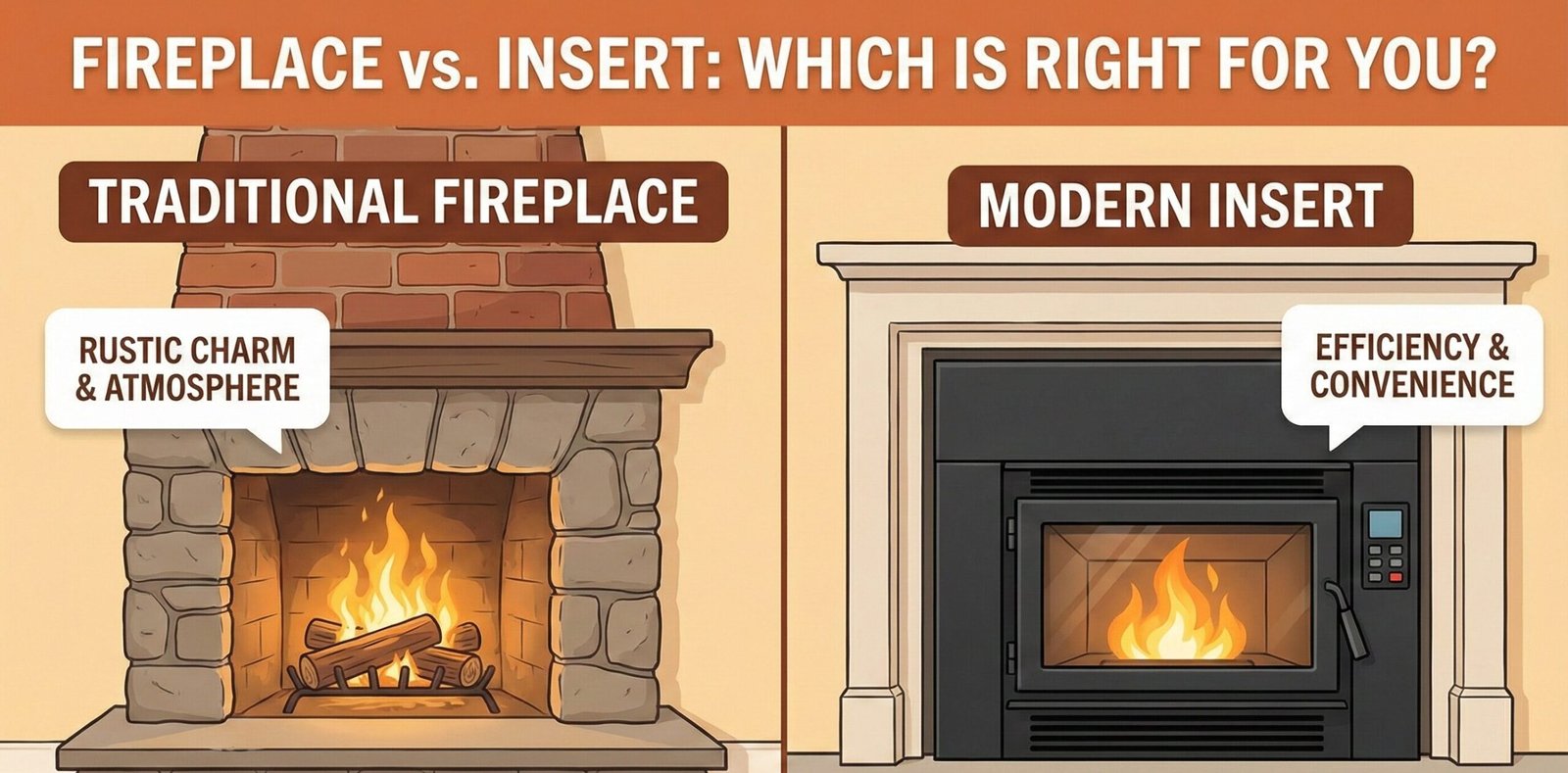
The crackle of a fire against a cold night is one of the most primal pleasures of home ownership. But when the question shifts from ambiance to actual heating, from aesthetics to energy bills, from tradition to modern performance — the choice between a traditional fireplace and a high-efficiency fireplace insert becomes one of the most impactful decisions a homeowner can make.
This guide goes well beyond the surface comparison. We cover the engineering physics of heat loss, every insert fuel type in depth, the installation process and liner requirements, the detailed cost-benefit analysis including ROI timelines, environmental and air quality regulations, the pellet stove alternative, resale value impact, and the complete maintenance protocols for both systems. By the end, you will have everything you need to make the right call for your specific home.
5–10%
Efficiency of a traditional open fireplace
80%+
Efficiency of modern high-efficiency inserts
$2K–$6K
Typical insert installation cost range
3–7 yrs
Typical ROI timeline for insert upgrade
1. The Traditional Fireplace: An Ambiance Champion with Efficiency Flaws
A traditional masonry fireplace, built directly into the home’s structure, is the quintessential icon of domestic warmth. Its design is centuries old, simple in concept, and genuinely beautiful. But simplicity of design does not translate to simplicity of performance — and understanding the thermodynamics of an open hearth reveals why its efficiency numbers are so dismal.
1.1 What Is a Traditional Fireplace?
The core components are: the firebox (the brick-lined combustion chamber), the throat (the narrow opening above the firebox), the smoke shelf (which deflects downdrafts), the smoke chamber (which compresses and accelerates exhaust gases), the flue (the exhaust channel), and the chimney cap. Factory-built (prefabricated) fireplaces follow the same functional architecture but use steel construction rather than masonry.
The traditional fireplace operates primarily through radiant heat — infrared radiation from the burning wood and the heated masonry surfaces directly warms people and objects in front of the fire. It does not circulate heat efficiently. For a deeper look at how draft dynamics affect performance, see our guide on fireplace draft problems.
1.2 The Physics of Heat Loss: Why Efficiency Is So Low
The fundamental flaw of an open-hearth fireplace is thermal — and it is unavoidable without modification. Here is the physics:
- Combustion requires oxygen, which is drawn from the room air through the open firebox face.
- For every cubic foot of hot exhaust gas that exits up the flue, an equal volume of cold outside air must infiltrate the home to replace it — typically through gaps around windows, doors, and other penetrations.
- The net effect: the fireplace is simultaneously warming a small zone in front of it with radiant heat while cooling the rest of the house by driving cold air infiltration and expelling already-heated room air up the flue.
- Studies show that in a well-insulated modern home, an open fireplace can actually reduce the temperature of rooms not directly in front of the fire while it burns.
The Net Heat Loss Reality
The commonly cited 5–10% efficiency rating for open fireplaces represents heat delivered to the room as a percentage of the fuel’s theoretical energy content. In practice, for homes with forced-air heating systems, the draft created by the fireplace actively competes with the furnace — the fireplace draws the furnace’s heated air out of the house faster than it can replace it. This is why many HVAC professionals advise against using an open fireplace as supplemental heating in a well-sealed modern home.
1.3 Advantages of a Traditional Fireplace
- Unrivaled sensory experience: The visual, auditory, and olfactory experience of a wood fire in an open hearth is genuinely impossible to replicate with any enclosed appliance.
- Architectural authenticity: In historic, traditional, or craftsman-style homes, an original masonry fireplace is an irreplaceable architectural feature with direct property value implications.
- Fuel flexibility: Can burn various wood species without fuel-specific engineering constraints. See our guide on the best firewood for fireplaces for species-by-species performance.
- Lower upfront cost: If an existing structure is in good condition, using a traditional fireplace has no upfront investment — only the cost of wood and ongoing maintenance.
- Emergency heat source: In a power outage, an open fireplace works without electricity. An insert with a blower motor requires power for full heating function (though it still produces some radiant heat without power).
1.4 Disadvantages of a Traditional Fireplace
- Thermal efficiency of 5–10%, often creating a net heat loss for the home
- Produces significantly more particulate emissions and indoor smoke exposure than enclosed appliances
- Open face creates ongoing risk of sparks, rolling embers, and direct fire hazard
- Requires vigilant annual maintenance: creosote removal, mortar inspection, crown inspection, flashing maintenance
- Damper must be manually opened before every fire and closed after every fire — a commonly forgotten step that creates significant ongoing heat loss
- Subject to downdrafts and draft problems more frequently than sealed systems
2. The Fireplace Insert: A High-Efficiency Upgrade
A fireplace insert is a sealed, self-contained heating appliance — essentially a sophisticated stove or firebox — engineered specifically to slide into the existing firebox of a traditional masonry or factory-built fireplace. It is the most common and most cost-effective way to transform an inefficient open-hearth system into a high-performance zone heater without tearing out the existing chimney structure.
2.1 How Inserts Achieve High Efficiency
The efficiency leap from a traditional fireplace to an insert is not incremental — it is transformational. The engineering features that make it possible:
CORE FEATURE
Sealed Combustion Chamber
The ceramic glass door creates an airtight seal when closed, preventing house air from being drawn into the fire uncontrolled. Combustion air is either drawn from outside the house or admitted in precisely controlled quantities through adjustable vents. This eliminates the cold-air infiltration problem entirely.
HEAT DELIVERY
Blower / Convection System
Most inserts include a built-in blower fan that draws cool room air in through vents at the bottom of the unit, circulates it through channels surrounding the hot firebox, and returns hot air to the room through upper vents. This convective distribution of heat is dramatically more effective than radiant-only delivery at warming an entire room or zone.
CLEAN BURN
Secondary / Tertiary Burn
High-end wood inserts use catalytic combustors or secondary combustion chambers to re-ignite and burn the volatile gases and particulates that would otherwise exit as smoke. This maximizes the energy extracted from each log and dramatically reduces particulate emissions — making them cleaner for both indoor air quality and outdoor air quality.
2.2 What a Fireplace Insert Is NOT
Clarity on terminology prevents costly mistakes. A fireplace insert is not:
- A fireplace surround or facing (purely decorative; does not affect combustion)
- A fireplace screen (a mesh or glass guard, not a heating appliance)
- A freestanding wood stove (similar technology but installed independently, not within an existing firebox)
- A zero-clearance fireplace (a factory-built fireplace installed in new construction; an insert is a retrofit into an existing firebox)
3. All Insert Fuel Types: A Complete Comparison
The fuel type is the most consequential variable in insert selection — it determines installation complexity, operating cost, maintenance burden, heat output capacity, and aesthetic character. There are four primary categories.
A. Wood Burning Inserts
Wood inserts are the closest aesthetic match to a traditional fireplace, retaining the real wood crackle and visible flame while dramatically improving efficiency. Modern EPA-certified wood inserts use catalytic or non-catalytic secondary burn technology to achieve 70%+ efficiency ratings and drastically reduced particulate output.
Advantages
- Most authentic fire experience of any insert type
- Fuel (firewood) is locally sourceable and relatively affordable
- Functions during power outages (with reduced heat output without blower)
- High BTU output — capable of heating large spaces
- EPA-certified models dramatically reduce emissions vs. open fireplace
Disadvantages
- Requires stocking, hauling, and storing seasoned firewood
- Needs constant tending — cannot be set and forgotten
- Still produces creosote, requiring annual chimney cleaning
- Not viable if local ordinances restrict wood burning
- Startup and shutdown times reduce convenience
EPA-Certified Wood Fireplace Insert
Meets stringent EPA emission standards with extended burn times and significantly reduced creosote production. Catalytic combustor models provide the cleanest burn and highest efficiency ratings available in a wood insert.
B. Gas Burning Inserts (Natural Gas & Propane)
Gas inserts are the convenience benchmark of the insert category. They deliver instant, thermostatically controlled heat at the touch of a button or remote control — with no wood hauling, no ash cleanup, and minimal maintenance. Most modern gas inserts use direct-vent technology, drawing combustion air from outside and exhausting through a dedicated co-axial vent pipe that runs through the existing flue.
For the question of whether a gas system needs the existing chimney structure, see our detailed guide: does a gas fireplace need a chimney?
Advantages
- Instant heat on demand — no startup time
- Thermostat and remote control capability
- No ash, no creosote, minimal annual cleaning
- Very clean combustion — low particulate output
- Highest convenience of any insert type
- Can include realistic log sets and glowing ember beds
Disadvantages
- Requires existing or newly installed gas line
- Gas line installation adds $300–$800+ to project cost if not present
- Ongoing fuel cost tied to natural gas or propane market prices
- Flame appearance, while realistic, lacks the organic variation of real wood
- Does not function in a gas service outage
30K BTU Direct-Vent Gas Insert
A premium, highly efficient unit with instant heat and precise temperature control. The direct-vent design draws combustion air from outside, keeping the sealed system fully independent from your home’s interior air supply.
C. Electric Fireplace Inserts
Electric inserts are the simplest installation category — requiring only a standard electrical outlet and no venting whatsoever. They use LED and light-refraction technology to simulate flame appearance with varying degrees of realism. As heating appliances, they are 100% efficient in converting electrical energy to heat (no exhaust losses), but their BTU output is limited — typically 4,000–5,000 BTU, compared to 30,000–80,000 BTU for wood and gas units. For a detailed comparison, see our electric vs. wood fireplace comparison.
D. Pellet Inserts (Covered in Detail in Section 11)
Pellet inserts burn compressed wood pellets automatically fed from a hopper. They offer the fuel economy of wood with the convenience approach of gas. We cover pellet inserts in their own dedicated section because they represent a distinct and often overlooked category with unique advantages for certain homeowners.
| Insert Type | Efficiency | BTU Range | Convenience | Fuel Cost | Install Cost |
|---|---|---|---|---|---|
| Wood (Non-Catalytic) | 65–75% | 35,000–80,000 | Low | Low–Med | Med |
| Wood (Catalytic) | 72–83% | 30,000–70,000 | Low | Low–Med | Med–High |
| Gas (Direct-Vent) | 70–85% | 20,000–50,000 | Very High | Med | Med–High |
| Gas (Natural Vent) | 55–70% | 20,000–40,000 | High | Med | Med |
| Pellet | 75–85% | 8,000–50,000 | Med–High | Low | Med–High |
| Electric | 99–100% | 4,000–5,000 | Very High | High ($/BTU) | Very Low |
| Open Fireplace | 5–10% | ~20,000 (net loss) | Med | High (waste) | None (existing) |
4. Side-by-Side Comparison: Fireplace vs. Insert
| Metric | Traditional Open Fireplace | Modern Fireplace Insert |
|---|---|---|
| Heating Efficiency | 5–10% (Often net heat loss) | 65–83% (Zone heater capable) |
| Heat Type | Radiant only (uneven) | Convection + Radiant (even, circulated) |
| Installation Cost | None (if existing structure is sound) | $2,000–$6,000 installed |
| Operating Cost | High (due to inefficiency) | Low–Moderate (fuel efficiently used) |
| Particulate Emissions | High | Low–Moderate (EPA certified models) |
| Carbon Monoxide Risk | Higher (open combustion zone) | Lower (sealed combustion) |
| Spark / Ember Hazard | Present (needs screen) | Eliminated (glass door) |
| Maintenance Burden | High (creosote, mortar, crown, flashing) | Low–Moderate (minimal creosote for gas/pellet) |
| Chimney Liner Required | Not required (existing flue) | Yes — new liner mandatory |
| Aesthetic Experience | Superior (open flame, natural sound) | Good (visible flame through glass) |
| Thermostat Control | No | Yes (gas, pellet, electric) |
| Function Without Power | Yes | Partial (no blower, radiant only) |
| Property Value Impact | High (original masonry) | Positive (efficiency upgrade) |
| ROI Timeline | N/A | 3–7 years (climate dependent) |
5. Installation: What It Actually Involves
Insert installation is not a DIY project for most homeowners. The process involves structural assessment, sizing, liner installation, and compliance with local codes — all of which require professional expertise. Understanding the process helps you evaluate quotes intelligently and avoid being oversold or undersold on scope.
The Installation Process, Step by Step
1
Professional inspection of the existing fireplace and chimney.
Before any insert is selected, a certified chimney professional must assess the firebox dimensions, flue size, liner condition, and structural integrity of the chimney. A damaged or structurally compromised chimney must be repaired before an insert can be safely installed.
2
Insert selection and sizing.
The insert must be matched to the existing firebox dimensions — both must physically fit and meet clearance requirements. BTU output must be matched to the heating zone’s square footage and insulation level. Oversized units waste fuel; undersized units underperform.
3
Liner installation.
A new, properly sized flexible stainless steel liner must be installed through the existing flue, connecting the insert’s exhaust collar to the chimney cap. This is a non-negotiable safety and performance requirement (detailed in Section 6).
4
Unit installation and connection.
The insert slides into the firebox. The exhaust connector is attached to the liner. The surround panel (decorative facing) is fitted to cover any gap between the insert front and the existing fireplace opening.
5
Blower and controls wiring.
The blower fan and any thermostat or remote control systems are wired. For electric and some pellet units, this requires a dedicated electrical circuit.
6
Startup, adjustment, and homeowner orientation.
A professional installer will perform the first operational test, verify draft and combustion performance, and walk the homeowner through proper operation, fuel loading, and maintenance procedures.
Permit Requirements
Most jurisdictions require a building permit for fireplace insert installation, particularly for gas units (which may also require a gas line permit). Always verify local requirements before beginning work. Unpermitted installations can create problems during home sale inspections and may affect insurance coverage in the event of a fire-related claim.
6. The Chimney Liner: The Non-Negotiable Requirement
The chimney liner requirement for insert installation is the most commonly misunderstood aspect of the project — and the one most frequently underestimated in budget planning. Understanding why it is mandatory, what the options are, and what it costs is essential before getting installer quotes.
Why a New Liner Is Mandatory
An existing masonry chimney was sized and designed for the open-face firebox it serves. A fireplace insert changes the exhaust dynamics fundamentally: the insert produces hotter, faster, and more concentrated exhaust gases through a smaller collar diameter than the original system. If these gases are allowed to exit through the original (now oversized) flue, several problems result:
- The exhaust gases cool too rapidly in the oversized flue, creating excessive condensation and rapid creosote buildup
- Draft performance is poor — the air column in the flue is too large to maintain adequate velocity
- Any existing cracks or deterioration in the masonry flue allow hot gases to migrate into the home’s structure
- Manufacturer warranties are voided; insurance coverage for fire damage may be compromised
Liner Options
RECOMMENDED
Flexible Stainless Steel
The most common and generally recommended liner type for inserts. Flexible corrugated stainless steel liner is sized to match the insert’s exhaust collar diameter and lowered through the existing flue. Grade 316L alloy is recommended for wood; 304 is acceptable for gas. Cost: $600–$2,000 depending on flue length and diameter.
ALTERNATIVE
Rigid Stainless Steel
Used when the flue is straight without offsets. Slightly better draft performance than flexible due to smoother interior surface. Requires accessible clean-out points and cannot accommodate flue bends. Generally less common for retrofit applications.
ALTERNATIVE
Cast-in-Place (Pumice)
A poured, seamless liner formed inside the existing flue using a pumice-based compound. Extremely durable and excellent insulation properties. Best for severely damaged original flues. Cost is highest ($3,000–$7,000+) but provides a near-permanent structural solution for the entire flue.
For DIY maintenance of stainless steel liners after installation, see our guide on the best chimney brush for stainless steel liners. The key point: never use a steel wire brush on a flexible liner — use a poly or nylon brush to avoid damaging the corrugations.
7. Full Cost Analysis & ROI Timeline
The upfront cost of a fireplace insert installation is the primary barrier for most homeowners. A thorough cost-benefit analysis, including realistic ROI timelines, clarifies the financial picture and helps separate genuinely value-creating upgrades from marginal cases.
Typical Cost Breakdown
| Cost Component | Wood Insert | Gas Insert | Pellet Insert | Electric Insert |
|---|---|---|---|---|
| Insert unit cost | $800–$3,500 | $1,200–$4,000 | $1,500–$4,000 | $200–$1,500 |
| Liner (6″ × typical 2-story) | $800–$1,500 | $600–$1,200 | $800–$1,500 | Not required |
| Installation labor | $400–$800 | $500–$1,000 | $500–$900 | $100–$300 |
| Gas line (if not present) | N/A | $300–$800 | N/A | N/A |
| Electrical circuit (if needed) | $150–$300 | $150–$300 | $150–$300 | $150–$300 |
| Total Installed Range | $2,150–$6,100 | $2,750–$7,300 | $2,950–$6,700 | $450–$2,100 |
ROI Calculation Framework
The ROI on an insert installation depends on how much you currently spend on heating fuel attributable to fireplace use and how much the insert reduces that cost. A simple framework:
- Estimate your current annual wood/fuel cost for fireplace use
- At 5% efficiency vs 75% efficiency, the insert effectively multiplies the useful heat output from the same fuel by approximately 15x — meaning you need 1/15th the fuel for the same heat delivery
- Alternatively, if you use the fireplace as supplemental heat and the efficiency upgrade reduces your gas or oil furnace runtime, calculate the furnace fuel savings
- Divide total installation cost by annual savings to get the payback period
✓ Example ROI Scenario
A homeowner in a cold climate burns 3 cords of wood per season at $250/cord ($750 annual cost) in an open fireplace for supplemental heat. After installing a wood insert ($3,500 total), they achieve the same heat output with 0.8 cords ($200), saving $550 per year on wood alone. If the insert also reduces furnace run time by $300/year in gas savings, total annual savings = $850. Payback period = $3,500 ÷ $850 = 4.1 years. Every year after that is pure return.
For the insurance dimension of the financial picture, review our dedicated guide: does homeowners insurance cover chimney repair? A properly installed and documented insert can actually reduce fire risk in ways that some insurers recognize.
8. Climate, BTU Sizing & Zone Heating Strategy
One of the most common insert selection mistakes is choosing a unit based on aesthetics or price rather than BTU output matched to the actual heating zone. Undersized units run continuously without reaching target temperature; oversized units cycle on and off rapidly in mild weather, reducing efficiency and accelerating wear.
BTU Sizing Guidelines
A general rule of thumb for zone heating: multiply the square footage of the space to be heated by 20–25 BTU per square foot for average insulation in a moderate climate. Add 15% for poorly insulated spaces or very cold climates. Reduce by 10% for well-insulated modern construction.
| Space Size | Recommended BTU Range | Suitable Insert Types |
|---|---|---|
| Small room (200–400 sq ft) | 8,000–15,000 BTU | Electric, small gas |
| Medium room (400–800 sq ft) | 15,000–25,000 BTU | Gas, small pellet |
| Open plan / large room (800–1,500 sq ft) | 25,000–45,000 BTU | Gas, wood, pellet |
| Whole floor / large zone (1,500–2,500 sq ft) | 40,000–70,000 BTU | Wood, large pellet, large gas |
The Zone Heating Advantage
Zone heating — using a high-efficiency insert to heat the rooms you actually occupy and reducing the central heating system’s output elsewhere — is where inserts deliver their most compelling financial case. Rather than heating the entire house to 68°F, you heat the living area to 72°F with the insert and drop the thermostat to 60°F everywhere else. The differential in furnace runtime adds up to hundreds of dollars per season in fuel savings in a cold climate.
9. Air Quality & Environmental Regulations
The environmental dimension of the fireplace vs. insert decision has become increasingly significant as air quality regulations tighten in many jurisdictions. Homeowners who ignore this dimension risk investing in equipment that becomes legally unusable in their area.
EPA New Source Performance Standards (NSPS)
The EPA’s Step 2 New Source Performance Standards require all new wood heaters sold at retail to emit no more than 2.0 grams of particulate matter per hour. This is a dramatic improvement over older standards and over traditional open fireplaces (which can emit 15–30+ g/hr). When selecting a wood insert, look for EPA-certified models compliant with the current Step 2 standard.
Local Burn Bans and Smoke Control Areas
Many urban and suburban areas have seasonal wood-burning restrictions or permanent smoke control designations:
- California air districts (Bay Area, South Coast) issue “Spare the Air” alerts prohibiting wood burning on high-pollution days
- UK Smoke Control Areas restrict burning to approved fuels and certified appliances only
- Several European countries are progressively banning older wood-burning appliances that do not meet modern emission standards
- Some US cities have banned new wood-burning appliance installations in new construction entirely
Gas and electric inserts face no burn-day restrictions, which is a meaningful operational advantage in regulated jurisdictions. If you live in an area with active air quality management, verify local rules before committing to a wood insert.
Indoor Air Quality
An open fireplace introduces fine particulate matter (PM2.5) and volatile organic compounds directly into the living space at levels that can significantly exceed EPA indoor air quality guidelines during use. Sealed insert combustion chambers, particularly gas and pellet units that use outside combustion air, essentially eliminate this pathway. Even high-quality wood inserts with sealed glass doors produce dramatically lower indoor air impacts than open fireplaces.
10. Safety Comparison: Fireplace vs. Insert
The safety comparison between traditional fireplaces and inserts breaks down into three domains: fire risk, carbon monoxide risk, and structural safety.
FIRE RISK
Spark & Ember Containment
An open fireplace always presents a risk of sparks and rolling embers reaching flooring, rugs, and furniture. A fireplace screen reduces but does not eliminate this risk. A sealed insert with ceramic glass doors eliminates it entirely — the combustion zone is physically sealed from the living space during operation.
CO RISK
Carbon Monoxide Pathways
Both systems produce carbon monoxide as a combustion byproduct. An open fireplace vents CO directly into the room if draft fails (backdraft, blocked flue, closed damper). A sealed insert with proper liner installation dramatically reduces this pathway. Direct-vent gas inserts draw combustion air from outside and vent externally — minimizing indoor CO risk to the greatest extent possible.
STRUCTURAL
Chimney Fire Risk
Both systems are subject to chimney fire risk from creosote buildup — but gas and pellet inserts produce minimal or zero creosote. Even wood inserts produce significantly less creosote than open fireplaces due to higher combustion temperatures and more complete burn. The properly sized liner in an insert system also reduces the conditions that accelerate creosote formation. See our full guide on chimney fire signs.
CO Detector Placement
Regardless of whether you have an open fireplace or a sealed insert, a functioning carbon monoxide detector must be located within 15 feet of the appliance and near every sleeping area. CO poisoning from chimney backdrafts — which can affect both open fireplaces and inserts with damaged or blocked flue systems — is the leading combustion appliance safety fatality. Test detectors monthly; replace every 5–7 years per manufacturer recommendation.
11. The Pellet Insert: An Often-Overlooked Option
Pellet inserts deserve their own section because they occupy a genuinely distinct position in the insert market — offering characteristics of both wood and gas systems that make them the best choice for a specific type of homeowner.
How Pellet Inserts Work
Pellet inserts burn compressed wood pellets — typically made from sawdust and wood waste — that are automatically fed from a hopper (typically 40–80 lb capacity) by an electric auger into a small combustion pot. An electric igniter starts the fire; a variable-speed fan manages combustion air and heat output. The system can maintain a set temperature autonomously for hours without user intervention — more like a gas appliance than a wood stove.
Who Pellet Inserts Are Best For
- Homeowners who want the visual authenticity of real wood combustion but need the convenience of a gas appliance
- Areas where natural gas is not available but heating needs are high
- Homeowners interested in using a renewable, locally-sourced fuel with low net carbon impact
- Environments where consistent, thermostatically maintained zone heating is the primary goal
- Areas where wood pellets are competitively priced compared to gas and electricity
Pellet Insert Limitations
- Requires 120V electrical connection to operate
- Does not function during power outages
- Pellet supply chain must be reliable in your area
- Auger and igniter components require periodic maintenance
- Initial startup is slower than gas (5–10 minutes vs. instant)
- Flame appearance is less dramatic than a wood fire
Pellet vs. Wood vs. Gas: The Decision Factors
The right fuel type depends on three primary factors in order of importance: (1) your local fuel availability and price, (2) your convenience tolerance, and (3) your ambiance preferences. In areas where wood pellets are available at $200–$300 per ton (a ton provides roughly the same heat as 1.5 cords of seasoned hardwood at similar efficiency), pellet inserts offer the best combination of low operating cost and high convenience in the insert category.
12. Property Value & Resale Impact
Both traditional fireplaces and fireplace inserts affect residential property value, but in different ways and for different buyer segments.
Traditional Fireplaces and Property Value
Real estate data consistently shows that buyers value fireplaces as a desirable feature — particularly original masonry fireplaces in older homes. The emotional appeal of a real fireplace influences buyer perception and can meaningfully affect sale price and time on market. Importantly, this value premium applies to the presence of the fireplace feature, not necessarily to its heating efficiency. Buyers looking for ambiance will pay for an original hearth.
Fireplace Inserts and Property Value
A well-selected, professionally installed insert is generally viewed as a positive feature by home buyers — particularly energy-conscious buyers and those in cold climates who value zone heating capability. A high-efficiency insert in a home in a cold climate effectively adds a functional, independent heating zone that reduces dependence on the primary HVAC system. Buyers in these markets will factor this into their offer.
The caveat: an insert that has been installed improperly, without a liner, or that shows evidence of deferred maintenance can be a red flag during a home inspection and may actually reduce buyer confidence. Proper documentation of installation (permits, professional invoices, inspection records) protects the value you have invested.
“For a historic home in a cold climate, keeping the original masonry fireplace and adding a high-efficiency wood insert is often the optimal outcome — preserving architectural value while delivering modern heating performance.”
13. Which Is Right for You? The Decision Framework
The right answer depends on your specific combination of climate, usage pattern, budget, and priorities. Use this framework to identify your situation.
Decision Matrix
Keep Your Traditional Fireplace If…
- You live in a mild climate with rare, light heating needs
- You use the fireplace 5–10 times per year purely for ambiance
- The original masonry is architecturally significant and well-preserved
- Your budget does not support the insert investment right now
- You want maximum sensory authenticity and open-flame experience
- You have no interest in zone heating or energy bill reduction
Upgrade to an Insert If…
- You live in a cold or temperate climate and use the fireplace regularly
- You use the fire as supplemental zone heating, not just ambiance
- Energy efficiency, lower fuel costs, or reduced emissions matter to you
- You want thermostat-controlled convenience (gas or pellet)
- You are concerned about spark/ember safety or chimney fire risk
- Your existing fireplace is already underperforming on draft or heating
14. Alternatives: When Neither Option Is Right
What if you do not have an existing masonry fireplace, or your chimney is in too poor a condition to support either system? Several alternatives offer high-efficiency heating without the requirements of an existing chimney structure.
Freestanding Wood Stoves
A freestanding wood stove installed on a hearth pad with a dedicated flue pipe and chimney is often more affordable and more powerful than an insert. It does not require an existing fireplace — it can be installed in any room with an exterior wall or access to the ceiling for a through-the-roof flue pipe. Modern EPA-certified wood stoves achieve the same 70–83% efficiency ratings as high-end inserts. For a detailed comparison of performance profiles, see our wood stove vs. fireplace heating comparison.
Direct-Vent Gas Fireplaces (Zero-Clearance)
For new construction or renovations without an existing chimney, a zero-clearance direct-vent gas fireplace offers maximum installation flexibility. These units vent through a simple co-axial pipe that can exit through an exterior wall or roof with no traditional masonry chimney required. They provide the same heating efficiency as a gas insert with fewer structural prerequisites. Explore the full range of options in our guide on gas fireplace venting options.
Professional Chimney Cleaning Brush & Rod Kit
Whether you choose an open fireplace or a wood/pellet insert, annual cleaning with the correct brush type is essential for safety. Use poly/nylon brushes for flexible steel liners; use steel brushes for masonry only. Match brush diameter precisely to flue size.
15. Maintenance & Long-Term Care
No matter which system you choose, long-term care is non-negotiable. Deferred maintenance on any combustion appliance creates cumulative safety risk that compounds over seasons. The maintenance obligations differ meaningfully between systems.
Traditional Fireplace Maintenance Calendar
- Annual (pre-season): Professional Level 1 or Level 2 inspection and sweep; cap and crown inspection; flashing inspection and resealing; mortar joint inspection
- Each use: Visual check of firebox, confirm damper fully open before lighting, use only seasoned hardwood
- Post-season: Close damper completely; inspect firebox for any post-season evidence of silent fire
- As needed: Repoint damaged mortar joints using appropriate refractory mortar; reapply masonry waterproofer every 3–5 years
Fireplace Insert Maintenance by Fuel Type
WOOD INSERT
Annual Tasks
Annual liner sweep and inspection; glass door cleaning; door gasket inspection and replacement if compressed; ash pan emptying (every 1–3 uses); catalytic combustor inspection (replace every 2–6 seasons)
GAS INSERT
Annual Tasks
Annual burner and vent inspection; log set and ember bed inspection; pilot and igniter function test; glass door cleaning; blower fan and motor lubrication; verify CO detector function
PELLET INSERT
Annual Tasks
Annual professional cleaning of combustion pot, heat exchanger, and exhaust path; auger mechanism lubrication and inspection; door gasket inspection; igniter function verification; exhaust fan cleaning
Solving Common Issues
- Draft problems: Often caused by a cold flue, improper damper position, or chimney height issues. See our comprehensive fireplace draft troubleshooting guide.
- Smoke in the room: May indicate a blocked flue, closed damper, negative pressure issues, or downdraft. Read our guide on fireplace smoke coming into the house.
- Water infiltration: Fix leaky chimneys immediately — water damage accelerates every other form of chimney deterioration. Review the how to fix a leaky chimney guide.
- Wildlife intrusion: Birds and raccoons exploit uncapped chimneys. See our guides on removing raccoons and install the best chimney caps to prevent recurrence.
For determining how often to schedule professional cleaning, our guide how often should you clean a chimney? breaks down the NFPA recommendations by appliance type and usage frequency. And for routine ash management, the best chimney sweep vacuum guide covers the purpose-built tools that protect both your lungs and your HVAC filters from fine soot particles.
16. Frequently Asked Questions
Can I install a fireplace insert myself?
Professional installation is strongly recommended for all insert types. The liner sizing and installation must be correct for the unit to perform safely — an incorrectly sized or installed liner creates serious carbon monoxide and chimney fire hazards. Gas inserts additionally require a licensed gas contractor for fuel line work. Most jurisdictions require permits. Electric inserts are the one exception where a confident DIYer can often handle the installation, though even here, a dedicated electrical circuit may require a licensed electrician.
How long does a fireplace insert last?
A quality wood or gas insert, with proper annual maintenance, typically lasts 20–30 years before major component replacement is needed. Catalytic combustors in wood inserts require replacement every 2–6 seasons depending on use frequency. Blower motors typically last 10–15 years and are replaceable. Pellet insert auger and igniter components have shorter replacement cycles (5–10 years for intensive use). A properly maintained insert will outlast many other major home appliances.
Can any fireplace accept an insert?
Most traditional masonry and factory-built fireplaces can accept an insert, but the firebox must meet minimum depth and width dimensions for the selected unit. Very shallow fireboxes (less than 16″ deep) may limit options. The chimney must be structurally sound and capable of accepting a liner. A professional inspection will determine whether the existing structure can support an insert and what liner specifications are required.
Does an insert affect my chimney draft?
Yes, in a positive way when properly installed. The dedicated liner creates a correctly sized exhaust pathway that maintains appropriate gas velocity and temperature for the insert’s output. This actually improves draft consistency compared to a large, unlined masonry flue. Draft problems that existed with the open fireplace are often resolved after insert installation with a properly sized liner.
What is the difference between a fireplace insert and a wood stove?
A fireplace insert is specifically engineered to be installed within an existing fireplace firebox. It has a surround panel that covers the original fireplace opening and connects to the existing chimney via a liner. A freestanding wood stove is a standalone unit that sits on a hearth pad, connects to its own flue pipe, and does not require an existing fireplace. Functionally, they achieve similar efficiency levels, but their installation requirements and visual presentation differ significantly.
Is a gas fireplace insert cheaper to run than a wood insert?
The answer depends entirely on local natural gas prices and wood fuel costs, which vary significantly by region. In areas with expensive natural gas but access to affordable cord wood or wood pellets, wood and pellet inserts can offer lower operating costs per BTU. In areas with cheap natural gas, gas inserts often win on operating cost. Calculate using local fuel prices: natural gas cost per therm vs. cord wood cost per cord, adjusted for each system’s efficiency rating.
Can I revert back to an open fireplace after installing an insert?
Yes. An insert can be removed and the liner extracted, restoring the original open-hearth configuration. This is sometimes done when a home is sold and the buyer prefers the original fireplace. The original firebox is not damaged by insert installation if done correctly. However, the cost of removal and liner extraction must be factored into the total investment picture.
Does a fireplace insert need a chimney cap?
Yes. The liner terminates at the chimney top and requires a properly fitted liner termination cap that prevents rain, debris, and animals from entering the liner. This is different from a standard masonry chimney cap but serves the same protective function. For review of the best options, see our guide on the best chimney caps for rain protection.
Further Reading
Winter Home & Car Comfort Tips
For additional industry perspective on insert types and specifications, consult: Napoleon Fireplaces: Fireplaces vs. Inserts — What’s the Difference?