Best Splitting Axes: Top-Rated Picks + Buyer’s Guide
By Chimney Insight Editorial Team
Posted on December 29, 2025
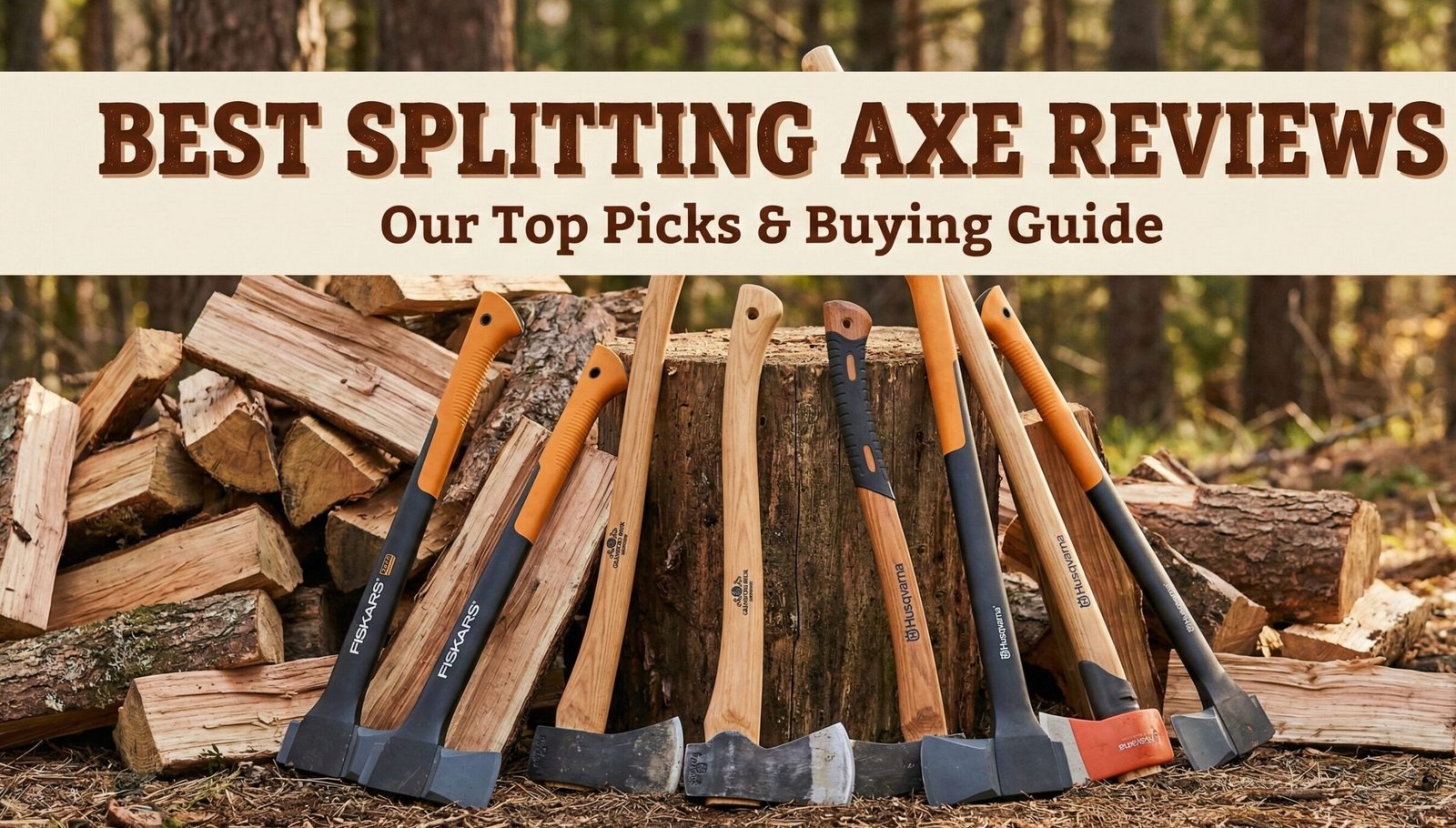
There is a distinct “pop” sound when a perfectly honed axe splits a log in one clean strike. It’s efficient, satisfying, and far less exhausting than hacking away with a dull tool.
While heavy machinery like gas log splitters or their quieter electric counterparts are great for massive volumes, nothing beats the agility of a good splitting axe for medium rounds and daily firewood tasks.
A splitting axe is different from a felling axe or a maul. It relies on head speed and sharp geometry rather than brute weight. We’ve analyzed steel quality, handle balance, head profile, and long-term durability to bring you the top 7 splitting axes on the market.
Quick Decision Guide
Short on time? Here are the top performers based on user needs.
| Category | Model | Why We Chose It |
|---|---|---|
| Best Overall | Fiskars X27 | Unbeatable price-to-performance. Indestructible handle and incredible head speed. |
| Best Premium | Gränsfors Bruk Large | Hand-forged Swedish steel. Heirloom quality that stays razor sharp. |
| Best Traditional | Husqvarna 30″ | Classic hickory handle and hand-forged steel at a budget-friendly price. |
| Most Versatile | Helko Werk Vario 2000 | Modular interchangeable head system — axe and maul in one tool. |
| Best Compact | Estwing Fireside Friend | One-piece indestructible steel. Perfect for kindling and camping. |
Splitting Axe vs. Maul: Do You Need Speed or Power?
Many homeowners confuse these two tools. Choosing the wrong one guarantees fatigue and frustration.
- Splitting Axe (3–5 lbs): Designed for speed. The head is lighter and sharper, meant to “slice” through wood fibers. Best for small-to-medium logs under 12 inches and straight-grained wood.
- Splitting Maul (6–8+ lbs): Designed for crushing. The head is a heavy blunt wedge that forces fibers apart. If you’re dealing with massive rounds or knotty oak, check our guide on the best splitting mauls instead.
| Factor | Splitting Axe | Splitting Maul |
|---|---|---|
| Weight | 3–5 lbs | 6–8+ lbs |
| Splitting Mechanism | Speed + sharp geometry (slices) | Weight + blunt wedge (crushes) |
| Best Log Size | Under 12″ diameter | 12″+ diameter rounds |
| Best Wood Type | Straight-grained seasoned hardwood | Knotty, green, or large-diameter rounds |
| Fatigue | Lower — lighter swing | Higher — heavy swing |
| Portability | Excellent — lightweight | Moderate — heavy to carry far |
| Kindling Use | Yes — precise and fast | Poor — too heavy for small pieces |
1. Fiskars X27 Super Splitting Axe (Top Pick)
Editor’s Choice
The Fiskars X27 is widely regarded as the best splitting axe for the money, period. Unlike traditional axes, it features a hollow FiberComp handle that is virtually unbreakable and absorbs shock better than wood. This makes the tool incredibly light, allowing you to generate massive head speed.
The 36-inch handle length gives tall users excellent leverage. The blade is coated with a low-friction finish that prevents it from getting stuck in the log — a common annoyance with cheaper axes.
pros
- Incredible head speed explodes wood apart
- Unbreakable composite handle with lifetime warranty
- Low-friction coating prevents sticking
- Excellent ergonomics for tall users
cons
- Lacks the traditional “feel” of wood
- Harder to sharpen the specialized steel geometry

The modern standard for efficiency and durability.
2. Gränsfors Bruk Large Splitting Axe
Premium Pick
If you view tools as functional art, the Gränsfors Bruk is for you. Hand-forged in Sweden, every axe head bears the initials of the smith who crafted it. It comes razor-sharp out of the box — sharp enough to shave with (though we don’t recommend it).
It features a protective steel collar below the head to save the hickory handle from overstrikes. The balance is perfect, and the steel holds an edge significantly longer than mass-produced alternatives.
pros
- Unmatched craftsmanship and out-of-box sharpness
- Steel collar protects the handle from overstrikes
- Heirloom quality — will last generations
- Comes with a leather sheath
cons
- Very expensive compared to alternatives
- Hickory handle requires oiling and care

The finest splitting tool money can buy.
3. Husqvarna 30″ Wooden Splitting Axe
Best Value
Husqvarna offers a fantastic middle ground. You get a hand-forged Swedish steel head and an American hickory handle for a fraction of the price of the Gränsfors Bruk. While the finish isn’t quite as polished, the performance is 95% there.
The 30-inch handle is versatile for both splitting large rounds and tighter work. An excellent entry point for those who want a traditional wooden axe without the boutique price tag.
pros
- Genuine hand-forged Swedish steel head
- Great balance and traditional feel
- Affordable compared to premium brands
cons
- Head can occasionally come loose (requires re-wedging)
- Rougher finish on the handle than premium brands

Traditional quality at a price that makes sense.
4. Helko Werk Vario 2000
The Helko Werk Vario 2000 is a unique beast. It features a patented interchangeable head system — the blade is bolted onto the handle, meaning if you ever break the handle or want to switch head profiles, you can do it in minutes with a hex key.
The geometry is a deep wedge, acting almost like a hybrid between an axe and a maul. Heavy enough to power through knots but balanced enough to swing with precision. The C50 German carbon steel holds an exceptional edge.
pros
- Fully modular — heads and handles are replaceable
- Heavy-duty German C50 carbon steel
- Excellent hybrid axe/maul splitting geometry
cons
- Heavier than standard axes
- Bolts need periodic tightness checks

German engineering with a replaceable head system.
5. Estwing Fireside Friend (Camp Axe)
Sometimes you don’t need a full-sized axe. For splitting kindling or managing a smaller wood stove, the Estwing Fireside Friend is unmatched. It is forged in one solid piece of American steel, meaning the head can never fly off — the most catastrophic failure mode of any axe.
The shock reduction grip is comfortable, and the weight (4 lbs) is surprisingly hefty for its size, allowing for effective one-handed splitting. The perfect companion to a larger tool or a manual hydraulic splitter.
pros
- Indestructible one-piece forged steel design
- Perfect for kindling and camping use
- Made in the USA
cons
- Too short for large logs on the ground
- Paint on the handle tends to peel over time
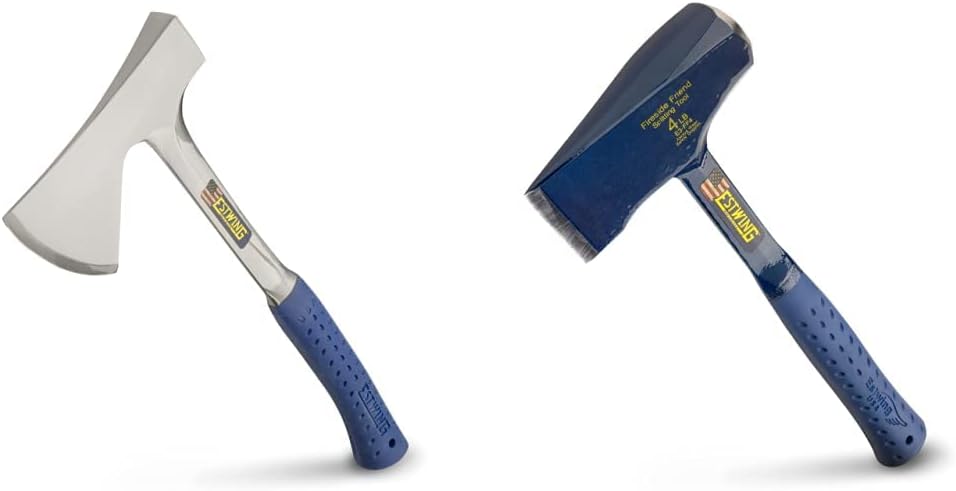
The ultimate kindling tool that will last forever.
6. Fiskars Norden N12
The Norden N12 is Fiskars’ attempt to bridge the gap between heritage and modern technology. It features a beautiful hickory handle seamlessly bonded to a FiberComp overstrike collar — you get the warm feel of wood with the unbreakability of composite protection at the most vulnerable point.
At 19 inches long, this is a compact axe ideal for smaller users or tight spaces. It retains the legendary Fiskars cutting geometry and razor-sharp edge.
pros
- Beautiful hybrid hickory/composite design
- FiberComp overstrike protection built-in
- Very light and easy to handle
cons
- Not suitable for large rounds
- Handle is shorter than full-size splitters
The perfect blend of tradition and modern technology.
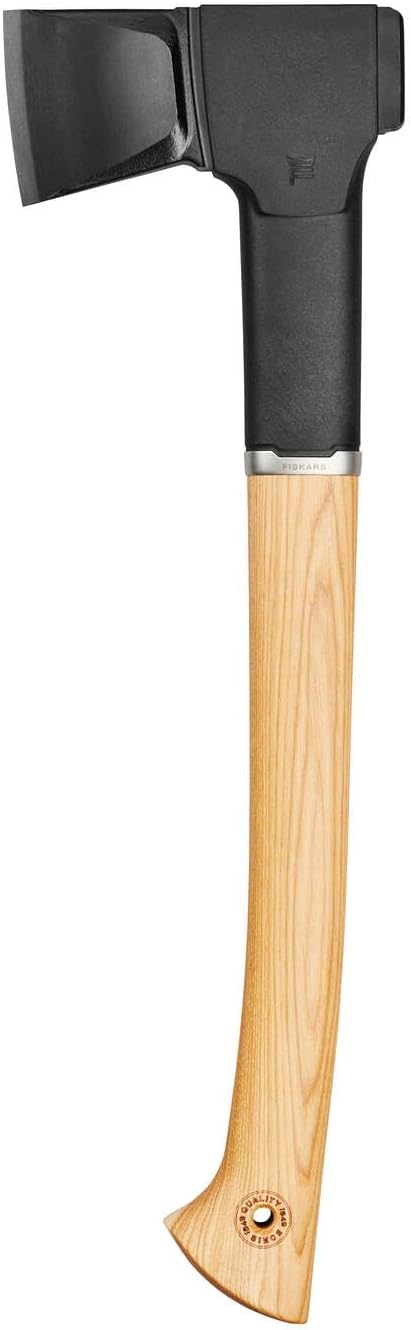
7. Cold Steel Trail Boss
While often marketed as a bushcraft axe, the Trail Boss is surprisingly capable at splitting. It features a European-style head with a 4-inch blade and a cutting edge that bites deep. Lightweight and agile, it’s a great “beater” axe to throw in the truck or keep at the cabin.
It requires a bit more sharpening out of the box than the Fiskars or Gränsfors, but for the price it’s a rugged workhorse that doubles as a general outdoor tool.
pros
- Very affordable entry-level price
- Versatile — can fell small trees and split
- Durable hickory handle
cons
- Requires sharpening before first use
- Head paint wears off quickly
A rugged, do-it-all axe for the budget-conscious.

Buyer’s Guide: Every Spec That Matters
An axe is a deeply personal tool. The “best” one depends on your height, strength, physical condition, and the wood you are splitting. Here is the complete specification breakdown.
1. Handle Length — Leverage and Swing Arc
Handle length determines how much speed and leverage you generate on the downswing. Longer is not always better — it depends on your height and the splitting environment.
- 30–36 inches: Standard for full-size splitting on a chopping block. Ideal for users 5’10” and taller. The Fiskars X27’s 36-inch handle is optimized for tall users who generate massive head speed from a high arc.
- 24–28 inches: Better for shorter users or confined spaces like a small shed or garage doorway. Provides good control with less arc.
- Under 20 inches: Strictly for kindling, camping, or one-handed use. The Estwing Fireside Friend and Fiskars Norden N12 occupy this category.
The Armpit Test for Handle Length
Hold the axe head in your armpit with the handle pointing forward. The end of the handle should reach roughly to your palm. If it extends past your fingertips, the axe may be unwieldy for you. If it only reaches your wrist or elbow, it’s more of a hatchet than a splitting axe.
2. Handle Material — Wood vs. Composite vs. Steel
This is the most argued specification in the axe community, with passionate advocates on every side. Here is an honest assessment.
- Composite/FiberComp (Fiskars): Lighter than wood of equivalent length, allowing higher swing speeds. Virtually unbreakable — will outlast any wooden handle in normal use. Excellent shock absorption through the hollow core. The trade-off is a less natural feel that some experienced woodsmen find less satisfying. Non-replaceable if the handle ever does fail, though this is exceedingly rare.
- Hickory (Gränsfors, Husqvarna, Cold Steel): The traditional choice for good reason. Hickory has outstanding grain strength and flex that absorbs impact. A beautiful feel in the hand that composite cannot replicate. Replaceable — if a handle breaks, you buy a new one for $15–$30 and re-hang the head. Requires oiling with linseed oil twice a year to prevent cracking, and is vulnerable to overshooting the target (“overstrikes”) without a steel collar.
- One-Piece Steel (Estwing): The most indestructible option. The head literally cannot separate from the handle because they are one solid piece. However, steel transmits vibration to the hands more directly than wood or composite, which causes hand fatigue over long sessions. The Estwing’s neoprene grip mitigates this considerably but does not eliminate it entirely.
- Hybrid (Fiskars Norden): Hickory in the grip zone bonded to a FiberComp collar at the head junction. The best of both aesthetics and protection, though more expensive than a standard wooden handle axe.
3. Head Weight — The Speed/Power Tradeoff
A splitting axe head should be between 2.5 and 4.5 lbs. Anything heavier crosses into maul territory. The sweet spot for most users is 3–3.5 lbs — light enough to generate high swing speed but heavy enough to carry meaningful momentum into the log on contact. The Fiskars X27 head weighs approximately 3.5 lbs; the Gränsfors Bruk Large is around 3 lbs.
4. Chopping Block Height
An often overlooked factor that affects every axe, regardless of quality. The correct chopping block height puts the log surface at approximately mid-shin level when you are standing upright with the axe in neutral grip. Too low and you bend at the waist, increasing back strain. Too high and you lose swing arc and power. A well-sized block — ideally a solid 18–24-inch diameter round of dense wood like elm or oak — is as important to efficient splitting as the axe itself.
Steel Types Explained: What’s Behind “Swedish Steel” and Carbon Steel?
Axe marketing is full of steel claims that are rarely explained. Understanding what these terms actually mean helps you evaluate whether a premium price is justified.
High-Carbon Steel vs. Stainless Steel
All quality splitting axes use high-carbon steel — never stainless. This is the correct choice for axes. High-carbon steel (typically 0.5–0.8% carbon content) can be hardened to hold a sharper, more durable edge than stainless steel. The trade-off is that high-carbon steel will develop surface rust if not maintained. A light oil coating after use prevents this entirely. Stainless steel, while rust-resistant, is significantly softer and cannot hold a working edge under the impact loads of log splitting.
What “Swedish Steel” Actually Means
The term refers to steel produced in Sweden, which has a long historical reputation for metallurgical quality. Swedish axe steel is typically a refined high-carbon steel with tight tolerances on impurities — particularly sulfur and phosphorus, which cause brittleness in impact applications. Brands like Gränsfors Bruk and Hults Bruk (who supplies Husqvarna) use genuinely high-quality Swedish steel that justifies the designation. The steel is typically hardened to a Rockwell hardness of 57–59 HRC — hard enough to hold a fine edge but tough enough not to chip under impact.
German C50 Carbon Steel (Helko Werk)
C50 refers to a European steel designation indicating approximately 0.50% carbon content. This is a well-balanced specification for splitting tools — providing good hardness (typically 54–58 HRC) and very good toughness. German steel manufacturing standards are highly consistent, and Helko Werk’s quality control is excellent. C50 is slightly softer than some Swedish axe steels, meaning it may require slightly more frequent sharpening but is less likely to chip when it encounters a hidden nail or knot.
Hardness (Rockwell HRC) and What It Means for You
| HRC Range | Edge Retention | Chip Resistance | Sharpening Ease | Typical Axes |
|---|---|---|---|---|
| 50–54 | Poor | Excellent | Very Easy | Budget import axes |
| 54–57 | Good | Good | Easy | Husqvarna, Cold Steel, Helko C50 |
| 57–60 | Very Good | Moderate | Moderate | Gränsfors Bruk, Hults Bruk, Fiskars |
| 60+ | Excellent | Poor (chips on knots) | Difficult | Not recommended for splitting |
The 57–60 HRC sweet spot is ideal for splitting axes. It holds a working edge through many sessions between sharpening while still being tough enough to survive contact with knots, hidden nails, and ground strikes without chipping.
Handle Deep Dive: Grain Orientation, Oiling, and Re-Hanging
Reading Handle Grain Orientation
For wooden handles, grain orientation is a critical quality indicator that almost no buyer checks but every experienced woodsman knows. The grain lines (visible as rings running along the handle) should run parallel to the plane of the axe head when viewed from the side — not perpendicular to it. When grain runs the wrong direction, the handle splits along the grain during an overstrike, which can cause the failure of the handle at the worst possible moment. Quality manufacturers like Gränsfors Bruk inspect and orient each handle correctly. Budget axes often ignore this entirely.
To check when buying: look at the end grain of the handle where it exits the top of the head. The annual rings should run front-to-back (the same direction as the edge faces), not side-to-side.
Oiling a Wooden Handle — How and Why
Raw hickory is porous and will absorb moisture from rain and humidity, then dry out when stored indoors, causing the wood to swell and shrink repeatedly. Over time, this cycle loosens the head and can crack the handle. Boiled linseed oil (BLO) penetrates the wood fibers and provides a flexible moisture barrier that prevents this cycle.
- Sand the handle lightly with 120-grit sandpaper to open the grain slightly and improve oil penetration. Remove all dust.
- Apply boiled linseed oil generously with a cloth or brush, working it into the grain. Let it soak in for 20–30 minutes.
- Wipe off all excess oil. Leftover oil on the surface will become tacky and gummy. Only the oil absorbed into the wood provides protection.
- Allow 24 hours to cure in a dry location before use. Repeat this process 3–4 times total for a new handle to build up good penetration.
- Maintain twice a year with a single coat. A well-maintained hickory handle will outlast many seasons of hard use.
BLO Fire Hazard Warning
Rags soaked with boiled linseed oil can spontaneously combust as the oil cures and generates heat. Never bunch or pile BLO-soaked rags indoors. Spread them flat outdoors to dry completely before disposal, or submerge them in water in a metal container.
Re-Hanging a Loose Axe Head
A loose head is a serious safety hazard — it can fly off the handle mid-swing and cause severe injury. Re-hanging is a straightforward repair that any woodsman should know.
- Soak the head end of the handle overnight in water or linseed oil to swell the wood and temporarily tighten the fit.
- Drive a wooden wedge deeper into the kerf in the top of the handle using a mallet. This expands the handle within the eye.
- Add steel wedges perpendicular to the wooden wedge to expand the handle in the opposite direction.
- If the handle cannot be re-tightened adequately, replace it. Handle replacement is inexpensive and straightforward for any traditional axe head.
Head Geometry Guide: Why Shape Matters More Than Weight
The shape of the axe head determines how it interacts with wood fibers during the split. Two axes of identical weight and steel quality can perform very differently based purely on head geometry.
The Wedge Profile (Cross-Section Shape)
Look at the axe head from the front (edge-on) and you see the wedge profile. A narrow, convex (“appleseed”) grind bites deep into the wood fiber but relies on the expanding cheeks to do the splitting work. This profile is used on felling axes and causes the “sticking” problem many people experience when trying to use a felling axe for splitting.
A proper splitting axe uses a broader convex profile with pronounced cheeks — the blade enters the wood and then the thick shoulders immediately behind it force the fibers apart laterally. This is why the same 3-lb head can split logs that would stop a 4-lb felling axe: the geometry is doing the work, not just the weight.
Bit Length and Heel-to-Toe Measurement
The cutting edge width (bit) on a splitting axe is typically 4–5 inches. Longer bits provide a wider initial entry point that begins fiber separation earlier. However, excessively wide bits on lighter heads reduce the concentration of force at initial contact. The Gränsfors Bruk Large has a 4.25-inch bit that balances entry force concentration with effective cheek spread — a geometry refined over decades of professional use.
Convex vs. Flat Grind
Quality splitting axes are ground with a convex edge — the bevel curves outward slightly rather than running flat. This convex geometry is stronger than a flat grind (less metal removed from behind the edge), easier to maintain in the field, and provides the “rolled” shoulder that pushes wood apart on entry. Never put a flat bevel on a splitting axe — use a sharpening puck that maintains the convex profile.
Poll (Back of Head) Design
The poll is the flat back face of the axe head. Some axes have a hardened poll that can be used for pounding (driving steel splitting wedges, for example), while others specifically warn against poll use. Never strike an axe poll that is not specifically hardened for that purpose — standard axe steel is not heat-treated for impact resistance, and a hammer blow to an unhardened poll can cause metal to chip or spall with potentially dangerous results. The Fiskars X27 explicitly prohibits poll use. Only tools specifically designed as combination axe/mauls have a hardened, strikeable poll.
Proper Splitting Technique: Get More from Every Swing
An excellent axe swung with poor technique will perform worse than a mediocre axe used correctly. These technique fundamentals will immediately improve your efficiency and reduce fatigue.
Stance and Foot Position
Stand with feet shoulder-width apart, perpendicular to the log. Your dominant foot should be slightly back. This stance provides a stable base and a natural swing arc that brings the axe straight down through the center of the log. Avoid standing directly in front of the log — if the axe glances off or the log splits and a piece flies back, you want it to pass between your legs, not into your shins.
The Swing: Full Arc vs. Controlled Chop
For splitting, you want a full overhead arc that generates maximum head speed at impact — not a controlled, short chop. The most common beginner mistake is “muscling” the axe with arm strength rather than letting the arc generate momentum. Focus on these elements:
- Start with both hands together near the head. This is the beginning grip position for many experienced splitters — it shortens the effective lever arm and makes the initial raise easier.
- As the axe rises to the top of the arc, slide your bottom hand to the end of the handle. This sliding motion creates the whip effect that generates head speed on the downswing.
- Keep your eyes on the target point. Look at where you want the axe to land — a crack in the end grain, a natural check, or the center of the round — not at the axe itself.
- Aim for the far edge of the log, not the center. This counterintuitive technique works because the momentum carries the axe through the log. Aiming at the center tends to produce a hit that stops in the middle.
- Let the axe do the work. A relaxed grip at the moment of impact allows the axe head to travel through its natural path. A white-knuckle grip at impact stiffens the wrists and deflects the strike.
Reading the Log: Where to Strike
Not every round should be struck in the center on the first swing. Learn to read the log before swinging:
- Look for existing checks (cracks): End-grain checks from drying are natural weak points. Strike along a check and the log often falls apart with minimal force.
- Identify the grain direction: Split with the grain, not against it. A log that was growing slightly curved has a dominant grain direction — splitting parallel to it is dramatically easier.
- Work the edges first on large rounds: Rather than bisecting a 14-inch round immediately (which requires maximum force), split a “slab” off the side first. Each slab you remove makes the next split easier by reducing diameter.
- Avoid knots on the first strike: A knot is where a branch intersected the trunk, creating interlocked grain in all directions. Split around knots where possible, or position the knot near the center of the round so the split passes through more straight-grained wood on either side.
Axe Choice by Wood Species: Matching Tool to Timber
Different species require different approaches — not just different amounts of force, but different technique and head geometry choices. Here’s how the major firewood species respond to axe splitting.
Easy Splitters
- Ash: Straight grain, splits nearly perfectly. Any axe works well.
- Pine/Fir: Soft fibers. Even a dull axe splits pine. Great for practice.
- Birch: Moderate hardness, clean splitting. The X27 excels here.
- Poplar: Very soft, lightweight. Ideal for kindling production.
Moderate Challenge
- Maple (Hard): Good straight sections, challenging crotch wood. 3–3.5 lb head ideal.
- Cherry: Splits well when seasoned. Beautiful aroma during work.
- Walnut: Dense but straight grain. A sharp axe handles it well.
- Red Oak: Splits along grain easily; avoid knots. 3.5 lb+ recommended.
Difficult — Use Maul or Wedge
- White Oak: Very dense and sometimes interlocked. Maul + wedge preferred.
- Elm: Notoriously interlocked grain. Almost impossible to axe-split large rounds.
- Hickory: Dense and can be stringy. A maul or gas log splitter is far more effective.
- Crotch wood (any species): Always use a maul and wedge — axe geometry cannot handle interlocked crotch grain.
The Green vs. Seasoned Splitting Rule
For most hardwood species, green (freshly cut) wood is actually easier to split than fully seasoned wood. The water in the fibers acts as a lubricant, and the wood has not yet had time to develop the full interlocking tightness that comes with drying. Oak and hickory are exceptions — they are difficult regardless of moisture content. If you have fresh-cut birch, maple, or ash, split it immediately rather than waiting for it to season.
Complete Sharpening Guide: Keep Your Axe Razor Sharp
A dull splitting axe is more than just less efficient — it is actually more dangerous. A dull axe is more likely to glance off a log rather than bite cleanly, sending the head in an uncontrolled direction. Keeping your axe properly sharp is both a performance and safety requirement.
How Sharp Does a Splitting Axe Need to Be?
A splitting axe does not need a razor edge like a carving knife. Its geometry does most of the work. The edge should be sharp enough to shave arm hair and to catch a thumbnail without sliding — this is the practical test. An edge this sharp will bite cleanly into end grain and allow the head geometry to do the splitting work. An edge that cannot catch a thumbnail needs sharpening.
Tools Required
- A double-sided puck stone (coarse/fine) or a dedicated axe whetstone — the most practical field tool
- A mill bastard file (8-inch) — for removing significant damage or reshaping a badly neglected edge
- A leather strop with stropping compound — for achieving a polished, hair-shaving edge (optional but beneficial)
- Honing oil or water — depending on your stone type
- A sharpening puck guide or angle guide — useful for beginners learning the correct bevel angle
Sharpening Procedure
- Secure the axe safely. Place the axe head in a vice with the edge facing up, or clamp the handle horizontally to a work surface. Never sharpen a free-held axe — a slip sends the stone across your fingers.
- Assess the edge condition. If there are visible chips, flat spots, or the edge is visibly dull (catches light reflections), start with a file or the coarse side of your puck. If the edge is simply dull from normal use, begin with the fine side.
- Work the file or coarse stone in circular motions along the bevel, maintaining the original factory angle (typically 25–30° for a splitting axe). Move from the heel to the toe in sweeping arcs. Apply light, consistent pressure. Count strokes and repeat on the opposite side to maintain symmetry.
- Switch to the fine stone and repeat with lighter pressure. The goal is to refine the scratch pattern left by the coarser grit and bring the edge to a consistent finish.
- Deburr the edge. Light sharpening raises a microscopic burr on the opposite face of the edge. Run the fine stone lightly and flat against the face side of the axe (not the bevel) to remove it. One or two very light strokes is all that is needed.
- Strop the edge (optional but recommended for premium axes). Draw the edge backward across a leather strop loaded with green compound 10–15 times per side. This aligns the final edge geometry and produces a noticeably sharper result.
- Test the edge using the thumbnail or arm hair test. If it catches reliably, the axe is ready to use.
Sharpening Frequency
For active splitting sessions, check the edge every 5–10 hours of use. A quick touch-up with a puck stone takes 3–5 minutes and keeps the edge performing well without requiring a full resharpening session. Budget axes with softer steel will need attention more frequently — sometimes after every hour of heavy use. Premium axes like the Gränsfors Bruk and Husqvarna hold their edges noticeably longer between sharpenings.
Safety Guide: Rules That Prevent Serious Injuries
Axe injuries are among the most severe in the home workshop environment because the tool is sharp, heavy, and swung at speed. The vast majority are entirely preventable with disciplined adherence to basic safety practices.
The Most Important Safety Rule
Before every swing, look at where the axe will go if it misses or passes through the log. A clean miss or complete pass-through sends the axe head toward the ground in front of you. Your feet should never be within the swing arc. Always split over a chopping block that elevates the log, and step back slightly after placing each log to ensure your feet clear the strike zone.
Personal Protective Equipment
- Steel-toed boots — mandatory. The most common axe injury is to the foot or lower leg from a glancing strike or a piece of split wood flying sideways
- Safety glasses or glasses — bark chips and wood splinters travel at high speed during splits
- Work gloves — leather preferred for grip and hand protection. Do not use slippery synthetic gloves that reduce control of the handle
- Long pants — protects the lower legs from flying debris
- Avoid loose clothing — dangling sleeves or jacket tails can catch on the axe head or interfere with the swing arc
Operational Safety Rules
- Always check that the head is securely attached to the handle before each use — shake the axe head and feel for any looseness or wobble
- Never swing an axe when fatigued — muscle fatigue reduces accuracy dramatically and increases miss probability
- Keep bystanders and children at least 15 feet away from the splitting area in all directions
- Never split a log while it is on the ground — a ground-level strike risks burying the axe in the earth, damaging the edge, or a deflected strike toward the legs
- Use a splitting block that is stable and cannot roll — an unstable block that shifts during a strike is the cause of many foot injuries
- Do not place a log on a hard surface like concrete — hard surfaces cause the axe to bounce unpredictably if it passes through the log
- When carrying an axe, always hold it with the head down or sheathed — never carry it over the shoulder with the blade exposed
- Store axes with a leather sheath or blade guard over the edge — an unsheathed axe in a storage area is a hazard to anyone reaching past it
Maintenance and Care Schedule
A quality axe maintained properly will outlast its owner. The maintenance requirements are minimal — an axe is beautifully simple — but the few tasks that matter are important.
| Task | Frequency | Specification / Tip |
|---|---|---|
| Head Attachment Check | Before every use | Shake the head firmly. Any wobble means re-wedging before use. A loose head is an immediate stop-work safety issue. |
| Edge Touch-Up | Every 5–10 splitting hours | Use a puck stone in circular motions maintaining the original bevel angle. 3–5 minutes restores a working edge. |
| Full Sharpening | Annually or when edge is significantly degraded | File followed by fine stone, then strop. Restores full geometry and removes accumulated micro-damage. |
| Handle Oiling (wood only) | Twice a year | Boiled linseed oil, wiped clean after 20–30 minutes. Prevents wood from drying, cracking, and loosening at the eye. |
| Head Rust Prevention | After every use or exposure to rain | Wipe dry and apply a thin coat of WD-40, gun oil, or camellia oil. A few drops on a rag is all that is needed. |
| Handle Inspection | Monthly during active use | Check for cracks, grain separation, or darkening (indicating absorbed moisture). Early detection prevents handle failure during use. |
| Sheath Conditioning (leather only) | Annually | Apply leather conditioner or neatsfoot oil to prevent the leather from drying and cracking. A well-conditioned leather sheath protects both the edge and anyone reaching near it in storage. |
Storage and Transport: Protecting Your Axe Between Sessions
Indoor Storage
The ideal indoor storage position for an axe is hanging on a wall rack or hook with the head up and the edge protected by a sheath. Storing an axe on a concrete garage floor exposes it to ground moisture that accelerates rust and can wick into a wooden handle. Never store an axe leaning against a wall with the edge touching the ground — this damages the edge and makes the axe an unsheathed tripping hazard.
For long-term storage (several months or more), apply a thicker coat of oil to the head and wrap it in an oil-impregnated cloth before placing the sheath over it. The oil prevents any surface rust from developing during the storage period.
Transporting an Axe in a Vehicle
Transport axes with the head in a sheath, positioned so the edge cannot contact anything during vehicle movement. A loose, unsheathed axe sliding around a truck bed is a serious hazard to anyone who reaches into the bed without looking first. The handle should also be secured — an axe sliding during hard braking can cause damage or injury even with the head sheathed. A purpose-built axe bag or a simple bungee arrangement in the truck bed keeps everything secure.
Field Carrying
When carrying an axe over a distance in the field, always carry it with the head down at your side and the edge facing away from your body. The sheath should be on the edge during any multi-minute carry. If you need to hand an axe to another person, extend the handle toward them with the head down, and wait until they have a secure grip before releasing your own.
Kindling Guide: Using Your Splitting Axe for Fine Work
A splitting axe doubles as an excellent kindling tool — far safer and more efficient than the common practice of using a hatchet on small pieces or trying to use a maul for fine work.
Safe Kindling Technique
The most important kindling safety rule: never hold a small piece of wood in your hand while striking it with an axe. Even experienced woodsmen occasionally miss a small piece, and a strike to the holding hand causes catastrophic injury. Use one of these safe techniques instead:
- The batoning method: Place the small piece on a chopping block and strike downward from above, keeping fingers well clear of the sides. Even small pieces can be safely split this way with a full swing.
- The block-and-axe method: Stand the piece upright on the block. Place the axe edge on top of the piece and then lift the axe and piece together, striking the axe head on the block. The block provides the anvil impact and the axe edge does the splitting — no free swing required and both hands can grip the handle safely above the head.
- The kindling splitter alternative: For very high-volume kindling production, a dedicated manual kindling splitter is safer and faster than any axe technique. These simple spring-loaded tools are specifically designed for small-diameter splitting and eliminate any risk of a miss.
Ideal Kindling Dimensions
Effective fire-starting kindling should be split to approximately thumb-width (0.5–0.75 inches) in diameter. Pieces this size ignite quickly from a firestarter or newspaper and burn hot enough to establish larger pieces. Split your kindling supply from straight-grained softwood like pine or cedar whenever possible — these species split to fine pieces with minimal effort and ignite readily even from a cold firebox.
Cost and Value Guide: What Should You Spend?
The splitting axe market spans from $25 import tools to $350+ hand-forged heirlooms. Understanding what you get at each price tier helps you invest appropriately for your actual use case.
| Price Range | What You Get | Typical Models | Best For |
|---|---|---|---|
| Under $50 | Soft steel (HRC 50–54), basic geometry, rough finish. Will work but dulls quickly and requires frequent sharpening. | Cold Steel Trail Boss, various imports | Occasional users, cabin/camp beater tools, beginners testing the activity |
| $60–$130 | Quality steel (HRC 54–57), good geometry, reliable handles. The performance sweet spot for most homeowners. | Fiskars X27, Husqvarna 30″, BILT HARD | Regular homeowners splitting 1–3 cords/year. The best value tier for most buyers. |
| $130–$200 | Premium steel (HRC 57–60), refined geometry, better handle quality. Noticeable performance improvement over mid-range. | Helko Werk Vario 2000, Hults Bruk | Serious wood burners who split frequently and appreciate quality tooling |
| $200–$350+ | Hand-forged excellence, individual craftsmanship, heirloom quality. Performance difference over good premium axes is real but incremental. | Gränsfors Bruk Large Splitting Axe | Those who value tools as craftsmanship and plan to pass the tool to the next generation |
The Lifetime Value Perspective
A $75 Fiskars X27 with a lifetime warranty will never need to be replaced under normal use. A $300 Gränsfors Bruk properly maintained will literally be used by your grandchildren. At both price points, the cost per year of ownership is negligible — a dollar or two annually over a lifetime of use. The correct question is not “which costs less” but “which provides the splitting experience I want.” If you enjoy the process of maintaining and using traditional hand tools, the Gränsfors is worth every cent. If you want maximum efficiency with minimal fuss, the Fiskars wins and the price difference buys no meaningful additional performance in the firewood pile.
Frequently Asked Questions
Is a heavier axe better for splitting?
Not necessarily. Splitting axes rely on speed and geometry. A 3.5 lb axe swung fast will split better than a 6 lb maul swung slowly on medium logs. Head speed at impact is more important than mass for smaller-diameter, straight-grained rounds. For large knotty rounds above 12 inches, however, the sustained crushing force of a maul outperforms any axe.
Can I hammer on the back of a splitting axe?
Generally, no. Most axe polls are not hardened for impact resistance. Hammering an unhardened poll can cause the steel to deform or spall — sending metal chips at high velocity. Only tools with a specifically hardened poll (explicitly stated by the manufacturer, as on some Fiskars IsoCore mauls) are designed to be struck. Check your product documentation before ever striking the poll.
Why does my axe get stuck in the wood?
This happens for three main reasons: the axe profile is too thin (a felling axe geometry rather than a splitting axe geometry), the cheeks behind the edge are not wide enough to force the fibers apart, or the wood is green and particularly fibrous. A true splitting axe with broad cheeks rarely sticks in properly seasoned wood. If sticking persists, verify you have a splitting axe and not a felling or general-purpose axe.
How do I know if the handle is too long?
Hold the axe head in your armpit. The end of the handle should reach roughly to your palm. If it extends past your fingertips, the axe may be unwieldy. However, handle length is personal — many tall users specifically seek out 36-inch handles for the leverage advantage even if the standard test suggests a shorter length.
What is the difference between a splitting axe and a maul?
A splitting axe is lighter (3–5 lbs) and relies on sharp geometry and speed to slice wood fiber apart. A maul is heavier (6–8+ lbs) with a blunt wedge shape designed to crush and force tough fibers apart through brute force. Use an axe for straight-grained rounds under 12 inches and a maul for larger, knotty, or particularly tough rounds.
Can I use a splitting axe for felling trees?
Technically yes for small trees, but it is not the right tool. A splitting axe’s broad wedge profile is inefficient for chopping across grain (which is what felling requires). You will fatigue much faster than with a purpose-designed felling axe with a thinner bit profile. Use the right tool for each task — a splitting axe for splitting, a felling axe for felling.
How do I remove a stuck axe from a log?
Grasp the handle firmly with both hands and twist the axe handle sideways while applying upward pressure. The twisting motion breaks the friction seal between the cheeks and the wood fiber walls. If the axe is deeply embedded, raise the log and axe together as a unit and bring both down firmly on the chopping block — the impact drives the log further onto the axe and often breaks it free. As a last resort, drive a steel splitting wedge into the same split from the other side to relieve the grip the wood has on the axe cheeks.
Final Verdict
For 95% of users, the Fiskars X27 is the undisputed king. It is efficient, durable, and affordable. It turns a chore into a workout you actually enjoy — and the lifetime warranty means you buy it once.
If you want a tool that feels like history in your hands and improves with every year of ownership, the Gränsfors Bruk Large Splitting Axe is an investment you will never regret. It is the kind of tool that gets passed down.