Best Gas Log Splitters: Tonnage, Engines & Buying Guide
By Chimney Insight Editorial Team
Posted on December 26, 2025
Disclosure: This page contains affiliate links. We may earn a commission from qualifying purchases at no extra cost to you. As an Amazon Associate I earn from qualifying purchases.
If you heat your home with wood, you know the reality: splitting by hand is great exercise, but it’s terrible for productivity. When you’re staring down five cords of unseasoned hickory or oak, an axe just won’t cut it. Gas log splitters are the heavy artillery of firewood preparation — they don’t need a power cord, meaning you can tow them directly to the tree fall, handle the heaviest rounds in vertical mode, and process in hours what would take days by hand.
In this guide, we’ve broken down the best gas log splitters available, from budget-friendly residential models to commercial beasts that can run all day. We also go deep on the specs that actually matter — tonnage, cycle time, engine reliability, and the often-overlooked question of which splitter matches which wood species.
Quick Decision Guide
In a rush? Here is the cheat sheet for the best models based on your specific needs.
| Category | Model | Why We Chose It |
|---|---|---|
| Best Overall | Champion 25-Ton | Perfect balance of power, cycle time, and price. Reliable engine and great support. |
| Best Value | WEN 56208 20-Ton | Surprising power for a price often hundreds less than competitors. |
| Heavy Duty | YardMax 35-Ton | Commercial-grade power. If it can’t split it, nothing can. |
| Most Portable | Boss Industrial GD16T | Compact and fast — fits in a truck bed, perfect for field use. |
| Best Built Quality | Swisher LSDD22 | Cast iron pump, Briggs engine, excellent long-term durability. |
Gas Power vs. The Alternatives
Before dropping over $1,000 on a machine, ensure you actually need gas power. Gas splitters are loud, require engine maintenance (oil, gas stabilizer, spark plugs), and are heavy to move. If you are only splitting small pine logs or kindling for a weekend fire, a gas unit is overkill. For lighter duties, check our guide on the best manual hydraulic log splitters, which are silent and maintenance-free. However, if you are dealing with large rounds, knots, or volume greater than a cord a year, gas is the only way to go.
1. Champion Power Equipment 27-Ton (Top Pick)
Editor’s Choice
The Champion 25-Ton hits the “sweet spot” for 95% of homeowners. It features a 224cc single-cylinder OHV engine that provides consistent power without the massive fuel consumption of larger 35-ton units.
One of the standout features is the 11-second cycle time. While that sounds fast, it feels even faster when you’re in a rhythm. It easily converts from horizontal to vertical, which is a back-saver when dealing with 100lb rounds you can’t lift onto the beam.
pros
- Fast 11-second cycle time speeds up workflow
- Towable up to 45 mph with DOT-approved wheels
- Vertical/Horizontal capability
- Includes log catchers (often a paid add-on)
cons
- Oil fill location is slightly awkward
- Assembly takes about 2 hours if working alone

The most reliable all-rounder for serious firewood processing.
2. WEN 56208 20-Ton Lumberjack (Best Value)
Best Value
WEN continues to disrupt the power tool market by offering near-premium performance at budget prices. The 56208 is a 20-ton splitter powered by a 212cc engine. While 20 tons is less than the Champion, it is still more than enough for oak, maple, and ash logs up to 14 inches in diameter.
It sits lower to the ground than some competitors, which actually makes loading heavy logs easier. However, it is not towable on public roads (off-road only), which is the main trade-off for the lower price tag.
pros
- Unbeatable price-to-performance ratio
- Reliable 212cc engine starts easily
- Compact footprint for storage
cons
- Not DOT towable (garden tractor towing only)
- Slower cycle time than the Champion

Save hundreds without sacrificing splitting power.
3. YARDMAX YS3567 35-Ton Half Beam
Commercial Grade
If you’re selling firewood or have massive, knotty rounds that stall smaller machines, the YardMax 35-Ton is the answer. This is a “half-beam” splitter — a design that makes it lighter and easier to use in the vertical position.
With 35 tons of force, “stalling” isn’t in this machine’s vocabulary. It powers through wet elm and twisted oak knots with ease. The spinner foot plate makes rotating logs significantly easier — a small detail that saves enormous effort over a long day.
pros
- Massive 35-ton crushing force
- Half-beam design is easier to maneuver
- Includes 4-way wedge (huge time saver)
- Briggs & Stratton engine options available
cons
- Overkill for average homeowner needs
- Fuel consumption is higher

Power through the toughest knots with 35 tons of force.
4. Boss Industrial GD16T 16-Ton
The Boss Industrial GD16T is designed for speed and portability. At 16 tons, it’s on the lower end of the gas spectrum, but it compensates with a lightning-fast cycle time and compact size. This is the ideal machine for someone who splits straight-grained wood and values efficiency over raw brute force. It fits easily in the back of a pickup truck, making it a favorite for rental properties or remote jobs.
pros
- One-handed operation system
- Very easy to transport
- Simple, durable hydraulic design
cons
- Cannot handle large knotty logs efficiently
- No vertical operation mode
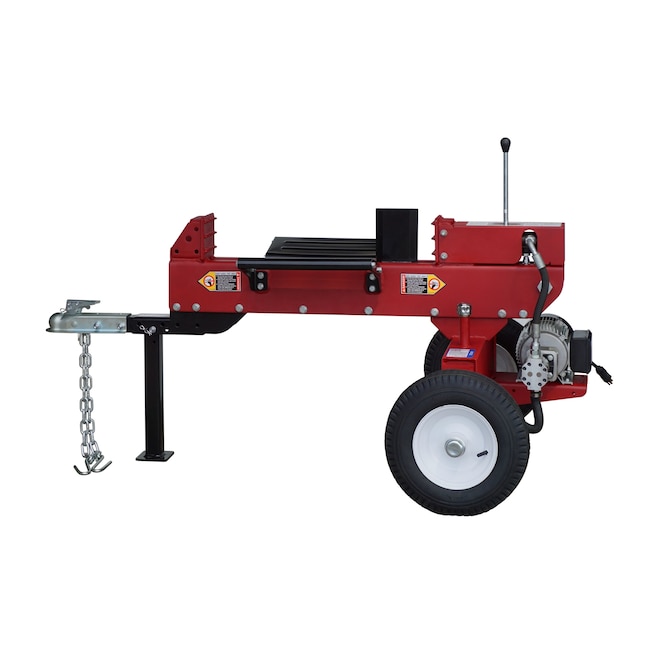
Compact and fast — perfect for straight-grained wood.
5. Swisher LSDD22 Timber Brute 22-Ton
Swisher is a legendary American brand known for rugged outdoor equipment. The LSDD22 “Timber Brute” features a commercial-grade cast iron pump and a heavy-duty steel frame. It’s built like a tank. Unlike many competitors that use generic engines, Swisher often partners with Briggs & Stratton, ensuring parts availability for decades. The integrated log cradle provides superior stability for heavy logs.
pros
- Made in the USA (with global parts)
- Heavy-duty cast iron pump
- Excellent towing stability
cons
- Usually more expensive than imports
- Heavier beam to lift for vertical mode

American-assembled durability for the long haul.
6. SuperHandy 20-Ton Portable
SuperHandy has gained traction for offering innovative designs. Their 20-ton gas model is surprisingly lightweight, utilizing a gear pump system that maximizes pressure while keeping the overall unit weight manageable. It handles logs up to 20 inches in length and features a recoil start that is generally reliable even in colder weather. It’s a great middle-ground choice for those who find the Champion too big but the Boss too small.
pros
- Lightweight design is easy to move by hand
- Good cycle time for the tonnage
- Affordable price point
cons
- Wheels are small; not for highway towing
- Lower hydraulic fluid capacity (runs hotter in long sessions)

A portable powerhouse for the backyard warrior.
7. PowerSmart 22-Ton Dual-Action (Runner-Up)
Runner-Up
The PowerSmart 22-Ton earns its place on this list with one genuinely differentiating feature: a dual-action hydraulic cylinder. Standard log splitters push the ram in one direction and use a spring to retract it. A dual-action cylinder generates splitting force during both the extension and retraction strokes — effectively doubling the number of split opportunities per cycle and dramatically reducing cycle time in use.
This makes the PowerSmart feel faster than its cycle time numbers suggest on paper. It handles logs up to 25 inches long and converts between horizontal and vertical positions. The 200cc engine is a reliable generic-clone unit that is widely serviced. For homeowners who process medium-to-large volumes of straight-grained hardwood, the dual-action advantage is real and tangible.
pros
- Dual-action cylinder for faster effective cycle time
- Handles logs up to 25 inches in length
- Horizontal and vertical operation
- DOT-towable with included ball coupler and safety chains
cons
- Dual-action valve is a potential additional maintenance point
- Some users report assembly instructions could be clearer
- Slightly heavier than comparable single-action 22-ton units
Buyer’s Guide: What Matters in a Gas Splitter?
Investing in a gas splitter is a long-term commitment. Here are the technical specs you need to understand to avoid buyer’s remorse.
1. Tonnage: How Much Is Enough?
Tonnage refers to the maximum force the hydraulic ram applies to the log at its working pressure. Higher tonnage isn’t always better — an oversized splitter wastes fuel and costs more to buy and maintain. Here’s the practical breakdown:
- 16–20 Tons: Sufficient for straight-grained softwoods and small to medium hardwood rounds. Good for occasional residential use with ash, pine, and straight maple.
- 22–25 Tons: The sweet spot for most homeowners. Handles seasoned oak, green maple, and ash up to 24 inches in diameter. Can manage moderate knots.
- 27–30 Tons: Recommended for anyone frequently dealing with green hardwood, knotty rounds, or elm. Rarely stalls on standard residential wood.
- 30–40 Tons: Commercial grade. Necessary for elm, very large diameter rounds (18 inches+), or splitting for profit. Comes with significant fuel and maintenance costs.
2. Cycle Time
Cycle time is how long it takes for the ram to fully extend, contact the log, complete the split, and fully retract — ready for the next log. Average is 13–15 seconds. Under 11 seconds is considered fast. A 3-second difference doesn’t sound like much until you process 200 logs in an afternoon — at that volume, it represents 10 minutes of saved time. Over a full cord of 300–400 rounds, a fast cycle time saves 20–30 minutes of continuous operation.
3. Engine Brand and Displacement (CCs)
Engine displacement (measured in cubic centimeters) gives you a rough proxy for power output, but the brand and design matter significantly. See the detailed engine comparison section below for a full breakdown.
4. Vertical vs. Horizontal Operation
Horizontal operation is faster for logs you can comfortably lift onto the beam — typically anything under 80 pounds. Vertical mode tilts the entire beam upright so you can roll or drag massive rounds under the wedge without lifting them. This is not a luxury feature — it’s a necessity for anyone dealing with large-diameter rounds. Never buy a 25-ton or larger splitter that doesn’t have vertical capability.
5. Log Length Capacity
The beam length determines the maximum log length the splitter can handle. Most residential models accept logs 24–25 inches long, which works well when logs are cut to standard 16-inch firewood length. If you’re processing timber in the field and cutting rounds longer than 20 inches, check the specification carefully.
6. DOT Towing Approval
This matters enormously if you want to tow the splitter to a job site on public roads. DOT-approved models include proper ball coupler sizing (typically 2-inch), safety chains, reflectors, and highway-rated tires. Non-DOT models are rated for off-road towing only, typically at speeds under 10 mph. Towing a non-DOT machine on a highway at 45 mph is both illegal in most states and genuinely dangerous.
Tonnage Deep Dive: Matching Force to Wood Species
One of the most common buying mistakes is either under-buying (getting a 16-ton machine for knotty elm) or over-buying (getting a 35-ton commercial beast for a cord of straight-grained pine per year). This reference table matches recommended tonnage to specific wood species and conditions.
| Wood Species | Condition | Min. Tonnage Recommended | Notes |
|---|---|---|---|
| Pine, Fir, Cedar | Seasoned, straight | 16 tons | Very easy to split; any residential splitter handles this |
| Ash | Seasoned or green | 16–20 tons | Straight grain; one of the easiest hardwoods to split |
| Maple (Hard) | Seasoned | 20 tons | Straight sections split well; crotch wood needs more tonnage |
| Oak (Red) | Seasoned | 22 tons | Dense but typically straight-grained; 20 tons often adequate |
| Oak (White) | Green or knotty | 25–27 tons | Very dense; green white oak is one of the toughest splits |
| Hickory | Any condition | 25 tons minimum | Extremely dense with interlocked grain; stalls under-powered machines |
| Elm (American) | Any condition | 30–35 tons | Interlocked grain makes elm notoriously difficult; 25 tons will stall on large rounds |
| Black Locust | Green | 25–30 tons | Very dense; twisted grain on older trees increases requirement |
| Any species | Crotch wood / knots | Add 5–10 tons to base recommendation | Crotch and knot sections dramatically increase required force regardless of species |
The Knot Multiplier
A round with a significant knot or from a crotch can require 2–3× the tonnage of a clean round from the same species. If you consistently deal with knotty wood, size up your tonnage beyond what seems necessary for straight rounds. A splitter that stalls on every third log is far more frustrating than one slightly over-specified for your average load.
Engine Brand Comparison: Reliability, Parts, and Cold-Weather Starting
The hydraulic system on a log splitter is remarkably simple and durable — pumps and cylinders rarely fail if fluid levels are maintained. The engine is the most likely source of long-term problems. Understanding the engine brands commonly found in residential gas splitters helps you buy with confidence.
Honda GX Series
- Industry gold standard for reliability
- Excellent cold-weather starting
- Parts available everywhere
- Typically adds $200–$400 to the price
- Ideal for professional/daily use
Briggs & Stratton
- American brand with 100+ year history
- Parts available at virtually every hardware store
- Very good reliability with proper maintenance
- Slightly heavier than equivalent Honda
- Ideal for Swisher, Husqvarna, and similar brands
Kohler Command Pro
- Strong commercial-grade reputation
- High power-to-weight ratio
- Excellent longevity when well-maintained
- Less common than Honda/B&S
- Found on some YardMax and mid-range commercial units
Generic “Clone” Engines
- Honda GX clones produced by various Chinese manufacturers
- Found on Champion, WEN, SuperHandy, and others
- Reliable for residential use with proper oil maintenance
- Parts available online but less commonly stocked locally
- Significantly lower cost — usually adequate for 1–2 cords/year
Cold-Weather Starting: What to Know
Gas engines become harder to start as temperatures drop due to thicker oil viscosity and slower fuel vaporization. If you regularly split wood in near-freezing temperatures, these tips significantly improve cold-start reliability regardless of engine brand:
- Switch to a thinner oil (5W-30 synthetic instead of 10W-30) for the cold season. Thinner oil flows immediately on startup, reducing the cranking resistance the pull-starter must overcome.
- Use fresh fuel — gasoline degrades over 30 days. Stale gas is the number one cause of hard starting in seasonal equipment.
- If the machine has been stored, run it briefly in your garage or another warmer location before taking it outside to split.
- Primer bulbs must be pressed the correct number of times — both over-priming (flooding) and under-priming cause failed starts in cold weather.
- Honda GX engines include a decompression valve that significantly reduces pull-cord force required for starting — one reason they are worth the premium for cold-climate users.
Gas vs. Electric Log Splitters: A Complete Head-to-Head
The gas vs. electric question comes up constantly in log splitter discussions, and the answer is genuinely nuanced. There are situations where an electric splitter is the objectively better choice — and situations where gas is the only practical option.
| Factor | Gas Splitter | Electric Splitter |
|---|---|---|
| Maximum Tonnage | Up to 40+ tons available | Typically 5–22 tons max |
| Portability | Excellent — no power cord; towable to job site | Limited by 120V power cord length (typically 50 ft) |
| Noise Level | Loud (85–95 dB) — requires hearing protection | Quiet (65–70 dB) — neighborhood-friendly |
| Maintenance | Regular engine oil, air filter, spark plug, fuel stabilizer | Minimal — hydraulic fluid check only |
| Operating Cost | $0.50–$1.00/hr in fuel | $0.05–$0.10/hr in electricity |
| Indoor Use | Never — CO exhaust hazard | Yes — safe in garage or barn |
| Cold Weather Starting | Requires technique and fresh fuel | Always starts instantly |
| Best For | Field use, large volumes, commercial production, knotty hardwood | Small residential volumes, garage/driveway use, lighter woods |
The Garage Rule
If you consistently split within 50 feet of an electrical outlet — in your driveway, garage, or barn — and your volume is under 2 cords per year, a quality electric splitter (20-ton or higher) is likely the better choice. It starts instantly, requires almost no maintenance, and costs pennies per hour to operate. Gas wins decisively when you need to move to the wood rather than moving the wood to you, or when you’re dealing with large-diameter, very hard rounds that exceed electric capacity.
Choosing Your Splitter Based on the Wood You Burn
The wood species you process most frequently should heavily influence your tonnage and engine choice. Here’s how to match the machine to the fuel.
If You Primarily Burn Softwood (Pine, Fir, Cedar)
Any residential gas splitter from 16 tons upward handles softwood comfortably. The WEN 56208 at 20 tons is genuinely more machine than you need for straight-grained pine and fir. For softwood-primary users, an electric splitter is actually the better recommendation — quieter, cheaper to run, and plenty powerful enough. If you do choose gas, your primary consideration should be portability and cycle time rather than maximum tonnage.
If You Primarily Burn Mixed Hardwood (Oak, Maple, Ash)
This is the scenario that defines the sweet spot of the residential gas market. The Champion 25-ton or a comparable 22–27 ton unit is the correct specification. You’ll have enough force to handle knotty sections without stalling, fast enough cycle times to process a cord in an afternoon, and appropriate fuel consumption for weekend use.
If You Primarily Burn Dense Hardwood (Hickory, Elm, Black Locust)
These species demand serious tonnage. Hickory’s interlocked grain, elm’s notorious splitting resistance, and locust’s extreme density will stall or severely stress any machine below 25 tons. The YardMax 35-ton with its included 4-way wedge is purpose-built for this application. For commercial firewood producers dealing primarily with these species, 35+ tons is not overkill — it’s necessary.
If You’re Splitting Green (Freshly Cut) Wood
Green wood is significantly harder to split than seasoned wood. Moisture content creates hydraulic resistance within the wood fibers, and the bark provides additional resistance to the wedge. As a rule, add 5 tons to your tonnage requirement when splitting any species green versus seasoned. A 20-ton machine that handles seasoned oak perfectly may stall on the same species when freshly cut.
Gas Log Splitter Safety: Rules That Prevent Serious Injuries
A hydraulic log splitter generates enormous crushing force — enough to cause catastrophic injuries to fingers, hands, and limbs. The vast majority of log splitter accidents are entirely preventable and result from inattention, fatigue, or ignoring fundamental safety rules.
The Two-Hand Rule
Every hydraulic log splitter manufactured for residential sale uses a two-handed control lever specifically designed so that both hands must be on the control to operate the ram. This is not a suggestion — it is a mandatory safety design. Never bypass, modify, or work around the two-handed control requirement. One moment of inattention with a single-handed bypass is the mechanism behind most log splitter amputations.
Personal Protective Equipment
- Steel-toed boots — mandatory. A rolling log can break every bone in a foot
- Safety glasses — wood chips and bark fragments travel at high velocity during splits
- Hearing protection — gas engines operate at 85–95 dB, above the OSHA damage threshold for sustained exposure
- Leather work gloves — provide grip on logs and protect against splinters, bark cuts, and minor contact
- Never wear loose clothing, scarves, or untied laces around any powered machinery
Operational Safety Rules
- Position bystanders well clear. Establish a 20-foot exclusion zone around an operating splitter. Split logs can fly unpredictably in any direction during a split, particularly from knotty rounds.
- Never place logs with loose bark or ice on the beam. Bark and ice create unpredictable surfaces that can cause logs to slip sideways during splitting, sending them toward the operator.
- Keep all appendages away from the wedge area during operation. Never use your hand to hold a small piece of wood against the wedge. Use a wooden pushing tool if a piece needs guidance.
- Stop the engine before any adjustment, clearing of jammed wood, or maintenance. Never reach near the wedge while the engine is running, even if the hydraulic lever is in neutral.
- Never operate in vertical mode with a fatigued back. Vertical mode requires bending and positioning rounds on the ground-level wedge, which is hard on the lower back. Use knee pads and take regular breaks.
- Check hydraulic fluid level before every use. Low fluid causes aerated hydraulic oil, which reduces force unpredictably and can cause the ram to move in an uncontrolled manner.
- Never split alone for extended sessions. In the event of an injury, a second person can stop the machine and call for help immediately.
Log Positioning Best Practices
How you position the log on the beam is as important as any safety equipment. Center the log on the beam — an off-center log can slip sideways and jam the wedge or fly off the beam entirely. For rounds larger than 18 inches in diameter, always use vertical mode to avoid the risk of the log rolling off the horizontal beam. When dealing with forked or crotch sections, position the widest part of the fork toward the wedge to allow it to enter the widest gap first, distributing the splitting force.
Maintenance and Service
Gas log splitters combine an engine, fuel system, hydraulic components, high-pressure lines, and moving parts. Maintenance intervals and approved fluids vary by model, so use the exact manufacturer manual for your machine rather than a generic schedule.
- Inspect the machine before use for visible damage, loose hardware, leaks, or worn guards.
- Follow the manufacturer’s specified inspection and service intervals.
- Do not open, modify, or service a pressurized hydraulic system unless you are trained and the manufacturer’s procedure specifically allows it.
- If the ram loses force, drifts, leaks, overheats, or behaves abnormally, stop using the machine and have it inspected by qualified service personnel.
- For seasonal storage, follow the engine and splitter manufacturer’s storage instructions for fuel, battery, fluids, and corrosion protection.
Never improvise repairs to hydraulic hoses, valves, guards, or safety controls. Replacement parts should meet the manufacturer’s specifications.
Must-Have Accessories for Gas Log Splitters
The right accessories dramatically improve your splitting efficiency and extend the working life of your machine. These are the additions most experienced wood processors consider essential.
4-Way Wedge Attachment
This is the single most productivity-enhancing accessory for any log splitter. A 4-way wedge slips over your existing wedge and splits each log into four pieces in a single pass — effectively quadrupling your throughput per cycle. The trade-off is that 4-way wedges require significantly more tonnage (generally 28+ tons minimum, with 35 tons recommended for consistent operation on hardwood). If your splitter has the tonnage to support one, a 4-way wedge is a transformative purchase for high-volume processing.
Log Lifter / Lift Table
Large-diameter rounds can weigh 80–150 pounds. Repeatedly lifting these onto a horizontal beam is exhausting and risks back injury over a long day. A hydraulic log lift table mounts to the splitter and uses a foot pedal to raise the round to beam height, eliminating manual lifting entirely. This accessory is particularly valuable for anyone processing large-diameter oak, elm, or locust.
Log Cradle / Catch Tray
After a split, the two halves of the log fall to the ground unless something catches them. Repeatedly bending to pick up pieces from the ground is one of the most fatiguing aspects of high-volume splitting. A bolt-on log catch tray holds the split pieces at waist height, allowing you to toss them directly onto a pile or into a cart without bending. Some machines (like the Champion) include this; most do not.
Splitting Maul and Wedges
A mechanical splitter handles 95% of your rounds, but the other 5% — particularly crotch sections, extremely large-diameter rounds, and highly knotted pieces — sometimes need a different approach. A quality splitting maul and a pair of steel splitting wedges give you the option to manually work these problem pieces rather than repeatedly stalling or overworking your machine.
Firewood Processor Tray
For serious volume processors, a chain-link or mesh tray that attaches to the side of the beam allows you to pre-load multiple rounds before splitting begins. This eliminates the feed-wait-feed rhythm of one-at-a-time processing and allows a two-person team (one loading, one splitting) to work at sustained high throughput.
Cost and ROI Guide: Is a Gas Splitter Worth the Investment?
A quality gas log splitter represents a significant purchase, typically ranging from $700 to $3,000+ depending on tonnage and features. Whether that investment makes financial sense depends on how much wood you process and what alternatives cost in your area.
The Cost of Not Owning One
Most firewood suppliers charge a meaningful premium for split and delivered wood versus rounds or unsplit wood. If you can access a source of inexpensive unsplit wood — through tree services, municipal programs, timber sales, or your own land — the ability to process it yourself is what captures the value.
| Scenario | Annual Cost Without Splitter | Annual Cost With Splitter | Annual Savings |
|---|---|---|---|
| 2 cords oak, pre-split delivered | $700–$900 | $180 (unsplit rounds + fuel) | $500–$700 |
| 4 cords mixed hardwood, pre-split | $1,400–$1,800 | $350 (unsplit + fuel) | $1,000–$1,400 |
| Own land / free timber source | $1,000–$1,500 delivery + processing | $50–$100 in fuel only | $900–$1,400 |
At $500–$1,400 in annual savings, a quality $1,200 gas splitter pays for itself in 1–2 seasons for a homeowner who heats primarily with wood. Over a 15-year lifespan with proper maintenance, the total value captured can be $7,500–$20,000 in avoided firewood costs.
Renting vs. Buying
For homeowners who process wood once or twice per year rather than continuously, renting may be more economical. Gas log splitter rental rates typically run $75–$150 per day at equipment rental outlets. If you rent twice per year at $120/day, that’s $240 annually — less than the ownership cost for the machine plus maintenance. Renting makes sense if your annual processing volume is under 1 full cord. Above 1–2 cords per year, ownership economics strongly favor purchase over time.
Buy Used, Save Significantly
Gas log splitters are excellent candidates for the used equipment market. The hydraulic system is extremely durable, and the engines — while requiring more care than electric motors — are well-understood, serviceable, and rebuildable. A quality used 25-ton machine in good working order can be purchased for 40–60% of new retail price. Inspect the hydraulic cylinder for chrome scoring, check the engine compression with a compression tester, and confirm the hydraulic fluid is clean and at proper level. A 15-minute inspection protects you from buying someone else’s deferred maintenance problem.
Frequently Asked Questions
What size log splitter do I need for oak?
Oak is a hardwood that becomes very tough when dry. A 22-ton splitter can handle straight-grained seasoned oak, but a 25-ton model is recommended for knotty or green oak rounds. White oak specifically should be split with 25+ tons due to its exceptional density.
Is a 25-ton log splitter big enough?
Yes, for almost all residential users, 25 tons is the sweet spot. It handles green wood, moderate knots, and all common hardwood species without stalling. The only time you need more is when dealing with large-diameter elm, persistent crotch wood, or commercial production volumes.
Can I tow a log splitter on the highway?
Only if it is DOT-approved. Look for models with 2-inch ball couplers, safety chains, and highway-rated tires. Most budget models are for off-road towing only — typically 5–10 mph maximum. Check the specification sheet specifically for DOT approval before assuming any model is highway-legal.
Which hydraulic oil should I use?
Most gas splitters use AW32 or ISO32 hydraulic fluid. In cold climates (below 20°F), you may need a thinner Dexron automatic transmission fluid — check your owner’s manual. Using the wrong viscosity oil causes excessive heat buildup and reduced splitting force.
How much gas does a log splitter use?
A typical 200cc engine runs approximately 2–3 hours per tank under normal residential splitting loads. Heavier loads (knotty hardwood, continuous high-volume splitting) reduce run time. A 1-gallon fuel can is typically sufficient for a full day’s splitting session.
Do gas splitters need to be broken in?
Yes. Almost all manufacturers recommend changing the engine oil after the first 5 hours of use to remove metal particles from the manufacturing break-in process. Skip this step and you’re circulating abrasive metal shavings through the engine during the period when wear is highest.
Can I use a log splitter in the rain?
Light drizzle is generally acceptable — these machines are built for outdoor use. Avoid heavy rain: water entering the fuel tank, hydraulic breather, or air filter causes expensive damage. The electrical components on modern machines with low-oil shutoffs are also vulnerable to water ingress. A simple quick-setup canopy provides adequate protection for extended sessions in variable weather.
What is a 4-way wedge?
A 4-way wedge slips over the standard 2-way wedge and splits the log into four pieces in a single pass. It requires significantly more tonnage (28–35 tons minimum for hardwood) to work effectively. On compatible machines, it is the single most productivity-enhancing accessory available — effectively quadrupling output per cycle on straight-grained wood.
How long does a gas log splitter last?
A quality machine with regular oil changes, clean hydraulic fluid, and proper end-of-season storage can provide 20+ years of reliable service for residential use. The hydraulic cylinder and pump are extremely durable — most failures over a machine’s lifespan relate to the engine (rings, carburetor, valves) rather than the hydraulic system. Budget brands with generic engines may require engine work within 10 years of regular use; premium engines (Honda GX, Kohler Command) routinely last 20+ years with proper maintenance.
Can I split elm with a gas log splitter?
Yes, but elm is notoriously difficult. Its interlocked, swirling grain pattern resists splitting in a way that most other species do not. You need a minimum of 30 tons to split elm reliably, with 35 tons strongly recommended for larger rounds. Even at 35 tons, very large elm rounds may require multiple passes. Splitting elm wet (freshly cut) is generally easier than splitting it dry — if you have elm to process, split it promptly rather than waiting for it to season.
Final Verdict
For most homeowners processing 1–5 cords of mixed hardwood per year, the Champion 25-Ton is the clear winner. It starts easily, tows legally, and has the power to crack gnarly rounds that would stop lesser machines.
If you’re on a tight budget but need gas power, the WEN 56208 is an incredible value that punches well above its weight class. For commercial production or persistently difficult wood like elm or very large-diameter locust, the YardMax 35-Ton is worth every additional dollar.