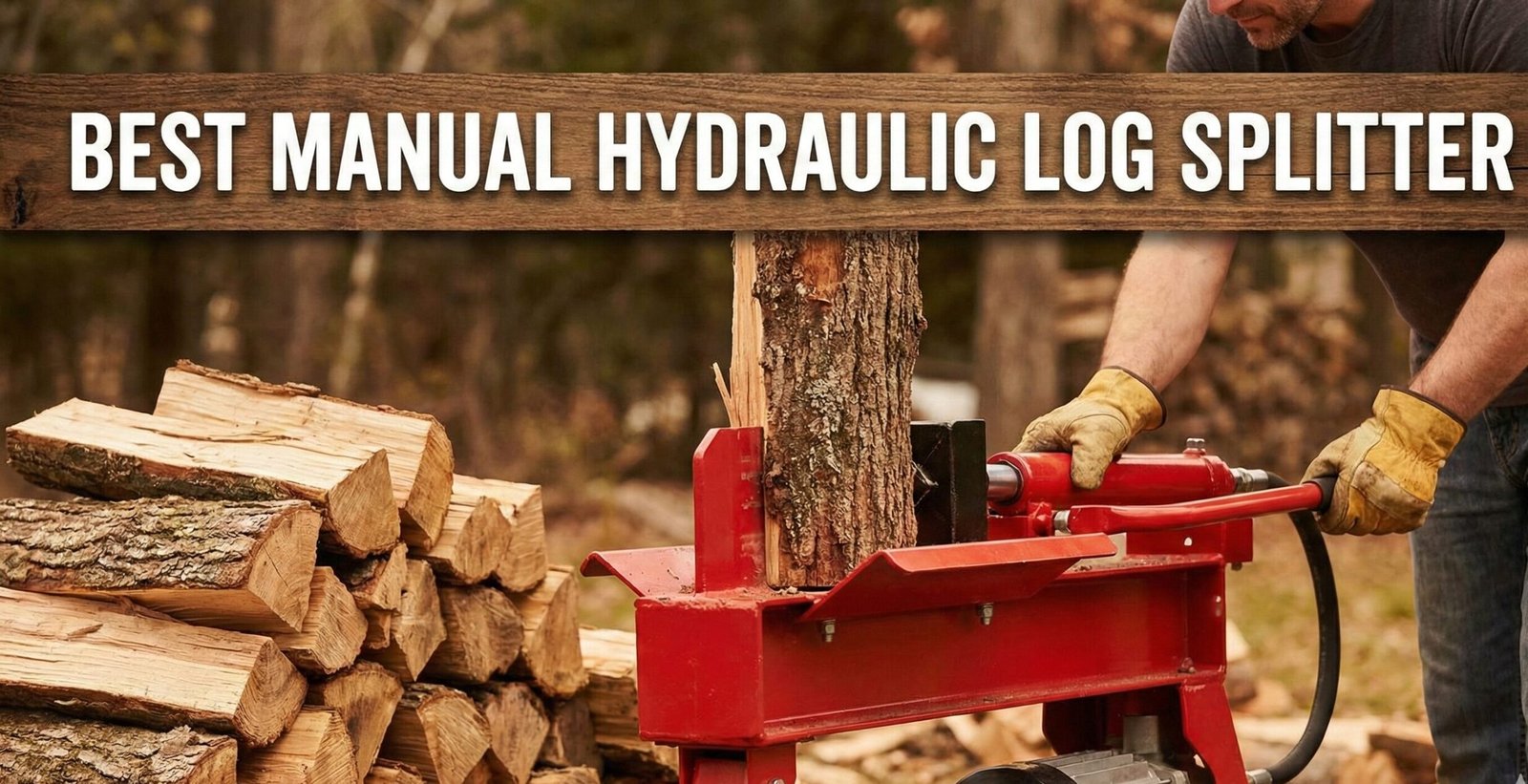
Best Manual Hydraulic Log Splitters: No Gas, No Noise, Just Power
Man using a manual hydraulic log splitter in backyard

Best Manual Hydraulic Log Splitters: No Gas, No Noise, Just Power

Skip the gym membership and the gas fumes. We tested the top manual splitters to find which ones actually crack hardwoods without breaking your back.

⚡ Quick Answer

Best Overall: Sun Joe LJ10M — 10-ton force, 2-speed pump, rear wheels, proven track record for seasoned hardwoods.

Best Value: Goplus 10 Ton — matching 10-ton output at a lower price point. Slightly smaller wheels, equally solid hydraulics.

Best Non-Hydraulic: Estwing Fireside Friend — fastest option for small rounds and kindling; zero maintenance, forged one-piece construction.

10 TonMax force — the minimum for hardwood splitting
2-SpeedPump design for efficiency and power delivery
18″Standard max log length capacity
AW32Correct hydraulic fluid specification
10+ yrsExpected lifespan with proper maintenance

Let’s face it: swinging an axe is romantic for about five minutes. After that, it’s just back pain and danger. But if you don’t split enough wood to justify a $1,500 gas-powered beast, where do you turn?

Enter the manual hydraulic log splitter. These tools bridge the gap between the exhausting axe and the expensive gas splitter. They are quiet, require zero fuel, and can generate up to 10 tons of splitting force — enough to crack seasoned oak and maple. Whether you are prepping the best firewood for your fireplace or just need kindling for the wood stove, we’ve analyzed the full market to bring you the definitive guide.

⚡ Quick Decision Guide

CategoryModelWhy We Love It
🏆 Best Overall Sun Joe LJ10M Proven 10-ton force, durable steel frame, 2-speed pump, excellent warranty.
💰 Best Value Goplus 10 Ton Simple, rugged design with high tonnage at a budget price.
💪 Heavy Duty Harbor Freight Central Machinery Industrial feel, wide log cradle, locally available parts.
🔩 Longest-Lived Bilt Hard Horizontal Over-engineered hydraulic seals; handles knotty, dense hardwoods best.
⚡ Kindling King Estwing Fireside Friend One-piece forged tool — fastest for small rounds, zero maintenance.

Why Choose a Manual Hydraulic Splitter?

Manual hydraulic splitters occupy a specific and valuable niche. Understanding who they are — and are not — designed for prevents expensive buyer’s remorse.

If you have 5 or more cords of wood to split before winter, a gas splitter is the right tool. If you split a single cord or less per season, or split opportunistically throughout the year rather than all at once, a manual hydraulic splitter delivers dramatically better value and convenience. Here is why:

🔇

Complete Silence

No engine noise. Split wood at 7am on a Sunday without disturbing a single neighbor. Usable in residential zones with noise ordinances.

🏠

Indoor-Safe

Zero combustion fumes means you can operate in a garage, shed, or barn — critical during wet weather when outdoor splitting isn’t practical.

🛡️

Inherently Safe

Slow, controlled ram movement eliminates the flying debris and glancing-blow risks of axe splitting. The log is captured and controlled throughout the split.

💲

Low Total Cost

No fuel costs. No carburetor maintenance. No spark plugs. One hydraulic fluid top-off per season. A manual splitter has the lowest operating cost of any powered splitting method.

📦

Compact Storage

Folds to a small footprint and can be stored vertically against a garage wall — unlike a gas splitter, which requires a dedicated horizontal storage space and fuel stabilizer management.

♻️

Always Ready

No battery to charge, no gasoline to go stale, no pull-start engine that won’t fire in cold weather. If you have hydraulic fluid and two hands, it works.

Manual Hydraulic vs. Gas vs. Electric: The Full Comparison

Before committing to a manual splitter, it helps to understand exactly where it sits in the broader splitting ecosystem. Each power source has a specific sweet spot of cord volume, budget, and use case.

Manual Hydraulic

Up to ~2 cords/season

Silent, fume-free, garage-safe. 10-ton max force. Slower cycle time but lowest total ownership cost. Best for casual to moderate firewood users.

Electric Splitter

2–5 cords/season

Requires power outlet within reach. 4–7 ton force typical. Faster cycle than manual, moderate noise, still fume-free. Mid-range purchase price.

Gas Splitter

5+ cords/season

Maximum force (25–35 ton), fastest cycle time, fully portable. High purchase price ($800–$2,500+), fuel costs, carburetor maintenance, significant noise. For serious volume.

PropertyManual HydraulicElectricGas
Typical Force 10 ton 4–7 ton 22–35 ton
Cycle Time ~30–60 sec/log ~10–20 sec/log ~3–10 sec/log
Noise Level Near silent Moderate Loud (85–95 dB)
Fumes None None CO/exhaust
Indoor Use Yes Yes (with outlet) Never
Purchase Price $120–$300 $300–$600 $800–$2,500+
Annual Operating Cost ~$5 (hydraulic fluid) ~$20–$50 (electricity) $60–$150+ (fuel + maintenance)
Storage Footprint Small (folds upright) Medium Large (requires horizontal space)

ℹ️ The “Electric Is Better” Misconception

Many buyers assume electric splitters are superior to manual hydraulic because they are “powered.” In reality, most consumer electric splitters deliver only 4–6 tons of force — significantly less than a 10-ton manual hydraulic model. For splitting seasoned hardwood, a 10-ton manual splitter will outperform a 5-ton electric every time.

How Manual Hydraulic Log Splitters Work

Understanding the mechanics of your tool makes you a better operator and a better troubleshooter. Most homeowners use these machines for years without understanding why the two-lever system exists or how the hydraulic circuit functions.

The Two-Speed Pump System Explained

The defining feature of a quality manual hydraulic splitter is the two-speed pump. Here is the physics: moving a hydraulic ram through 14 inches of empty air requires very little force but a lot of fluid volume. Delivering 10 tons of crushing force requires very little fluid volume but very high pressure. These two requirements are physically incompatible in a single pump stage — which is why the two-lever design exists.

  • First Lever (Fast Advance): Operates a large-displacement, low-pressure pump. Each pump stroke moves a high volume of hydraulic fluid, advancing the ram rapidly across the gap between the wedge and the log. This stage generates low force — enough to contact the wood, but not enough to crack it.
  • Second Lever (Power Stroke): Switches to a small-displacement, high-pressure pump. Each stroke moves less fluid but at significantly higher pressure. This is where the 10-ton force is generated. The ram advances slowly but with enough force to split even dense, knotty rounds.

A single-speed pump must compromise — it is either slow and powerful (tedious for positioning) or fast and weak (insufficient for hard splits). Always avoid single-lever “budget” models if you plan to split anything harder than seasoned softwood.

The Return Mechanism

After a split, the ram must retract to the home position for the next log. On most manual splitters, retraction is handled by a heavy-duty return spring. When you release the power lever, a spring-loaded valve opens, and the return spring mechanically retracts the ram while pushing hydraulic fluid back into the reservoir. The quality of this return spring is often what differentiates a pleasant-to-use splitter from a frustrating one — stiff, weak, or broken return springs are the most common cause of slow cycle times and operator fatigue.

The Hydraulic Wedge: Geometry Matters

The splitting wedge is not just a sharp edge — its geometry is carefully designed. The wedge angle determines how the wood fibers separate. A narrower angle (more acute point) requires less initial force to enter the wood grain but may bind in very dense rounds. A wider wedge angle requires more initial force but is more effective at driving apart knotty sections where the grain changes direction. Most consumer manual splitters use a compromise angle of approximately 25–35 degrees that performs acceptably across most wood species.


🏆 Best Overall 10 Ton Force 2-Speed Pump Rear Wheels

1. Sun Joe LJ10M Logger Joe (Top Pick)

Editor’s Choice

The Sun Joe LJ10M is widely considered the gold standard for manual hydraulic splitters. With 10 tons of driving force, it handles logs up to 18 inches long and 8 inches wide — though it can crack wider rounds if you work the edges first on knotty pieces.

It features a two-speed pump system: use the rapid lever to move the ram quickly to the log, then switch to the power lever to deliver the crushing force. It is built from solid steel and feels exceptionally stable on level ground. The rear wheel design makes repositioning between splitting sessions straightforward — no lifting required. The Sun Joe’s track record across multiple seasons of heavy use makes it the clear choice for homeowners who want to buy once and use for years.

Pros

  • True 10-ton splitting force
  • 2-speed pump for efficient operation
  • Rear wheels for easy maneuverability
  • Great for seasoned hardwoods
  • Strong customer service reputation

Cons

  • Slower cycle time than gas models
  • Return spring can be stiff initially
  • Flue cover may need extension for very tall ceilings
Sun Joe LJ10M Log Splitter

Get the most reliable manual splitter on the market today.

Check Price on Amazon
💰 Best Value 10 Ton Force Budget-Friendly

2. Goplus 10 Ton Hydraulic Log Splitter (Best Value)

Best Value

The Goplus 10 Ton splitter is a robust competitor to the Sun Joe, frequently coming in at a lower price point while maintaining the essential 10-ton splitting force. It utilizes a similar two-lever mechanism that enables speed during positioning and maximum force during the power stroke.

Constructed with a heavy-duty steel frame, the Goplus is designed for durability. Users consistently appreciate the straightforward assembly and the fact that it is ready to tackle various firewood types immediately. The paint finish is less premium than the Sun Joe, but the hydraulic mechanics are comparably solid. For buyers who want 10-ton performance without paying a premium price, this is the clear choice.

Pros

  • High 10-ton crushing power
  • Simple, reliable two-handle operation
  • Compact storage footprint
  • Excellent value for the price

Cons

  • Small, hard wheels struggle on gravel surfaces
  • Assembly instructions can be slightly vague
Goplus 10 Ton Log Splitter

Professional splitting power at a budget-friendly price.

Check Price on Amazon
🏪 Local Parts Heavy Steel Build 10 Ton

3. Harbor Freight Central Machinery 10 Ton

If you have a Harbor Freight nearby, you’ve likely seen this orange machine. The Central Machinery 10-ton splitter is a workhorse. It is heavy, simple, and effective — and its biggest advantage is local availability.

While it lacks the refined finish of the Sun Joe, it compensates with brute durability. The hydraulic seals are generally reliable, and parts are easy to source locally if you are mechanically inclined. The return spring action is slightly more sluggish compared to the Sun Joe or Goplus models, which makes the cycle feel slower — but the splitting force is equivalent. For buyers who value the ability to walk into a store for warranty service or replacement parts, this is a compelling option.

Pros

  • Easy local availability for parts and returns
  • Heavy steel construction
  • Adjustable ram positioning

Cons

  • Paint tends to chip easily
  • Heavier to move around the yard
  • Slower return spring action than competitors

Rugged durability for the weekend warrior.

Check Latest Price
🔩 Industrial Seals Farm Store Grade Stable on Uneven Ground

4. Bilt Hard Horizontal Manual Hydraulic

The Bilt Hard is built for longevity. The hydraulic cylinder on this unit feels deliberately over-engineered — it is unlikely to blow a seal even when pushed hard on a knotty piece of dense oak or elm. It is especially well-suited for users who understand the difference between seasoned vs. unseasoned firewood and will be working with fully dried hardwood rounds.

The wider base stance provides excellent stability on uneven terrain — a meaningful advantage when splitting in a dirt-floor barn or on irregular ground. The tradeoff is weight: it is noticeably heavier than the Sun Joe or Goplus, making it less convenient to reposition between sessions but more stable during each split.

Pros

  • Industrial-grade hydraulic seals
  • Heavy-duty steel beam construction
  • Very stable on uneven ground
  • Handles knotty rounds better than lighter models

Cons

  • Significantly heavier than competitors
  • Slower cycle time between splits

Industrial-grade seals for long-lasting performance.

SuperHandy Log Splitter Check Price on Amazon
⚡ Fastest for Kindling One-Piece Forged Zero Maintenance

5. Estwing Fireside Friend (The “Manual” Manual)

Best Non-Hydraulic

This isn’t hydraulic. But for many people searching for “manual splitters,” this is actually what they need. If your logs are already small or you are primarily making kindling, a hydraulic splitter’s setup and cycle time is too slow to be practical.

The Estwing Fireside Friend is a 4-pound splitting maul and sledge hybrid, forged in a single piece with no joint between head and handle. For small rounds under 6 inches, this is faster than any hydraulic machine — no pumping, no positioning, no return cycle. One swing. It is completely indestructible under normal use because there is no handle-to-head joint to fail, which is the primary failure point of traditional wooden-handled mauls.

Pros

  • Zero maintenance required
  • Forged in one piece — no handle failures
  • Fastest method for small logs and kindling
  • Compact and easy to store anywhere

Cons

  • Requires physical swinging — not suitable for those with back or shoulder limitations
  • Not practical for large, knotty logs over 8 inches
Estwing Fireside Friend

The fastest solution for kindling and small logs.

Check Price on Amazon

📚 Full Buyer’s Guide: What to Look For

Not all hydraulic splitters are equal. Here is every specification you need to understand before purchasing.

1. Tonnage (Splitting Force)

Tonnage is the single most important specification. It determines what wood species and diameters the splitter can handle. The 10-ton rating on quality models is not marketing — it is a hydraulic physics calculation based on cylinder bore diameter and pump pressure rating.

  • 5-ton models: Adequate for softwoods (pine, fir, cedar) up to about 6 inches diameter and straight-grained rounds. Struggles badly with knots, interlocked grain, or anything over 8 inches.
  • 10-ton models: The correct choice for all hardwoods — oak, maple, hickory, ash. Handles most rounds up to 10–12 inches if the wood is well-seasoned. Stalls on very large diameter (14″+) rounds with complex grain patterns.
  • 15-ton+ models: Available in some manual hydraulic configurations for splitting firewood from large-diameter trees. The pumping effort required per stroke increases significantly. Best reserved for very experienced users who frequently process large rounds.

2. Two-Speed Pumps: Non-Negotiable

A two-speed pump is not a luxury feature — it is the difference between a usable tool and a frustrating one. Single-speed pump models exist at lower price points, but their cycle times are so slow (often 3–5 minutes per log including repositioning) that the productivity advantage over an axe disappears entirely.

With a two-speed pump, a practiced operator can split a well-seasoned 8-inch oak round in approximately 45–75 seconds including reset. Without it, that same log could take 3–4 minutes of continuous pumping. Over a session of 50 logs, this difference amounts to more than 2 hours of extra work.

3. Log Capacity: Length and Diameter

Standard manual hydraulic splitters accommodate logs up to 18 inches long and 8–10 inches in diameter. These specifications are constrained by the hydraulic ram’s stroke length and the physical throat width between the wedge and the log cradle. Before purchasing, measure the average length of rounds you will be splitting from your wood source. If your wood stove or fireplace requires 16-inch lengths, a splitter with an 18-inch capacity gives you minimal working margin — consider whether sizing up is possible.

Diameter is the more commonly underestimated constraint. A freshly bucked white oak at 14 inches across the face is a very different challenge than an 8-inch red maple. If you regularly process large-diameter logs from fallen trees rather than purchasing pre-cut rounds, ensure the splitter’s rated maximum diameter covers what you will actually encounter.

4. Frame Construction and Weld Quality

The frame must withstand repeated 10-ton hydraulic loads without flexing, cracking, or deforming at the weld points. Key areas to assess — either from photos or in person — are the weld joints at the beam-to-base connection and the cylinder mounting bracket. These are the highest-stress points in the structure. Clean, full-penetration welds with no visible gaps or porosity indicate quality construction. Spot welds or partial welds at these locations are a warning sign that the frame may crack under repeated use.

5. Hydraulic Cylinder and Seal Quality

The hydraulic cylinder is the most expensive component to replace if it fails. Quality cylinders use hardened steel rod, precision-machined bore walls, and multi-lip seals that maintain pressure under sustained load. Budget models sometimes use softer steel and single-lip seals that develop bypassing (internal leakage) after 100–200 splitting cycles. Signs of cylinder quality include chrome-plated rod surface (visible as a mirror finish on the exposed section of the ram) and a heavier wall cylinder body.

6. Footprint and Wheel Design

You will reposition your splitter dozens of times per splitting session. Wheels that are too small — typically under 6 inches in diameter — dig into soft ground, dirt paths, and grass rather than rolling over them. For backyard use on grass or soft earth, look for larger-diameter wheels (8 inches or more) with a wider tire to distribute the weight. If you exclusively use the splitter on a concrete garage floor, wheel quality matters less.

Wood Species Splitting Guide: What You Will Actually Encounter

Understanding your wood species before you start splitting is not just intellectual preparation — it directly determines the correct technique, the expected effort level, and whether a manual hydraulic splitter is the right tool for the job or whether you need a more powerful alternative.

SpeciesJanka HardnessSplitting DifficultyManual Splitter Suitable?Notes
White Pine 420 lbf Easy Yes — 5-ton sufficient Splits cleanly along straight grain. Ideal for kindling.
Douglas Fir 620 lbf Easy Yes — 10-ton ideal Straight grain. Resinous — seasons quickly.
Red Maple 950 lbf Moderate Yes — 10-ton handles well Occasional interlocked grain at branch unions.
Ash 1,320 lbf Moderate Yes — splits very cleanly Notably straight, predictable grain. Splits beautifully even green.
Red Oak 1,290 lbf Moderate Yes — if well-seasoned Season fully (min. 12 months). Green oak is extremely difficult manually.
White Oak 1,360 lbf Hard Yes — with patience, dry only Work from edges inward on wide rounds. Do not attempt green.
Hickory 1,820 lbf Very Hard Possible — 2+ seasons dry Dense, stringy fibers. Works best if bucked to shorter lengths.
Elm 830 lbf Very Hard Not recommended Highly interlocked grain. Notoriously resistant to splitting by any manual method.
Black Locust 1,700 lbf Very Hard Possible if dry, small diameter High BTU value makes the effort worthwhile. Keep rounds under 8″.

⚠️ The Elm Problem

Elm is notoriously the most difficult North American hardwood to split by any manual method. Its grain is highly interlocked — the fibers spiral and interweave rather than running parallel — which means splitting force tends to compress and shear the fibers rather than separating them cleanly. Even gas-powered splitters at 25+ tons struggle with large-diameter elm. If you have elm to process, use a gas splitter or a splitting axe after the wood has dried for at least two full seasons.

Safety Guide: Manual Splitter Operation

Manual hydraulic splitters are dramatically safer than axes or gas splitters for most users. The slow, controlled ram movement eliminates the glancing-blow and miss-swing risks that cause the majority of axe injuries. However, they introduce their own specific hazard categories that must be understood before first use.

Personal Protective Equipment

  • Steel-toed boots — required. Logs will roll off the cradle unexpectedly.
  • Eye protection — flying wood chips and bark fragments are common during the final crack of a split.
  • Work gloves — protects against splinters from rough bark, not required for operation but recommended for log handling.
  • No loose clothing — specifically no loose shirt cuffs, scarves, or laces near the ram mechanism.

Positioning and Stability

  • Always operate on a flat, stable surface. A splitter that tips during a power stroke can cause hydraulic line stress or injury.
  • Keep both hands on the pump levers during the power stroke — never place a hand on the log while the ram is advancing.
  • Keep bystanders — especially children — at least 10 feet back. Split wood can fly unpredictably when a round finally gives.
  • Never stand directly in line with the ram when pumping. Stand slightly to the side.

Hydraulic Pressure Safety

🚨 Never Work Under Raised Hydraulic Load

If the ram stalls on a particularly stubborn log and will not advance further, do not attempt to adjust the log while the hydraulic system is under pressure. Release the pressure by returning the lever to neutral first, then reposition the log. A hydraulic line under maximum pressure that suddenly releases can cause serious hydraulic fluid injection injury if a fitting fails near your hand.

Cold Weather Operation

Standard AW32 hydraulic fluid has a pour point of approximately -20°F, meaning it remains pumpable in very cold conditions. However, viscosity increases significantly in cold weather — the fluid becomes thicker, which increases pumping resistance and reduces effective force delivery. If operating in temperatures below 20°F, allow the splitter to warm up in a heated space for 30 minutes before use, or consider switching to a lower-viscosity hydraulic fluid (AW22) during winter months.

Wood Seasoning and Optimal Splitting Timing

The relationship between wood moisture content and splitting difficulty is one of the most misunderstood aspects of firewood preparation. Knowing when to split and when to wait makes a significant difference in the effort required and the quality of the end result.

The Freshly Cut (Green) vs. Seasoned Debate

The firewood community is genuinely divided on whether to split wood green (immediately after felling) or after initial air drying. The correct answer depends on the species:

ApproachBest ForAdvantageDisadvantage
Split Green (Fresh) Ash, maple, most softwoods Easier to split before cell walls harden. Speeds seasoning by increasing surface area. Heavier to handle. Sap can clog saw chains. Not suitable for elm or hickory.
Split Dry (Seasoned) Oak, hickory, black locust Harder species become more brittle and split more cleanly after drying. Less physical effort. Rounds must be stored whole (space-intensive) before splitting. Round bark can harbor insects during storage.

Moisture Content: The 20% Target

Properly seasoned firewood for burning should have a moisture content below 20% — ideally between 15% and 18%. At this moisture level, the wood burns efficiently, produces maximum BTU output per cord, and generates significantly less creosote in the flue. Wet wood above 25% moisture burns inefficiently, produces dense smoke, and is the primary cause of rapid Stage 2 and Stage 3 creosote accumulation that leads to chimney fires.

A basic wood moisture meter — available for under $20 at any hardware store — takes all the guesswork out of this. Insert the two probes into a freshly split face (not the outer bark surface) and read the percentage directly. Do not use wood that reads above 20% for your fireplace. If you need better firewood guidance, our complete guide on the best firewood for your fireplace covers species selection, BTU comparisons, and storage methods in full detail.

Seasoning Timeline by Species

  • Softwoods (pine, fir, cedar): 6 months minimum, ideally 9 months when split to stove-length pieces and stacked with airflow.
  • Light hardwoods (ash, maple): 9–12 months when split promptly after felling.
  • Dense hardwoods (oak, hickory): 18–24 months minimum. Oak split at 12 months will typically still be above 25% moisture content on the interior. Many experienced wood-burners season oak for 2 full years before burning.

✅ Stack Smart for Faster Seasoning

Stacking split wood bark-side up (not bark-side down) allows moisture to escape from the cut faces rather than being trapped under bark. A single row stack with 6 inches of separation from any wall or fence, with good overhead sun exposure and cross-air flow, will season 30–40% faster than a pile dumped in a shaded, humid corner. Always use a cover that shields the top but leaves the sides open — a completely covered stack with no airflow actually slows drying.

Splitter Storage and Winter Preparation

A manual hydraulic log splitter stored incorrectly between seasons is one of the most common causes of hydraulic system failure. The investment of 20 minutes of proper storage preparation extends the tool’s life by years.

End-of-Season Storage Checklist

  1. Clean the Exterior Thoroughly

    Remove all wood debris, bark fragments, and sap deposits from the beam, cylinder, and wedge. Sap is mildly acidic and will attack paint and metal finishes over a winter of contact. A pressure washer works well — allow the splitter to dry completely before the next steps.

  2. Inspect All Hydraulic Fittings

    Check every hydraulic line connection for weeping oil or visible wetness. A fitting that weeps slowly during use may appear dry after cleaning but will develop into a significant leak over winter. Address any suspect fittings before storage.

  3. Check and Top Off Hydraulic Fluid

    Open the reservoir fill cap (typically located on the pump body) and verify the fluid level is at the full mark. Top off with fresh AW32 hydraulic oil if needed. If the existing fluid appears dark brown or black rather than amber, drain and replace it entirely before storage — degraded fluid causes accelerated seal wear.

  4. Retract the Ram Fully and Close the Bleed Screw

    Cycle the ram to the fully retracted position before storage. This minimizes the exposed chrome rod surface area, reducing the risk of surface rust during humid storage months. Ensure the bleed screw is fully closed — an open bleed screw allows atmospheric moisture to enter the hydraulic circuit, which promotes rust inside the cylinder bore over winter.

  5. Apply a Light Oil Coat to Exposed Metal Surfaces

    Wipe the wedge, the exposed ram rod, any bare steel beam surfaces, and the spring coils with a light penetrating oil (WD-40 or equivalent). This displaces moisture and forms a protective film against winter condensation cycles.

  6. Store Indoors or Under Cover

    The single most effective storage practice is simply keeping the splitter out of the weather. A garage, barn, or shed is ideal. If outdoor storage is unavoidable, use a breathable cover (not a sealed plastic tarp) that sheds rain but allows humidity to escape rather than concentrating beneath the cover.

🛠️ Maintenance and Troubleshooting

Manual splitters are low maintenance — but not zero maintenance. Here is the complete guide to keeping yours running for decades.

Annual Maintenance Schedule

  • Check hydraulic fluid level and color before first use each season
  • Inspect all hydraulic fittings for seeping oil
  • Test return spring for smooth, complete retraction action
  • Check wedge for rolling or chipping — resharpen if needed
  • Inspect wheel axle bolts for tightness
  • Touch up any rust spots with rust-inhibiting primer paint before they spread
  • Drain and replace hydraulic fluid every 2–3 seasons or when it appears dark/contaminated
IssueLikely CauseThe Fix
Ram won’t move Air trapped in the hydraulic lines Open the bleed screw and pump the handle repeatedly to release trapped air. Close bleed screw before resuming use.
Loss of splitting power Low hydraulic fluid level Check the reservoir and top off with AW32 hydraulic oil. Also check for leaking fittings that caused the fluid loss.
Ram moves but jerky/inconsistent Air in lines or degraded oil Bleed the system first. If the oil appears dark brown or smells burnt, drain completely and refill with fresh AW32.
Ram advances but won’t return Weak or broken return spring Inspect the return spring coils for cracks or deformation. Replace the spring — it is an inexpensive consumable part available from most major suppliers.
Oil leaking from around the ram Worn piston rod seal (lip seal) A hydraulic seal kit for the specific cylinder model is required. Replacement is a moderate DIY task requiring a clean work environment and basic hand tools.
Very slow cycle even on fast lever Thick fluid in cold weather or low fluid level In cold weather, allow the unit to warm up indoors. Otherwise, check fluid level. Consider switching to AW22 for winter operation in very cold climates.
Splitter tips during use Uneven ground or off-center log positioning Always operate on level ground. Position logs centered on the beam, not hanging off one side. Use wedges under the base feet if the ground is slightly uneven.

⚠️ Storage Pro Tip

Always store your splitter with the bleed screw fully closed to prevent atmospheric moisture from entering the hydraulic fluid. Rust contamination inside the cylinder bore is the single most common cause of premature seal failure and is entirely preventable with this one habit.

Hydraulic Fluid Complete Guide: Selection, Change, and Disposal

Hydraulic fluid is the lifeblood of your splitter. Most homeowners fill it once at purchase and never think about it again — until something fails. Understanding the fluid’s role, the correct specifications, and the change interval prevents the most common causes of splitter failure.

Understanding AW32 Hydraulic Oil

AW32 hydraulic oil is the industry standard specification for manual and light-duty hydraulic equipment. The “AW” designation stands for Anti-Wear — the oil contains additives that form a protective film on metal surfaces under high-pressure contact, preventing direct metal-to-metal contact between the pump components and cylinder bore. The “32” is the ISO viscosity grade, approximately equivalent to SAE 10W weight oil. This viscosity provides the correct balance of pump-ability in cold conditions and adequate film strength under maximum operating pressure.

When to Change the Hydraulic Fluid

Unlike an automobile engine, manual splitters have no hour meter to track service intervals. Use these condition-based indicators instead:

  • Fluid appears dark brown or black instead of amber — indicates thermal degradation and oxidation
  • Fluid appears milky or cloudy — water contamination, typically from condensation when the bleed screw was left open during storage
  • Fluid smells burnt or acrid — high-temperature breakdown of the anti-wear additives
  • Splitter has been in service for more than 3 full seasons without a fluid change
  • Any hydraulic fitting replacement or seal repair that exposed the circuit to air or contamination

How to Change Hydraulic Fluid: Step by Step

  1. Position for Full Drain

    Tilt the splitter beam slightly downward at the cylinder end (prop up the pump end) to allow full drainage from the cylinder into the reservoir. Place a drain pan with at least 1-gallon capacity under the reservoir drain plug.

  2. Open the Bleed Screw and Remove the Fill Cap

    Open both the bleed screw and the reservoir fill cap before opening the drain plug. This allows air to enter from above as fluid drains below, preventing a vacuum lock that slows or stops drainage.

  3. Remove the Drain Plug and Drain Completely

    Allow full drainage for 10–15 minutes. Dark, thick fluid may drain slowly. Do not reinstall the drain plug until no more fluid is dripping.

  4. Refill with Fresh AW32

    Reinstall the drain plug snugly but not over-torqued. Fill through the reservoir fill opening with fresh AW32 to the marked full level. Close the fill cap. Close the bleed screw.

  5. Bleed the System of Air

    Operate the splitter through 5–10 full extend-and-retract cycles with no load on the wedge. This circulates fresh fluid through all circuit passages and purges any air introduced during the change. Check the fluid level again after bleeding and top off if needed.

Hydraulic Fluid Disposal

Used hydraulic fluid is a regulated waste product and must not be poured down a drain, into soil, or into the household trash. Most auto parts stores (AutoZone, O’Reilly, NAPA) accept used hydraulic fluid for recycling at no charge — they process it alongside used motor oil. Many municipal waste facilities also have used oil drop-off programs. A typical splitter change generates less than one quart of used fluid.

✅ Compatible Alternatives to AW32

If AW32 is unavailable, the following are acceptable direct substitutes: Dexron III or Dexron VI automatic transmission fluid (ATF), ISO VG 32 hydraulic oil from any brand, or 10W motor oil in a pinch for a season. All of these fall within an acceptable viscosity and anti-wear additive range for manual hydraulic splitters. Do not use power steering fluid, brake fluid, or penetrating oils (WD-40) as hydraulic fluid substitutes — these are incompatible with the rubber seals used in hydraulic cylinders.

Frequently Asked Questions

Can manual splitters handle green wood?

It depends on the species and the tonnage. A 10-ton manual splitter handles green softwood (pine, fir, cedar) reasonably well. Green light hardwoods like ash split surprisingly cleanly even fresh-cut. Green dense hardwoods — oak, hickory, black locust — are a different story. Their cellular structure holds significantly more moisture and their fiber structure has not yet dried to the more brittle state that aids splitting. The result is a wood that compresses under the wedge rather than cracking. For best results with hardwoods, let the wood dry for at least one full season before attempting to split with a manual hydraulic tool.

What kind of oil do I need?

Most manual splitters use AW32 hydraulic fluid — also called ISO VG 32 hydraulic oil. It is available in one-quart and one-gallon containers at any auto parts store, home improvement store, or farm supply retailer for approximately $8–$15 per quart. Do not use motor oil, power steering fluid, or brake fluid as substitutes. If AW32 is unavailable, Dexron III/VI automatic transmission fluid is an acceptable temporary substitute. For cold-weather operation below 20°F, consider AW22 hydraulic fluid, which maintains better flow characteristics at low temperatures.

Are they faster than an axe?

For large, dense, or knotty logs — no. A skilled axeman working with a properly tuned splitting maul can outpace a manual hydraulic splitter on straight-grained softwood. However, for large-diameter hardwoods, knotty rounds, or any log that would require multiple axe strikes or repositioning, the hydraulic splitter is faster per log because it applies consistent, sustained force regardless of grain direction. The hydraulic splitter’s real advantage is not speed — it is consistency, safety, and the ability to work for 2–3 hours without physical exhaustion, which an axeman cannot match.

Can I use it vertically?

Most manual hydraulic splitters are designed strictly for horizontal operation. The hydraulic oil reservoir and pump pickup tube are designed to draw oil from the bottom of a horizontally-oriented reservoir. When tilted vertically, the oil level shifts away from the pump pickup, causing oil starvation — the pump draws air instead of oil, which causes cavitation damage to the pump internals. Never operate a manual hydraulic splitter in an orientation that the manufacturer has not specified as approved. Some specific models are designed for convertible horizontal/vertical operation — check your manual before attempting it.

How long do they last?

With proper storage out of weather and seasonal hydraulic fluid maintenance, a quality manual hydraulic splitter easily lasts 10–15 years of typical homeowner use. The components most likely to require replacement over this period, in order of probability, are: the return spring, the pump shaft seal (where the lever enters the pump body), and the cylinder rod seal. All three are inexpensive consumable parts that most mechanically inclined owners can replace themselves with basic tools and a $15–$25 seal kit.

Can I sharpen the wedge myself?

Yes, and it is worth doing every few seasons. A dull wedge requires more hydraulic force to enter the wood grain, which increases the load on the cylinder seals and reduces efficiency. Use an angle grinder with a metal-grinding disc to restore the original bevel angle. The correct approach is to grind both sides of the wedge symmetrically, maintaining the same included angle as the factory finish (typically 25–35 degrees). Finish with a coarse file to remove any burrs from the grinding process. Do not sharpen to a razor edge — a slightly rounded apex is more durable and resists rolling better than a very sharp thin edge.

What is the most difficult part of operating a manual splitter?

For most users, the most fatiguing aspect is not the splitting stroke itself but the repeated bending and lifting to position logs on the beam cradle and clear split pieces from around the work area. Reducing this by setting the splitter at an ergonomic working height — using a solid wood block or purpose-built stand to raise the beam to approximately hip height — dramatically reduces fatigue over a long splitting session. This single ergonomic adjustment is the most frequently overlooked improvement for homeowners who find manual splitting tiring.

Final Verdict

If you want the best blend of power, reliability, and ease of use, the Sun Joe LJ10M is the clear winner. Its two-speed pump, rear wheel design, and proven track record make it the gold standard for manual hydraulic splitting — season after season.

For those on a tighter budget, the Goplus 10 Ton delivers matching 10-ton performance at a lower price point. For kindling and small rounds, the Estwing Fireside Friend is genuinely faster than any hydraulic machine.


Shop Top Picks on Amazon