
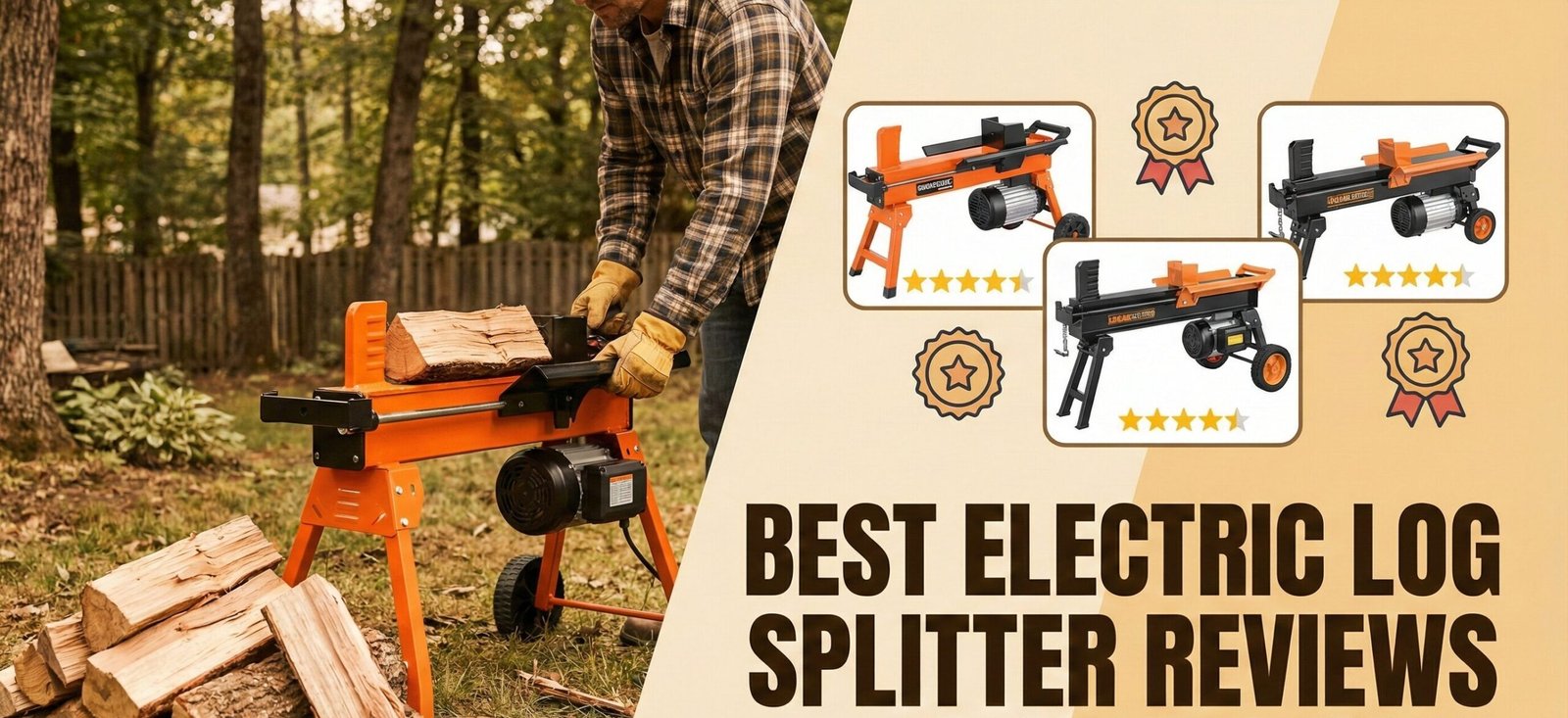
7 Best Electric Log Splitters Reviewed: Quiet Power for Your Backyard
Stop swinging the axe and ditch the noisy gas engine. We found the best electric splitters that plug in, power up, and crush logs with zero fuss.
There was a time when “electric” meant “weak.” That time is gone. Modern electric log splitters have evolved into serious machines capable of generating up to 7 tons of force — more than enough to handle the 10-inch seasoned oak rounds sitting in your driveway.
For most homeowners, electric splitters are the “Goldilocks” solution. They are powerful enough to save your back, quiet enough to use on a Sunday morning without angering the neighbors, and require almost zero maintenance compared to gas engines. Plus, you can use them inside a garage or shed during winter without worrying about exhaust fumes.
After analyzing motors, cycle times, build quality, and real-world user feedback, here is our complete breakdown of the best electric log splitters available today.
⚡ Quick Decision Guide
Don’t want to read the whole list? Here are the winners by category.
| Category | Model | Why It Wins |
|---|---|---|
| 🏆 Best Overall | WEN 56207 | Perfect balance of 6.5-ton power, stand availability, and price. |
| 💰 Best Value | Sun Joe LJ602E | Undisputed king of budget splitters. Simple and effective. |
| 💪 Heavy Duty | Boss Industrial ES7T20 | 7 tons of force and one-handed operation — rare for electrics. |
| 🔧 Best Features | YardMax YS0552 | Stroke limiter + stand + log tray included as standard. |
| 🚗 Most Portable | SuperHandy 6-Ton | Balanced weight distribution and larger wheels for lawn use. |
Gas vs. Electric vs. Manual: Which Do You Need?
Before buying, ensure electric fits your wood profile. If you are splitting massive 20-inch knotty elm rounds, check our best gas log splitters guide. For pure silence and exercise, our manual hydraulic log splitter reviews cover lighter-duty options. Electric sits squarely in the middle — the right tool for the majority of residential wood burners.
Choose Electric If:
- You split rounds under 10–12 inches in diameter.
- You want to work in a garage, basement, or shed without fume concerns.
- You hate pull-starting engines and changing spark plugs.
- You have easy access to a power outlet or can run a heavy-duty extension cord.
- Your annual volume is under 3 cords of seasoned hardwood.
- Noise is a concern — neighbors, early mornings, suburban lots.
1. WEN 56207 6.5-Ton (Top Pick)
Editor’s ChoiceWEN has dominated the electric splitter market for years, and the 56207 is their current flagship for homeowners. It sits on a sturdy stand (optional on some bundles, but highly recommended) which lifts the work to waist height — saving you from bending over for every single log.
With a 15-amp motor delivering 6.5 tons of force, it handles seasoned hardwoods surprisingly well. The 20-second cycle time is standard for electrics, but the auto-return mechanism helps you keep a rhythm.
Pros
- Elevated stand saves your lower back
- 6.5 tons handles most residential firewood
- Reliable 15A motor
- Side support wings keep logs from falling
Cons
- Requires two hands to operate (safety feature)
- Wheels are plastic and struggle on gravel

2. Sun Joe LJ602E 5-Ton (Best Budget)
Best ValueIf you have a smaller fireplace and just need to crack some cured logs for the weekend, the Sun Joe LJ602E is unbeatable for the price. It is smaller, lighter, and easier to store than the WEN.
While 5 tons sounds significantly less than 6.5, in practice it still handles 8–10 inch rounds of seasoned firewood effectively. It sits low to the ground, so you will be kneeling or squatting, but its portability makes it a favorite for older homeowners and those with limited storage.
Pros
- Extremely affordable
- Lightweight and easy to roll into a corner
- Great for small to medium softwood and hardwood
Cons
- Low to the ground — no stand included
- Struggles with knotty or green wood

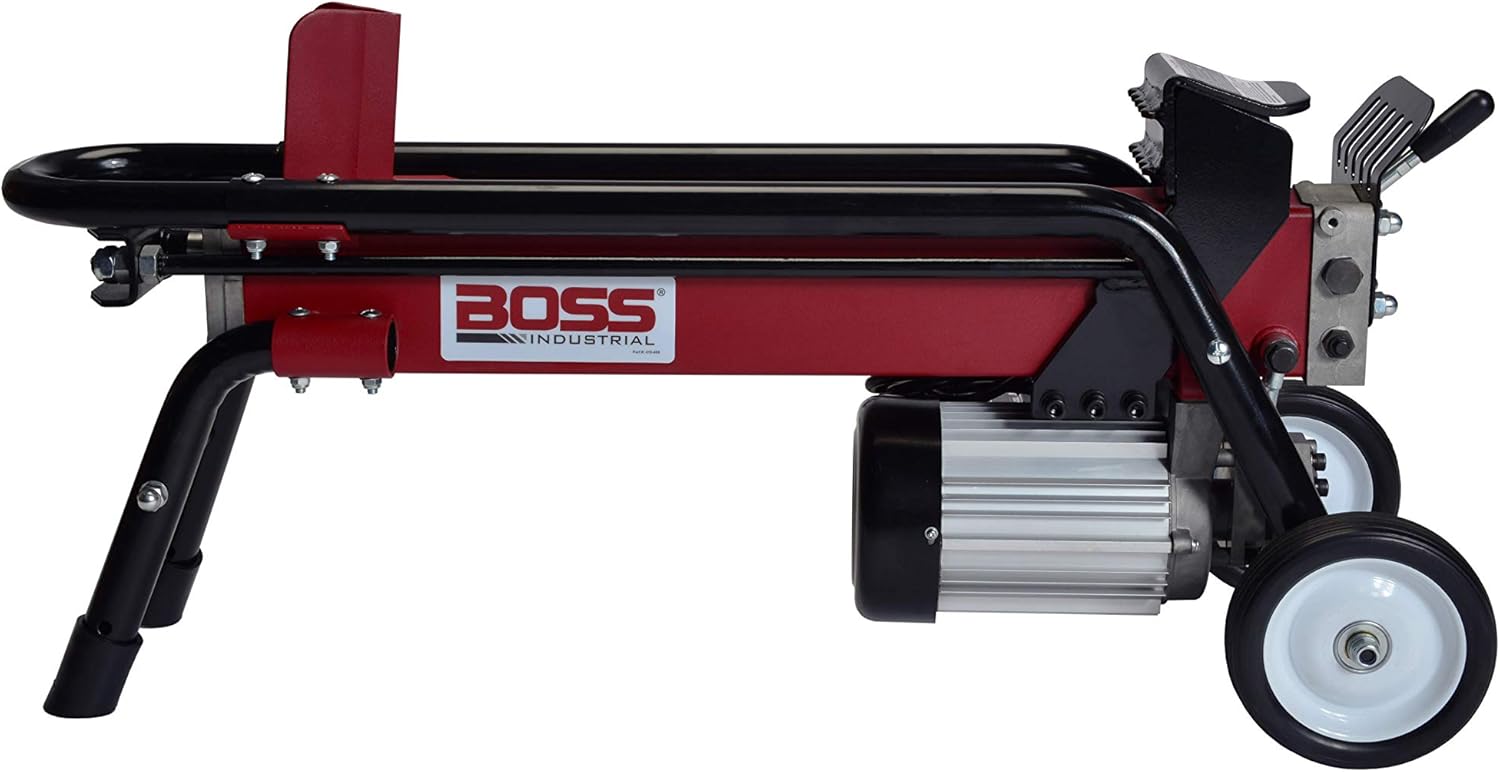
3. Boss Industrial ES7T20 7-Ton
Heavy DutyBoss Industrial is known for making hydraulics that last. The ES7T20 is their premier electric model, boasting a true 7 tons of splitting force. This extra half-ton over the WEN can make the difference when you encounter a nasty knot.
The standout feature is the one-handed operation. Most electric splitters require two hands for safety, but Boss designed a system that allows one-handed use safely, letting you stabilize the log with your free hand — a genuine workflow advantage.
Pros
- Highest tonnage in its class (7 tons)
- One-handed operation speeds up workflow
- Very durable build quality
Cons
- More expensive than WEN or Sun Joe
- Does not typically come with a stand
4. YardMax YS0552 5-Ton (With Stand)
YardMax often competes directly with WEN, offering feature-rich tools at competitive prices. The YS0552 is a 5-ton splitter that comes standard with a stand and a log tray. The log tray is a subtle but excellent feature — it catches split wood so it doesn’t fall on your toes or force you to bend constantly.
The stroke limiter is a genuine pro feature: if you are splitting short logs (12-inch stove lengths), you can shorten the return stroke to speed up cycle time significantly — a time-saving detail that adds up over a full splitting session.
Pros
- Includes stand and log tray as standard
- Stroke limiter for faster cycling on short logs
- Solid warranty support
Cons
- Assembly can be tricky with the stand
- 5-ton limit means it prefers straighter grain

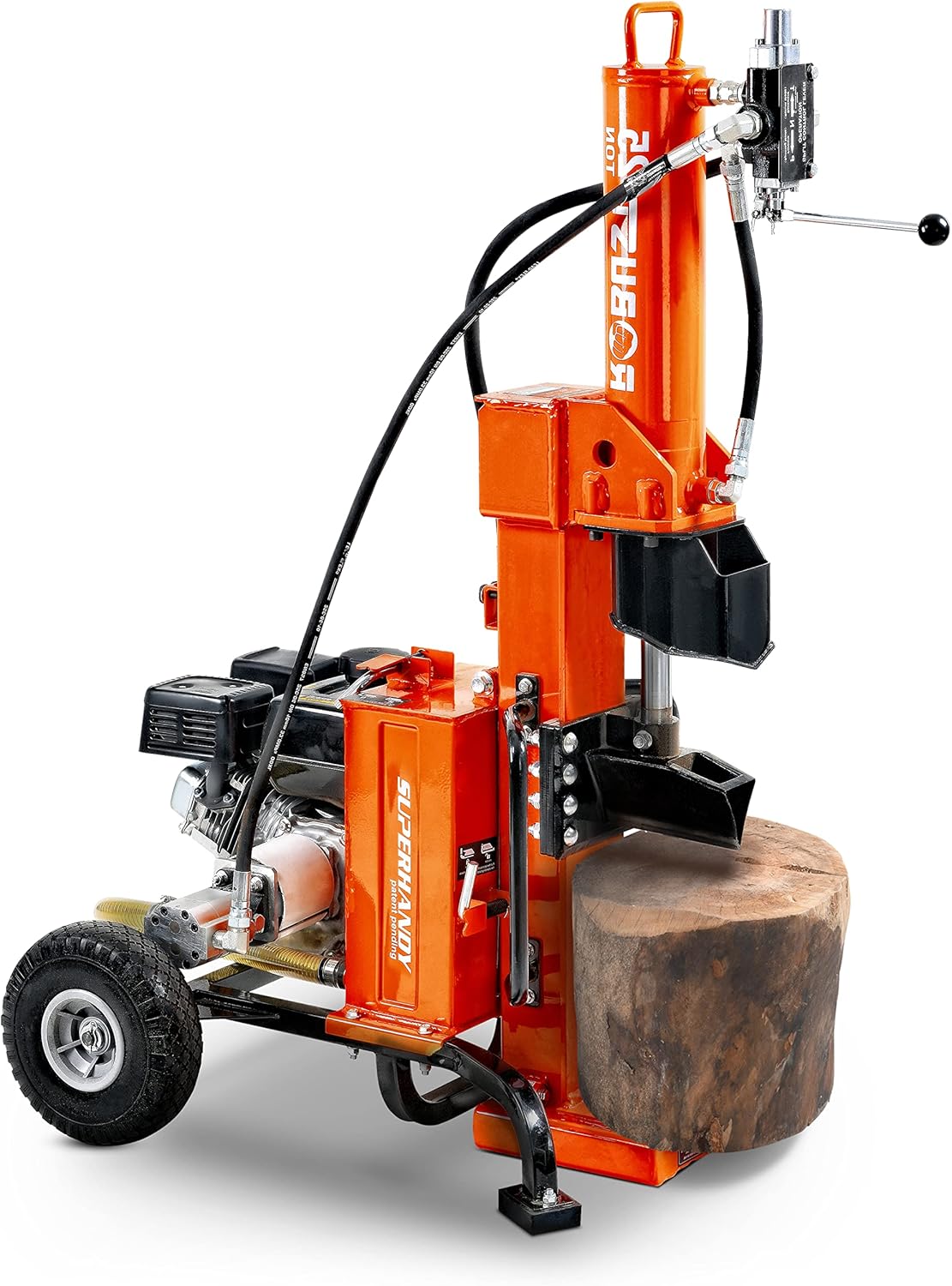
5. SuperHandy Portable 6-Ton
SuperHandy lives up to its name with a design focused on portability. While many “portable” splitters are heavy bricks with tiny wheels, the SuperHandy features more balanced weight distribution and rugged wheels suitable for rolling across a lawn. It delivers 6 tons of force, placing it right between the Sun Joe and the Boss — an excellent choice for homeowners who need to wheel the splitter across uneven turf from garage to woodpile.
Pros
- Good mobility on uneven ground
- Fast cycle time (approximately 15 seconds)
- Compact storage footprint
Cons
- Motor can get hot under continuous heavy load
- Hydraulic fluid port is hard to reach
6. BILT HARD 6.5-Ton Log Splitter
BILT HARD is a newer entrant gaining traction for offering specs similar to the WEN 56207 at a competitive price. It features a 6.5-ton ram and a 15-amp motor with a surprisingly robust all-steel construction. For budget-conscious buyers who want more power than the 5-ton Sun Joe but don’t want to pay WEN’s price, this hits the sweet spot.
Pros
- High power-to-price ratio
- All-steel construction
- Effective for logs up to 9 inches in diameter
Cons
- Customer service is slower than major brands
- Paint tends to chip on the beam

7. PowerSmart PS9006 6-Ton
PowerSmart offers a visually distinct red splitter focused on safety and stability. The low center of gravity makes it very difficult to tip over — great for uneven garage floors or driveways. It handles the standard 20-inch long log but performed best with hardwood rounds cut to 16–18 inches, where the ram geometry applies force most efficiently.
Pros
- Very stable base, difficult to tip
- Safety lockout switch is easy to use
- Good for shorter firewood lengths
Cons
- Slower ram return speed
- Heavier than it looks

📚 Buyer’s Guide: Every Spec That Actually Matters
Electric splitters aren’t as complex as gas engines, but the specs that manufacturers highlight are not always the ones that determine your daily satisfaction. Here is what you actually need to evaluate before buying.
1. Tonnage — The Real Numbers
Electric splitters generally range from 5 to 7 tons. Unlike the tonnage on gas splitters (which extends to 40+ tons for commercial models), the electric range is narrow enough that every half-ton difference matters in practice.
- 5 tons: Handles kindling, softwood, and straight-grained hardwood rounds up to 8 inches in diameter. Best for light recreational fires. Adequate for ash, birch, and well-seasoned pine.
- 6–6.5 tons: The sweet spot for most homeowners. Handles seasoned oak, maple, and cherry up to 10–11 inches in diameter. Can manage minor knots in straight-grained wood.
- 7 tons: The maximum currently available in consumer electric models. Handles most seasoned hardwood rounds up to 12 inches and gives you meaningful reserve capacity for small knots that would stall a 5-ton unit.
A critical caveat: these tonnage figures are peak force at maximum hydraulic pressure, typically achieved only at the moment the ram first contacts the log. Sustained splitting force through a dense or knotted round is lower in practice. This is why real-world performance often depends as much on cycle control and log positioning as on the spec-sheet tonnage.
2. The Stand — Non-Negotiable
We cannot stress this enough: get a stand. Without one, the splitter sits 6 inches off the ground. After 30 minutes of squatting or bending to load logs, your lower back will be in serious discomfort. Over the course of a cord of firewood — 300–400 individual rounds — the ergonomic difference between a stand-equipped and standless splitter is enormous. Models like the WEN 56207 and YardMax YS0552 include stands. For models that don’t, aftermarket stands are available.
3. Motor Amperage and Circuit Compatibility
Most quality electric splitters use a 15-amp motor — the standard maximum draw for a single 15A household circuit. This is an important practical consideration: you cannot run a 15A splitter on the same circuit as other high-draw appliances (a refrigerator, electric heater, or air compressor) without tripping the breaker. Ideally, run your splitter on a dedicated 15A or 20A circuit. If you’re running on a shared circuit, locate the breaker panel and identify which outlets are on which circuit before starting.
4. Cycle Time
This is how long it takes the ram to extend, split, and return to the starting position. The standard range is 15–20 seconds for electric models. A 5-second difference doesn’t sound significant, but over a session processing 200 rounds, a 15-second cycle takes 50 minutes of pure cycle time versus a 20-second cycle taking over 66 minutes — a 25% productivity difference. Look for models with a stroke limiter (also called an adjustable return stroke), which shortens the retraction distance for shorter logs, further reducing cycle time.
5. Log Length Capacity
Most electric splitters accept logs up to 20 inches in length. This matches standard 16-inch firewood cuts well, with room to spare. If you process longer logs (18–20 inch cuts), confirm the beam length specification before purchasing. Running a log that overhangs the beam end creates instability and reduces effective splitting force.
6. Log Diameter Capacity
Officially listed diameter capacities on electric splitters are often optimistic. The listed maximum typically assumes a straight-grained, perfectly seasoned round. In practice, apply a 15–20% reduction for real-world performance. A machine listed as handling 10-inch diameter logs will reliably split 8–9 inch rounds of harder species like oak and maple.
7. Hydraulic Fluid Accessibility
A detail almost never mentioned in marketing: how easy is it to check and add hydraulic fluid? Some designs place the fill cap in an awkward location that requires tilting or partially disassembling the machine to access. SuperHandy’s models have been specifically noted for this issue. If ongoing maintenance ease matters to you, look for models where the hydraulic reservoir cap is clearly accessible from above when the machine is in its normal operating position.
Tonnage by Wood Type: Matching Power to Your Fuel
The single most common frustration with electric log splitters — a machine that stalls or repeatedly fails to complete a split — almost always comes down to a mismatch between the machine’s tonnage and the wood being split. This table gives you a practical reference for what to expect from each tonnage tier with specific wood species.
| Wood Species | Diameter | Condition | 5-Ton Result | 6–6.5-Ton Result | 7-Ton Result |
|---|---|---|---|---|---|
| Pine, Cedar, Fir | Up to 10″ | Seasoned | ✅ Easy | ✅ Easy | ✅ Easy |
| Birch | Up to 8″ | Seasoned | ✅ Good | ✅ Easy | ✅ Easy |
| Ash | Up to 10″ | Seasoned | ✅ Good | ✅ Easy | ✅ Easy |
| Maple (Hard) | 8″ | Seasoned | ⚠️ Marginal | ✅ Good | ✅ Easy |
| Oak (Red) | 8–9″ | Seasoned | ❌ Stalls | ⚠️ Marginal | ✅ Good |
| Oak (White) | 8″ | Seasoned | ❌ Stalls | ❌ Stalls | ⚠️ Marginal |
| Any species | Any | Green (wet) | ❌ Stalls | ❌ Stalls frequently | ⚠️ Marginal on small rounds |
| Any species (knotty) | Any | Any | ❌ Stalls | ❌ Often stalls | ⚠️ Marginal — consider gas |
Electric splitters genuinely cannot replace gas for persistently knotty wood, large-diameter rounds (12″+), or any species being split green. This is not a product deficiency — it is a fundamental limitation of the 120V power supply available in a residential setting. If your wood regularly includes large knotty oak or elm, a gas splitter is the correct tool. Forcing an electric splitter beyond its capacity repeatedly will overheat the motor and shorten its lifespan dramatically.
Electric vs. Gas Log Splitters: The Complete Head-to-Head
The choice between electric and gas is not simply about power. There are scenarios where electric is the objectively superior choice — and scenarios where it simply cannot substitute for gas. This section gives you the complete comparison so you can make a clear, informed decision.
✅ Electric Wins Here
- Indoor use (no exhaust fumes)
- Noise-sensitive environments
- Zero engine maintenance
- Instant start — every time
- Operating cost (pennies/hr in electricity)
- Cold weather starting (always works)
- Long-term reliability (no carburetor)
⛽ Gas Wins Here
- Maximum tonnage (20–40+ tons)
- Field portability (no power cord)
- Green/wet wood processing
- Very large diameter rounds (12″+)
- Knotty, interlocked wood species
- Commercial/high-volume production
- Towing to remote job sites
| Factor | Electric | Gas |
|---|---|---|
| Max Available Tonnage | 7 tons (consumer limit) | 40+ tons (commercial) |
| Portability | Limited by 120V cord (50 ft max) | Unlimited — tow anywhere |
| Noise Level | ~65 dB — conversational level | 85–95 dB — hearing protection needed |
| Maintenance | Hydraulic fluid check only | Oil, filter, plug, fuel stabilizer |
| Operating Cost | $0.05–$0.10/hr in electricity | $0.50–$1.00/hr in fuel |
| Indoor Use | Yes — no exhaust | Never — CO hazard |
| Cold-Weather Start | Always instant | Requires technique and fresh fuel |
| Green Wood Capability | Very limited | Good with adequate tonnage |
| Typical Purchase Price | $150–$600 | $700–$3,000+ |
Many serious wood burners use both: an electric splitter for the majority of their seasoned, manageable rounds (processed quickly in the garage), and a rented gas splitter for one or two days per year to tackle the large, knotty, or green rounds that the electric can’t handle. This hybrid strategy gives you 95% of the convenience of electric ownership with access to gas power when genuinely needed, without the year-round maintenance burden of owning a gas machine.
Extension Cord Guide: Get This Wrong and You’ll Burn Out Your Motor
The extension cord is one of the most overlooked yet most important considerations for electric log splitter ownership. An undersized cord is the most common cause of premature motor failure in residential electric splitters — and it’s entirely preventable.
Why Cord Gauge Matters So Much
Every electrical conductor has resistance, and resistance increases with length. When a 15-amp motor draws power through a long, thin extension cord, voltage drops along the cord before reaching the motor. The motor, receiving less than its rated voltage, draws higher-than-normal current to compensate — generating excess heat in the windings. Repeated operation under this condition degrades insulation, burns out brushes, and eventually causes complete motor failure. This is called “voltage drop” and it is the mechanism behind most warranty-voiding motor burnouts.
| Cord Length | Minimum Wire Gauge | Recommended for 15A Splitter |
|---|---|---|
| Up to 25 feet | 14 AWG | ✅ Acceptable |
| 25–50 feet | 12 AWG | ✅ Recommended |
| 50–100 feet | 10 AWG | ✅ Required |
| 100+ feet | Not recommended | ❌ Voltage drop too severe — reposition splitter or add outlet |
The standard household orange extension cord is 16 AWG — absolutely inadequate for a 15A log splitter motor, even at short distances. Using one will void most manufacturer warranties and will cause detectable heat in the cord itself within minutes of operation. If your cord feels warm to the touch while the splitter is running, it is the wrong gauge. Replace it immediately.
The 3-Prong Grounded Connection Requirement
All electric log splitters use a grounded 3-prong plug. Never use a 3-to-2 prong adapter (“cheater plug”) to connect to an ungrounded outlet. The grounding wire is a safety critical component — if a motor winding fails and energizes the metal frame of the splitter, the ground wire directs that current safely away rather than through the operator. Using an ungrounded connection in a wet garage or outdoor environment is a genuine electrocution hazard.
Can an Electric Splitter Handle Green Wood?
This is one of the most searched questions about electric log splitters, and the honest answer is nuanced: it depends on the species, the diameter, and your definition of “handle.”
Why Green Wood Is Harder to Split
Freshly cut “green” wood contains 50–60% water by weight. This moisture saturates the wood fibers, making them flexible and compressible rather than brittle. When a wedge contacts green wood, the fibers absorb the force rather than fracturing cleanly, creating a spongy resistance that absorbs hydraulic force. The same round that splits in one stroke when seasoned may require three or four stalled attempts when green — or may refuse to split at all.
Green Wood Results by Species and Tonnage
- Green softwood (pine, fir, cedar) — 5–6 tons: Generally manageable if rounds are under 8 inches. Softwood’s open-grain structure still fractures reasonably well even when wet.
- Green ash — 6.5–7 tons: Ash is unique in that it can be split relatively well even when freshly cut, as its grain structure is naturally less resistant to splitting than most hardwoods. A 7-ton machine handles green ash rounds up to 8 inches with reasonable success.
- Green maple or birch — any electric tonnage: Very difficult. The flexibility of wet maple fibers absorbs force effectively. Expect frequent stalls on rounds larger than 6 inches.
- Green oak — any electric tonnage: Not recommended. Green oak’s combination of density and moisture flexibility makes it the most demanding split possible. Even gas splitters are challenged by large green oak rounds. An electric machine will stall repeatedly and risk motor overheating.
If you receive a delivery of green rounds that you need to process, split them into half-rounds first with a manual wedge and maul (halving dramatically reduces the splitting resistance), then run the half-rounds through the electric splitter to final firewood size. This hybrid approach lets your electric machine handle green wood it would otherwise stall on, by reducing the diameter and thus the force required for each powered stroke.
Electric Log Splitter Safety: Rules That Prevent Injuries
Electric log splitters are significantly safer than gas models in several respects — no engine exhaust, no hot surfaces from a running engine, and lower peak forces than commercial gas machines. But they still generate enough hydraulic force to cause serious crushing injuries, and several unique electrical hazards deserve attention.
The Two-Handed Control Requirement
Virtually all electric log splitters (with the notable exception of the Boss Industrial’s patented one-handed system) require simultaneous activation of two separate controls — typically a button and a lever — to operate the ram. This design ensures both hands are away from the wedge zone during every stroke. This is not merely a design choice; it is a CPSC (Consumer Product Safety Commission) safety requirement for all log splitters sold in the United States. Never attempt to bypass, tape down, or otherwise defeat this dual-control requirement.
Electrical Safety Specific to Electric Splitters
- Always use a properly grounded 3-prong outlet and cord — never use a cheater adapter
- Do not operate in rain, standing water, or wet grass — water and exposed electrical connections are lethal
- Keep the extension cord away from the splitting area — a cord under the beam can be cut or damaged during operation
- Inspect the cord and motor housing before each use for visible damage, cracking, or signs of burning
- Allow the motor to cool for 15 minutes after extended heavy use — overheating motors can cause insulation breakdown
- Store indoors or in a weatherproof enclosure — leaving the machine exposed to rain overnight corrodes electrical connections
Personal Protective Equipment
- Steel-toed boots — mandatory. Rolling logs and split pieces falling from the beam are the most common injury mechanism
- Safety glasses — wood chips, bark fragments, and small splits travel at high velocity during splitting
- Work gloves — leather preferred for grip and protection against bark cuts and splinters
- Hearing protection — not required for electric splitters at 65 dB, but recommended during extended sessions
Log Positioning Safety
- Center the log on the beam before activating the ram. An off-center log can roll off the beam during splitting, creating a falling hazard. Take a moment to ensure the log is stable before engaging the controls.
- Never place your hand near the wedge end of the beam during operation. Stabilize the log from the back end or side, well away from the wedge path.
- Remove the previous split before placing the next log. A loose piece left on the beam can be struck by the incoming log and become a projectile.
- Keep children and pets completely clear of the operating area. Establish a clear boundary at least 10 feet around the machine during use.
- If a log jams and the ram stalls, release the controls immediately. Do not hold the lever continuously — modern pressure relief valves will protect the hydraulic system if you release, but sustained pressure against a jammed log can damage seals. Retract, reposition, and try again at a different angle.
🛠️ Complete Maintenance Schedule for Electric Log Splitters
The beauty of electric is dramatically reduced maintenance compared to gas — no engine oil, no spark plugs, no carburetor. But “low maintenance” does not mean “no maintenance.” The hydraulic system requires periodic attention, and the bleed screw procedure before each use is critical and poorly understood by many owners.
| Task | Frequency | Specification / Tip |
|---|---|---|
| Open the Bleed Screw | Before EVERY use | Critical: open the bleed screw 1–2 turns before starting. This releases air pressure that builds in the cylinder during storage. Skipping this step can blow the cylinder seals within a single session. |
| Check Hydraulic Fluid Level | Every 5–10 hours of use | Use AW32 hydraulic fluid (also called ISO 32). Check with the machine horizontal and the ram fully retracted. Add slowly — overfilling causes foaming and reduced force. |
| Inspect Extension Cord | Before every use | Check for cuts, kinks, heat damage, or loose connections at the plug. A damaged cord is both a fire risk and a motor damage risk. |
| Clean the Ram Cylinder | After every use | Wipe the chrome ram surface clean with a dry rag. Sawdust and sap left on the ram surface are drawn into the cylinder seal on retraction, accelerating seal wear. |
| Inspect Wedge Sharpness | Annually | A dull wedge requires more force to initiate splits, increasing motor load. File the leading edge with a metal file to restore a sharp profile. |
| Change Hydraulic Fluid | Every 150 hours or every 3–5 years for typical residential use | Old fluid accumulates metal particles and moisture, reducing pump efficiency and accelerating wear. Drain completely before refilling. |
| Inspect Electrical Connections | Annually | Check the motor housing for moisture intrusion, corroded terminals, or loose wiring. If the motor housing shows rust staining, the machine has been stored in wet conditions that can damage windings. |
| Lubricate Beam Rail | Annually or if ram movement feels stiff | Apply a light coat of general-purpose grease to the beam rail that guides the ram. Dry rails increase motor load and can cause uneven ram movement. |
The bleed screw on an electric log splitter allows air that accumulates in the hydraulic cylinder during storage to escape before the machine is pressurized. If you skip this step and operate the machine with trapped air in the cylinder, the air compresses rapidly under hydraulic pressure and creates a hydraulic hammer effect that can rupture cylinder seals in a single session. Always open the bleed screw 1–2 turns before the first use of each session, then close it snugly before powering on the motor.
Storage and Off-Season Care
Unlike gas splitters that require fuel treatment and carburetor draining for seasonal storage, electric log splitters are much more forgiving to store. However, several specific practices protect your investment and ensure reliable starting when you bring it back out.
End-of-Season Procedure
- Clean thoroughly. Remove all sawdust, bark debris, and wood sap from the entire machine — beam, ram cylinder, frame, and wheels. Organic material holds moisture and causes corrosion over a long storage period.
- Retract the ram fully and wipe it clean. Apply a light coat of machine oil or WD-40 to the chrome surface of the ram. This prevents surface rust during storage.
- Check and top up hydraulic fluid to the maximum mark. A full reservoir has less air space, which reduces condensation moisture buildup during storage.
- Close the bleed screw firmly. An open bleed screw during storage allows moisture to enter the hydraulic system.
- Coil and store the power cord separately. Coil it loosely — tight coiling damages the internal wires over time. Store it indoors away from rodents, which will chew through electrical cords given the opportunity.
- Store in a dry, covered location. Garages and sheds are ideal. If outdoor storage is unavoidable, use a breathable equipment cover. Solid plastic tarps trap condensation underneath and actually accelerate corrosion.
Bringing It Back Out After Storage
Before first use after a storage period, always open the bleed screw (as described in maintenance), check hydraulic fluid level, inspect the cord, and run the machine through 3–4 unloaded cycles to verify all systems are operating normally before loading the first log.
Troubleshooting Guide: When Things Go Wrong
Most electric log splitter problems have straightforward causes and solutions. This guide covers the most common issues in order of frequency.
Problem: Ram Moves Slowly or Lacks Splitting Force
This is the most common complaint. In order of likelihood:
- Voltage drop from undersized extension cord: Check your cord gauge and length against the table above. Swap to a heavier gauge cord and retest immediately.
- Low hydraulic fluid: Check the reservoir level with the ram retracted. Add AW32 fluid to the full mark.
- Air in the hydraulic system: Confirm the bleed screw was opened before use. If not, open it now, cycle the ram several times unloaded, then close and retest.
- Motor tripping thermal protection: If the machine was working fine and suddenly lost power/speed, the motor’s thermal cutout has activated. Switch off, allow 15–20 minutes to cool, then resume at a slower work pace with more breaks.
Problem: Breaker Trips When Splitter Is Turned On
This typically means the circuit is already loaded near its limit. Check that no other significant loads are on the same circuit. If the breaker trips even on a dedicated circuit, the motor may have a shorted winding — contact the manufacturer. Do not simply reset and continue; a motor with a shorted winding draws excessive current that generates dangerous heat.
Problem: Log Gets Stuck on the Wedge
A log stuck mid-split is a common occurrence with knotty or fibrous wood. The correct response: release the controls immediately, engage the retract function to pull the ram and log back, rotate the log 90 degrees, and restart the split from a different angle. Trying to split off the sides of a round (slabbing) rather than bisecting it through the center is often more effective on knotty sections.
Problem: Hydraulic Fluid Leaking
Minor seepage from hydraulic fittings is normal during the first few hours on a new machine and usually self-seals as seals seat under pressure. Active leaks from the ram cylinder seal or pump housing are more serious. Tighten any obviously loose fittings first. If leaking persists from the cylinder seal, the unit requires seal replacement — contact the manufacturer under warranty if applicable.
Problem: Ram Drifts Back After Full Extension
If the ram reaches full extension and slowly drifts back without engaging the return stroke, the control valve spool is worn or contaminated. Flush the hydraulic system with fresh fluid. If drifting persists after a fluid change, the valve requires replacement — typically a repair for the manufacturer’s service center.
Best Firewood Types for Electric Log Splitters
Matching your wood species and preparation to your electric splitter’s capabilities makes the entire firewood processing experience faster and less frustrating. Here is a practical guide to which woods work best with electric tonnage and which require a different approach.
Ideal Candidates for Electric Splitting
Ash is the electric splitter’s best friend. Its naturally straight grain and relatively low splitting resistance make it the easiest hardwood to process regardless of tonnage. Even 5-ton machines handle seasoned ash reliably. Its unique characteristic — splitting well even when freshly cut — also gives it an advantage over other hardwoods when you occasionally receive green rounds.
Birch is another excellent candidate. The wood splits cleanly along natural planes, and the characteristic papery bark actually helps the wedge find the grain. The wood is moderately dense, producing good heat output per cord, and processes quickly through any electric machine at 6 tons or more.
Soft and medium hardwoods — cherry, black walnut, silver maple, and alder — all split well through 6–7 ton electric machines when properly seasoned. Cherry and walnut in particular have a rewarding splitting quality: clean, fragrant, and satisfying. These species also happen to be among the most aromatic woods for burning, making them a pleasure to process for the indoor fireplace user.
Challenging Woods to Approach with Caution
Hard maple and red oak are within the capability of 6.5–7 ton electric machines when the rounds are seasoned and under 9 inches in diameter. Above that size, or in any knotted section, expect frequent stalls. For occasional rounds that exceed electric capability, a manual steel splitting wedge and sledgehammer handles the exceptions without forcing you to rent a gas machine for one or two problem pieces.
Elm should not be attempted in an electric splitter regardless of tonnage. Its interlocked, swirling grain pattern resists splitting in a way that is categorically beyond electric machine capability. The same applies to very large diameter rounds of any species above 12 inches.
The Importance of Proper Seasoning for Electric Use
For electric splitters specifically, proper seasoning is more critical than for gas machines — because the electric has no reserve tonnage to compensate for the additional resistance of wet wood. Before splitting, confirm moisture content with a wood moisture meter (below 20% is the target). Attempting to split green wood with an electric machine is the single most common cause of motor overheating and frustration. If your wood was recently delivered and moisture meter readings are above 25%, wait until it seasons further or use a gas splitter for that batch.
Cost and ROI Guide: Does an Electric Splitter Pay for Itself?
An electric log splitter represents a real but modest financial investment compared to gas machines. Understanding when and how it pays back helps you make a confident purchasing decision.
Purchase Cost Range
- Entry level (5-ton, no stand): $150–$250 — Sun Joe LJ602E and similar
- Mid-range (6–6.5 ton, with stand): $300–$450 — WEN 56207, YardMax, BILT HARD
- Premium (7-ton, commercial durability): $450–$600 — Boss Industrial ES7T20
Operating Cost: Electric Is Dramatically Cheaper Than Gas
A 15-amp motor running at 120V draws 1,800 watts (1.8 kW). At the US average electricity rate of approximately $0.13 per kWh, an hour of splitting costs about $0.23 — roughly a quarter. A gas splitter running a 200cc engine consumes approximately 0.5 gallons per hour at a fuel cost of $1.50–$2.00 per hour. Over a full season of 20 hours of splitting, the electric machine costs $4.60 versus $30–$40 for gas — a difference that compounds over years of use.
The Real Return: Time and Labor Saved
The most meaningful return from any log splitter isn’t measured in fuel savings — it’s the hours of hard physical labor eliminated. Hand-splitting a cord of seasoned hardwood with a maul takes an average adult 6–10 hours. The same cord through an electric splitter takes 2–3 hours, largely at low physical exertion. For a homeowner burning 2–3 cords per year, that is 8–21 hours of annual labor saved for a one-time investment of $300–$450. The machine pays back in time savings in its very first season.
Renting vs. Buying: When Each Makes Sense
Electric log splitters are not as commonly available in the rental market as gas machines, but where they are offered, rental rates run $50–$100 per day. For homeowners who process less than half a cord per year, renting makes more financial sense than purchasing. Above half a cord annually, the math strongly favors purchase — especially considering that the electric’s operating cost is near-zero, maintenance is minimal, and the machine should last a decade or more with proper care.
A $350 electric splitter that lasts 10 years costs $35 per year in capital cost. Add $5 per year in electricity for a typical homeowner splitting 2 cords annually. Total cost: $40/year. Compare to hand-splitting those same 2 cords: 12–20 hours of strenuous labor annually, with significant injury risk. The electric splitter is one of the highest-value tools a wood-burning homeowner can own.
Frequently Asked Questions
Can I use an extension cord with an electric splitter?
Yes, but it must be heavy duty. Because these motors draw 15 amps, use a 12-gauge cord for runs up to 50 feet and a 10-gauge cord for 50–100 feet. Using a standard thin orange garden cord will cause voltage drop, motor overheating, and premature failure — and will void most warranties.
Will an electric splitter handle green wood?
Generally, no — not reliably. Electric splitters work best on properly seasoned wood (under 20% moisture content). Green wood is wet and flexible, which absorbs the hydraulic force rather than fracturing cleanly. For green wood, you need the higher tonnage of a gas splitter. The exception is green ash and some softwoods in small diameter rounds, which can be managed by 6.5–7 ton machines with patience.
Can I use an electric log splitter inside my house?
A garage, basement, or shed is ideal and completely safe from a fumes standpoint — electric produces no exhaust. However, logs bring in dirt, insects, bark debris, and occasionally mold. An attached garage is preferable to operating inside a living space. Ensure the floor surface is stable and non-slip when wet.
How often do I need to change the hydraulic fluid?
Most manufacturers recommend every 150 hours of operation. For the average homeowner processing 1–2 cords per year (10–15 hours of splitting annually), that works out to once every 10–15 years. However, if you notice the fluid has turned dark or smells burnt, change it sooner regardless of hours.
What happens when a log gets stuck?
Release the controls immediately and engage the retract function. Most electric splitters have a pressure relief valve that prevents seal damage if you release within a few seconds. Once retracted, rotate the log 90 degrees and re-attempt. If the round consistently resists splitting through the center, try “slabbing” — splitting off a side piece first to reduce the diameter before bisecting the remainder. For rounds that stall every attempt, consider that they may be beyond the machine’s capacity.
Why does my electric splitter lose power after a few minutes?
This almost always indicates thermal overload protection activating. Electric motors have built-in thermostats that shut down power when the motor temperature exceeds safe limits. This happens from one of three causes: an undersized extension cord (causing the motor to run hot from voltage drop), continuous heavy use without pauses, or attempting to split wood that exceeds the machine’s tonnage capacity. Allow 15–20 minutes of cooling before resuming, then address the root cause.
Is a 6-ton electric splitter strong enough for oak?
For seasoned red oak rounds up to 8–9 inches in diameter with reasonably straight grain, a 6.5–7 ton machine can manage. White oak is significantly harder and approaches the limit of what electric can reliably handle even at 7 tons. For any oak over 10 inches or with significant knots, a gas splitter is the practical choice. If oak is your primary firewood species and your rounds are consistently large, consider renting a gas machine for that batch rather than fighting your electric through them.
What is the bleed screw and why does it matter?
The bleed screw is a small valve on the hydraulic cylinder that allows trapped air to escape before operation. Air trapped in a hydraulic system creates a hammer effect when suddenly compressed by the pump — this can rupture cylinder seals in a single session. Always open the bleed screw 1–2 turns before your first use of each day, then close it firmly before starting the motor. This 10-second step is the single most important maintenance action for electric log splitter longevity.
Can I split logs longer than 20 inches with an electric splitter?
Not safely. The beam length on most electric splitters is designed for logs up to 20 inches. A log that overhangs the end of the beam creates a tipping/rolling hazard and also results in the force being applied at the wrong angle — reducing effective splitting power and potentially bending or stressing the beam over time. Cut logs to the appropriate length before splitting.
Final Verdict
For 90% of homeowners who want to keep their fireplace fed without the hassle of a gas engine, the WEN 56207 is the smart buy. The stand saves your back, and the 6.5 tons is plenty for seasoned wood.
If you are on a strict budget, the Sun Joe LJ602E is a fantastic entry-level tool that beats swinging an axe any day. For the occasional knotty round that stops lesser machines, the Boss Industrial ES7T20‘s extra half-ton and one-handed operation make it the premium choice.
Shop Top Picks on Amazon