How to Tell if Creosote Is Glazed (Stage 3): Signs & Safety
By Chimney Insight Editorial Team
Posted on March 3, 2026
Disclosure: This page contains affiliate links. We may earn a commission from qualifying purchases at no extra cost to you. As an Amazon Associate I earn from qualifying purchases.
There is an undeniable comfort in loading up the fireplace on a freezing winter evening, listening to the crackle of wood, and feeling the radiant heat fill your living room. But behind that cozy facade, right inside the dark vertical shaft of your chimney, a silent, highly combustible threat might be brewing. It’s called creosote.
Creosote is the natural, inevitable byproduct of burning wood. Every time you light a fire, smoke, water vapor, unburned wood particles, and hydrocarbon gases travel up your chimney flue. As these hot gases hit the cooler masonry or metal liner near the top of your chimney, they undergo condensation. The result is a dark, sticky residue that clings to the walls. While all wood fires produce some level of creosote, not all creosote is created equal.
As a homeowner, distinguishing between standard soot and the terrifyingly dangerous “Stage 3” glazed creosote is one of the most vital safety skills you can develop. Standard chimney sweeps can handle light soot, but if your creosote has glazed, you are sitting beneath a ticking time bomb. In this comprehensive, expert-led guide, we will break down exactly how to tell if creosote is glazed, why it forms, the catastrophic risks it poses, and the concrete steps you must take to eradicate it.
Understanding the 3 Stages of Creosote (Setting the Baseline)
To identify glazed creosote accurately, you first need to understand the lifecycle of wood combustion byproducts. Creosote buildup is categorized into three distinct stages, each progressively more dangerous and difficult to remove than the last.
Stage 1: Velvety Soot (The Best-Case Scenario)
Stage 1 creosote is what you *want* to see if you have a dirty chimney. It indicates that you are burning good wood and your chimney is drafting well. It looks like a fine, velvety black dust. If you run your finger across it, it easily wipes away, much like the dust on a neglected bookshelf. Standard chimney brushes easily sweep Stage 1 creosote away, making your annual chimney cleaning frequency a quick, painless process.
Stage 2: Crunchy, Flaky Deposits
If the smoke is lingering in the flue a bit too long, or if moisture is entering the equation, Stage 1 evolves into Stage 2. This creosote looks like dark, porous, crunchy flakes. Think of the texture of burnt toast crumbs or coarse black coffee grounds. While it requires a bit more elbow grease and a stiffer wire brush to remove, a professional sweep can still clear Stage 2 deposits without specialized chemical treatments.
Stage 3: Glazed Creosote (The Danger Zone)
If you are reading this guide, this is the stage you are likely worried about. Stage 3 creosote is fundamentally different from the previous two stages. It occurs when layers of creosote continually build up, get heated by subsequent fires, melt, and then cool into a hard, dense state. It is highly concentrated fuel, and standard chimney brushes will simply glide over it without making a scratch.
| Creosote Stage | Appearance | Texture | Removal Difficulty | Combustibility Risk |
|---|---|---|---|---|
| Stage 1 | Velvety, matte black dust | Soft, easily wipes away | Very Easy (Standard Brush) | Low to Moderate |
| Stage 2 | Porous, flaky, crumbly | Crunchy, like burnt toast | Moderate (Stiff Wire Brush) | High |
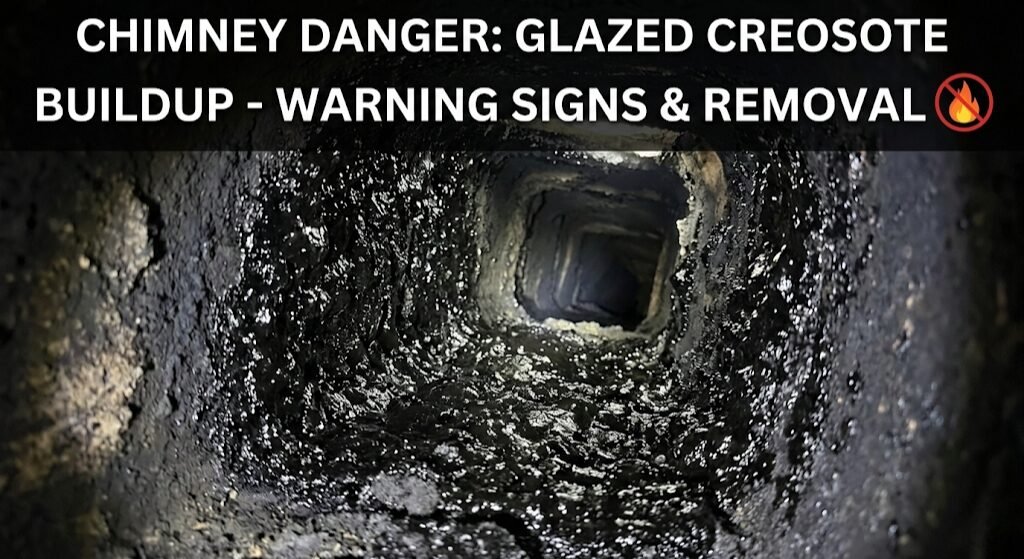
| Stage 3 (Glazed) | Shiny, dripping, tar-like | Rock hard (when cold) / Sticky (when hot) | Extreme (Chemicals / Rotary Chains needed) | Severe / Critical |
Recommended Solution

Pine Mountain Creosote Buster Sweeping Log
If you suspect you are developing Stage 2 or early Stage 3 creosote, burning a chemical sweeping log is an excellent diagnostic and preparatory step. The active minerals in this log bond with the sticky tar, drying it out and turning it into a flaky ash that is much easier to sweep away. It is highly recommended to burn one of these 14 days before a mechanical sweeping.
Pros
- Significantly reduces chimney fire risk
- Dries out sticky, glazed creosote
- Non-toxic and safe for all wood-burning fireplaces
- Incredibly easy to use (just burn it like a normal log)
Cons
- It does NOT replace mechanical sweeping
- Extremely thick Stage 3 glaze may require multiple treatments
You don’t necessarily need to be a certified chimney sweep to spot the warning signs of Stage 3 glaze. Armed with a bright LED flashlight and a little courage, you can perform a basic visual inspection from your firebox.
Put on a pair of safety glasses and a dust mask. Open your damper fully. Shine your high-lumen flashlight straight up the flue. Here is exactly what glazed creosote looks like:
- The “Black Glass” Effect: Unlike Stage 1 or 2, glazed creosote is highly reflective. When your flashlight beam hits it, the light will bounce back. It looks like the inside of your chimney has been coated in shiny black glass or a thick layer of wet obsidian.
- Dripping Tar Formations: As glazed creosote is subjected to the heat of the fire, it briefly turns into a viscous liquid before hardening again when the fire dies. Because of gravity, you will often see it forming thick, solidified “drips,” icicles, or tear-drop shapes clinging to the masonry joints or the metal flue liner.
- Puffy, “Baked” Sections: If your chimney has already experienced a minor, undetected chimney fire, you might see patches where the glaze has expanded. It will look puffy, honeycombed, or like heavily scorched marshmallows. If you see this, stop using your fireplace immediately, as it is one of the most critical chimney fire signs indicating heat and creosote combustion have already occurred.
- A Narrowed Flue Opening: In severe cases, the glazed tar builds up so thickly that it physically chokes the diameter of your chimney. If the opening at the top of the damper looks substantially narrower than it should be, coated in a thick, shiny black ring, you have a massive Stage 3 problem.
Tactile & Auditory Warning Signs
Visual confirmation is usually enough, but glazed creosote also gives off distinct tactile and auditory clues.
Warning: Never touch the inside of your chimney when a fire is burning or shortly after one has died out. Only perform a tactile test when the chimney is completely cold.
The Poke Test
If you can safely reach a section of the creosote buildup with a metal fireplace poker or a flathead screwdriver, give it a firm tap or scrape.
- If it’s Stage 1 or 2: The poker will easily push through it, and a shower of black dust or flakes will fall down.
- If it’s Glazed (Stage 3): Your poker will bounce off. When cold, glazed creosote feels rock hard, like concrete. If you try to scrape it aggressively, your tool will likely just glide over the surface or, at best, chip off a tiny, solid black shard.
- If the chimney is warm (NOT hot): Glazed creosote takes on a tacky, sticky, tar-like consistency. It may feel like incredibly dense, sticky molasses.
Auditory Clues: The “Roar”
If you have glazed creosote, you might actually hear it starting to catch fire. A healthy wood fire crackles and pops in the firebox. However, if you hear a loud, low, rumbling noise coming from *inside the wall* above the fireplace—often described by homeowners as sounding like a freight train or a low-flying airplane—that is the sound of the thick, glazed creosote rapidly burning up your flue. This requires immediate evacuation and a call to 911.
Why Does Glazed Creosote Form in the First Place?
Understanding the root cause of glazed creosote is the only way to prevent it from coming back after you’ve paid hundreds of dollars to have it removed. Glaze is not an accident; it is the direct result of poor burning habits or a structurally flawed chimney system.
1. Burning Unseasoned (Wet) Wood
This is the #1 culprit. Freshly cut wood contains up to 50% water by weight. When you throw unseasoned wood onto a fire, the fire’s energy is entirely consumed by boiling off that water rather than producing heat. This creates a low-temperature, highly smoky fire. That heavy, wet smoke travels sluggishly up the chimney, cooling rapidly and condensing into massive amounts of sticky tar. You must assess firewood seasoning to impact smoke and efficiency. Always burn wood with a moisture content below 20%.
2. Smoldering, Low-Temperature Fires
Many homeowners try to “stretch” their firewood by restricting the air intake on their wood stove to make it burn all night. While this produces a long-lasting fire, it starves the wood of oxygen. The fire smolders rather than burns, releasing massive clouds of uncombusted hydrocarbon gases. These gases cool quickly in the flue and coat the walls in thick glaze.
3. An Oversized or Uninsulated Flue
Smoke needs to stay hot to exit the chimney effectively. If you hook a modern, highly efficient wood stove into an old, massive, uninsulated masonry chimney, the small amount of smoke gets lost in the giant, freezing cold space. The smoke’s temperature plummets instantly, causing rapid creosote condensation. This is why stainless steel chimney liners are often mandated.
Recommended Solution

Rutland Creosote Remover Powder (2 lb Tub)
For ongoing maintenance and combating the sticky, tar-like nature of Stage 3 glaze, Rutland’s Creosote Remover Powder is a professional-grade chemical modifier. By throwing a scoop of this powder onto a hot bed of coals twice a week, the chemical vapors travel up the flue, reacting with the glazed creosote. Over a few weeks, it chemically alters the glaze, turning it into a brittle, powdery ash that can be easily swept out by a standard brush.
Pros
- Highly effective at breaking down the structural integrity of glazed tar
- Safe for all chimneys (masonry and metal liners)
- Very economical (a 2 lb tub lasts a long time)
- Prevents Stage 2 from turning into Stage 3
Cons
- Requires consistent, repeated use to break down heavy glaze
- Must be applied to a hot bed of coals to activate the chemical vapors
The Extreme Dangers of Stage 3 Glaze
We cannot overstate this: if you have verified that the shiny, hard substance in your chimney is glazed creosote, your fireplace is currently unsafe to use. You are operating an active hazard.
Glazed creosote is highly concentrated fuel. It is essentially pure petroleum tar plastered against the walls of your home. All it takes is a single, high-flying spark or a particularly hot fire to ignite that glaze. Once Stage 3 creosote catches fire, it burns with terrifying ferocity. Temperatures inside the chimney can rapidly exceed 2,000°F (1,093°C).
The consequences of a chimney fire include:
- Thermal Shock: The extreme, sudden heat causes clay flue tiles to instantly shatter and mortar to melt.
- House Fires: Once the flue tiles crack, the 2000°F flames shoot through the cracks directly into the wooden framing, insulation, and drywall surrounding your chimney, instantly igniting your house.
- Total Chimney Replacement: Even if the fire department saves your home, a chimney that has experienced a glazed creosote fire is usually condemned and requires a complete, extremely expensive tear-down and rebuild. If you suspect this has happened, you must immediately review chimney fire emergency response and safety protocols.
Can You Remove Glazed Creosote Yourself?
The hard truth is: No. Standard DIY chimney brushing will not remove Stage 3 glazed creosote.
If you run a standard wire or poly brush down a glazed chimney, the bristles will simply bend and slide over the hard, glass-like surface. You might remove the superficial soot resting on top, but the dangerous glaze will remain completely intact.
How Professionals Remove Glaze
To eradicate glazed creosote, certified chimney sweeps must use aggressive mechanical and chemical interventions:
- Chemical Modifiers: As mentioned above, professionals will often spray a highly concentrated chemical modifier (like Anti-Creo-Soot or TSR) directly onto the glaze. This chemical sits for a week, breaking the molecular bonds of the tar and turning it brittle.
- PCR (Poultice Creosote Remover): For severe cases, a professional will coat the inside of the chimney with a specialized poultice. As it dries, it physically shrinks and rips the glazed creosote off the masonry walls.
- Rotary Chain Whips: Once the glaze has been chemically treated and turned brittle, the sweep will use a power drill attached to a rotary chain whip. Instead of soft bristles, metal chains spin at high speeds, violently chipping and pulverizing the rock-hard glaze away from the tiles. (Note: This must be done by a pro, as improper use of a chain whip can destroy your flue tiles).
DIY Exception: If you are highly experienced and confident in your DIY skills, you can use chemical powders (like the Rutland powder mentioned above) consistently for a month, and then use a drill-powered rotary *cable* system (which is safer than chains for DIYers) to attempt to knock down the weakened glaze. However, a follow-up professional inspection is mandatory.
Recommended Solution

VEVOR Rotary Chimney Cleaning System (Drill Powered)
Once you have spent weeks using chemical modifiers (logs or powders) to break down the hard glaze, standard push-brooms won’t cut it. You need kinetic energy. The VEVOR Rotary System connects to your standard power drill. As the drill spins, the heavy-duty nylon strings fan out, using centrifugal force to violently whip and chip the treated, brittle creosote off the walls of your flue without damaging the masonry.
Pros
- Drill-powered action does 90% of the physical labor for you
- Flexible rods easily navigate bends and offsets in the chimney
- Whip action is aggressive enough for treated Stage 3, but safe for liners
- Pays for itself after a single use compared to professional sweeping fees
Cons
- Requires a powerful corded or 20V cordless drill
- Can be very messy; requires careful sealing of the fireplace opening
Ultimate Prevention Strategies
Once your chimney is clean, keeping glazed creosote from returning is entirely in your control. Follow these three golden rules:
- Only Burn Seasoned Hardwood: Buy a cheap digital moisture meter. Split a piece of wood and press the prongs into the center. If it reads above 20%, do not burn it. Oak, hickory, and ash are excellent, but only if they have been drying for 6 to 12 months.
- Burn Hot and Fast: Avoid the temptation to completely damp down your wood stove at night to make the logs last. Fires need oxygen to burn cleanly. A shorter, hotter, brightly flaming fire produces drastically less creosote than a long, smoldering, smoky fire.
- Warm the Flue Before Lighting: Cold chimneys create instant creosote condensation. Before lighting your main logs, roll up a piece of newspaper, light it, and hold it high up near the open damper for 30 seconds. This pushes a column of warm air up the chimney, establishing a strong draft and heating the masonry so smoke doesn’t immediately condense.
Frequently Asked Questions (FAQs)
Still unsure about the state of your chimney? Here are direct answers to the most pressing questions homeowners have about glazed creosote.
1. What exactly is glazed creosote?
Glazed creosote (Stage 3) is a highly concentrated, combustible tar. It forms when regular soot and smoke condensation build up thickly, melt under the heat of subsequent fires, and then cool and harden into a dense, shiny, rock-like substance against the chimney walls.
2. Does a regular chimney sweep remove glazed creosote?
No. A standard “Level 1” sweep using traditional wire or poly brushes will not remove glazed creosote. The bristles will just slide over the hard surface. It requires specialized chemical treatments (PCR poultice) and aggressive mechanical removal (rotary chains) by a certified professional.
3. How do I know if I have a chimney fire?
Signs of an active chimney fire include a loud, roaring noise (like a jet engine or freight train) coming from the chimney, dense dark smoke pouring from the top, flames shooting out of the chimney cap, and an intense, unusual heat radiating through the walls above the fireplace.
4. Do creosote sweeping logs really work?
Yes, but they are not a cure-all. Creosote sweeping logs contain chemical modifiers that rise with the smoke and bond to the sticky tar, drying it out and making it flaky. They make subsequent mechanical sweeping much easier, but they do not magically make the creosote disappear on their own.
5. Can I scrape glazed creosote off myself?
You can try, but it is incredibly difficult and risky. Scraping blindly with a hard metal tool can easily crack clay flue tiles or puncture stainless steel liners. It is safer to use chemical modifiers to break it down first, then use a drill-powered rotary nylon whip.
6. Why does my chimney smell like a campfire even in the summer?
A strong, pungent campfire or barbecue smell during the humid summer months is a massive red flag that your chimney is coated in thick, glazed creosote. As the humidity and temperature rise, the porous creosote off-gases odors into your home.
7. Does burning aluminum cans clean the chimney?
This is a dangerous myth. Burning aluminum cans creates highly toxic fumes and requires an incredibly hot fire to melt the metal, which actually drastically increases your risk of starting a chimney fire. Do not do this. Stick to approved chemical powders.
8. How thick is too thick for creosote?
According to the CSIA (Chimney Safety Institute of America), if you have 1/8 of an inch of creosote buildup anywhere in your chimney, it needs to be swept. If you have 1/4 of an inch or more, it represents a severe, immediate fire hazard.
9. Will a hot fire burn off the creosote safely?
Absolutely not. Intentionally building a massive, roaring fire to “burn out” the chimney is incredibly dangerous. This will immediately ignite the glazed creosote, causing an uncontrolled chimney fire that can easily spread to the structural framing of your home.
10. Can burning pine cause glazed creosote?
Pine contains a lot of sap, which can contribute to rapid creosote buildup if burned incorrectly. However, if pine is cut, split, and allowed to season (dry) perfectly for a year, it burns very hot and fast, and is safe to use as kindling. The danger comes from burning *wet* pine.
Conclusion & Final Thoughts
Your fireplace is meant to be a source of warmth, comfort, and ambiance—not a source of anxiety. Knowing exactly how to tell if creosote is glazed is your absolute best defense against the catastrophic reality of a chimney fire. If you shine a light up your flue and see that shiny, hard, dripping black tar, take it seriously. Do not light another fire.
Invest in the right diagnostic and treatment tools, like chemical modifiers and drill-powered whips, or better yet, call in a certified professional sweep to handle the heavy lifting. Once your chimney is clean, commit to only burning fully seasoned, dry wood, and ensure your fires are hot and oxygen-rich. By treating your chimney with the respect its chemistry demands, you guarantee that your hearth remains the safest, coziest spot in your home all winter long.
Recommended Solution
Don’t Wait for a Chimney Fire
Equip yourself with the tools to break down dangerous glazed creosote today. The safety of your home depends on it.
Related tool: For an educational self-check, try our creosote buildup risk checker. It does not replace a chimney inspection.