How Often Should You Clean a Chimney? The Safety Guide
By Chimney Insight Editorial Team
Posted on November 23, 2025
Disclosure: This page contains affiliate links. We may earn a commission from qualifying purchases at no extra cost to you. As an Amazon Associate I earn from qualifying purchases.
Quick Answer
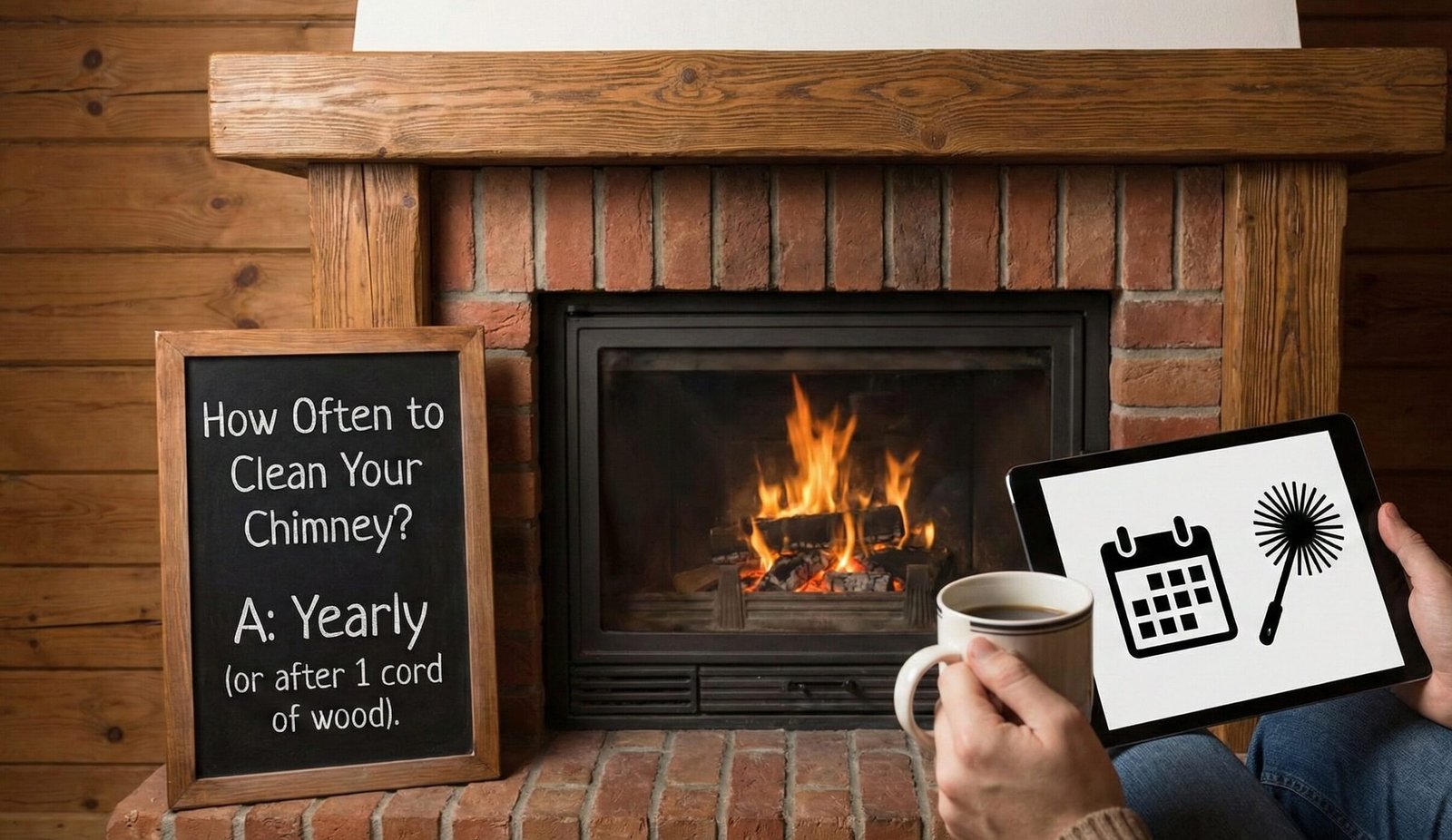
According to the National Fire Protection Association (NFPA), you should have your chimney inspected at least once a year. If you use your fireplace regularly (more than 30 fires a season), a cleaning should be performed after every 1 to 2 cords of wood burned, or when soot buildup reaches 1/8th of an inch. Heavy users should clean twice annually — before the season begins and at its end.
Owning a fireplace adds a layer of cozy ambiance to any home, but it also introduces significant maintenance responsibilities. Neglecting the flue isn’t just about poor performance — it is a critical safety hazard that causes thousands of house fires and hundreds of carbon monoxide incidents every single season. Whether you are curious about winter home comfort tips or specifically worried about creosote, understanding the cleaning frequency question is the single most important piece of chimney knowledge a homeowner can have.
In this comprehensive guide, we go far beyond a simple answer. We cover the science of why chimneys get dirty, every factor that affects how quickly your specific chimney needs attention, the three stages of creosote and what each requires, a complete DIY walkthrough, guidance on hiring professionals, the fuel and burning habit changes that cut your cleaning frequency dramatically, and everything in between. By the end, you will know your chimney’s needs as well as a certified chimney sweep does.
The Science of Soot and Creosote Formation
The primary reason for chimney cleaning is the buildup of creosote — a collective term for the complex mixture of combustion by-products that deposit on flue walls when wood burns. Understanding how and why creosote forms is essential to understanding why some chimneys need cleaning every six months while others can go an entire season without accumulating dangerous levels.
When wood burns, it undergoes a two-stage combustion process. The first stage releases volatile gases and particles — wood tars, phenols, organic acids, and condensable hydrocarbons — as the wood breaks down at lower temperatures. These substances rise with the flue gases. The second stage burns off those gases if the fire is hot enough. When the fire is cool, the wood is wet, or the flue temperature is insufficient, the gases do not fully combust and instead rise through the chimney and contact the relatively cooler flue walls, where they condense and deposit. This deposit is creosote.
The Flue Temperature Factor
Flue gas temperature is the single most important variable in creosote formation rate. At flue gas temperatures above 250°F, most volatile compounds remain gaseous and pass out of the chimney without depositing. At temperatures below 150°F, condensation happens rapidly and consistently. The temperature range between 150°F and 250°F is the danger zone — some condensation occurs on every firing cycle.
This is why an uninsulated exterior chimney in a cold climate produces dramatically more creosote than an interior chimney in the same climate: the exterior chimney walls stay cold, pulling the flue gas temperature below the condensation threshold faster. Insulating the liner is one of the most effective structural interventions for reducing creosote formation — it keeps gases hot all the way to the top.
What Creosote Actually Is
Creosote is not a single substance. It is a mixture of hundreds of compounds including phenols, polycyclic aromatic hydrocarbons (PAHs), benzene derivatives, and various organic acids. Its composition and physical form change depending on combustion temperature, wood species, moisture content, and flue temperature. This is why creosote appears in three distinctly different stages with very different cleaning requirements.
Creosote vs. Soot: These terms are often used interchangeably but they describe different things. Soot is the dry, powdery black carbon particulate that deposits in a relatively uniform layer on flue surfaces. It is the easiest to remove and the least flammable. Creosote includes soot but also contains condensed wood tars, which range from dusty and flaky (Stage 1) to glazed and rock-hard (Stage 3). Stage 3 creosote is so flammable it can sustain a chimney fire — a situation no homeowner wants.
The Three Stages of Creosote — And Why Each Changes Everything
Not all chimney cleaning is equal. The stage of creosote present in your flue determines what cleaning method is required, whether DIY cleaning is feasible at all, and how urgently the situation needs to be addressed. Every homeowner who burns wood should know these three stages by sight.
Stage 1 — Dusty / Flaky
Loose, dusty, or flaky deposits. Easily removed with a standard chimney brush. The ideal state to maintain — clean before it progresses. Color: light gray to black powder.
Stage 2 — Crunchy / Porous
Harder, shiny, tar-like deposits. Requires a rotary cleaning system or chemical treatment to break up. Standard brushing alone will not remove it. Requires urgent attention.
Stage 3 — Glazed / Rock-Hard
Dense, glazed, concentrated fuel coating on the flue walls. Extremely flammable. Cannot be removed by brushing. Requires professional chemical application and often liner replacement. Do not use the fireplace.
Stage 1 Creosote — Detection and Removal
Stage 1 deposits are loose, dusty, and flaky. They appear as a powdery or lightly crystalline coating on the flue surface, ranging in color from light gray to black. This is the ideal state to catch your chimney in — Stage 1 is easily removed with a standard chimney brush in a single cleaning session and poses a minimal fire risk at typical accumulation depths. The cleaning trigger for Stage 1 is the NFPA standard of 1/8 inch depth — at this point, cleaning is recommended regardless of usage frequency.
Stage 2 Creosote — The Urgent Zone
Stage 2 deposits are harder and shinier — sometimes described as appearing “crunchy” or having a tar-like gloss. They form when Stage 1 deposits are heated repeatedly and partially pyrolyzed, becoming a denser, more adhesive substance. A standard chimney brush will loosen some Stage 2 material but cannot fully remove it. For Stage 2 creosote, you need either a rotary cleaning system (power-driven stiff wire brushes that physically grind through the deposit) or a chemical treatment such as a chimney cleaning log or a powdered chemical catalyst applied during burning.
Stage 2 is the critical transition point. If addressed promptly when it first appears, it can often be managed with the right DIY tools. If left to continue accumulating or if the chimney is used heavily with Stage 2 present, it transitions to Stage 3 — which is a professional-only situation.
Stage 3 Creosote — Professional Territory Only
Stage 3 creosote is a dense, concentrated, glazed coating that has been thermally concentrated by repeated high-temperature fires burning against existing deposits. It is rock-hard, extremely flammable, and cannot be removed by any brush-based system — standard or rotary. Stage 3 creosote actually insulates and protects itself from mechanical removal, and attempts to chip it off risk damaging the flue liner.
Professional removal of Stage 3 creosote requires specialized chemical application. Products like Anti-Creo-Soot (ACS) are applied by a chimney professional during controlled fires. The chemical alters the molecular structure of the deposit, making it porous and friable so that subsequent mechanical cleaning can remove it. In severe cases where the Stage 3 deposit has significantly narrowed the flue or where the liner has been damaged, complete liner replacement may be the most practical solution.
Never Use the Fireplace with Stage 3 Creosote Present: Stage 3 deposits can ignite from a normal operating fire, creating a chimney fire that burns at temperatures exceeding 2,000°F — hot enough to crack terra cotta liner tiles, distort stainless liners, and ignite adjacent wood framing in the roof structure. If you suspect Stage 3 creosote, stop using the appliance immediately and schedule a professional inspection.
How Often to Clean: A Complete Frequency Guide by Use Pattern
The right cleaning schedule is not one-size-fits-all. It depends on how intensively you use the fireplace, what fuel you burn, the design of your chimney, and the condition of your flue liner. Use the table below as your starting baseline, then adjust based on the additional factors covered in the next section.
| Usage Pattern | Recommended Cleaning | Recommended Inspection | Primary Risk |
|---|---|---|---|
| Daily / Heavy Use (primary heat source, 5–7x per week) | 2× per season (mid-winter + spring) | Annual minimum; Level 2 every 3–5 years | Rapid creosote glazing; Stage 3 risk |
| Regular Use (2–4× per week, most of the season) | 1× per year (end of season / spring) | Annual Level 1 | Stage 2 creosote buildup |
| Weekend Use (1–2× per week) | 1× per year (spring / pre-season) | Annual Level 1 | Bird nests, seasonal soot |
| Occasional / Holiday Use (fewer than 15 fires per season) | Every 2 years if soot is light; inspect annually | Annual Level 1 | Structural decay, animal nesting |
| Gas Appliance (natural draft) | Annual inspection; cleaning as needed | Annual Level 1 | Condensation debris, nesting, blockage |
| Oil Furnace Flue | Annual cleaning — no exceptions | Annual Level 1 | Carbon soot, positive-pressure issues |
| Pellet Stove | Annual; check cat combustor quarterly | Annual Level 1 minimum | Ash and silica buildup |
The Rule of 1/8 Inch: Regardless of how many fires you have burned, clean the chimney whenever soot or creosote depth reaches 1/8 inch anywhere in the flue. This is the NFPA 211 standard cleaning trigger and it supersedes any calendar-based schedule. A chimney sweep’s flat inspection mirror or a Level 1 inspection will measure this during the annual check.
8 Factors That Directly Affect Your Cleaning Schedule
The cleaning frequency table above gives you a solid baseline, but eight specific factors can either compress your cleaning schedule significantly (requiring more frequent attention) or extend it (allowing you to go longer between cleanings). Understanding how these factors interact with your specific chimney system is how you move from a generic schedule to a personalized one.
1. Wood Moisture Content
This is the single biggest controllable variable in creosote formation. Freshly cut (“green”) wood contains 50–65% moisture by weight. When burned, all of that water must be evaporated before the wood can combust fully, which cools the fire and massively increases the volume of unburned volatile gases reaching the flue. Wet wood fires can accelerate creosote accumulation by 3–5 times compared to properly seasoned wood.
Properly seasoned hardwood contains less than 20% moisture content and is confirmed by a wood moisture meter — visual inspection alone is not reliable. Splits of properly dried wood have visible checking (end-grain cracks), sound hollow when knocked together, and are noticeably lighter than fresh-cut pieces of the same species. Always choose the best firewood for your fireplace to minimize creosote and extend your cleaning interval.
2. Fire Temperature and Burn Habits
Low, smoldering fires produce far more creosote than hot, vigorous fires. This is why “banking” a fire overnight — damping it down to a slow smolder to extend burn time — is one of the most creosote-promoting practices a wood-burner can adopt. A fire burning at 600–800°F in the firebox produces dramatically less creosote than the same wood smoldering at 300–400°F.
The counterintuitive recommendation: burn hotter, shorter fires rather than long, slow ones. Allow good airflow during combustion. Avoid closing down the damper significantly until the fire has fully combusted to ash. A hot, complete burn followed by a properly closed damper is far better for chimney cleanliness than an extended slow-burn session.
3. Chimney Height and Exterior vs. Interior Location
A taller chimney creates more draft — faster flue gas velocity means gases spend less time in contact with the flue walls, reducing condensation. But a taller chimney also has more surface area for condensation to occur on, particularly in the upper sections where the masonry is coldest. The net effect is that tall chimneys often have concentrated creosote deposits in the upper third of the flue, even when the lower sections look relatively clean during firebox inspection.
Exterior chimneys — those built on the outside of the home rather than running through conditioned interior space — are exposed to outdoor temperatures on all four sides. The masonry stays cold, flue gas temperatures drop faster, and creosote accumulates more rapidly. Homeowners with exterior chimneys should assume a compressed cleaning schedule and consider liner insulation as a structural solution.
4. Flue Liner Type and Condition
Smooth-walled flue liners accumulate creosote more slowly than rough-walled ones because smooth surfaces provide fewer nucleation points for condensation and the reduced turbulence allows gases to pass through faster. Modern stainless steel flexible liners have smooth interiors and are far more cleanable than old terra cotta tile liners with offset joints, cracks, or ledge deposits from previous liner failures.
Cracked or offset liner tiles create ledges where creosote accumulates far faster than on a continuous smooth surface. If your terra cotta liner has known damage, expect compressed cleaning intervals and consider liner replacement or relining as a medium-term investment. The reduction in cleaning frequency alone often justifies the liner installation cost.
5. Appliance Type and Sizing
The connected appliance has a profound effect on creosote formation rate. Open masonry fireplaces are the worst performers — they are inherently inefficient, with most heat going up the chimney rather than into the room, and they tend to produce lower flue gas temperatures with proportionally more creosote. Certified wood stoves with secondary combustion systems are far more efficient and burn a higher percentage of the volatile gases before they reach the flue.
Liner sizing relative to the appliance also matters. An oversized liner relative to the connected appliance means lower flue gas velocity and longer residence time in the flue — both of which increase condensation. If your stove is connected to a liner that is significantly larger than its collar size, the slow-moving gases cool faster and deposit more creosote. Proper liner sizing is covered by NFPA 211 and the appliance manufacturer’s specifications.
6. Cap and Crown Condition
A missing or damaged chimney cap allows rain, snow, and animals directly into the flue. Water mixing with soot creates an acidic slurry that attacks mortar joints, accelerates tile liner deterioration, and adds moisture to existing creosote deposits — making Stage 2 deposits worse and harder to remove. A functional cap with appropriate mesh screens is not optional equipment; it is fundamental maintenance infrastructure.
7. Ambient Temperature and Climate
Cold climates with extended heating seasons mean more fire-hours per season, accelerating creosote accumulation simply by volume. But the ambient temperature also affects the chimney itself — in very cold weather, the exterior masonry is colder, flue gas temperatures drop more quickly, and condensation rates are higher per fire. Homeowners in Climate Zones 6–7 (northern states, upper Midwest, high elevations) should assume the more aggressive end of any cleaning frequency recommendation.
8. Chimney Offset and Bends
An offset or angled chimney flue — one that is not straight from firebox to cap — creates turbulence in the rising flue gases. Turbulent flow increases contact between the gas and the flue wall, increasing condensation and creosote deposition rates. It also creates ledges and horizontal surfaces at the bend points where creosote accumulates faster than on vertical surfaces. If your chimney has an offset section (common in renovation scenarios where the chimney was moved to accommodate a room addition or second floor change), inspect those offset sections specifically and plan for more frequent cleaning.
7 Signs Your Chimney Needs Immediate Cleaning
Before you even look at the calendar, your fireplace might be telling you it needs attention. These warning signs should trigger an immediate inspection and cleaning regardless of when the last service was performed.
- Poor Draft: If you are experiencing fireplace draft problems or difficulty getting a fire started, the flue may be narrowed by soot or creosote deposits. A significantly reduced cross-section in the flue creates resistance that reduces the natural draft.
- Smoke Entry: Is fireplace smoke coming into the house? This is a dangerous sign of blockage, negative building pressure, or a compromised flue. Stop using the fireplace immediately and diagnose the cause.
- Campfire Odor (Unused Fireplace): A strong “campfire” or smoky smell when the fireplace isn’t in use — particularly in summer when the chimney is warm and the house is under negative air pressure — is a sign of damp creosote deposits off-gassing into the living space. This is both a comfort issue and a sign of moisture infiltration.
- Oily or Shiny Black Spots: Black, oily-looking spots on the firebox walls or above the damper indicate Stage 2 or Stage 3 creosote. If you can see this from the firebox opening, the actual accumulation deeper in the flue may be significantly more severe.
- Reduced Fireplace Opening Heat: If your fireplace seems to radiate less heat or the fire doesn’t draw as vigorously as it used to, reduced flue cross-section from deposits is the most likely cause.
- Evidence of Animals: Chirping or scratching sounds, debris falling into the firebox, or unusual smells are all signs of animal intrusion. Learn who to call if a bird is stuck or how to remove a raccoon. Animal nesting material is extremely flammable and can block the flue entirely.
- Previous Chimney Fire Signs: Warped or discolored metal components in the firebox, honeycomb-patterned cracking on terra cotta liner tiles, or rainbow-colored staining on masonry all indicate a past chimney fire. If any of these are present, do not use the fireplace until a Level 2 professional inspection has confirmed the integrity of the liner and surrounding structure.
Smoke Detector Note: Carbon monoxide detectors are not optional equipment for any home with a wood-burning or gas appliance vented through a chimney. They should be installed on every level of the home and tested monthly. CO is odorless, colorless, and can be produced by a partially blocked chimney flue or a damaged liner even when no fire is burning — residual CO from a gas appliance flue that becomes blocked can be fatal.
Understanding Chimney Inspection Levels (1, 2, and 3)
The NFPA 211 standard defines three levels of chimney inspection, each appropriate for different circumstances. Many homeowners confuse “cleaning” with “inspection” — they are different services. A cleaning removes deposits. An inspection assesses the structural and safety condition of the system. Both are required for comprehensive chimney maintenance.
Level 1 — Annual Standard
- Visual inspection of all accessible components
- No special equipment or tools required
- Appropriate when chimney has had no changes and no unusual events
- Should be performed annually for any chimney in regular use
- Typically included in a standard sweep/cleaning appointment
Level 2 — Change or Event Triggered
- All Level 1 components plus accessible attic, basement, and crawl space
- Video camera inspection of the full flue interior
- Required when buying or selling a home
- Required after any chimney fire, earthquake, or lightning strike
- Recommended after any change in appliance or fuel type
Level 3 Inspection: A Level 3 inspection is the most invasive — it may involve removing portions of the chimney structure to access areas of suspected damage. It is only performed when a Level 2 inspection reveals evidence of serious structural damage that cannot be fully assessed visually. It is rare in residential settings and is typically preceded by a Level 2 that identified specific concerns.
When to Request Each Level
| Situation | Appropriate Level | Urgency |
|---|---|---|
| Annual routine maintenance | Level 1 (with cleaning) | Before each heating season |
| Buying or selling a home | Level 2 | Before closing |
| After a chimney fire | Level 2 | Before any subsequent use — mandatory |
| After an earthquake | Level 2 | Before any subsequent use |
| Changing appliance type or fuel | Level 2 | Before connecting new appliance |
| Extended period of non-use (5+ years) | Level 2 | Before resuming use |
| Evidence of serious structural damage | Level 3 | Immediately; do not use |
DIY Cleaning: A Complete Step-by-Step Process
If you have a simple masonry fireplace with a straight flue and Stage 1 creosote, DIY cleaning is a manageable project with the right equipment. However, it is genuinely messy, requires specific tools, and demands proper respiratory and eye protection. Going in unprepared results in soot covering your living room and a partially-cleaned flue — which is worse than no cleaning because it dislodges deposits that then settle back into crevices in the liner.
Equipment You Will Need
- Chimney brush — sized to your specific flue dimensions (round, square, or rectangular). The brush must contact all four walls to be effective. An undersized brush is useless.
- Extension rods — fiberglass rods that connect to extend the brush the full length of the flue.
- HEPA chimney sweep vacuum — standard shop vacuums cannot handle the ultra-fine particle size of chimney soot and will blow it back into the room through the filter. Only use the best chimney sweep vacuum designed for this application.
- Drop cloths and plastic sheeting — cover all furniture, flooring, and the firebox opening completely. Soot travels far in air currents created by cleaning.
- N95 or P100 respirator — mandatory. Chimney soot contains carcinogenic PAHs and fine particles that cause serious lung disease with repeated exposure.
- Safety goggles and gloves
- Bright flashlight or headlamp
- Mirror and flashlight for inspecting the flue before and after
The Bottom-Up Cleaning Method (Recommended for Most Homeowners)
1
Seal the firebox opening completely
Use plastic sheeting and painter’s tape to seal the entire firebox opening, including around the damper area. Leave only a small access hole for the brush rods. This prevents soot from entering the room. Some professionals use a chimney cleaning bag (a plastic bag that seals over the firebox opening with a hole for the rods) for even better containment.
2
Set up the vacuum
Place the chimney vacuum inside the firebox behind the seal (with its intake hose through the firebox opening) or position it to capture falling debris as you work. Run the vacuum continuously during the entire cleaning process — the airflow captures dislodged particles before they settle.
3
Insert and work the brush
Open the damper fully. Insert the brush through the access hole and attach rods as you push upward. Use a firm, consistent scrubbing motion — 3–4 full up-and-down strokes per rod section before adding the next rod. The brush should contact all four walls with enough pressure to dislodge loose deposits without excessive force.
4
Work to the full height
Continue adding rods and scrubbing until you feel the brush exit at the chimney top. At the top, do several full strokes, then slowly withdraw the brush while continuing to scrub on the way down. Falling debris should be captured by the vacuum.
5
Remove the seal and clean the firebox
After withdrawing the brush completely, allow 10–15 minutes for airborne particles to settle. Remove the plastic seal carefully, folding inward to capture any deposited soot on the sheeting surface. Vacuum the smoke shelf, firebox floor, and all ledges thoroughly. Wipe down all surfaces with a damp cloth.
6
Inspect your work
Using a mirror and flashlight, visually inspect the flue from the firebox opening. The flue walls should appear relatively clean and free of loose deposits. If you see shiny or sticky areas, those are Stage 2 deposits that your brush has not fully removed — note their location and evaluate whether a professional cleaning service with rotary equipment is needed.
For Maintenance Cleaning

Creosote Sweeping Log
A great preventative measure to burn periodically between full cleanings. It dries out sticky Stage 1–2 creosote, making it brittle and easier to sweep during your next mechanical cleaning session.
For The DIY Sweeper

Holikme Chimney Brush Kit
Extendable drill-powered rods for bottom-up cleaning without climbing the roof. Compatible with round flexible liner systems. Ensure you match the brush diameter precisely to your flue size.
The Top-Down Method (Roof Access Required)
Some chimney configurations require cleaning from the top down — inserting the brush into the flue from the chimney crown and working downward. This is necessary when the flue is inaccessible from the firebox (offset sections, sealed dampers, or insert configurations) or when the professional wants to clear debris at the cap level first. The top-down method requires roof access and proper fall protection. For DIYers uncomfortable on the roof, the bottom-up method with extension rods is strongly preferred — it achieves the same result with none of the fall risk.
DIY vs. Professional Cleaning — Honest Comparison
Can you do it yourself? Yes, for straightforward Stage 1 cleaning on a simple masonry fireplace. But with caveats. Here is an honest comparison so you can make the right call for your specific situation without spending money unnecessarily or taking on a job that exceeds DIY limitations.
DIY Is Fine When…
- The flue is straight with no offsets
- Creosote is Stage 1 (dusty, powdery)
- You have the right brush, rods, and HEPA vacuum
- The flue liner appears intact from firebox inspection
- The chimney cap is in place and functioning
- No evidence of past chimney fires
- You are comfortable with the mess and have time for proper setup
Hire a Professional When…
- Creosote is Stage 2 (shiny, hard) or Stage 3 (glazed)
- There is any evidence of a past chimney fire
- The flue has an offset section
- You are buying or selling the home (Level 2 required)
- The appliance or fuel type has changed
- There has been an earthquake, flood, or major storm
- Animals have been inside the flue
- The liner is terra cotta with unknown condition
- It has been 5+ years since the last professional inspection
If you choose the DIY route, you cannot use standard household tools. You need equipment designed to handle toxic dust, hard-bristle chisel contact, and continuous-use motor loads. You need the best chimney brush for stainless steel liners if you have a metal flue — wire brushes can damage flexible liner corrugations. You also absolutely need the best chimney sweep vacuum to prevent carcinogenic soot dust from coating your living room and your lungs.
External Factors: Caps, Crown, Mortar, and Flashing
Cleaning the flue is only half the battle. The structural condition of the chimney exterior determines how quickly it gets dirty again and whether the cleaning you just paid for will hold up through the season. Four external components have the most direct effect on cleaning frequency and difficulty.
- Caps: Install the best chimney caps for rain to prevent moisture and animals. A cap with a correctly sized wire mesh screen (5/8-inch openings) keeps birds and small animals out while maintaining adequate draft. This single addition dramatically reduces the frequency of animal-related blockages and the moisture-accelerated creosote deposits that form when rain mixes with soot.
- Crown & Mortar: Check the masonry around the crown and the mortar joints. If it’s crumbling, use the best mortar for chimney repair before the next heating season. Cracks in the crown and open mortar joints allow oxygen infiltration, which can provide additional air to an established chimney fire, accelerating the damage.
- Waterproofing: Apply the best chimney flashing sealant to the base where the stack meets the roof. A sealed flashing prevents the moisture infiltration that creates the acidic environment where creosote becomes sticky and adhesive rather than dry and brushable.
The Moisture-Creosote Connection
Water infiltration through a missing cap or cracked crown dramatically changes the character of existing creosote deposits. Dry, loose Stage 1 deposits that would brush off easily become sticky, hygroscopic masses that bond to the liner surface and resist mechanical cleaning. A chimney that was Stage 1 before a wet summer can present as Stage 2 in the fall — not because more fires were burned, but because moisture exposure transformed the existing deposits. This is one of the strongest arguments for prompt cap installation and crown maintenance — they protect not just the structural masonry but the cleanliness of the deposits already present.
Choosing the Right Fuel to Reduce Cleaning Frequency
You can effectively double the time between required cleanings simply by burning the right fuel the right way. Wet, green wood is the primary cause of rapid creosote buildup — nothing else you do will make as much difference to your cleaning schedule as fuel moisture content. Here is the complete picture of how fuel choice affects chimney maintenance.
Wood Species and Creosote Production
Always choose the best firewood for your fireplace — specifically, seasoned hardwoods with low moisture content. Hardwood species such as oak, hickory, maple, ash, and beech have higher energy density (BTUs per cord), burn hotter, and produce less smoke per unit of heat than softwoods. Hotter combustion means more of the volatile gases burn in the firebox and firebox throat rather than rising unburned into the flue.
| Wood Type | Creosote Risk | BTU per Cord (Approx.) | Notes |
|---|---|---|---|
| Seasoned Oak (dry) | Low | 24–28 million | Best overall; burns hot and clean |
| Seasoned Hickory (dry) | Low | 25–28 million | Dense, long burn; excellent for overnight embers |
| Seasoned Maple (dry) | Low | 23–26 million | Clean burn; readily available in most regions |
| Seasoned Ash (dry) | Low | 20–24 million | Burns well even at slightly elevated moisture |
| Seasoned Birch (dry) | Low–Medium | 20–23 million | Burns fast; good kindling; higher sap content |
| Pine / Softwood (dry) | Medium–High | 15–18 million | High sap content; more creosote per fire |
| Any green/wet wood | Very High | 50–70% of potential | Never burn; primary cause of rapid buildup |
Alternative Fuels and Appliance Options
If you are tired of the wood sourcing, storage, and moisture management hassle, there are alternatives worth considering. Pellet stoves burn kiln-dried compressed wood pellets with extremely consistent moisture content (typically less than 8%), producing far less creosote than even the best-seasoned cordwood. The tradeoff is more frequent ash removal from the burn pot and a more complex appliance requiring greater mechanical maintenance.
For a broader comparison of the ongoing maintenance implications of different heating choices, consider reviewing the electric fireplace vs wood fireplace comparison or the wood stove vs fireplace heating efficiency guide. Electric alternatives require no chimney cleaning whatsoever — but they do not provide the same ambiance or backup heating capability as a wood-burning system.
Creosote-Reducing Burning Practices
- Never burn cardboard, trash, or treated wood: These produce far more volatile gases than firewood and cause rapid, sticky creosote formation. Treated or painted wood also releases toxic compounds into the flue.
- Start fires with the damper fully open: A fully open damper and a quick-starting fire with dry kindling establishes a strong draft and heats the flue quickly, reducing the condensation window.
- Use the top-down lighting method: Place large logs at the bottom, medium logs above, small splits above those, and kindling on top. Light the top. This produces a cleaner-burning, lower-smoke fire than the traditional bottom-up method.
- Maintain a hot, active fire rather than a slow smolder: Once established, keep the fire burning at medium to high output rather than damping down excessively. A fire maintained at 600°F or above in the firebox produces significantly less creosote per unit of wood burned.
- Burn a creosote sweeping log periodically: These chemical logs do not replace mechanical cleaning, but they do slow Stage 1 buildup and can make the next cleaning easier by desiccating sticky deposits.
Cleaning Frequency by Appliance Type
Each type of appliance that connects to a chimney flue has different maintenance requirements. Using the wrong cleaning approach for your specific appliance is a common mistake that results in either under-cleaning (dangerous) or unnecessary work and expense.
Open Masonry Fireplaces
Open masonry fireplaces are the most common residential chimney application and the worst for creosote production. The large firebox opening means air infiltration rates are high, fire temperatures are variable, and a significant portion of the heat (and unburned gases) goes up the chimney. Annual cleaning is the minimum for any regular use — if you are burning more than 10–15 fires per season, consider twice-annual service. The smoke shelf (the horizontal ledge behind the damper plate) is a particular accumulation point that requires specific attention and is often missed in quick DIY cleanings.
Certified Wood Stoves
EPA-certified wood stoves with secondary combustion or catalytic combustion systems burn far more efficiently than open fireplaces. They combust a higher percentage of the volatile gases before they reach the flue, significantly reducing creosote formation per BTU of heat delivered to the room. Annual cleaning is still required for regular users, but the deposits removed will typically be Stage 1 and the overall volume will be considerably less than from an open fireplace burning the same wood.
Catalytic stoves require additional maintenance: the catalytic combustor (the ceramic honeycomb that facilitates secondary combustion) should be inspected quarterly during the heating season and replaced when it shows significant deterioration. A failing catalytic combustor sharply increases creosote formation because unburned gases bypass the secondary combustion process.
Pellet Stoves
Pellet stoves burn kiln-dried compressed wood pellets with a forced-draft blower. The consistent, low-moisture fuel and controlled combustion produce minimal creosote but generate significant fine ash that accumulates in the burn pot, ash trap, and heat exchanger. Pellet stoves need more frequent cleaning than wood stoves (weekly to bi-weekly ash removal from the burn pot) but an annual professional cleaning and inspection covers the flue and exhaust system adequately for most users.
Gas Fireplaces and Appliances
If you are unsure if your setup even requires chimney maintenance, check our guide: Does a gas fireplace need a chimney? Natural gas and propane appliances produce essentially no creosote, but they are not maintenance-free. The flue can accumulate debris from the bird and animal entry (if the cap is missing or damaged), condensation deposits from high-efficiency appliances, and carbon soot from incomplete combustion due to a misadjusted burner. Annual inspection is mandatory; cleaning frequency depends on the inspection findings. Gas appliances also present a greater carbon monoxide risk from a blocked flue than wood-burning appliances — a partially blocked gas flue can accumulate CO in the living space with no visible smoke or flame behavior change to alert the occupant.
Oil Furnace and Boiler Flues
Oil-fired heating systems produce carbon soot that accumulates in the flue and heat exchanger. Unlike wood creosote, oil soot is a dry, powdery carbon deposit that is easy to brush out — but it accumulates consistently and must be removed annually. Oil systems also often use positive-pressure venting, which means flue gas is pushed through the system rather than pulled by draft. Any blockage in a positive-pressure system will push combustion gases back into the appliance room rather than into the chimney. Annual professional service including flue cleaning, heat exchanger inspection, and burner tune-up is essential for every oil system without exception.
Carbon Monoxide: The Hidden Danger of an Uncleaned Chimney
Creosote-related chimney fires are the most dramatic consequence of neglected chimney maintenance, but carbon monoxide poisoning is the more statistically significant danger. CO is produced whenever a carbon-containing fuel combusts incompletely — which includes every wood fire, every gas flame, and every oil burner. Normally, CO exits harmlessly through the flue. When the flue is blocked, restricted, or the appliance is not drafting properly, CO enters the living space.
How Chimney Conditions Create CO Hazards
- Blocked cap or flue: A bird nest, animal nesting material, or debris blockage at the cap can completely prevent flue gases from exiting, forcing CO back down into the firebox and into the room.
- Severely restricted flue: Stage 2 or Stage 3 creosote that has reduced the flue cross-section significantly restricts draft, reducing the flue’s ability to carry all combustion gases upward and out. Partial backdrafting — where some CO-containing gases escape into the living space — can occur without any visible smoke.
- Cracked liner: A cracked terra cotta flue tile can allow CO to escape through the masonry into adjacent living spaces without any visible smoke or flame indication inside the firebox.
- Negative building pressure: Modern, well-sealed homes under negative interior pressure (caused by kitchen exhaust fans, bathroom fans, clothes dryers, or other appliances running simultaneously) can pull flue gas back down the chimney into the living space — a problem dramatically worsened by any restriction in the flue.
CO Detector Placement: Install CO detectors within 15 feet of every sleeping room and on every level of the home. The detector should be mounted at breathing height (5 feet) rather than ceiling height — CO is approximately the same density as air and does not accumulate at the ceiling the way smoke does. Test monthly and replace the detector per the manufacturer’s recommended service life (typically 5–7 years).
Seasonal Chimney Cleaning Checklist
A year-round approach to chimney maintenance is far more effective than a once-annual scramble. Each season has specific tasks that collectively keep the chimney clean, structurally sound, and safe throughout the heating season.
Fall — Pre-Season
- Schedule annual inspection + sweep
- Inspect cap and screen for nesting material
- Check crown condition
- Test damper operation
- Confirm CO detector is functioning
- Inspect smoke shelf for debris
Winter — In-Season
- After first 10 fires, do a flashlight check from firebox
- Heavy users: mid-winter inspection at 1 cord burned
- Monitor for campfire odor when not in use
- Check cap for ice blockage after freezing rain
- Listen for crackling (chimney fire sign)
Spring — Post-Season
- End-of-season sweep if not done mid-winter
- Inspect flue for winter damage (frost heave on liner)
- Check for new efflorescence on exterior
- Close damper after final cleaning
- Consider a creosote log if resuming use next fall
Summer — Off-Season
- Ideal time for masonry repairs (warm cure conditions)
- Tuckpointing if needed
- Crown re-coat if water-bead test fails
- Check cap for new animal nesting
- Schedule fall sweep while pros have availability
How to Find and Vet a Professional Chimney Sweep
Not all chimney cleaning companies are equal. This is a specialized trade — a general handyman with a brush and a vacuum is not the same as a CSIA-certified chimney sweep who understands liner chemistry, NFPA 211, and the diagnostic signs of structural compromise. Choosing the wrong service provider puts your home at risk.
The CSIA Certification Standard
The Chimney Safety Institute of America (CSIA) administers the most widely recognized certification for chimney sweep professionals in the United States. CSIA Certified Chimney Sweeps have passed a rigorous examination covering NFPA 211, fuel combustion chemistry, appliance sizing, liner systems, waterproofing, and safety protocols. Always verify CSIA certification directly on the CSIA website before hiring. The certification number is verifiable and current status is searchable.
See our list of best chimney services for vetted provider guidance.
Questions to Ask Before Hiring
- Are you CSIA certified? (Ask for certification number — verify online)
- Do you carry liability insurance and workers’ compensation? (Request proof)
- What inspection level will this appointment include?
- Do you use a video camera for flue inspection? (Level 2 requires it)
- What will you do if you find Stage 2 or Stage 3 creosote during cleaning?
- Will you provide a written report of inspection findings?
- Do you have references from jobs in my area with similar chimney types?
Red Flags to Avoid: Door-to-door chimney sweep solicitations with unusually low prices (often under $50) are a well-documented scam pattern. The sweep arrives, tells you the chimney is dangerously blocked, and quotes $1,000–$3,000 for unnecessary work. Always use a CSIA-certified professional found through the CSIA locator or verified references, not cold-call solicitations.
Cost Breakdown for Cleaning and Inspection
Understanding what chimney services actually cost helps you identify fair pricing, avoid scams, and budget accurately for annual maintenance. Prices vary significantly by region — rural areas and cities with high labor costs will both differ from national averages.
$150–$300
Level 1 inspection + sweep
$300–$600
Level 2 inspection (video)
$400–$800
Stage 2 creosote removal
$1,000+
Stage 3 professional treatment
$75–$200
Animal nest removal
$0–$80
DIY cleaning (materials)
| Service | DIY Cost | Professional Cost | Notes |
|---|---|---|---|
| Level 1 inspection + standard cleaning | $40–$80 (tools) | $150–$300 | Annual minimum for regular users |
| Level 2 inspection (video camera) | Not DIY-feasible | $300–$600 | Required for home sale, after chimney fire |
| Stage 2 creosote removal | $30–$60 (rotary kit) | $400–$800 | May need chemical pre-treatment |
| Stage 3 creosote treatment | Not DIY-safe | $1,000–$3,000+ | Often includes liner assessment |
| Animal nest removal | $0 (DIY possible) | $75–$200 | Includes disinfection of debris |
| Chimney sweep vacuum purchase | $150–$300 one-time | N/A | Amortizes across many DIY cleanings |
| Creosote log (preventative) | $15–$25 per log | N/A | Not a substitute for mechanical cleaning |
The ROI of Regular Cleaning: A standard annual professional sweep costs $150–$300 and prevents chimney fires, CO incidents, and the accelerating damage of Stage 2/3 creosote progression. A single chimney fire requiring liner replacement costs $2,500–$8,000 or more. The return on investment for regular cleaning is among the highest of any home safety maintenance activity.
Frequently Asked Questions
Does homeowner’s insurance cover chimney cleaning?
Typically, no. Cleaning is considered routine maintenance, which is the homeowner’s responsibility and is explicitly excluded from most homeowner’s insurance policies. However, if a sudden event — such as a windstorm that drives a tree limb through the chimney cap, or a lightning strike — causes damage, the resulting repair may be covered. Check our guide on homeowners insurance and chimney repair for the distinction between covered events and maintenance exclusions. Keeping dated maintenance records significantly strengthens any claim you do submit.
What happens if I never clean my chimney?
The progression is predictable. Stage 1 deposits advance to Stage 2 and then Stage 3 with continued use. Stage 3 creosote can ignite from a normal operating fire, creating a chimney fire that burns at temperatures exceeding 2,000°F — hot enough to crack terra cotta liner tiles, warp or melt stainless steel liner components, and ignite the wood framing and roof sheathing adjacent to the chimney structure. Beyond the fire risk, a narrowed and deteriorating flue increases carbon monoxide exposure risk every time you use the appliance. Neither risk is theoretical — they are the direct, documented cause of thousands of residential fires and CO incidents each season.
How much does a professional chimney sweep cost?
Prices vary by region, but expect to pay between $150 and $300 for a standard Level 1 inspection and sweep of a single-flue residential chimney. Heavy creosote removal requiring rotary cleaning equipment or chemical pre-treatment runs $400–$800. Animal nest removal adds $75–$200 to any appointment. A Level 2 video inspection, which is required when buying a home or after a chimney fire, typically runs $300–$600 as a standalone service or $150–$250 when bundled with a cleaning. See our list of best chimney services for regional pricing guidance.
Can I use a gas fireplace without cleaning the chimney?
Gas appliances produce essentially no creosote, so the creosote-related cleaning urgency does not apply. However, the annual inspection requirement does apply — and is arguably more important for gas appliances than wood-burning ones because gas produces carbon monoxide and the risk of a CO incident from a blocked gas flue is extremely serious. Animal nesting in an unprotected gas chimney flue is a common cause of partial blockage and elevated CO production. Annual inspection by a CSIA-certified professional is the NFPA 211 standard for all chimney types, including those serving gas appliances. Do not skip this service just because your appliance burns gas.
Is spring or fall the better time to clean the chimney?
Both have valid arguments. Spring cleaning removes the end-of-season deposits before they sit through a warm, humid summer — hot temperatures activate creosote’s organic compounds, causing odors to off-gas into the house and accelerating the transition from Stage 1 to Stage 2 in wet conditions. Fall cleaning ensures the chimney is ready to use immediately when you need it and allows any structural repairs identified in the inspection to be addressed before heating season begins. The pragmatic answer: schedule spring cleaning for the deposit removal benefit, and do a fall visual inspection yourself (water-bead test, cap inspection, and a flashlight check of the flue from the firebox) to confirm nothing has changed over the summer. If you can only do one service per year, pre-season fall is the higher-priority timing from a safety standpoint.
Do chimney cleaning logs really work?
Chimney sweeping logs (such as Creosote Sweeping Log and similar products) contain minerals and chemicals that, when volatilized during combustion, react with deposited creosote and cause it to become dry, porous, and brittle rather than sticky and adhesive. Multiple independent studies have confirmed that these products do reduce Stage 1 deposit accumulation and make subsequent mechanical cleaning more effective. What they do not do is replace mechanical cleaning — they do not remove the deposits from the flue, they simply change the physical character of those deposits so that the next brush cleaning or the natural airflow over subsequent fires carries them out. Use them as a between-cleaning supplement, not a substitute for the annual sweep.
How do I know if I had a chimney fire?
Some chimney fires are dramatic — a roaring sound from the flue, flames visible from the cap, and neighbors calling the fire department. Many are not — they are slow, smoldering fires at the creosote deposit level that the homeowner never detects. Signs of a past chimney fire to look for during inspection include: honeycomb patterned cracking on terra cotta tile liner pieces that have fallen to the smoke shelf, discolored or distorted metal components in the firebox (damper frame, throat area), rainbow-colored staining or puffed appearance on exterior masonry, and a heavy, petroleum-like smell from the firebox. If any of these signs are present, do not use the fireplace until a Level 2 professional inspection has assessed the structural integrity of the entire chimney system.
What is the best time of year to schedule a chimney sweep?
Summer — specifically July and August — is the ideal time to schedule chimney service for several practical reasons. Chimney sweeps are significantly less busy in summer than in fall, giving you better scheduling flexibility and potentially better pricing. Structural repairs identified during the inspection (tuckpointing, crown repair, flashing work) are best performed in warm, dry weather for optimal cure conditions. And you avoid the fall rush — many sweeps are fully booked through October and November by homeowners who waited until they needed the fireplace. Book your fall service in July and you will have your choice of appointment times and no risk of going into the heating season with an uninspected chimney.
Community Insight: See what real homeowners are saying about their cleaning schedules in this Reddit discussion.
Disclaimer: This guide is for informational purposes. Always consult a CSIA-certified chimney sweep for professional advice regarding your specific heating system and local code requirements.