Boss Industrial Log Splitter Reviews: Pros, Cons & Verdict
By Chimney Insight Editorial Team
Posted on December 31, 2025
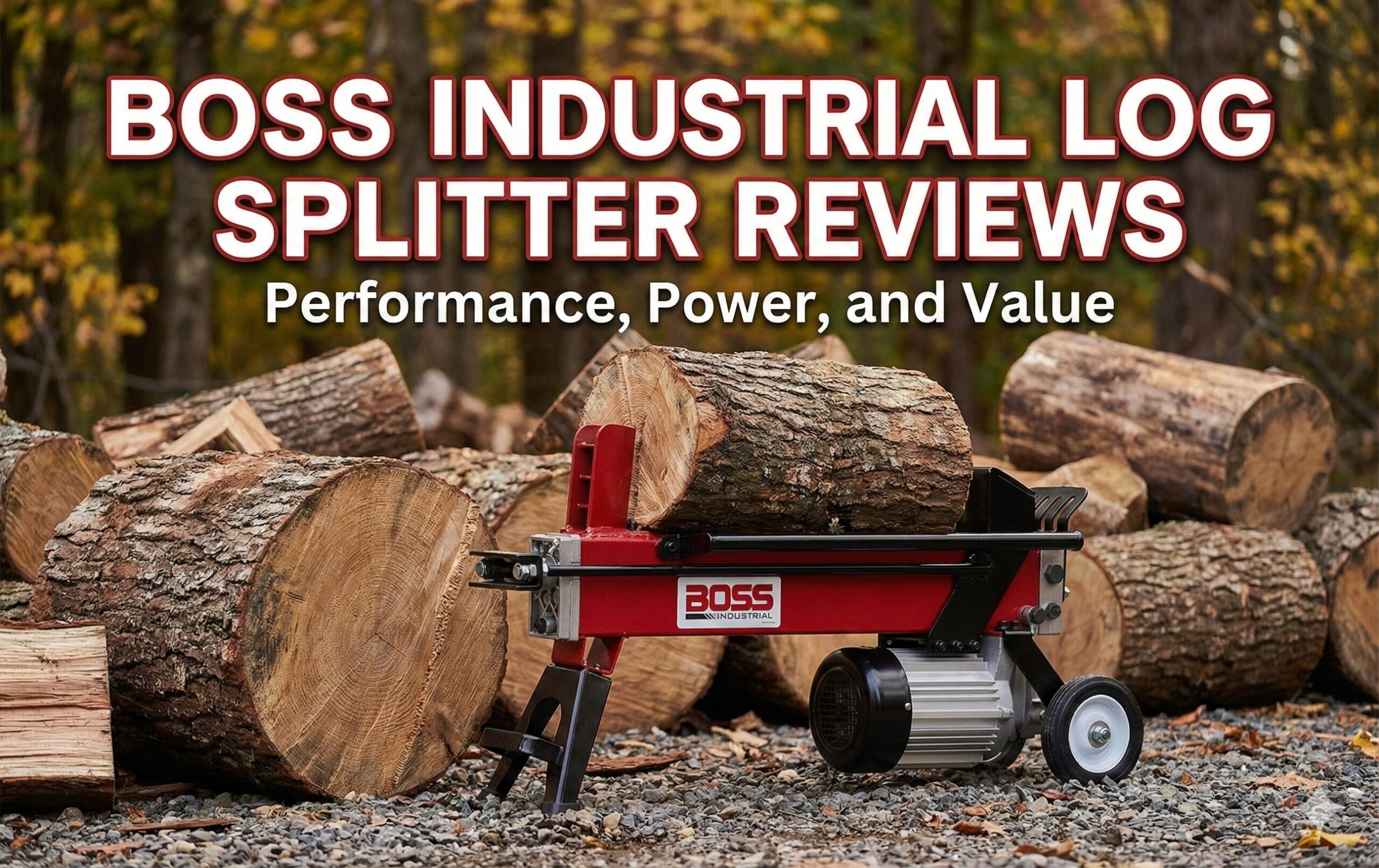
In a market flooded with generic power tools, Boss Industrial stands out by doing one thing and doing it well: hydraulics. Unlike other brands that slap their logo on a lawnmower one day and a splitter the next, Boss Industrial focuses heavily on hydraulic technology for log splitting applications.
Their reputation is built largely on their electric models, which are widely considered some of the best electric log splitters available. They are known for their patented one-handed operation systems and robust motors that punch above their weight class.
Whether you need a portable unit for the garage or a gas-powered beast for the farm, this guide breaks down the pros, cons, and real-world performance of the entire Boss lineup—from the entry-level 5-ton all the way up to their 37-ton tractor-drive models.
Quick Decision Guide
Short on time? Here is the cheat sheet for the Boss Industrial lineup.
| Your Situation | Recommended Model | Why? |
|---|---|---|
| Residential / Fireplace | Boss EC5T20 (5-Ton) | Lightweight, portable, perfect for seasoned rounds up to 10″. |
| Hardwoods / Tough Knots | Boss ES7T20 (7-Ton) | Extra tonnage handles knotty oak and maple far better. |
| Mid-Volume Homeowner | Boss 10-Ton Electric | Dual-action cutting doubles throughput vs. the 7-ton. |
| High-Volume / Large Rounds | Boss 16-Ton Electric | Maximum electric power; handles rounds up to 12″ diameter. |
| Off-Grid / Heavy Volume | Boss Gas Series (20–37 Ton) | No power cords; tow to the woodpile. |
| Farm / Commercial | Boss Tractor PTO (22–35 Ton) | Uses tractor hydraulics; no extra engine to maintain. |
Quick BOSS Log Splitter Picks
Amazon Associates disclosure: As an Amazon Associate, Chimney Insight earns from qualifying purchases at no additional cost to you.
Boss EC5T20 5-Ton Electric
Best for: Occasional residential splitting of seasoned firewood.
Practical advantage: Compact electric design for homeowners who prioritize portability.
Check before buying: Confirm your log size, wood condition, outlet, and extension-cord requirements.
Check EC5T20 Compatibility on AmazonBoss ES7T20 7-Ton Electric
Best for: Homeowners who need more force for harder or knotty seasoned wood.
Practical advantage: More splitting force than the 5-ton model while remaining electric.
Check before buying: It is heavier and still requires the correct electrical setup and working height.
Compare ES7T20 Options on AmazonWhy Choose Boss Industrial?
Before diving into individual reviews, it is important to understand what makes this brand unique. Boss isn’t the cheapest option on the shelf, but you are paying for component quality and proprietary engineering that generic brands simply do not offer.
- One-Handed Operation: Many Boss electric models allow for safe one-handed use, unlike competitors that require two hands (one on a button, one on a lever). This significantly speeds up your workflow when you are feeding one log after another for hours at a time.
- Hydraulic Expertise: Their pumps and cylinders are rated for higher duty cycles than generic brands. Boss uses professional-grade hydraulic components borrowed from commercial equipment, not the cheap sub-rated parts common in big-box store competitors.
- Portability: Models like the EC5T20 and ES7T20 are engineered to be lifted into a truck bed by a single person. This is not an afterthought—the chassis, weight distribution, and handle positioning are all designed with one-person transport in mind.
- Emissions Compliance: The full electric lineup operates with zero emissions, making them legal for indoor use in garages, barns, and workshops where engine fumes would be a hazard.
- Full Beam Construction: Unlike many competitors whose split-beam designs sacrifice rigidity, Boss uses a full-beam channel construction on most models. This eliminates flex under load and keeps the ram and wedge in perfect alignment for clean splits every time.
Where is Boss Industrial made? Boss Industrial is a Canadian company headquartered in Ontario. Their products are designed and engineered in Canada, though manufacturing uses components sourced from international suppliers. This Canadian engineering pedigree is part of why their hydraulic design tends to be more sophisticated than similarly priced American and Chinese-branded competitors.
How Electric Log Splitters Work (and Why It Matters)
If you are shopping for your first log splitter, understanding the mechanics helps you interpret the spec sheet intelligently. Every hydraulic log splitter—whether electric or gas powered—operates on the same basic principle: a pump drives hydraulic fluid into a cylinder, which pushes a ram (piston) against the log, forcing it onto a wedge that splits the wood along the grain.
The Key Components
The Motor: In electric models, an AC motor spins the hydraulic pump. Motor power is expressed in horsepower (HP) or amps. A 1.8 HP motor (as in the EC5T20) draws roughly 15 amps at 115 volts. A 2.5 HP motor (as in the 10-ton and 16-ton models) draws approximately 20 amps, which is why Boss specifies a 20-amp dedicated circuit for those units. Running a 20-amp motor on a 15-amp circuit or through an undersized extension cord is the single most common cause of motor failure and warranty disputes.
The Hydraulic Pump: This is where Boss earns its reputation. Their pumps generate higher hydraulic pressure (PSI) than most competitors at equivalent motor ratings. The 16-ton electric model, for example, delivers 3,800 PSI from its 2.5 HP motor—a figure usually associated with much larger machines. Higher PSI from the same bore cylinder produces more splitting force, which is why Boss’s tonnage ratings are consistently verified as genuine rather than optimistic marketing numbers.
The Cylinder and Bore: The diameter of the hydraulic cylinder bore directly determines splitting force. Boss uses a 2.5-inch bore in the 10-ton model and a 2.8-inch bore in the 16-ton—both significantly larger than the 2.2-inch bore in the 5-ton and 7-ton units. A larger bore means more surface area for hydraulic pressure to act upon, which translates directly to more splitting force. It also requires more hydraulic fluid volume per cycle, which is why larger models have slower cycle times despite higher pressure.
The Wedge: Boss uses a 7-inch wedge on most models. The wedge angle determines whether the splitter excels at wedging apart straight-grained wood (a steep wedge) or at forcing through twisted and knotty grain (a shallower wedge with more brute force). The Boss CW-S 4-way cross wedge accessory is worth discussing separately—see the Accessories section below.
Electric vs. Gas: The Real Trade-Offs
| Factor | Electric | Gas |
|---|---|---|
| Noise level | ~75 dB (library quiet by comparison) | ~90–100 dB (hearing protection required) |
| Emissions | None (indoor use OK) | CO/exhaust (outdoor only) |
| Maintenance | Minimal (hydraulic fluid checks) | Oil changes, spark plugs, carb cleaning |
| Max practical tonnage | 16–20 tons | Up to 37+ tons |
| Portability | Carry in car trunk | Towable trailer required above 20 tons |
| Power cord dependency | Within 50 ft of outlet | Unlimited range |
| Cold weather starting | Instant, always | Difficult below freezing |
The Full Boss Industrial Lineup at a Glance
| Model | Type | Tonnage | Motor | Cycle Time | Max Log Length | Best For |
|---|---|---|---|---|---|---|
| EC5T20 | Electric | 5 Ton | 1.8 HP / 115V | ~14 sec | 20.5″ | Portable homeowner use |
| ES7T20 | Electric | 7 Ton | 2 HP / 115V | ~14 sec | 20.5″ | Hardwood homeowners |
| EC10T20 (10-Ton) | Electric | 10 Ton | 2.5 HP / 120V | 9+13 sec (dual) | 20.5″ | Mid-volume; dual action |
| 16-Ton Electric | Electric | 16 Ton | 2.5 HP / 120V | ~13 sec | 20.5″ | High-volume electric users |
| GD16T | Gas | 16 Ton | 208cc engine | Fast | 24″ | Off-grid / heavy use |
| Professional 27-Ton Gas | Gas | 27 Ton | Briggs CR950 6.5 HP | 15 sec | 26″ | Farm / large rounds |
| Professional 37-Ton Gas | Gas | 37 Ton | Large OHV | Fast | 26″+ | Commercial / very large logs |
| 3-Point PTO 22-Ton | Tractor | 22 Ton | Tractor hydraulics | Variable | 24″ | Tractor owners |
| 3-Point PTO 35-Ton | Tractor | 35 Ton | Tractor hydraulics | Variable | 26″ | Large farm operations |
1. Boss Industrial EC5T20 5-Ton Electric
Best Seller
The Boss Industrial EC5T20 is the brand’s flagship homeowner model. It is a 5-ton electric splitter powered by a durable 1.8 HP motor running on standard 115-volt household current. Designed for portability, it weighs approximately 58 pounds and is light enough to fit in the trunk of most cars, making it ideal for taking to a cabin, helping a neighbor, or simply storing on a garage shelf rather than leaving it outdoors year-round.
It features automatic ram return and the signature one-handed operation, which makes splitting seasoned wood incredibly fast compared to the two-handed safety systems required by competing brands. While 5 tons might sound light compared to gas models, it easily handles logs of 10-inch diameter from seasoned pine, ash, birch, and even straight-grained oak.
The EC5T20 is sold as a compact electric splitter for lighter-duty firewood processing. Check the current manufacturer manual and product listing for setup, hydraulic specifications, rated capacity, and operating requirements. Actual splitting performance varies with log diameter, grain, species, moisture, and condition.
Key Specifications
| Spec | Detail |
|---|---|
| Splitting force | 5 tons |
| Motor | 1.8 HP, 115V, 60Hz, 15A |
| Max log length | 20.5 inches |
| Max log diameter | 10 inches |
| Hydraulic bore | 2.2 inches |
| Weight | ~58 lbs |
| Warranty | 2 years residential / 180 days commercial |
| Oil capacity | Approx. 2.5L |
Pros
- One-Handed Operation: Significantly faster workflow than two-handed competitors.
- Portability: At ~58 lbs, it fits in trunks and can be stored on a shelf.
- Ready Out of Box: Pre-filled with hydraulic fluid; plug and split.
- Quiet: Electric motor is far quieter than any gas model.
- Indoor Use: Zero emissions; safe in garage or workshop.
- Warranty: Solid 2-year residential coverage.
Cons
- Tonnage Ceiling: 5 tons struggles with large knots or any green wood.
- Low Working Height: No stand included; uncomfortable for extended sessions.
- Extension Cord Sensitive: Requires 12-gauge cord; motor fails on undersized cords.
- Log Size Limit: Not suitable for rounds over 10 inches diameter.

The perfect portable companion for backyard firewood.
2. Boss Industrial ES7T20 7-Ton Electric
Power Upgrade
If you like the idea of electric but are worried that 5 tons isn’t enough, the ES7T20 is the answer. It bumps the crushing force up to 7 tons by pairing a slightly more powerful 2 HP motor with the same 2.2-inch bore cylinder operating at higher pressure. That extra 2 tons makes a meaningful difference when you encounter a knot or a slightly greener piece of wood.
The ES7T20 retains quiet operation and the low maintenance profile of the smaller unit. It is slightly heavier—approximately 69 pounds—but still manageable for a single person to lift. The wedge is the same 7-inch design used across the Boss electric line, and it is the same non-replaceable design mentioned in the 10-ton section. For many homeowners who regularly burn hardwood species, this model represents the sweet spot of portability versus capability.
Key Specifications
| Spec | Detail |
|---|---|
| Splitting force | 7 tons |
| Motor | 2 HP, 115V, 60Hz |
| Max log length | 20.5 inches |
| Max log diameter | 12 inches |
| Weight | ~69 lbs |
| Warranty | 2 years residential / 180 days commercial |
Pros
- 7-ton force reliably cracks tough hardwood knots.
- Same full-beam hydraulic build quality as the 5-ton.
- Still portable enough for one-person transport.
- Handles logs up to 12 inches diameter.
Cons
- More expensive than the 5-ton version.
- Still requires a heavy-gauge extension cord.
- Wedge is not user-replaceable.
- No stand included; low working height remains a complaint.
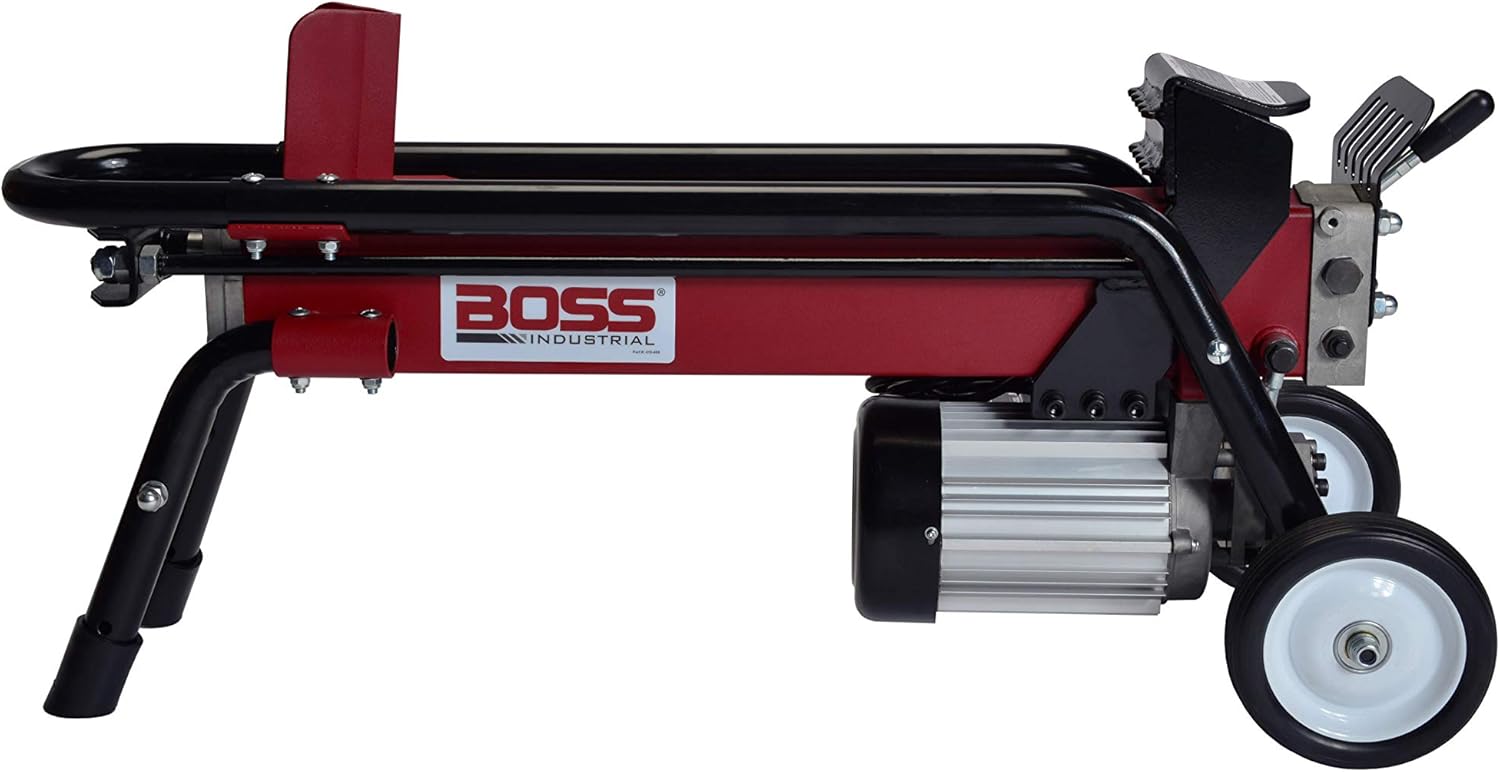
Upgrade to 7 tons for reliable hardwood splitting.
3. Boss Industrial EC10T20 10-Ton Electric
Dual Action
The 10-ton model is where the Boss lineup makes a significant jump in capability—and where it introduces a feature that fundamentally changes splitting throughput: dual-action cutting. Unlike the 5-ton and 7-ton models, which split only on the forward (push) stroke, the 10-ton splits on both the forward and return cycles. This effectively doubles the number of splits per cycle, making it considerably more productive for high-volume splitting sessions.
The 10-ton uses a larger 2.5-inch bore hydraulic cylinder compared to the 2.2-inch bore in the smaller units, and the motor is upgraded to 2.5 HP running on 120V at 20 amps. This means a dedicated 20-amp circuit is required—you cannot run this model on a standard 15-amp outlet without tripping the breaker. The machine also features a built-in stand, which addresses one of the most consistent complaints about the 5-ton and 7-ton models.
The cycle time is notably slower than the smaller units—approximately 9 seconds for the forward stroke and 13 seconds for the return—but because each cycle produces two splits rather than one, the effective throughput per hour is substantially higher than the cycle numbers suggest.
Pros
- Dual-action splitting doubles productivity per cycle.
- Built-in stand at a comfortable working height.
- 2.5 HP motor delivers genuine 10-ton force.
- Handles 12-inch diameter rounds.
Cons
- Requires dedicated 20-amp circuit.
- Heavier at 161 lbs—not a solo carry item.
- Slower individual cycle times than smaller models.
- Significantly higher price point than the 7-ton.
4. Boss Industrial 16-Ton Dual-Action Electric
Max Electric Power
The 16-ton electric is Boss Industrial’s most powerful electric model and represents the upper limit of what single-phase household current can realistically drive. At 2.5 HP delivering 3,800 PSI, it uses a 2.8-inch bore cylinder—the largest in the electric lineup—to generate genuine 16-ton splitting force. Boss specifies a 20-amp circuit breaker for this unit, and compliance with this requirement is non-negotiable.
Despite its impressive force rating, the 16-ton’s cycle time reflects the physics of pushing a larger bore cylinder: the feed cycle takes approximately 16 seconds, and the retract cycle takes 13 seconds. The dual-stage pump helps the ram retract faster than it extends, but the volumetric flow rate limitation of the electric motor means total cycle times are longer than the smaller units. For splitting very large rounds—up to 12 inches in diameter—the throughput is still excellent because the sheer force means fewer hung splits and re-positioning attempts.
At approximately 140 to 170 pounds depending on configuration, the 16-ton is not a portable carry item for one person. However, it remains compact enough to be moved around a property on a hand truck and stored in a garage or barn when not in use.
Pros
- Maximum electric splitting force available in this class.
- Handles rounds up to 12 inches that defeat smaller electric models.
- No emissions; can be used in garage year-round.
- Dual-action cutting with integrated stand.
Cons
- Slowest cycle time in the electric lineup.
- Requires strict 20-amp circuit compliance.
- Too heavy for solo portability.
- At this price range, gas models offer more raw capability.
5. Boss Industrial Gas Models (20–37 Tons)
Sometimes, electric just won’t cut it. If you are dealing with massive rounds, green wood, or working off-grid far from any power outlet, you need gas. Boss Industrial brings their hydraulic expertise to a full line of gas-powered splitters ranging from 16 to 37 tons of splitting force.
The flagship Professional 27-Ton Gas Splitter uses a Briggs & Stratton CR950 6.5 HP 208cc engine combined with 4,050 PSI hydraulic pressure, delivering 15-second splitting cycles. It features both horizontal and vertical splitting positions, a 7-inch wedge, automatic ram return, and single-hand operation. A trailer hitch is included, making it easy to tow to wherever the wood is. For homeowners with large properties, small farm operations, or anyone processing more than two or three cords per year, this is the model to consider.
The Professional 37-Ton is the brand’s most powerful offering and enters the territory of commercial and semi-professional use. Very few residential users need 37 tons of splitting force—this model is for large-diameter old-growth hardwoods, heavily knotted timber, and users who process 10 or more cords per year.
Pros
- High tonnage for any wood type, including green and knotted.
- No power cords or circuits required.
- Fast cycle times even at high tonnage.
- Horizontal and vertical splitting positions.
- Towable to the wood pile.
Cons
- Loud (hearing protection required).
- Regular engine maintenance (oil, spark plugs, carb).
- Significantly heavier and bulkier than electric models.
- Cannot be used in enclosed spaces due to exhaust.
Raw power for the toughest splitting jobs.
If you need this level of power, check our guide on the best gas log splitters for more heavy-duty options and competitive alternatives.
Boss Industrial Tractor PTO / 3-Point Hitch Models
For property owners who already own a tractor, Boss Industrial’s three-point hitch models represent an extraordinarily cost-effective path to 22 to 35 tons of splitting force without buying a separate gas engine. These splitters mount to the tractor’s Category 1 or Category 2 three-point hitch and draw their hydraulic power directly from the tractor’s hydraulic system. No separate engine to fuel, start, or maintain.
The 3-Point PTO 22-Ton and 3-Point PTO 35-Ton models both support horizontal and vertical splitting positions. The 35-ton dual-action version—which splits on both the forward and return stroke—is one of the most productive splitting machines available to non-commercial users. Logs are simply placed vertically under the wedge, eliminating the need to lift heavy rounds onto a horizontal beam entirely.
Tractor Compatibility: Before purchasing any 3-point hitch splitter, verify that your tractor’s hydraulic system flow rate (GPM) meets or exceeds the splitter’s requirement. Most Boss PTO models require a minimum tractor hydraulic output of 8 to 10 GPM. An underpowered tractor hydraulic pump will result in very slow cycle times regardless of the splitter’s rated tonnage.
Boss vs. The Competition
How does the Boss electric lineup stack up against the other major players in the electric log splitter market?
| Feature | Boss EC5T20 | WEN 56207 (6.5T) | Champion 90720 (7T) | Sun Joe LJ10M (10T) |
|---|---|---|---|---|
| Tonnage | 5 Ton | 6.5 Ton | 7 Ton | 10 Ton |
| Operation | One-Handed | Two-Handed | Two-Handed | Two-Handed |
| Stand Included | No | Yes | Yes | Yes |
| Weight | ~58 lbs | ~70 lbs | ~68 lbs | ~105 lbs |
| Indoor/Outdoor | Both | Both | Both | Both |
| Dual Action | No | No | No | No |
| Best For | Speed & Portability | Ergonomics & Value | Force per dollar | High volume |
If ergonomics are your priority, you might prefer the WEN for its included stand. Read our full WEN 6.5 Ton review to compare the two side by side in greater detail.
The Champion 90720 at 7 tons is worth considering if you want more raw splitting force than the Boss 5-ton without paying the Boss 7-ton premium. However, it sacrifices the one-handed convenience that is Boss’s defining advantage and adds weight without adding Boss’s full-beam rigidity.
Tonnage Guide: Matching the Right Model to Your Wood
The single most common mistake when buying a log splitter is selecting the wrong tonnage for the wood types you actually burn. Undersizing leads to frustration and motor overloading; oversizing wastes money. Here is a practical guide based on species and condition.
| Wood Type / Condition | Minimum Tonnage | Recommended Boss Model |
|---|---|---|
| Seasoned softwoods (pine, spruce, fir) – up to 8″ | 3–5 tons | EC5T20 |
| Seasoned softwoods – up to 12″ | 5–7 tons | ES7T20 |
| Seasoned hardwoods (ash, birch, elm) – up to 10″ | 5 tons | EC5T20 |
| Seasoned hardwoods (oak, maple) – up to 10″ | 7 tons | ES7T20 |
| Seasoned hardwoods (hickory, walnut) – knotty | 10 tons | 10-Ton Electric |
| Green (freshly cut) hardwood – any size | 16+ tons | 16-Ton Electric or Gas |
| Large rounds 14″+ diameter | 20+ tons | Gas Series |
| Old growth / heavily knotted / crotch wood | 27+ tons | Gas 27-Ton or PTO |
Why Green Wood Is So Much Harder to Split
Green wood—freshly cut timber with moisture content above 30%—presents a unique challenge that confounds many first-time splitter buyers. The wood fibers in green logs are still saturated with sap and moisture, making them elastic and resilient rather than brittle. Instead of cracking cleanly along the grain when a wedge is applied, green wood tends to compress and absorb force, springing back when the ram retracts without fully splitting. A 5-ton or 7-ton electric splitter that handles seasoned oak effortlessly may fail to split the same species green—not because anything is wrong with the machine, but because the wood is simply too elastic at that moisture level for those tonnage levels to overcome.
The solution for green wood is either to season it for at least 6 to 12 months before splitting (which also makes it lighter and easier to handle), or to use a gas-powered model with 16 or more tons of force. Some wood species—notably elm and sycamore—have interlocked grain that makes them genuinely difficult to split even when fully seasoned. These species should always be split green when the grain is less interlocked, and even then require high-tonnage equipment.
Buyer’s Guide: What to Look For
When shopping for any log splitter—Boss Industrial or otherwise—keep these specifications and considerations in mind before making your final decision.
1. Tonnage vs. Wood Type
Buy based on your wood, not your budget. Refer to the tonnage table above and always round up to the next tier if you are on the boundary between two categories. The extra cost of one tier of tonnage is far less than the frustration of a splitter that stalls on your wood or the cost of replacing a motor you burned out by chronically overloading.
2. Horizontal vs. Vertical Splitting
Electric Boss models split horizontally only—the log is placed on the beam and the ram pushes it into the wedge. This is fine for logs up to about 100 pounds that can be lifted onto the beam. Gas and PTO models in the Boss lineup that offer vertical splitting allow you to stand a heavy round on end on the ground and lower the wedge onto it—a significant ergonomic advantage when processing large, heavy rounds that would be impractical to lift.
3. One-Handed vs. Two-Handed Operation
Boss is famous for one-handed operation. This allows you to steady the log with your free hand while engaging the lever with the other. It is faster and less fatiguing over a long splitting session than two-handed systems, which require you to release the log to engage both controls simultaneously. However, one-handed operation requires the operator to maintain strict personal discipline about hand positioning—your free hand must never be near the wedge or ram path when the lever is engaged. Boss addresses this with a log tray that positions the log and guides hand placement naturally.
4. Log Capacity Dimensions
Both log length and log diameter are limiting factors. All Boss electric models are rated for a maximum log length of 20.5 inches—if you are splitting firewood to 16-inch stove lengths, you have ample room. The diameter rating varies: 5-ton handles up to 10 inches, the 7-ton up to 12 inches, and the 16-ton up to 12 inches as well. If you regularly process large-diameter rounds, the 10-ton or 16-ton is the minimum practical option in the electric line.
5. Stand or No Stand
The 5-ton and 7-ton models do not include a stand. This means the splitting beam sits low to the ground, requiring significant bending and stooping during operation. For occasional use, this is tolerable. For anyone splitting more than a half-cord at a time, a dedicated splitter table or stand is a necessary accessory purchase. Third-party stands compatible with the EC5T20 and ES7T20 are available and significantly improve the ergonomic experience. The 10-ton and 16-ton models include an integrated stand.
Understanding Cycle Times: What the Numbers Really Mean
Cycle time is one of the most misunderstood specifications in log splitter marketing. It is defined as the total time for the ram to travel from its fully retracted position to fully extended (forward stroke) and back again (return stroke). A shorter cycle time means more splits per hour—which directly determines how long it takes you to work through a cord of wood.
How Cycle Time Affects Real-World Productivity
A 14-second cycle time means approximately 4 cycles per minute, or about 240 cycles per hour (in theory). In practice, you must account for placing each log, adjusting it on the tray, removing the split pieces, and any repositioning for second splits on large rounds. Realistic throughput is typically 30–40% lower than the theoretical maximum based on cycle time alone. A rough guide:
- 14-second cycle (EC5T20, ES7T20): Approximately 100–120 productive splits per hour
- 9+13 second dual-action (10-ton): Approximately 80–100 productive cycles per hour, each producing two splits
- 16+13 second dual-action (16-ton): Approximately 60–75 productive cycles per hour, each producing two splits
Dual Action vs. Single Action: The Productivity Math
It is tempting to conclude that a 16-second cycle time on the 10-ton makes it slower than the 14-second 5-ton. But this ignores the dual-action advantage. The 10-ton splits a log on both strokes—forward and return—so each full cycle produces two split pieces. A 5-ton running at 14-second cycles produces one split per cycle. The 10-ton running at 22-second total cycles (9 forward + 13 return) produces two splits per cycle. At equivalent productivity rates, the 10-ton produces roughly twice the output volume of the 5-ton, even though its cycle time is longer.
Extension Cord Guide: The Most Overlooked Spec
Undersized extension cords are the single most common cause of Boss Industrial electric splitter motor failures, warranty disputes, and unsatisfied customers. Electric motors draw significantly higher current at startup (inrush current) than during steady operation—often three to six times their running current. An extension cord that limits current causes voltage to drop under load, the motor runs hot, thermal protection trips, and over time the motor windings degrade and fail.
| Model | Cord Length Up to 25 ft | Cord Length 25–50 ft | Cord Length 50–100 ft |
|---|---|---|---|
| EC5T20 (1.8 HP / 15A) | 14-gauge minimum | 12-gauge required | Not recommended |
| ES7T20 (2 HP / 15A) | 14-gauge minimum | 12-gauge required | Not recommended |
| 10-Ton (2.5 HP / 20A) | 12-gauge minimum | 10-gauge required | Not recommended |
| 16-Ton (2.5 HP / 20A) | 12-gauge minimum | 10-gauge required | Not recommended |
Critical: The 10-ton and 16-ton Boss electric models require a dedicated 20-amp circuit. Running these machines on a standard 15-amp household outlet will trip the breaker instantly. If your garage or work area does not have a 20-amp outlet, have one installed by a licensed electrician before purchasing these models.
The best practice is to plug directly into a wall outlet whenever possible and keep any extension cord as short as practical. The further the electricity must travel through a cord, the more resistance (and thus voltage drop) is introduced. If you must use a 50-foot cord, step up one wire gauge beyond the minimum recommendation in the table above.
Boss Accessories: The 4-Way Cross Wedge and More
One of the underappreciated aspects of the Boss Industrial ecosystem is the genuine quality of their accessory lineup. While many log splitter accessories are afterthought products, Boss’s CW-S 4-way cross wedge is a serious productivity multiplier.
The Boss CW-S 4-Way Cross Wedge
The standard Boss wedge splits each log into two pieces per pass. The CW-S 4-way cross wedge replaces the standard wedge and splits each log into four pieces in a single ram stroke. For firewood production—where the goal is consistently sized pieces for the firebox rather than splitting technique—this accessory can dramatically increase the volume of finished firewood produced per hour.
There are important caveats. The 4-way wedge requires more force to drive through a log than the standard wedge, because it is simultaneously making two crossing cuts. Boss recommends the 4-way wedge only for models with at least 7 tons of splitting force, and only for logs that are already reasonably straight-grained and free of major knots. Using the 4-way on knotty or twisted logs risks stalling the motor or, in worst cases, a log splitting in an unexpected direction. For clean, straight softwood and moderately straight hardwood, however, it is an excellent accessory that effectively doubles output.
Log Tables and Stands
As mentioned in the buyer’s guide, the absence of an included stand on the EC5T20 and ES7T20 is a real-world limitation for sustained use. Third-party log splitter tables that bring the beam to waist height are available online and from farm supply stores, and most are compatible with the Boss mounting pattern. If you are buying a 5-ton or 7-ton Boss unit for regular use, budget for a stand as part of your setup cost.
Hydraulic Fluid Type
Boss Industrial electric splitters come pre-filled with AW32 hydraulic oil. When adding or replacing hydraulic fluid, always use AW32 (or AW46 in warmer climates where the oil will not experience temperatures below freezing). Never use automotive motor oil, transmission fluid, or generic “hydraulic fluid” not rated for log splitter applications—these can damage the seals and pump over time.
Safety: Operating a Boss Industrial Log Splitter
Log splitters are among the most effective tools in a firewood operation, but they are also among the most dangerous if used incorrectly. The following safety guidelines apply to all Boss Industrial models.
Personal Protective Equipment
- Safety glasses or goggles: Wood chips and bark fly unpredictably during splitting. Eye protection is non-negotiable.
- Steel-toed boots: Logs roll and heavy pieces fall. Protect your feet from both the log and the split pieces.
- Gloves: Handling rough, barky logs without gloves causes blisters and lacerations. However—and this is critical—never wear gloves that are loose or have dangling material that could catch on the ram or beam.
- Hearing protection: Electric models are relatively quiet, but long sessions still produce fatiguing noise. Gas models require hearing protection at all times.
Operational Safety Rules
- Never place your hands near the wedge during a split. Use the log tray to position the log, and keep both hands on the tray edges or away from the splitting zone while the ram is in motion.
- Never split knotty wood vertically at ground level unless the machine is rated and designed for vertical operation. Knotty logs can split sideways with significant force.
- Keep bystanders—especially children—at least 10 feet away from the machine during operation. Split pieces can fly.
- Never operate the splitter while impaired by fatigue, alcohol, or medication. Log splitting is a physically repetitive task that lends itself to lapses in attention—exactly the conditions where accidents happen.
- Disconnect the power cord before clearing a hung split on any electric model. Never try to manually push or pull the ram while the motor is running.
The Air Bleed Screw: This is the most commonly misunderstood feature on Boss electric splitters. The air bleed screw must be opened before operation and closed during storage and transport. If you start the machine with the bleed screw closed after the unit has been stored, thermal expansion of trapped air will build pressure and blow out the hydraulic seals—causing a hydraulic leak that voids the warranty. Opening the bleed screw before the first use of any session is the most important pre-operation step on every Boss electric model.
Maintenance & Troubleshooting
Boss Industrial electric splitters are relatively low-maintenance compared to gas models, but they are not maintenance-free. A simple routine significantly extends service life and prevents the most common failure modes.
Routine Maintenance Schedule
- Before each use: Check hydraulic fluid level. Open the air bleed screw. Inspect the cylinder for leaks. Check that the wedge is secure.
- After each use: Close the air bleed screw before storing. Wipe down the beam and ram with a clean rag. Coil the power cord neatly and store it away from the machine.
- Seasonally (end of splitting season): Check hydraulic fluid level and condition—if the fluid is dark, cloudy, or milky, drain and replace with fresh AW32. Inspect all hoses and fittings for seeping. Lubricate the ram and beam with a light machine oil. Store in a dry location.
Troubleshooting Table
| Symptom | Likely Cause | Solution |
|---|---|---|
| Weak splitting force / ram won’t fully extend | Air in hydraulic system or low fluid level | Open the bleed screw; check and top up fluid with AW32. |
| Motor hums but won’t start | Undersized extension cord causing voltage drop | Switch to 12-gauge cord under 50 feet. Plug directly to wall if possible. |
| Motor trips breaker immediately | Wrong circuit (15A circuit for 20A model), or shorted motor | Verify circuit is correct amperage. If correct, call Boss customer service. |
| Hydraulic fluid leaking from ram seal area | Bleed screw left closed during storage; thermal expansion blew seal | Replace seal kit. Always open bleed screw before use. |
| Fluid leaking from fitting near control valve | Loose fitting or damaged O-ring | Tighten fitting first. If still leaking, replace O-ring on that fitting. |
| Ram moves slowly in cold weather | Hydraulic fluid is too viscous in cold temperatures | Allow machine to warm up with a few light cycles. Consider AW32 (thinner) vs. AW46. |
| Log not splitting cleanly / stalling mid-split | Wood is too knotty, green, or oversized for the tonnage rating | Try quartering the log first with an axe, or upgrade to higher tonnage model. |
Pro Tip: Always open the air bleed screw before you start any splitting session. If you leave it closed after storage, the heat generated during operation expands the trapped air inside, which can blow out the hydraulic cylinder seals—an expensive and warranty-voiding failure that is entirely preventable.
Customer Service Reality Check
No review of Boss Industrial is complete without addressing what has become one of the brand’s most visible weaknesses in customer feedback: customer service responsiveness. While the products themselves earn strong marks for build quality and performance, Boss Industrial’s service infrastructure has received significant criticism from customers who needed warranty support or replacement parts.
Common complaints include extended wait times for email responses (sometimes measured in weeks rather than days), phone lines that go unanswered with automated messages citing high call volume, and difficulty obtaining warranty replacements when machines arrived damaged or failed prematurely. Multiple customer reviews specifically mention that purchasing from a physical retailer (such as Home Depot) rather than directly from Boss Industrial provides better recourse when problems arise, because the retailer’s return policy serves as an additional safety net.
This is worth factoring into your purchasing decision. If post-purchase service access is important to you—if you are the type of person who wants to know that technical support is readily available—Boss Industrial’s current service model may be a point of concern. The machines themselves are well-built, but the service layer behind them has been inconsistent based on user reports.
Purchase Tip: Consider buying Boss Industrial from a major retailer (Home Depot, Amazon) rather than directly from Boss Industrial. Retailer return and exchange policies provide a simpler resolution path for shipping damage and early failures, as multiple customers have confirmed.
Where to Buy Boss Industrial Log Splitters
Boss Industrial products are available through several channels, each with different advantages:
- Amazon: Widest selection of electric models with fast shipping, third-party seller competition that can drive prices down, and Amazon’s customer-friendly return policies. The best option for most buyers of the EC5T20 and ES7T20.
- Home Depot: Physical stores carry select Boss Industrial models, allowing you to inspect before buying. Home Depot’s return policy is an important safety net, as multiple customers have noted. Some models are available exclusively through Home Depot.
- Boss Industrial Direct (boss-industrial.com): Full lineup including the gas and tractor models not always stocked by retailers. Free standard shipping advertised. The concern is that returns and warranty service go directly through Boss Industrial rather than a retailer intermediary—see the Customer Service section above.
- Costco: Occasionally carries Boss Industrial gas models at competitive prices. Costco’s return policy is industry-leading and multiple customer reviews specifically cited buying from Costco as the reason their warranty issue was resolved smoothly.
Frequently Asked Questions
Does the Boss EC5T20 come with hydraulic fluid?
Yes. Boss Industrial splitters come pre-filled with hydraulic fluid and are factory-tested before shipping. In most cases you can plug the machine in and begin splitting within minutes of unboxing. The only pre-operation step is opening the air bleed screw, which should always be done before each use.
Can I use a Boss electric splitter in the rain?
No. Electric motors and water do not mix. Use it in a dry environment such as a garage, shed, or on a clear day outdoors. If you need all-weather capability, consider a manual splitter or a gas model used under a canopy.
What is the warranty on Boss log splitters?
All Boss Industrial splitters carry a 2-year residential warranty and a 180-day commercial warranty. Warranty claims require proof of purchase and are handled directly through Boss Industrial customer service. See the Customer Service section above for practical considerations about the warranty experience.
Can the 5-ton or 7-ton handle green wood?
The 5-ton and 7-ton electric models are not designed for green (freshly cut) wood. Green wood is spongy and absorbs splitting force without fracturing cleanly at these tonnage levels. For green wood, you need a minimum of 16 tons, and preferably a gas-powered model with 20-plus tons. Split your firewood and allow it to season for at least six months before processing it with the smaller electric models.
What hydraulic oil does Boss Industrial use?
Boss Industrial uses AW32 hydraulic oil in their electric splitters. Use the same grade when topping up or replacing fluid. AW46 is acceptable in warm climates where temperatures will not drop below freezing. Never use motor oil, ATF, or generic hydraulic oil not rated for log splitter applications.
How do I know if I need a stand for my Boss splitter?
If you plan to split more than a half cord at a time, you need a stand for the EC5T20 and ES7T20. Without one, the beam sits at shin height and requires significant stooping that becomes very fatiguing over an extended session. The 10-ton and 16-ton models include integrated stands.
Is Boss Industrial the same company as Boss snowplows?
No. Boss Industrial (boss-industrial.com) is a separate company from Boss Products (a Michigan-based manufacturer of snow and ice control equipment). The name overlap causes occasional confusion in search results, but they are entirely different businesses with different product lines.
Can I sharpen or replace the Boss log splitter wedge?
The wedge on Boss electric models is fixed and not designed to be user-replaced. It can be sharpened on a bench grinder or with a file if it becomes dull over time, though dullness is rarely a practical issue under normal residential use. The 4-way CW-S cross wedge is a separately sold accessory that replaces the standard wedge and splits logs into four pieces per pass.
Which BOSS Electric Splitter Fits You?
Choose the EC5T20 when…
You mainly process smaller, seasoned firewood and value easier storage and transport.
Limitation: The lower tonnage is not intended for oversized, green, or heavily knotted rounds.
Review EC5T20 Details on AmazonChoose the ES7T20 when…
You regularly split tougher seasoned hardwood and want a step up in force without moving to gas.
Limitation: Compare weight, stand needs, electrical requirements, and log capacity before ordering.
Review ES7T20 Details on AmazonFinal Verdict
Boss Industrial has earned its reputation through genuine hydraulic engineering expertise, not marketing spend. The EC5T20 is a fantastic, durable, and portable option for the average homeowner who wants to keep the fireplace fed without the hassle of a gas engine. The ES7T20 is the smarter buy for anyone burning significant quantities of hardwood. For high-volume production, the 10-ton dual-action and 16-ton electric models represent the best electric splitting performance available in their class.
The brand’s one real weakness is customer service responsiveness, which has been a meaningful source of frustration for some customers. Buy from a retailer with a strong return policy to hedge this risk.
If you need speed and reliable hydraulics in a package you can carry, this is the brand to beat in the electric log splitter category.