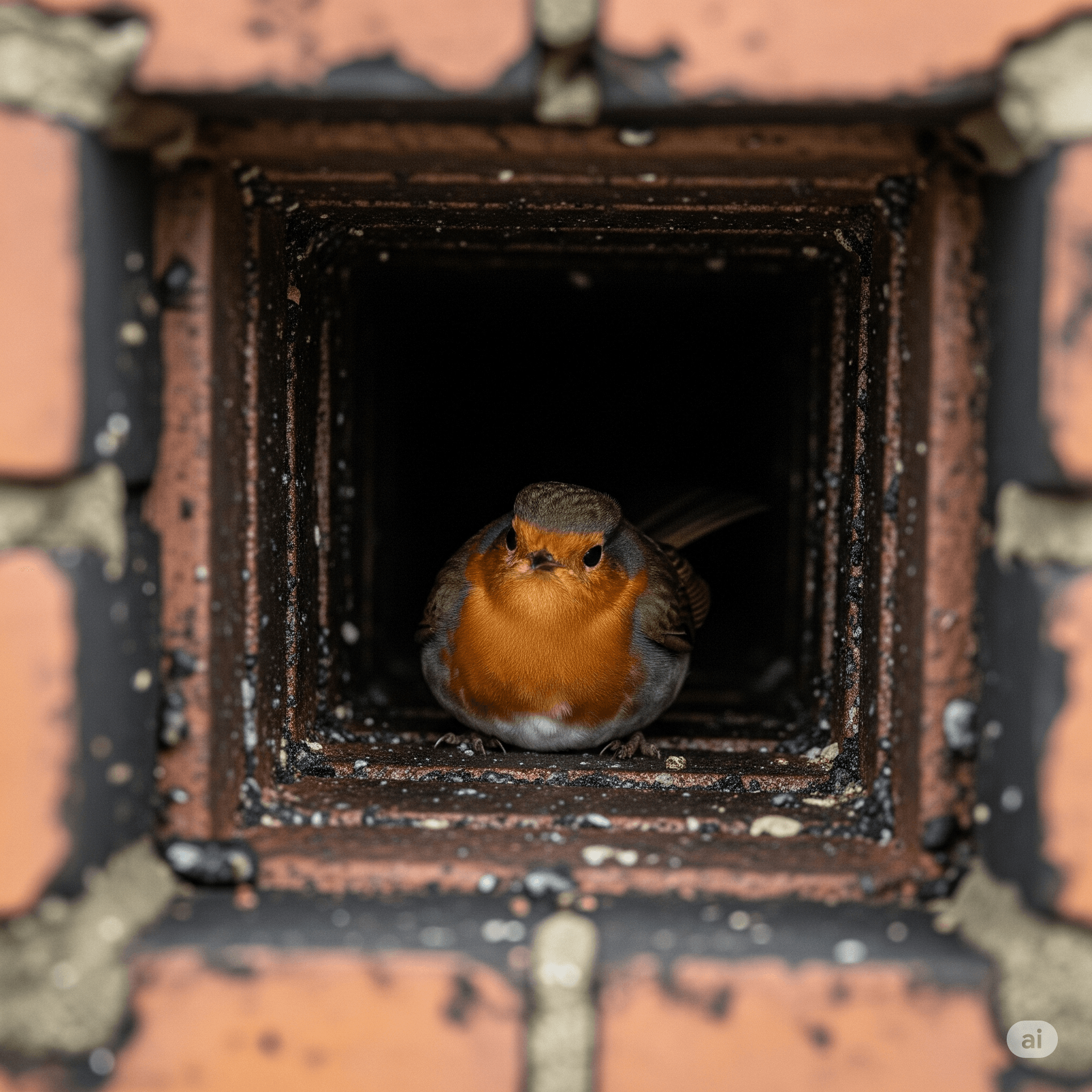
How Long for a Bird Stuck in a Chimney to Die? A Humane Guide

How Long for a Bird Stuck in a Chimney to Die? A Humane Guide

It’s a sound that’s both perplexing and deeply distressing: a frantic flapping, scratching, or panicked chirping coming from the one place in your home you never expect to hear life—your chimney. Discovering a trapped animal is always upsetting, but when it’s a delicate bird, a sense of urgency takes over. Your immediate concern is for the animal’s welfare, which quickly leads to the grim but necessary question: how long for a bird stuck in chimney to die?

As a certified chimney professional and humane wildlife control operator, I get this call frequently. Homeowners are worried, and rightly so. The answer isn’t a single number; it’s a somber calculation based on a harsh reality. A chimney is a dark, vertical trap with no food, no water, and no easy way out. The survival timeline depends heavily on the bird’s size, its health, and the conditions inside the flue.

This comprehensive guide will walk you through the harsh realities a bird faces, the survival timeline you can expect, how to identify the signs of a trapped bird, and most importantly, a safe, step-by-step plan for rescue. We will also cover the crucial final step: how to ensure this never, ever happens again.

⚡ Quick Answer

A small bird stuck in a chimney can die in as little as 48–72 hours from dehydration and exhaustion. Medium-sized birds like pigeons may survive up to a week, but they suffer throughout. Do not wait — every hour matters. Scroll down for the step-by-step rescue guide.

A small, worried-looking bird perched on a branch, representing a trapped animal.

The Grim Timeline: Factors Affecting a Trapped Bird’s Survival

A chimney is one of the most hostile environments a bird can encounter. Understanding the specific threats it faces helps clarify the urgent need for action. Below are the key variables that determine how quickly a trapped bird will succumb.

48–72hrs Fatal window for small birds (sparrows, wrens, finches)
5–7 days Estimated max survival for medium birds like starlings
Up to 14 days Reported pigeon survival in rare cases
<2 hrs Time to act before exhaustion compounds injuries

Dehydration & Starvation (The Primary Threats)

This is the most critical factor. A chimney is essentially a desert. Without access to water, dehydration sets in rapidly. For a small songbird, this can be fatal in as little as 48 to 72 hours. Starvation is a parallel threat. Birds have incredibly high metabolisms and need to eat constantly to fuel their energy. With no insects or seeds available inside a dark flue, their reserves are depleted at an alarming rate. The stress response itself burns through caloric stores even faster — a frightened bird metabolizes energy far more quickly than a calm one.

The Stress Response and Capture Myopathy

This is one of the most underappreciated killers in trapped-bird scenarios. When a bird enters a state of extreme panic — which a trapped chimney bird absolutely does — it triggers a physiological stress cascade. Cortisol and adrenaline flood its system. Sustained panic can lead to a condition called capture myopathy, a form of muscle damage caused by acute stress. The bird literally shakes itself apart at the cellular level. Even birds that are physically rescued can die hours later from this condition if the stress was severe and prolonged enough. This is another critical reason why early intervention matters so much.

Size, Species, and Metabolism

The type of bird makes a significant difference in the timeline. Smaller birds have faster metabolisms and tinier reserves, making them far more time-sensitive rescue cases than larger birds. Larger birds carry more body fat and have slower metabolic rates, giving them a modestly longer window — but not by enough to delay action.

The Chimney Environment (The Unseen Dangers)

The flue itself is a hazardous space in ways people rarely consider. Soot and creosote can coat a bird’s feathers, making flight difficult or impossible even if it were to find an exit. These particles are caustic and can damage the bird’s eyes and respiratory tract when inhaled. Furthermore, the temperature inside a chimney can swing wildly — becoming a sweltering oven in summer or a frigid trap in winter, drastically shortening survival times. In older masonry chimneys, rough brick and mortar ledges can also cause lacerations as the bird thrashes against the walls.

Exhaustion and Injury

A bird’s instinct is to fly toward light, which means it repeatedly tries to fly upward. However, most chimney flues are too narrow for the bird to generate enough lift to fly vertically. It beats its wings against the walls, falls back down, and tries again. This cycle leads to severe exhaustion, broken or dislocated flight feathers, and in serious cases, fractured wing bones. Once a wing is broken, the bird cannot fly even if an escape route is opened, making professional extraction the only option.

“In my fifteen years of chimney work, the single biggest mistake homeowners make is waiting a day or two before calling for help, assuming the bird will find its own way out. It almost never does. The flue is a trap designed by geometry — narrow at the top, dark throughout, with no perches. Every hour compounds the bird’s injuries and exhaustion.” — Jonathan Pierce, CSIA-Certified Chimney Sweep & Humane Wildlife Control Operator

Species-by-Species Survival Breakdown

Not all birds are created equal when it comes to chimney survival. The table below provides a realistic, experience-based guide to how long different common species can survive, based on field data from wildlife control operators.

Bird Species Size Est. Survival Risk Level Notes
Sparrow / Wren Small 1–3 days Critical Fastest metabolism; dehydrate fastest
Robin / Finch Small 2–4 days Critical Thin skull, very stress-prone
Starling Medium-small 3–5 days Urgent Commonly enters via gaps; aggressive fighter
Magpie / Jackdaw Medium 3–5 days Urgent Strong beak but tire quickly; corvids common in UK
Pigeon / Dove Medium-large Up to 7–14 days Urgent Longer survival but extreme suffering; wing damage common
Crow / Rook Large 4–6 days Urgent Intelligent but physically constrained; hard to remove
Owl (Barn / Tawny) Large 4–7 days Critical Protected; nocturnal disorientation makes escape unlikely
Chimney Swift / Vaux’s Swift Small N/A (nesting) Protected Federally protected; adapted to chimneys — do NOT remove
📌 Note on Pigeons Pigeons are frequently reported as surviving up to two weeks in chimneys. Some professionals recommend leaving a confirmed-pigeon alone for 24–48 hours to let it tire slightly before removal, because a fully energetic pigeon can injure itself and the rescuer violently during extraction. However, this should only be done with professional guidance and never for any other species.

How to Tell If a Bird Is Trapped Right Now

Early detection is the key to a successful rescue. The sooner you identify the problem, the better the outcome for the bird. Listen and look for these common indicators at different stages:

Stage 1 — Fresh Entrapment (Hours 1–6)

  • Loud, frantic flapping and wing-beating — you may even hear feathers hitting brick walls
  • Urgent, distressed chirping or squawking — the bird is in a panic and vocalizing constantly
  • Falling soot, mortar chips, or small debris into your firebox — movement above is dislodging material
  • Visible soot or feathers settling on the firebox floor

Stage 2 — Exhaustion Setting In (Hours 6–48)

  • Intermittent flapping that comes in bursts, followed by silence — the bird is resting between desperate escape attempts
  • Softer, infrequent chirping or complete silence between bouts of movement
  • More falling debris as the weakened bird scrapes against walls rather than flying

Stage 3 — Critical or Deceased (48+ hours)

  • Complete silence where sounds previously existed — this is alarming
  • A faint, then increasingly strong foul odor seeping from the fireplace — this indicates death and decomposition have begun
  • An unusual number of flies appearing around the fireplace or on nearby windows — blowflies are attracted to carrion and are a definitive sign
⚠️ Don’t Confuse Nesting with Trapping If you hear a constant, rapid, high-pitched chittering from a single spot in your chimney — especially from multiple sources — you may have a nest of Chimney Swift chicks, not a trapped bird. These sounds are healthy baby birds calling for their parents. Do not attempt to “rescue” them; they are exactly where they should be. Wait until they fledge and then install a chimney cap immediately.

Why Do Birds Fall Into Chimneys in the First Place?

Understanding why this happens helps you prevent it. Birds don’t enter chimneys out of curiosity or spite — there are specific, predictable reasons they end up trapped inside your flue.

The Chimney Looks Like a Hollow Tree

From a bird’s evolutionary perspective, a tall, open chimney pot looks remarkably similar to a hollow tree trunk — one of nature’s most prized nesting and roosting locations. Birds that naturally seek cavities for shelter, like starlings, jackdaws, and doves, are especially susceptible to this visual deception. They land on the rim, peer inside, and sometimes fall or deliberately enter before realizing there is no floor below.

Disorientation from Heat and Light

Warm weather is a significant contributing factor. On hot summer days, the warm air rising from the chimney can disorient birds flying nearby. The thermal updraft mimics natural air currents, drawing birds downward. Additionally, on bright sunny days, the dark opening of a chimney pot becomes nearly invisible against the glare of the sky, causing birds to fly directly into it without seeing it.

Seasonal Nesting Behavior

In spring, birds actively scout for sheltered, cavity-like nesting sites. A chimney pot, especially one without a cap, is an irresistible candidate. Once a bird commits to entering to investigate, it can easily lose its footing on the smooth flue lining and tumble downward, unable to correct its descent.

Juveniles and First-Year Birds

Newly fledged birds are at significantly higher risk. They lack the flight experience and spatial awareness of adults, making them more prone to accidental chimney entry, especially during the summer months when fledglings are testing their wings and exploring the world for the first time.

Damaged or Absent Chimney Caps

A missing, rusted, or crumbling chimney cap is the single greatest contributing factor to animal chimney entrapment. Once that barrier is removed — whether by weather, age, or neglect — your chimney becomes an open invitation to every bird, squirrel, and raccoon in the neighborhood.


The Humane Rescue Plan: Step-by-Step Guide

There are several distinct rescue scenarios depending on where exactly the bird is in your chimney system. Do not attempt any rescue without first determining which situation applies to you.

First: Determine Where the Bird Is

Open the damper slightly (if you have one) and use a flashlight to peer up into the firebox. You may be able to hear movement above. If the bird is flapping at the bottom of the firebox, it has already descended to your fireplace opening — that’s the easiest rescue scenario. If you can hear it but it’s clearly higher up in the flue, you’ll need to use the box method to coax it down.

🔥 CRITICAL SAFETY WARNING: WHAT NOT TO DO Under no circumstances should you light a fire to “smoke out” the bird. This is an incredibly cruel and dangerous act. It will kill the bird painfully and poses a massive fire risk if any nesting material is in the flue. Do not poke at the bird from below with a broom handle or other objects, as this causes severe injury and drives the bird higher into the flue. Do not use chemical repellents or scents to drive the bird out — these are toxic in a confined space.

Scenario A: Bird Has Descended to the Firebox

If the bird has made it all the way down to your fireplace, a DIY rescue is often straightforward. Your goal is to provide a calm, clear path to freedom.

  1. Prepare the Room Close all interior doors to contain the bird to one room. Close all blinds and curtains except for one large window or an exterior door that leads directly outside. This creates a single visual target for the bird.
  2. Darken the Room Turn off all artificial lights. The room should be as dark as possible. Birds are phototropic — they move toward light — so the single bright source from your open window or door will act as a beacon.
  3. Protect Yourself Lay down a drop cloth in front of the fireplace. Put on heavy-duty gloves and safety glasses. A panicked bird can scratch, peck, and carry mites, so protective gear is non-negotiable.
  4. Open the Damper Fully Reach into the fireplace and fully open the damper. If you have glass fireplace doors, open them slowly and quietly. Sudden movements will startle the bird into the room prematurely.
  5. Retreat and Wait Step completely out of the room if possible. Leave the room quiet and empty for at least 20–30 minutes. The bird needs silence and perceived solitude to feel safe enough to fly toward the light. Most birds will find the exit without any further intervention.
  6. Monitor from a Distance If you haven’t heard wing beats indicating the bird has left after 30 minutes, peer quietly around the door. If the bird is on the floor or a piece of furniture, move to Scenario C (towel catch) below.
A pair of heavy-duty leather work gloves.

Safety First: Heavy-Duty Leather Work Gloves

Before attempting any rescue, protect your hands. A panicked bird can peck or scratch, and your fireplace is a dirty environment with soot and old creosote. These durable leather gloves provide essential protection while still allowing enough dexterity to handle a distressed bird safely.

View on Amazon

Scenario B: The Cardboard Box & Flashlight Method (Bird Still in Flue)

If the bird is still high up in the flue and cannot or will not descend on its own, a cardboard box and a flashlight are your two most important tools. This method exploits the bird’s natural attraction to light to lure it safely downward and into a containable space.

What You Need

  • A large cardboard box, big enough to span the width of your fireplace opening
  • A piece of cardboard large enough to cover the top of the box (as a lid)
  • A flashlight (not a phone light — a true directional flashlight works better)
  • Heavy-duty work gloves and safety glasses
  • Tape or clips to hold the cardboard lid in place quickly

The Process

  1. Prepare the Room Follow the same room preparation as Scenario A — close all interior doors and darken the space. This is critical for the flashlight method to work.
  2. Position the Box Slide the open cardboard box into the bottom of the fireplace opening, sitting on the hearth. It should cover as much of the firebox opening as possible, leaving minimal gaps on the sides where the bird could escape into the room.
  3. Shine the Flashlight Into the Box Position the flashlight so it shines against the inside wall of the box, creating a warm, visible glow inside the dark firebox. Do not shine it directly upward into the flue — this will blind the bird. The light should create a visible, attractive glow that the bird can see from its position in the flue.
  4. Step Back and Wait in Silence Do not make a sound. Remain absolutely still. The bird will hear and see the lit box below it, and its instinct to move toward light should draw it down. This may take 10–30 minutes. Be patient.
  5. Trap and Cover The moment you hear the bird drop or flutter into the box, move swiftly but calmly to slide the cardboard lid over the top. Tape or clip it shut securely. The bird is now contained.
  6. Transport Outside Carry the closed box outside, away from the building, and gently tilt it open. Stand back and give the bird space to assess its surroundings and fly away on its own terms. Do not dump it or shake the box.
✅ Post-Release Check Once released, watch the bird for a minute or two if possible. A healthy bird will fly directly away. A bird that hops around, tilts to one side, cannot fly, or sits with fluffed feathers may be injured or in shock. In that case, re-contain it gently with a towel and contact your nearest licensed wildlife rehabilitator immediately.

Scenario C: The Towel Catch (Bird Loose in the Room)

Sometimes a bird exits the firebox before you’ve prepared the room, and it’s now flying panicked around your living space. This requires a different approach — calm, deliberate, and focused on reducing the bird’s stress rather than catching it quickly.

  1. Don’t Chase It This is the hardest instinct to suppress. Chasing a bird dramatically increases its panic, exhausts it faster, and significantly increases the risk of it hitting a wall or window and injuring itself. Stand still and let it settle.
  2. Wait for It to Land A panicked bird will eventually land on a surface — a shelf, the floor, a curtain rail — when exhausted. This is your moment. Move very slowly toward it, keeping your body low.
  3. Drape a Towel Over It Using a large, lightweight towel (a tea towel works well for small birds, a bath towel for larger ones), drape it gently over the bird. This immediately darkens its visual field and reduces panic dramatically — birds calm significantly when they cannot see.
  4. Scoop and Contain Cup your gloved hands around the towel-covered bird, keeping its wings pressed against its body. Grip firmly but never tightly. You should feel its heartbeat, not feel its bones grinding. Carry it directly outside.
  5. Release Gently Unwrap the towel gently and open your hands, letting the bird make the first move. Most will immediately orient themselves and fly away. Some may sit for a few seconds. Give them that time.

Special Case: Bird Behind a Gas or Electric Fire

This is a significantly more complicated scenario that requires specific professional involvement. If your fireplace has a gas fire or an electric unit installed, you must not attempt to access the flue yourself.

Gas fires must be disconnected by a qualified, registered gas engineer (Gas Safe Register in the UK, or a licensed contractor in North America) before anyone can safely access the chimney space behind them. This is not optional — it is a legal and safety requirement. The cost of disconnection varies, but it is far preferable to the health hazard of a decaying bird carcass trapped behind a sealed fireplace unit, or the risk of a gas incident.

Once a registered engineer has safely disconnected the appliance, you can then implement the light-in-chimney method: place a flashlight shining on the floor of the firebox or at the base of the flue, open any accessible external windows, leave the room quiet and empty, and allow the bird several hours to navigate toward the light and out through an open window or door.


What to Do if the Bird Is Injured or in Shock

Not every rescue ends with a healthy bird flying freely away. Some birds, particularly those that have been trapped for more than 24 hours, will be in various states of injury or stress-induced shock by the time you reach them. Knowing how to handle these situations compassionately and correctly can mean the difference between recovery and death.

Signs of Shock

  • Sitting very still, not attempting to flee when approached
  • Fluffed feathers and hunched posture
  • Rapid, shallow breathing or open-mouthed panting
  • Eyes partially or fully closed during daylight
  • Inability to grip your finger or a perch with its feet
  • Tilting to one side or inability to hold its head upright

Immediate First Aid for a Bird in Shock

Do not attempt to give the bird food or water. Well-intentioned feeding at this stage can cause aspiration pneumonia (water inhaled into the lungs) and will kill the bird faster than starvation. The bird’s body is in a survival-crisis state and is not capable of processing nutrition safely.

Instead, contain the bird in a small, ventilated cardboard box lined with a clean cloth. Place the box in a quiet, warm (not hot) location away from pets, children, and noise. If the bird appears cold, you can place a warm (not hot) hot water bottle wrapped in a towel outside one end of the box, allowing the bird to move toward or away from the warmth as needed. Never apply direct heat to a bird in shock.

Contact a licensed wildlife rehabilitator or wildlife rescue center as soon as possible. Most areas have 24-hour hotlines. Do not attempt to splint a broken wing, force-feed the bird, or treat it with human medications. These well-meaning interventions almost always cause more harm than good.

Signs of Injury Requiring Immediate Professional Care

  • A wing held visibly lower than the other, or dragging on the ground
  • Visible bleeding or open wounds
  • Eyes coated in heavy soot or showing signs of damage
  • The bird cannot stand or is spinning in circles
  • Head tilting severely to one side (indicating neurological trauma)

When to Immediately Call for Professional Help

The DIY scenarios above are only appropriate for specific, straightforward situations. There is a significant range of circumstances where amateur intervention is not just ineffective but actively dangerous for both you and the bird. Call a certified chimney professional or licensed wildlife control operator if any of the following apply:

  • The bird is confirmed to be stuck high up in the flue and has not descended after 2 hours with the box method
  • You suspect the species is a Chimney Swift, Vaux’s Swift, or any other protected migratory bird
  • You can hear multiple birds, suggesting a nest of chicks
  • The bird appears obviously injured, is not moving, or shows signs of severe distress
  • You have a gas fire, sealed fireplace, or any appliance blocking access to the firebox
  • The chimney is blocked and has no opening at the bottom
  • You detect a foul odor, indicating the bird may have already perished
  • You are uncomfortable, unable, or physically not capable of performing the rescue safely
  • The bird is between the chimney liner and the outer chimney wall (a specialized scenario requiring structural access)

Professional chimney sweeps have inspection cameras that can locate the exact position of a trapped animal in a flue. They carry specialized tools and are experienced in humane extraction techniques that minimize stress and injury to the bird. In many regions, the local fire brigade is also legally obligated to respond to calls about animals blocking ventilation systems — it’s worth making that call.

The Aftermath: Cleanup, Decontamination, and Health Risks

Once the bird is free — whether alive or deceased — your responsibilities do not end. A chimney that has hosted a trapped bird, especially one that has perished inside it, presents a number of real health risks to your household that must be addressed properly.

Histoplasmosis: The Hidden Risk

Bird and bat droppings can harbor the spores of Histoplasma capsulatum, a soil-dwelling fungus that causes a respiratory illness called histoplasmosis when its spores are inhaled. In most healthy adults, infection produces mild, flu-like symptoms or none at all. However, in immunocompromised individuals, the elderly, and young children, it can cause severe pulmonary illness. The spores become airborne when dry droppings are disturbed — exactly what happens when you clean a firebox without proper protection.

Other Pathogens and Parasites

Beyond histoplasmosis, birds carry a range of secondary parasites that can survive in nesting debris long after the bird is gone. These include bird mites (which can briefly bite humans before dying off), ticks, and fleas. In a small firebox space where nesting material may have accumulated, these parasites can be present in significant numbers. Proper decontamination is not just good hygiene — it’s a genuine health precaution.

Safe Cleanup Protocol

  1. Gear up properly — wear an N95 or FFP2 respirator mask, disposable gloves, safety glasses, and old clothing you can wash immediately at high temperature.
  2. Dampen the area — lightly mist droppings and debris with a water-and-bleach solution (1 part bleach, 9 parts water) before disturbing them. This prevents spores and dust from becoming airborne.
  3. Bag and seal — remove debris into a heavy-duty plastic bag, seal it tightly, and dispose of it in outdoor trash.
  4. Clean all surfaces — wipe down the firebox, hearth, and any surfaces the bird contacted with the bleach solution. Let it sit for 10 minutes before wiping clean.
  5. Wash all cloths and protective gear — wash any reusable items at the highest temperature recommended on their label. Dispose of gloves.

For anything more substantial — a full nest, a dead bird deeper in the flue, or significant droppings accumulation — a professional cleaning is the safest option. A chimney sweep will use the best chimney sweep vacuum systems with HEPA filtration to safely contain all hazardous dust and ensure your system is clean and safe to use.

Removing a Deceased Bird from the Flue

If the bird has died inside the flue and cannot be accessed from the firebox, do not attempt to pull it out yourself with improvised tools. A professional with camera equipment and flexible retrieval tools can locate and remove it without damaging the flue lining. Attempting to pull a carcass with hooks or wire can tear it apart, leaving decomposing material embedded in ledges and crevices that will continue to smell and harbor pests for months.


The Permanent Solution: How to Bird-Proof Your Chimney for Good

A rescue is a temporary fix to what is fundamentally a structural problem. Prevention is the permanent, definitive solution. Once you have successfully resolved the immediate crisis, your next priority must be securing your chimney against future animal entry. This is a moral obligation as well as a practical one.

The Non-Negotiable: Install a Chimney Cap

This is the single most effective way to prevent animals from entering your chimney. A chimney cap is a metal cover that attaches to the top of your flue. It has a solid top to block rain and mesh sides that allow smoke and gases to escape while forming an impenetrable barrier to birds, squirrels, and other wildlife.

A quality chimney cap is a modest investment — typically ranging from $30 for a basic single-flue unit you can install yourself, to $400+ for a custom-fabricated full-width cap installed by a professional. This investment also protects against water damage, one of the leading causes of chimney deterioration. Rain entering an uncapped flue corrodes the liner, damages the firebox, and can cause expensive structural deterioration of the chimney crown and the surrounding masonry.

A cap is also the first line of defense against larger, more stubborn animals. It’s far easier to install a cap than to figure out how to get a raccoon out of your chimney.

A black steel chimney cap with wire mesh sides.

The Essential Upgrade: Shelter Bolt-On Chimney Cap

This is your permanent solution. Made of heavy-gauge steel with a galvanized mesh screen, this cap bolts directly to your flue liner, providing a secure barrier against all animals and weather intrusion. It’s the best investment you can make for your chimney’s long-term health and local wildlife safety. Be sure to measure your flue interior dimensions carefully before ordering.

View on Amazon

Chimney Cap Types: Which One Do You Need?

Not all chimney caps are the same, and choosing the right type for your specific chimney is important for both effectiveness and longevity. Here’s a breakdown of the main options:

Single-Flue Caps

These are the most common type and are designed to fit directly over a single round or rectangular flue tile. They’re held in place by screws that tighten against the inside of the flue liner. They are the easiest to install DIY and cover the vast majority of standard residential chimneys. Measure the interior dimensions of your flue opening precisely before purchasing — an ill-fitting cap is almost as bad as no cap.

Multi-Flue Caps (Top-Mount / Lid Caps)

Some chimneys have multiple flues emerging from the same chimney crown, or an unusual crown design that makes single-flue caps impractical. Multi-flue caps are wide, flat covers that span the entire top of the chimney crown, covering all flues simultaneously. They attach via brackets or adhesive to the chimney crown itself. These provide excellent coverage but require professional measurement and are typically professionally installed.

Stainless Steel vs. Galvanized vs. Copper

The material of your cap determines its longevity. Galvanized steel is the most affordable option but will typically rust and degrade within 5–10 years, especially in wet climates. Stainless steel caps, while more expensive upfront, are essentially permanent and will outlast the chimney in most cases. Copper caps are the premium choice — extremely durable, completely rust-proof, and aesthetically beautiful as they develop a verdigris patina over time. For homes where longevity and aesthetics matter, copper is the clear winner.

Wire Mesh Cowls and Birdguards

For disused chimneys — those that are no longer connected to an active fireplace or stove — a solid chimney pot cover or a wire mesh birdguard cowl may be the appropriate solution. These completely seal the opening, preventing any animal from entering without restricting airflow into an active flue. For unused chimneys, sealing the pot entirely is often the safest and simplest option.

✅ Best Chimney Cap Practices

  • Measure your flue interior before buying
  • Choose stainless steel or copper for longevity
  • Inspect the cap annually for damage or displacement
  • Replace immediately if damaged by storms or animals
  • Ensure mesh gauge is small enough to exclude all birds

❌ Common Chimney Cap Mistakes

  • Buying galvanized steel in high-humidity climates
  • Guessing the flue size instead of measuring
  • Choosing a cap with mesh too large (1″ mesh lets small birds in)
  • Skipping annual inspection after severe weather
  • Forgetting to cap a disused chimney — these are the most common bird traps

Seasonal Patterns: When Do Birds Enter Chimneys Most?

Bird-in-chimney incidents are not evenly distributed throughout the year. Understanding the seasonal pattern helps you prioritize your prevention efforts and know when to be most vigilant.

Spring (Nesting Season — High Risk)

This is peak nesting season for most bird species across North America and Europe. Birds are actively scouting cavities for nest sites, and an uncapped chimney is a perfect candidate. You may find fully built nests in chimney flues during this period, which presents its own set of legal considerations (see the Legal Protections section below). Many chimney sweeps report that the majority of their nest-related calls come in from March through June.

Summer (Juvenile Dispersal — Very High Risk)

Summer is when juvenile birds, freshly fledged and learning to fly, are at the highest risk of chimney entry. Young birds lack the spatial awareness and flight precision of adults and are frequently found in chimneys, vents, and other openings during this period. The heat disorientation factor also peaks in summer, particularly in regions with intense afternoon sun. Wildlife removal professionals report that the largest volume of calls comes during July and August.

Autumn (Roost Scouting — Moderate Risk)

As temperatures drop, birds begin scouting warm roosting locations for the winter. Chimney flues that have residual warmth from the heating season beginning again can attract birds seeking shelter. This is also when some species, particularly starlings, form large roost groups and may collectively choose a large chimney or chimney stack as a communal roosting site.

Winter (Low Risk, But Most Dangerous Outcomes)

While fewer bird incidents occur in winter, those that do are typically the most serious. A bird trapped in a cold flue in winter faces a brutally compressed survival timeline. Cold temperatures accelerate hypothermia, and the bird’s energy is consumed rapidly trying to regulate its body temperature rather than simply maintaining resting metabolism. A small bird trapped in a cold chimney in winter may survive only 24 hours or less.


Legal Protections for Chimney Birds: What You Need to Know

This section is critically important and is often overlooked by homeowners who discover birds in their chimneys. Wild birds — including their nests, eggs, and chicks — are protected by law in most jurisdictions. Ignorance of these laws is not a legal defense, so understanding the basics before you act is essential.

United States: The Migratory Bird Treaty Act (MBTA)

The Migratory Bird Treaty Act is one of the oldest and most comprehensive wildlife protection laws in the United States. It makes it a federal offense to pursue, hunt, take, capture, or kill any migratory bird — and that includes their nests, eggs, and feathers — without a specific federal permit. The list of protected species under the MBTA includes virtually every wild bird you are likely to encounter in your chimney, with the notable exceptions of House Sparrows, European Starlings, and Rock Pigeons (common pigeons), which are introduced, non-native species and are not covered by the MBTA.

Chimney Swifts are explicitly covered under the MBTA. This means it is a federal crime to remove a Chimney Swift nest from your chimney during active nesting season, even if the birds are creating inconvenience. If you have Chimney Swifts nesting in your flue, you must wait until the nesting season is complete and all birds have departed before installing a cap. After they leave, cap immediately.

United Kingdom: Wildlife and Countryside Act 1981

In the UK, the Wildlife and Countryside Act 1981 provides comprehensive protection to all wild birds, their nests (while in use), and their eggs. It is a criminal offense to intentionally kill, injure, or take any wild bird, or to intentionally damage, destroy, or take the nest of any wild bird while it is in use or being built. This means that if you discover an active nest in your chimney, you must not remove it and must not prevent the birds from accessing it until it has been abandoned. Only after the nest is abandoned can it be removed and the chimney capped.

Canada and Australia

Both countries have analogous federal and state/provincial wildlife protection legislation that covers most native bird species. The general principle is the same: active nests cannot be disturbed, and any removal of protected birds must be carried out by licensed wildlife control operators. If in doubt, always call your local wildlife authority for guidance before taking any action that might affect a bird or its nest.

⚠️ Important Legal Note If you are unsure whether the birds in your chimney are a protected species, do not take any action until you have consulted a licensed wildlife professional or your local wildlife authority. Attempting removal of a protected nest can result in substantial federal fines in the United States.

The Importance of Annual Professional Chimney Inspections

An annual inspection by a CSIA-certified chimney sweep is crucial not just for your home’s safety, but as a proactive measure against animal entrapment. During a Level 1 inspection, a professional will check the exterior crown and cap for cracks or damage that might allow animal entry, inspect the flue for blockages (including nesting material or debris), and assess the overall structural integrity of the chimney.

They can spot and fix structural issues that might allow animal entry, check for cracks in the crown, and identify deteriorating brickwork that needs the best mortar for chimney repair treatment. This inspection is also critical for your home’s safety and can be important for insurance purposes, so it’s wise to know if your homeowners insurance covers chimney repair. During exterior assessments, they’ll even ensure other rooftop installations like your best chimney antenna mount are secure and properly sealed.

A sweep’s inspection is also your best early warning system. If a bird or other animal has entered your chimney and is in the early stages of nesting, a professional will catch it before it becomes an entrapment emergency. The cost of an annual inspection is a fraction of the cost of a dead-animal decontamination and chimney repair.

Quick-Reference: Do’s and Don’ts at a Glance

✅ DO

  • Act quickly — time is critical
  • Darken the room, open one exit point
  • Wear gloves and eye protection
  • Use a cardboard box and flashlight to lure the bird down
  • Call wildlife professionals for protected species or nests
  • Decontaminate thoroughly after any bird incident
  • Install a chimney cap as soon as the bird is out
  • Schedule annual inspections

❌ DON’T

  • Light a fire or use smoke to drive the bird out
  • Poke at the bird with tools from below
  • Chase the bird around the room
  • Force-feed water or food to a bird in shock
  • Disturb an active nest (it may be illegal)
  • Ignore the smell — a dead bird is a health hazard
  • Wait more than a few hours before seeking help
  • Assume the bird will find its own way out

Frequently Asked Questions

How long for a bird stuck in a chimney to die?

The timeline depends heavily on the species. Small birds such as sparrows and wrens can die from dehydration and stress within 48 to 72 hours. Medium-sized birds like starlings may survive 3 to 5 days. Pigeons are the exception and have been reported to survive up to 14 days in some cases, though they experience significant suffering throughout. Cold weather dramatically shortens these timelines. Immediate action is always the correct response.

Will a trapped bird eventually find its own way out?

It is extremely unlikely without human intervention. The vertical, narrow structure of a chimney flue is a near-perfect trap. Birds instinctively fly upward toward light, but the flue is typically too narrow to allow the horizontal wing movement needed to generate upward flight. The bird will almost certainly exhaust itself, become injured, or perish from dehydration without intervention. Do not wait and hope — act.

What if I find a nest of baby birds in my chimney?

If you suspect an active nest — whether Chimney Swifts or any other species — your best and legally safest course of action is to leave it undisturbed and call a wildlife rehabilitator for advice. They will likely advise you to wait until the babies have fledged and left the nest, which typically takes 3 to 6 weeks depending on the species. After all birds have departed, have a chimney cap installed immediately. Disturbing an active nest of a protected species is a federal offense in the United States under the Migratory Bird Treaty Act.

How much does it cost to have a bird professionally removed from a chimney?

For a straightforward removal, you can typically expect to pay between $150 and $350 for a professional wildlife control operator or chimney sweep. If a nest is involved, the animal is inaccessible without specialized camera equipment, or if a gas appliance must be disconnected first, the cost may be higher. Many wildlife rescue organizations — particularly those operating as nonprofits — offer these services free of charge or for a voluntary donation. It is always worth making that call first.

Can I get sick from a bird in my chimney?

Yes, there are genuine health risks associated with bird droppings and nesting material in a chimney. The primary concern is histoplasmosis, a respiratory illness caused by inhaling the spores of a fungus that grows in bird and bat droppings. Secondary concerns include bird mites, ticks, and other parasites that may be present in nesting debris. Always wear an N95 mask, gloves, and eye protection when cleaning a firebox after any bird incident, and consider professional decontamination for significant debris accumulation.

What are Chimney Swifts and why can’t I remove them?

Chimney Swifts (Chaetura pelagica) are remarkable migratory birds that are specially adapted to live in vertical cavities like chimneys. Unlike most birds that are accidentally trapped, Chimney Swifts deliberately nest and roost inside chimneys, using their specialized feet to cling to vertical surfaces. They are protected under the U.S. Migratory Bird Treaty Act, making it illegal to remove them, their nests, or their eggs during nesting season. They are excellent insectivores and consume thousands of mosquitoes and other insects daily, making them highly beneficial neighbors. If you have Chimney Swifts, listen for their distinctive rapid chattering call. Embrace the season; after they depart in autumn, cap the chimney immediately.

How do I know if the bird is dead or just very quiet?

A live bird that is exhausted will still respond to gentle sounds — tap lightly on the wall near the firebox and listen for a faint rustle or movement. A dead bird will produce no response. The definitive indicators of death are the onset of a foul odor (typically beginning 24–48 hours after death, faster in warm weather) and the appearance of blowflies around the fireplace area. If you suspect the bird has died, do not attempt to extract the remains yourself — contact a chimney professional for safe removal and decontamination.

What is the best chimney cap mesh size to keep birds out?

For excluding birds, a mesh with openings no larger than ¾ inch (19mm) is recommended. Standard chimney caps often come with 1-inch mesh, which is adequate for keeping out large birds like pigeons and crows but may allow small sparrows and starlings to squeeze through. If small bird exclusion is your priority, look specifically for caps labeled with ¾-inch or smaller mesh. Always verify the mesh size specification before purchasing, as this information is not always prominently displayed.

Should I put food or water in the firebox to help the bird survive longer?

This is a well-intentioned but potentially counterproductive intervention. While leaving a small shallow dish of water in the firebox is unlikely to cause direct harm and may help sustain a bird that has descended low enough to access it, placing food can attract additional wildlife and create other problems. More importantly, the effort involved in opening the firebox may cause enough disturbance to drive the bird higher into the flue. Your efforts are better directed at implementing the rescue techniques described above, which will resolve the situation entirely rather than simply extending the bird’s ordeal.

Conclusion: A Call for Compassion and Prevention

The question of how long for a bird stuck in a chimney to die is a hard one, but it forces us to confront a preventable tragedy. While the timeline is short and grim — as little as 48 hours for the smallest species — your quick and compassionate action can absolutely lead to a successful rescue. The techniques described in this guide, from the cardboard box flashlight method to the towel catch, are proven, humane approaches that have reunited thousands of trapped birds with the open sky.

But the ultimate responsibility lies in prevention. By installing a quality chimney cap, you are closing the door to this suffering permanently — not just for the bird you rescued today, but for every bird that would otherwise face that same dark, vertical trap in the months and years ahead. Schedule an annual inspection with a certified chimney sweep, understand the legal protections that apply to the birds in your area, and take the few minutes required to verify that your chimney cap is intact and properly seated after every major storm.

Your chimney should be a conduit for warmth and comfort, not a trap for unsuspecting wildlife. With the right knowledge and a modest investment in prevention, it absolutely can be — secure, functional, and harmless to the birds that share your sky. And as for the most famous chimney visitor of all, even many people now wonder how does Santa get in without a chimney — proof that even the most beloved traditions can adapt!

About the Author

Jonathan Pierce is a CSIA-Certified Chimney Sweep and a licensed Humane Wildlife Control Operator with over 15 years of experience. He specializes in animal-safe chimney solutions and is passionate about educating homeowners on how to coexist safely and responsibly with local wildlife. Jonathan consults with state wildlife authorities on best practices for residential chimney wildlife management and speaks regularly at community events on humane animal control.