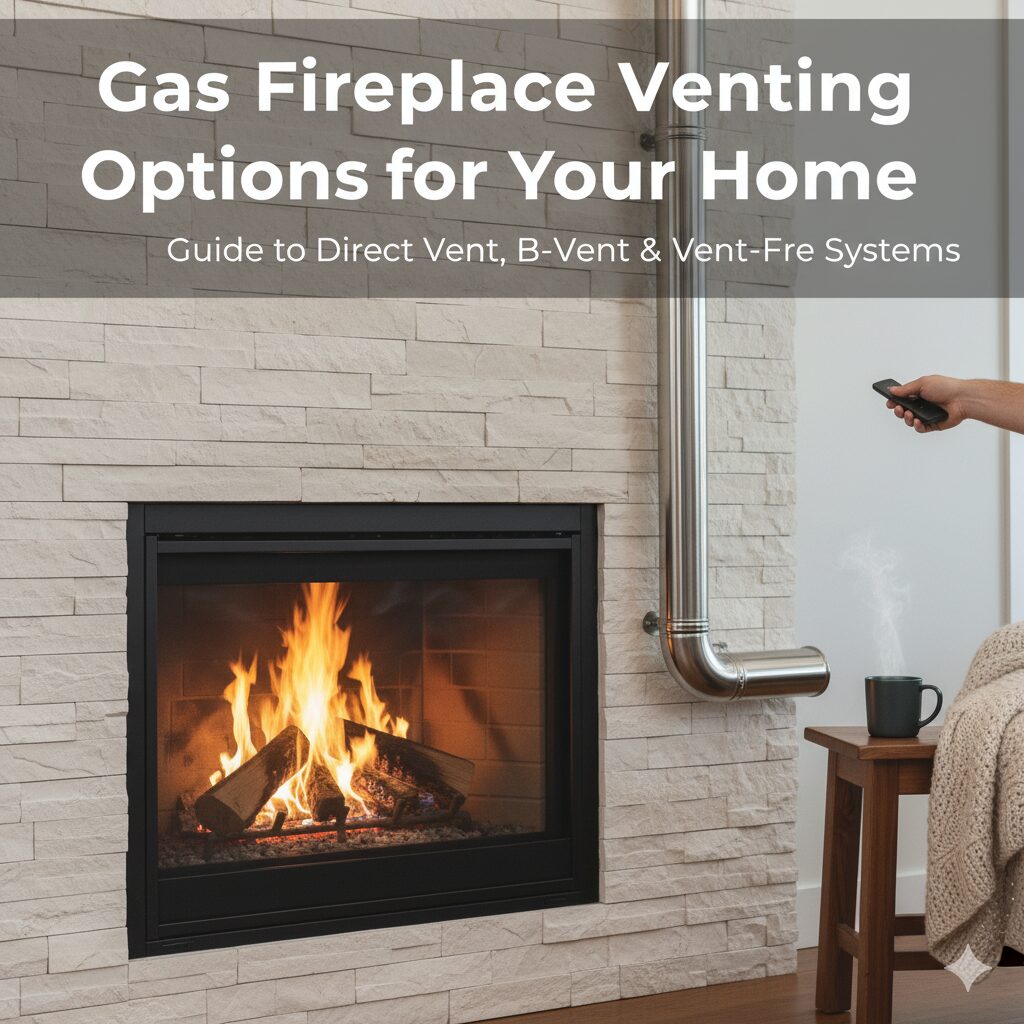
Gas Fireplace Venting Options: A Complete Expert Guide for Homeowners
A gas fireplace offers the beautiful ambiance and warmth of a traditional fire with unparalleled convenience and control. But before you can enjoy that instant fireside coziness, there’s a critical, often overlooked decision to make: how will it be vented? This isn’t just a technical detail—it’s the single most important choice affecting your fireplace’s safety, efficiency, installation location, and even the air quality inside your home.
The world of fireplace venting can seem complex, filled with terms like “Direct Vent,” “B-Vent,” and “Vent-Free.” Choosing the wrong option for your home can lead to poor performance, safety hazards, or a failed inspection. This comprehensive guide is designed to cut through the confusion. We will walk you through each gas fireplace venting option, explain how gas fireplace types, BTU sizing, installation costs, and smart controls all connect to your venting decision, and give you a complete maintenance framework to keep your system running safely for decades.
📋 Complete Guide Contents
- Expert’s Foreword on Safety
- Why Gas Fireplaces Need Vents
- Types of Gas Fireplace Appliances
- Direct Vent: The Gold Standard
- B-Vent: The Traditional Approach
- Vent-Free: The Controversial Option
- Full Comparison Chart
- How to Size BTUs for Your Room
- Natural Gas vs. Propane
- Direct Vent Pipe: Sizing & Run Length
- Horizontal vs. Vertical Venting
- Gas Fireplace Installation Costs
- Gas vs. Electric Fireplace
- Understanding Efficiency Ratings
- Remote Controls & Smart Home Integration
- Outdoor Gas Fireplace Venting
- Annual Maintenance Checklist
- How to Relight a Pilot Light
- Common Problems & Fixes
- Carbon Monoxide Safety Guide
- How to Tell If Your Vent Is Blocked
- Final Thoughts
- Frequently Asked Questions
Expert’s Foreword: Why Venting is a Matter of Safety First
As an NFI (National Fireplace Institute) Certified Gas Specialist with over 15 years of field experience, I can tell you that a proper installation starts and ends with the venting system. The primary job of any vent is to safely exhaust harmful combustion byproducts—most importantly, carbon monoxide (CO)—out of your home. A correctly installed venting system is a sealed, safe pathway for these gases. An incorrect one is a potential health hazard. This guide prioritizes safety standards and real-world application to ensure you understand that this decision is about more than just convenience; it’s about protecting your family.
The Fundamental Question: Why Do Gas Fireplaces Need Vents?
Before diving into the “types,” it’s crucial to understand the “why.” Like any fire, a gas flame consumes oxygen and produces exhaust. The primary components of this exhaust are:
- Water Vapor: A harmless byproduct on its own, but in large volumes can increase indoor humidity and promote mold in tightly sealed homes.
- Carbon Dioxide (CO2): Also relatively harmless in small quantities, though high concentrations cause fatigue and headaches.
- Carbon Monoxide (CO): An odorless, colorless, and highly toxic gas. Even brief exposure to elevated levels is dangerous; chronic low-level exposure is insidious.
- Nitrogen Oxides and other particulates: Pollutants that can affect indoor air quality and exacerbate respiratory conditions like asthma.
The venting system has two main jobs: 1) Safely remove the harmful exhaust from your living space, and 2) Provide a source of fresh air (oxygen) for the fire to burn. How each system accomplishes these two tasks is what defines it.
Your First Line of Defense: Kidde Carbon Monoxide Detector
This is non-negotiable for any home with a fuel-burning appliance. A reliable CO detector is your essential safety net. This plug-in model from Kidde features a digital display to show CO levels and a battery backup to ensure it’s always working, even if the power goes out. Place one on every level of your home and outside sleeping areas.
Check Price on AmazonTypes of Gas Fireplace Appliances: Which One Are You Installing?
Your venting choice doesn’t exist in a vacuum — it must match the type of gas fireplace appliance you’re installing. These are the four main appliance categories, and each has different venting compatibility and requirements.
🔲 Built-In Gas Fireplace
A factory-built zero-clearance unit that is framed into a wall or entertainment center from scratch. Typically Direct Vent. Offers the widest selection of styles and sizes. Requires no existing masonry structure — you build around it.
🔲 Gas Fireplace Insert
Designed to fit directly into an existing wood-burning masonry or prefab fireplace opening. Uses the existing chimney for venting (via co-linear liners for DV, or the existing flue for B-Vent log sets). The most common retrofit option when converting from wood to gas.
🔲 Gas Log Set
A set of ceramic “logs” placed on a burner inside an existing open masonry fireplace. The fireplace’s existing damper and chimney handle venting — the damper must remain fully open during operation. These are B-Vent by nature. The most affordable entry point into gas but the least efficient.
🔲 Freestanding Gas Stove
A stand-alone appliance that resembles a wood stove aesthetically. Can be Direct Vent or B-Vent depending on the model. More portable than a built-in and can be placed in rooms where wall framing is undesirable. Vents through the wall or up through the ceiling.
Venting Type #1: Direct Vent (DV) — The Gold Standard for Safety & Efficiency
Direct Vent is, by far, the most popular and recommended venting option for gas fireplaces in modern homes. It’s a masterpiece of safe and efficient engineering that solves the problems inherent in older fireplace designs.
How Direct Vent Works
A Direct Vent fireplace uses a completely sealed system. It draws all the air it needs for combustion from the outside and expels all its exhaust to the outside. This is accomplished through a specialized co-axial or co-linear pipe system:
- Co-axial Pipe: A pipe-within-a-pipe design. The smaller, inner pipe carries exhaust out; the larger, outer pipe draws fresh air in from outside. These run simultaneously in a single compact assembly.
- Co-linear Pipes: Used for fireplace inserts installed in an existing chimney, this system uses two separate pipes running side-by-side up the flue — one for intake and one for exhaust.
The key takeaway is that the firebox is a sealed glass box that never interacts with the air inside your room. This is the cornerstone of its safety and efficiency.
Advantages of Direct Vent Fireplaces
- Unmatched Safety: Because the combustion system is completely sealed from your room, there is zero risk of exhaust fumes like CO entering your home. It also eliminates backdraft issues that can plague other systems. When people complain about fireplace draft problems with wood units, this sealed system is the ultimate solution.
- High Efficiency: Direct Vent fireplaces are excellent heaters, with efficiency ratings often between 70% and 85%. No heated room air is lost up the chimney, which is a major source of heat loss in traditional fireplaces. This performance is a key differentiator in the wood stove vs fireplace heating debate, bringing gas units closer to the efficiency of a quality wood stove.
- Installation Flexibility: Since a DV system doesn’t require a traditional vertical chimney, it can be vented directly through an exterior wall (horizontally) or up through the roof (vertically). This means you can install a gas fireplace in almost any room, including bedrooms, bathrooms, and even on interior walls (with a vertical vent run).
- Improved Indoor Air Quality: It doesn’t consume your heated, humidified indoor air, nor does it create the negative pressure that can pull in cold air and allergens from outside.
Disadvantages of Direct Vent Fireplaces
- Higher Upfront Cost: The specialized venting components and the complexity of the fireplace unit itself make DV systems more expensive than other types.
- Installation Requirements: The vent termination cap must be located a specific distance from windows, doors, and air intakes, which can sometimes limit placement. Professional installation from one of the best chimney services is essential to meet these strict code requirements.
- Fixed Glass Front: The glass front is permanently sealed and cannot be opened during operation. For some, this detracts from the “open fire” feel.
Verdict: For new construction, major renovations, or any situation where safety and heating efficiency are the top priorities, Direct Vent is the superior choice. Its versatility and performance make it the modern standard for gas fireplaces.
Venting Type #2: B-Vent (Natural Vent) — The Traditional Approach
B-Vent, also known as Natural Vent, operates much more like a traditional wood-burning fireplace. It’s an open system that relies on the natural buoyancy of hot air (the “stack effect”) to carry exhaust gases up and out of the home.
How B-Vent Works
A B-Vent fireplace uses a single, dedicated pipe (the B-Vent) that must run vertically and terminate above the roofline. Unlike a Direct Vent unit, a B-Vent fireplace is not sealed:
- It draws combustion air from the room it’s installed in. It literally pulls the oxygen it needs to burn from your living space.
- It vents all exhaust up the vertical pipe via natural convective draft.
This system is often used for gas log sets installed in an existing, fully functional masonry or prefabricated wood-burning fireplace chimney.
Advantages of B-Vent Fireplaces
- Lower Cost: The fireplace units and the B-Vent pipe itself are generally less expensive than Direct Vent systems.
- Utilizes Existing Chimneys: It’s a good option for converting a sound wood-burning fireplace to gas without the expense of running new co-linear liners for a DV insert.
- More “Realistic” Flame: Because it’s an open system with a larger draft, some users feel the flame pattern appears more random and traditional than in a sealed DV unit.
Disadvantages of B-Vent Fireplaces
- Lower Efficiency: B-Vent fireplaces are significantly less efficient (around 40–60%). They consume a large volume of pre-heated air from your room and send it straight up the chimney along with the exhaust.
- Potential for Downdrafts: Just like a wood fireplace, a B-Vent is susceptible to pressure imbalances in the home or wind-related issues that can cause a backdraft, spilling exhaust into the room. This is why a CO detector is absolutely critical with these units. It can suffer from the same issues that cause fireplace smoke coming into the house in a wood unit, but with invisible, odorless CO.
- Strict Installation Requirements: The vent must be run vertically with minimal offsets and terminate a specific height above the roof, which severely limits installation locations. You cannot vent it through an exterior wall.
- Impact on Air Quality: It pulls air from your home, which can create negative pressure and make your home feel drafty.
Verdict: B-Vent is a viable, budget-friendly option primarily for those looking to install a gas log set in an existing, code-compliant chimney. For new installations, its inefficiency and potential safety concerns make it less desirable than a Direct Vent system.
Venting Type #3: Vent-Free (Ventless) — The Controversial Option
Vent-Free fireplaces, as the name implies, have no chimney, flue, or vent pipe at all. They are designed to burn so cleanly that the low levels of exhaust are released directly into the room. This makes them a topic of significant debate and regulation.
How Vent-Free Works
Vent-Free appliances use precision-engineered burners that create a near-perfect combustion of the gas. They are required by law to come equipped with an Oxygen Depletion Sensor (ODS). This safety device automatically shuts the fireplace off if the oxygen level in the room drops below a preset, safe threshold (typically around 18%, down from normal atmospheric 20.9%).
Advantages of Vent-Free Fireplaces
- 100% Efficiency: Since no heat is lost up a chimney, every bit of heat generated by the flame stays in the room. They are excellent supplemental heat sources.
- Ultimate Installation Flexibility: You can install them virtually anywhere a gas line can be run — on any wall, in any room, or even as a standalone unit.
- Lowest Installation Cost: With no venting components to buy or install, they are the cheapest option upfront.
⚠️ IMPORTANT: Safety and Concerns with Vent-Free Appliances
While manufacturers stress their safety due to the ODS pilot system, there are significant concerns that homeowners MUST be aware of. Vent-Free appliances are illegal in some states (like California) and many municipalities. Always check your local building codes before purchasing.
Disadvantages and Concerns of Vent-Free Fireplaces
- Moisture Production: The primary byproduct of clean combustion is water vapor. A vent-free unit can release a significant amount of moisture into your home (up to a gallon of water for every 100,000 BTUs). In modern, tightly sealed homes, this can lead to condensation on windows, and potentially mold and mildew problems.
- Indoor Air Quality: While they burn cleanly, they still release low levels of carbon dioxide, nitrogen dioxide, and other combustion byproducts directly into your living space. People with asthma, allergies, or other respiratory sensitivities may be affected.
- Legal Restrictions: Their use is restricted or banned in many areas due to safety and air quality concerns. California has banned them entirely. Always check local codes before purchasing.
- Limited Burn Time: Typically intended for supplemental, intermittent use — not as a primary, all-day heat source.
Verdict: Vent-Free fireplaces should be approached with extreme caution. They are best suited for specific, limited applications in large, well-ventilated rooms where other venting options are impossible. You must verify local code compliance and be aware of the potential impact on indoor air quality and moisture levels.
Comparison Chart: Which Venting Option Is Right for You?
| Feature | Direct Vent (DV) | B-Vent (Natural Vent) | Vent-Free (Ventless) |
|---|---|---|---|
| Safety | Excellent (Sealed System) | Fair (Open; requires CO detector) | Poor to Fair (Relies on ODS; affects air quality) |
| Heating Efficiency | High (70–85%) | Low (40–60%) | Excellent (99.9%) |
| Installation Flexibility | Excellent (Horiz. or Vert.) | Poor (Vertical Only) | Excellent (Anywhere w/ Gas Line) |
| Upfront Cost | High | Medium | Low |
| Indoor Air Quality | Excellent (No impact) | Fair (Consumes room air) | Poor (Exhausts into room; adds moisture) |
| Legal Status (US) | Legal everywhere | Legal everywhere | Banned in some states/municipalities |
| Best For… | New installs, efficiency, safety, and renovations. The modern standard. | Converting an existing wood fireplace to gas on a budget. | Supplemental heat in large rooms where venting is impossible (check local codes!). |
Keep Your View Clear: Rutland Fireplace Glass Cleaner
Direct Vent fireplaces have a sealed glass front that can develop a white film over time from mineral deposits in the gas. A specialized cleaner like Rutland’s White-Off is formulated to safely remove this haze without scratching or damaging the ceramic glass, keeping your view of the flames crystal clear.
Check Price on AmazonHow to Size Your Gas Fireplace: The BTU Guide
Choosing the right venting type is only half the equation — you also need to choose the right size of appliance. Undersized units struggle to heat the space; oversized units cycle on and off inefficiently and may overheat the room. BTU (British Thermal Unit) output is the key measurement for matching a fireplace to a space.
BTU Sizing by Room
The general industry rule of thumb is 20 BTUs per square foot of living space for a well-insulated home in a moderate climate. However, this figure needs to be adjusted for several variables:
| Room Size | BTU Range (Moderate Climate) | Adjustment for Cold Climate | Typical Unit Type |
|---|---|---|---|
| Small room (up to 400 sq ft) | 8,000–10,000 BTU | Add 20–30% | Small insert or vent-free log set |
| Medium room (400–800 sq ft) | 10,000–20,000 BTU | Add 20–30% | Standard Direct Vent insert or built-in |
| Large room (800–1,500 sq ft) | 20,000–35,000 BTU | Add 30–40% | Large Direct Vent built-in or gas stove |
| Open-plan / whole floor (>1,500 sq ft) | 35,000–60,000+ BTU | Consult an NFI specialist | High-output commercial-grade insert |
Additional factors that increase your BTU requirement: high ceilings (add 10% per additional foot above 8′), poor insulation, large windows or exterior walls, northern climate zones, and using the fireplace as a primary (rather than supplemental) heat source.
One of the greatest practical advantages of a correctly-sized gas fireplace is “zone heating.” By heating only the room you’re actually occupying — and turning down the central thermostat — many homeowners cut overall heating bills by 20–40%. A 30,000 BTU gas fireplace running for 3 hours in the evening heats a large living room for roughly $0.60–$1.20 at typical natural gas rates, making it dramatically more cost-effective than heating the whole house to the same temperature.
Natural Gas vs. Propane: Which Fuel Is Right for You?
Before finalizing your venting choice, you need to confirm which fuel source your appliance will use. This affects not just operating costs but also installation requirements, regulator settings, and in some cases venting parameters.
🔵 Natural Gas (NG)
- Delivered via underground utility lines
- No storage tanks needed on your property
- Generally lower cost per BTU in most U.S. markets
- Requires your home to be on a gas utility line
- Burns at lower pressure than propane
- Most urban and suburban homes have access
- Supply is uninterrupted — no “running out”
- No tank lease or delivery scheduling
🟡 Propane (LP Gas)
- Stored in a tank on your property (owned or leased)
- Works in rural areas without gas utility access
- Higher BTU content per cubic foot than natural gas
- Burns at higher pressure — requires correct orifice settings
- Generally more expensive per BTU than natural gas
- Tank refills must be scheduled with a delivery service
- Can “run out” if not monitored — bad in winter
- Most gas fireplaces can be converted between NG and LP with a conversion kit
Important: Gas fireplaces are factory-set for either natural gas or propane — they are not interchangeable without a manufacturer-approved conversion kit installed by a licensed technician. Running a natural gas appliance on propane (or vice versa) without proper conversion is dangerous and can damage the appliance or cause a gas leak. Always confirm your fuel type when ordering.
Direct Vent Pipe: Sizing, Run Length & Configuration
For Direct Vent systems, the vent pipe configuration is as engineered as the fireplace itself. You cannot just buy any pipe and run it wherever you want — the pipe diameter, total run length, number of elbows, and termination type all must match the specific fireplace manufacturer’s requirements to the letter.
Pipe Diameter
Direct Vent pipes are sold in matched sets and come in two standard formats: 3×5 (3-inch inner exhaust pipe, 5-inch outer intake pipe) and 4×6.625 (4-inch inner, 6.625-inch outer). Which you use is determined entirely by your specific fireplace model. The larger 4×6.625 system is typically used with higher-BTU units that require greater airflow. Never mix components from different diameter systems or from different manufacturers without verifying compatibility.
Maximum Run Length
Every Direct Vent fireplace has a published “maximum vent length” specified in its installation manual. This is not a general industry standard — it varies significantly by brand and model. Some compact units allow only 6–10 feet of pipe with a single 90-degree elbow. Premium units from manufacturers like Regency, Valor, or Napoleon may allow 30–40 feet of total run with multiple elbows. Exceeding the maximum run length reduces draft, degrades combustion quality, and voids the manufacturer’s warranty. This is a critical specification to confirm before choosing your installation location.
Elbow Count and Equivalent Length
Each elbow in a vent run has a “friction equivalent” that reduces the effective maximum pipe length. Most manufacturers specify that a 90-degree elbow is equivalent to approximately 2–5 feet of straight pipe. A 45-degree elbow is typically equivalent to 1–3 feet. Always calculate your total “equivalent length” — actual pipe length plus elbow equivalents — to confirm you’re within the manufacturer’s allowed specifications.
Horizontal vs. Vertical Venting: When to Use Each
One of the most frequently asked questions about Direct Vent systems is whether to vent through the wall (horizontal) or up through the ceiling and roof (vertical). Both approaches are valid, but each has distinct advantages and use cases.
➡️ Horizontal (Through-the-Wall) Venting
- Shorter, simpler pipe run — lower material cost
- No roof penetration — no roofing trade required
- Ideal when an exterior wall is nearby
- Cap must meet clearance requirements from windows, doors, gas meters
- More susceptible to wind interference at the cap
- The most common choice for first-floor installations
⬆️ Vertical (Through-the-Roof) Venting
- Better natural draft — less susceptible to wind gusts
- Required when the fireplace is on an interior wall or upper floor
- Requires a roof penetration — may need a roofing contractor
- Higher material cost and more complex installation
- The only option for rooms without direct exterior wall access
- Performs better in extremely cold climates where condensation is a concern
Gas Fireplace Installation Cost Breakdown
Understanding costs upfront prevents sticker shock and helps you budget realistically. Installation costs vary significantly by region, appliance type, and complexity of the vent run. Here is a realistic range breakdown for U.S. homeowners:
| Cost Component | Direct Vent Built-In | DV Insert (Retrofit) | B-Vent Log Set | Vent-Free Unit |
|---|---|---|---|---|
| Appliance Cost | $1,500–$5,000+ | $1,200–$4,000 | $300–$1,200 | $200–$1,000 |
| Venting Components | $300–$800 | $400–$1,000 (co-linear liners) | $200–$500 | $0 |
| Labor (Install) | $800–$2,000 | $700–$1,800 | $400–$900 | $200–$600 |
| Gas Line Extension | $300–$800 (if needed) | $300–$800 (if needed) | $300–$800 (if needed) | $300–$800 (if needed) |
| Framing & Finishing | $500–$2,000+ | Minimal | None | Minimal |
| Typical Total Range | $3,500–$10,000+ | $2,700–$8,000 | $1,200–$3,500 | $700–$2,500 |
These ranges reflect U.S. national averages. High cost-of-living markets like New York, San Francisco, or Boston will run 30–50% higher. Always obtain a minimum of three quotes from NFI-certified technicians, and ask each installer to provide an itemized breakdown separating equipment from labor.
Gas Fireplace vs. Electric Fireplace: The Full Comparison
For homeowners deciding between gas and electric, venting requirements are often the deciding factor. Here’s a complete side-by-side analysis to help you choose:
🔥 Gas Fireplace
- Real flame — authentic visual and warmth
- Produces genuine radiant and convective heat
- Requires venting (Direct Vent, B-Vent, or Vent-Free)
- Requires a gas line — higher installation cost
- Works during power outages (most models)
- Lower operating cost than electric in most U.S. regions
- Annual professional maintenance required
- BTU output is continuous and powerful
- More complex installation — must meet building codes
⚡ Electric Fireplace
- Simulated flame — LED visual effect only
- Produces supplemental heat via a heating element
- Zero venting required — plug into any outlet
- Very low installation cost
- Does not work during power outages
- Higher operating cost — electricity more expensive than gas per BTU
- Minimal maintenance required
- Limited heat output compared to equivalent gas unit
- Can be installed anywhere with an electrical outlet
The verdict for most homeowners who want a primary or meaningful supplemental heat source: gas wins on heat output and operating economics. Electric wins on simplicity, installation cost, and flexibility for renters or those in apartments where gas installation is impractical.
Understanding Gas Fireplace Efficiency Ratings
Gas appliance efficiency is measured and reported in two ways, and understanding the difference will save you from comparing apples to oranges when shopping.
AFUE (Annual Fuel Utilization Efficiency)
AFUE is the standard efficiency metric for most heating appliances. It measures the ratio of heat output delivered to the space versus the total energy input from the fuel, accounting for all losses including start-up and cool-down cycles across an entire heating season. A gas fireplace with an AFUE of 75% converts 75 cents of every dollar of gas into usable heat. AFUE is the most meaningful real-world efficiency figure for a heat-producing appliance.
Steady-State Efficiency
Steady-state efficiency measures the appliance’s efficiency only while it’s running at its designed operating temperature — not during start-up or cool-down. Manufacturers often advertise steady-state efficiency because it produces a more flattering number. A unit advertised at 85% steady-state might have an AFUE closer to 75–78% in real-world use. When comparing appliances, try to find AFUE ratings for both — or use steady-state figures as a relative comparison tool between similarly-advertised products.
Remote Controls & Smart Home Integration
Modern gas fireplaces have evolved far beyond a simple on/off switch. Today’s control options range from basic handheld remotes to full smart home integration, giving you unprecedented convenience and energy management capability.
📡 Basic Handheld Remote
Most mid-range and premium gas fireplaces include or offer a handheld RF remote as standard. These allow on/off control and flame height adjustment from across the room without bending to reach a wall switch. Essential for fireplaces in media rooms or bedrooms where you want to adjust the fire without leaving your seat.
🌡️ Thermostat-Integrated Remotes
These remotes include a built-in thermostat that automatically modulates the flame to maintain a set room temperature. This is the single best feature for energy efficiency — the fireplace acts like a zone thermostat, reducing gas consumption dramatically compared to running at full output continuously.
📱 Smart Home Integration (Wi-Fi)
Premium fireplace lines from brands like Napoleon, Heat & Glo, and Regency now offer Wi-Fi-enabled control systems compatible with Alexa, Google Home, and dedicated smartphone apps. You can schedule your fireplace to turn on before you arrive home, check operational status remotely, and set weekly programs.
🔘 Wall Switches & Timers
The simplest upgrade from a manual valve is a wall-mounted on/off switch or programmable timer. These are inexpensive additions that make a standard fireplace dramatically more convenient for daily use. Timers are particularly useful for morning or bedtime fire schedules.
Outdoor Gas Fireplace Venting Considerations
Outdoor gas fireplaces are a growing category and introduce unique venting considerations that differ meaningfully from their indoor counterparts.
Linear outdoor gas fireplaces built into outdoor kitchens or patio walls typically use a Direct Vent system even outdoors, primarily to provide a clean exhaust path and protect the structure from combustion byproducts. Even though the installation is outdoors, combustion products directed upward or toward seated guests are uncomfortable and potentially problematic, making a proper vent cap configuration important.
Open outdoor fireplaces and fire tables fueled by natural gas or propane operate essentially vent-free — they burn in the open air with unlimited oxygen supply. These are legal everywhere they meet local fuel gas codes, since the combustion products simply dissipate into the outdoor atmosphere. The key installation consideration is gas line sizing (adequate supply pressure), proper weather-rated shutoff valves, and ensuring the burner is positioned away from overhead structures or combustible materials.
Outdoor clearance requirements for vent termination caps are even more generous than indoor requirements. The cap should be positioned away from outdoor furniture clusters, beneath patio overhangs with adequate clearance, and protected from direct precipitation ingress. Consult your local AHJ (Authority Having Jurisdiction) for specific setback requirements in your area, as these vary by municipality.
Annual Gas Fireplace Maintenance Checklist
Unlike a wood fireplace, which needs sweeping after every cord burned, a gas fireplace requires lighter but equally important annual maintenance. Skipping annual service on a gas appliance is not just an efficiency issue — it’s a safety issue.
- Schedule a professional inspection and service by an NFI-certified technician before the first use of the season
- Inspect the vent termination cap exterior — check for bird nests, debris blockage, or physical damage
- Clean the glass front with a manufacturer-approved ceramic glass cleaner (never regular glass cleaner)
- Vacuum or blow out dust from ceramic logs, ember materials, and burner ports with low-pressure compressed air
- Test the pilot light ignition — confirm it lights promptly and stays lit
- Test the thermocouple or thermopile (a professional should do this with a multimeter)
- Inspect the gasket seal around the glass — replace if cracked or deteriorated (Direct Vent only)
- Check the blower/fan (if equipped) — clean the fan blades and confirm it operates
- Inspect all visible gas connections for signs of corrosion or loose fittings — use a gas leak detector spray
- Test your CO detector — replace batteries and test with the test button
- Review your annual inspection records and file the new one for reference
How to Relight a Pilot Light on a Gas Fireplace
A pilot light that has gone out is the most common non-emergency issue homeowners encounter with gas fireplaces. Before calling a technician, follow these steps — it’s a straightforward process in most units.
- Turn the gas valve to OFF. Locate the control knob on the gas valve assembly (usually behind the lower louver panel). Turn it to the OFF position and wait a full 5 minutes to allow any accumulated gas to dissipate. This step is non-negotiable for safety.
- Locate the pilot assembly. Behind the lower access panel, you’ll see the pilot assembly — a small tube with a tiny nozzle pointing at a thermocouple and thermopile rod. This is where the pilot flame burns.
- Turn the knob to PILOT. Press and hold the control knob inward (this manually opens the gas valve to the pilot).
- Press the igniter button while holding the knob. Repeatedly press the piezo igniter button (usually a separate red button) until you see a small blue pilot flame at the pilot assembly tip. On some models, you’ll use a long-reach lighter through the access hole instead.
- Hold the knob for 30–60 seconds. Keep the knob depressed after the pilot lights. This allows the thermocouple to heat up sufficiently to hold the safety valve open. Release slowly — if the pilot stays lit, you’re done. If it goes out, repeat from Step 3.
- Turn the knob to ON. Once the pilot is stable, turn the knob to the ON position. You can now operate the fireplace normally via the wall switch or remote.
Do not attempt to relight the pilot if you smell gas before beginning, if the pilot repeatedly goes out after relighting (thermocouple failure), if you see physical damage to the gas valve or connections, or if you are unsure of any step. In these cases, turn off the main gas supply and call a licensed gas technician.
Common Gas Fireplace Problems & What They Mean
Problem: Pilot lights but main burner won’t ignite
Likely cause: Failed thermopile. The thermopile generates the small amount of electricity (typically 300–750 millivolts) needed to open the main gas valve. When it weakens or fails, it can maintain the pilot but can’t generate enough voltage to operate the main valve. Test with a multimeter; replace if millivolt output is below the manufacturer’s specified minimum.
Problem: Pilot repeatedly goes out after relighting
Likely cause: Weak or failed thermocouple. The thermocouple is a safety device that senses the pilot flame and keeps the gas valve open. If it’s dirty, bent out of position, or at end of life, it won’t generate enough signal to hold the valve. It’s a relatively inexpensive part that any gas technician can replace in under an hour.
Problem: Flame appears yellow or orange instead of blue
Likely cause: Insufficient air-to-gas ratio, clogged burner ports, or dust in the burner. A healthy gas flame should be predominantly blue with small yellow tips at the flame tops. A predominantly yellow or orange flame indicates incomplete combustion and may indicate elevated CO production. Do not continue operating — have a technician service the burner before further use.
Problem: Fireplace produces a strong odor during operation
Likely cause: Dust and debris burning off (normal at season start), gas odorant, ceramic log off-gassing (common in new units), or a vent blockage causing incomplete exhaust. If the odor is sulfurous (rotten eggs), this is the added mercaptan odorant in the gas — shut off the gas, leave the home, and call your gas utility or 911 immediately.
Problem: White film on the glass front
Likely cause: Mineral deposits from gas combustion or silicone-based paint burning off the ceramic logs. Use a ceramic glass fireplace cleaner (like Rutland White-Off) applied to a cool glass with a soft cloth. Never use abrasive cleaners or razor blades on ceramic fireplace glass.
Carbon Monoxide Safety: The Complete Guide for Gas Fireplace Owners
Carbon monoxide is the most serious hazard associated with any gas-burning appliance. It’s produced by incomplete combustion — a perfectly operating gas fireplace produces very little CO, but a poorly maintained, improperly vented, or malfunctioning one can produce dangerous levels. Understanding CO — how to detect it, where to place detectors, and what to do if alarm sounds — is non-negotiable knowledge for every homeowner with a gas appliance.
How CO Affects the Body
CO binds to hemoglobin in the blood 200 times more readily than oxygen, effectively preventing the blood from carrying oxygen to organs. Early symptoms at low concentration are easily confused with flu symptoms: headache, fatigue, nausea, and slight dizziness. This is why CO poisoning claims lives — people often feel unwell but don’t recognize the cause until they lose consciousness. The symptoms worsen with continued exposure and at higher concentrations.
CO Detector Placement
Detector placement matters. CO is roughly the same density as air, so unlike smoke (which rises) or propane (which sinks), CO can accumulate anywhere in a room. The following placement guidelines are recommended by the NFPA and UL:
📍 Mandatory Locations
- At least one on every level of the home, including the basement
- Outside every sleeping area (in the hallway leading to bedrooms)
- Within 10–15 feet of any fuel-burning appliance
📍 Recommended Additional Locations
- Inside each bedroom for maximum early warning
- In an attached garage (cars produce significant CO)
- Near any gas water heater or furnace equipment
❌ Where NOT to Place Detectors
- Within 5 feet of fuel-burning appliances (false alarms from normal start-up CO)
- Near cooking appliances (false alarms from cooking fumes)
- In extremely humid locations like bathrooms
- In dead-air spaces (corners, behind furniture)
🔋 Maintenance
- Test monthly using the test button
- Replace batteries annually (or choose a plug-in model with battery backup)
- Replace the entire unit every 5–7 years — sensors degrade over time regardless of battery state
Do not dismiss a CO alarm as a false alarm. Immediately move everyone (including pets) outside. Call 911 from outside or a neighbor’s phone — do not re-enter the home to make the call. Do not re-enter until emergency responders have declared the building safe and identified the source. Once the source is identified and repaired, have the entire gas system re-inspected before restarting any appliance.
How to Tell If Your Gas Vent Is Blocked
A blocked vent is a serious safety hazard that can force combustion gases — including CO — back into the living space. Blockages can occur from animal nests, debris, ice formation, or physical damage to the exterior cap. Here are the warning signs to watch for:
- The appliance shuts off unexpectedly during normal operation — many modern units have thermal sensors that detect abnormal flue temperatures caused by blockages
- The glass front becomes heavily sooted or blackened — indicates combustion gases are backing up rather than exhausting properly
- Unusual odors during operation — combustion gases entering the room have a distinctive smell
- Soot or dark residue visible around the gas valve access panel or air intake grille
- Your CO detector alarming during operation — this is the definitive sign of exhaust spillage
- Visible obstruction at the exterior vent cap — inspect annually; bird nests in spring, ice in winter, and leaves in fall are common seasonal blockers
If you suspect a blocked vent, immediately discontinue use of the fireplace and contact a chimney or gas appliance professional. Do not attempt to clear a vent blockage yourself without the proper tools and training — improper handling of a gas vent system can damage components and create new hazards.
Final Thoughts: Making the Right Choice
Choosing your gas fireplace venting system is a foundational decision. For the overwhelming majority of American homeowners, a Direct Vent fireplace is the safest, most efficient, and most flexible option. It represents the pinnacle of modern fireplace technology and provides peace of mind alongside powerful heating performance. While B-Vent has its place for specific retrofit applications and Vent-Free offers a solution for otherwise impossible installations, they come with compromises that must be carefully considered.
Always consult with a certified professional from a list of the best chimney services in your area. They can assess your home, explain your local code requirements, and help you design a system that will provide safe, reliable, and beautiful warmth for decades to come.
Frequently Asked Questions About Gas Fireplace Venting
Q: Can I convert my wood fireplace to gas?
Yes, this is a very common and popular project. The best way is to install a Direct Vent gas insert, which uses two new liners inside your existing chimney. A B-Vent gas log set is another, more budget-friendly option if your chimney is in excellent condition, but it will be far less efficient. In both cases, a professional inspection of the existing chimney is mandatory before installation.
Q: How far can a Direct Vent pipe run horizontally?
This depends entirely on the manufacturer and model of the fireplace. Some systems allow for short, simple runs of a few feet, while others can accommodate runs of 20–40 feet with a certain number of elbows. This is specified in the installation manual and is a critical part of the system design — always verify before choosing your installation location.
Q: Do I need a chimney cap for my gas fireplace vent?
Absolutely. Both Direct Vent and B-Vent systems terminate outside with a specialized cap. This cap prevents rain, debris, and animals from entering the vent pipe. It’s just as important as the best chimney caps for rain on a traditional chimney. It’s also a reason to know who to call if a bird is stuck in the chimney or vent.
Q: My vent-free fireplace smells. Is this normal?
An odor, often described as similar to kerosene, is a common complaint with vent-free units, especially during the first few uses as factory coatings burn off. However, a persistent strong odor can be a sign of incomplete combustion or dust and debris burning on the logs. Ensure the unit is clean and serviced annually. If you smell sulfur (rotten eggs) at any point, shut off the gas immediately and leave the home.
Q: Does a B-Vent fireplace need a chimney liner?
Yes. You should not vent a B-Vent unit directly into an unlined masonry chimney. The moisture in the gas exhaust can damage the masonry over time. A properly sized B-Vent pipe should be installed inside the chimney from the appliance to the top. This is just as important as using the right mortar for a chimney during construction.
Q: How often does a gas fireplace need professional service?
At a minimum, annual inspection and cleaning by an NFI-certified gas specialist. If you use your fireplace heavily (daily for several months), consider servicing at the beginning and end of the heating season. Unlike wood fireplaces, gas appliances don’t produce creosote, but the burner, thermocouple, thermopile, ignition system, and vent integrity all require periodic professional assessment to maintain safe, efficient operation.
Q: Can I install a Direct Vent fireplace on an interior wall?
Yes, but it requires a vertical vent run up through the ceiling and out the roof — you cannot vent horizontally from an interior wall. This increases material and labor costs compared to a simple exterior wall horizontal termination, but it’s a perfectly viable and often-used approach for interior installations, particularly on upper floors or in rooms without exterior wall access.
Q: What is a thermocouple and when does it need to be replaced?
A thermocouple is a safety device that senses the pilot flame and sends a small electrical signal to the gas valve to keep it open. If it’s not sensing heat from the pilot, it closes the valve — this is the safety mechanism that shuts off the gas if the pilot goes out. Signs of a failing thermocouple include a pilot that repeatedly goes out after relighting, or a pilot that won’t stay lit when you release the control knob. Replacement is inexpensive (typically $20–$50 in parts) and takes a certified technician under an hour.
Q: Is a gas fireplace safe to use during a power outage?
Most gas fireplaces with a standing pilot light operate completely independently of electrical power — the pilot flame provides the ignition energy via the millivolt system. However, if your fireplace has an electronic ignition (no standing pilot), it typically requires power to operate. Check your model’s specifications. Fireplace-mounted blowers/fans will not operate without electricity, but the fireplace itself will still produce heat via radiation even without the fan circulating warm air.