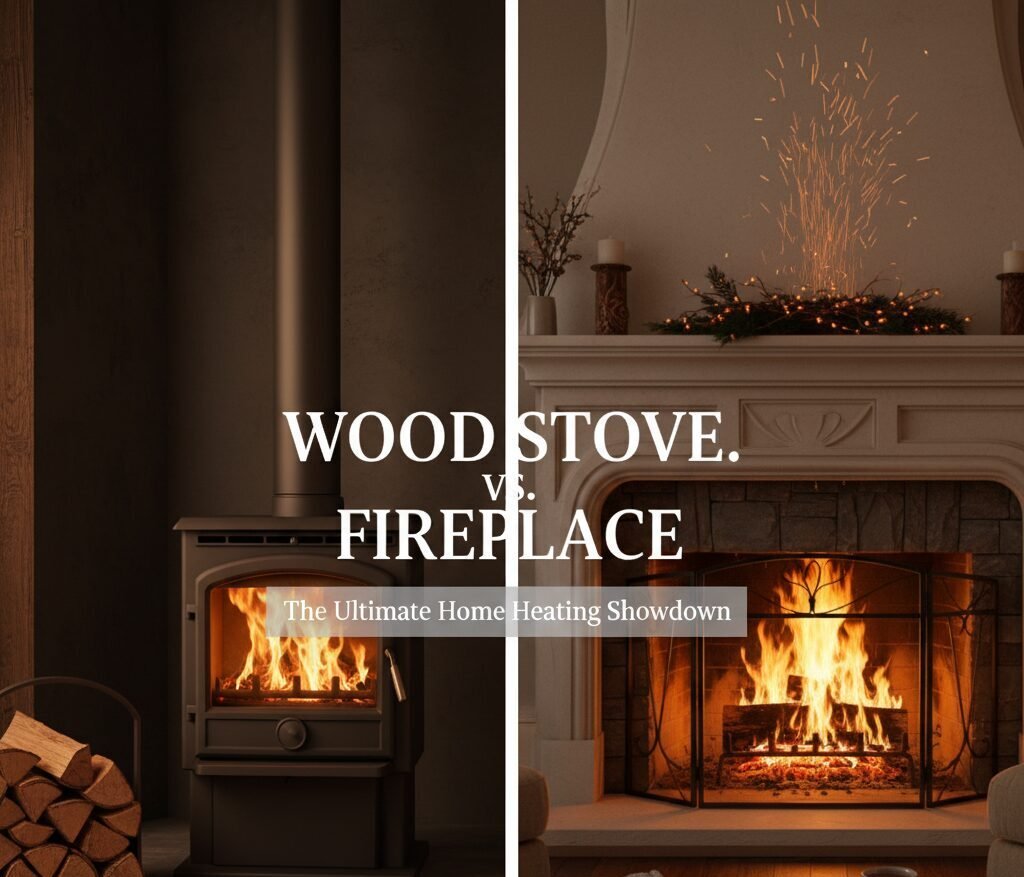
Wood Stove vs. Fireplace: The Ultimate Home Heating Showdown
The crackle of a real wood fire is an undeniable comfort — a primal call to warmth and relaxation that has drawn people together for millennia. As the temperature drops and thoughts turn to cozy evenings at home, many American homeowners face a classic dilemma: choosing between the rustic charm of a traditional fireplace and the powerhouse performance of a modern wood stove. This isn’t just a question of aesthetics; it’s a major decision that impacts your home’s warmth, your energy bills, your air quality, and your daily routine during the colder months.
Whether you’re building a new home, renovating an old one, or simply looking for a better way to heat your space, understanding the nuances of a wood stove vs. a fireplace is crucial. Both options offer the ambiance of a real flame, but they differ significantly in efficiency, cost, heat output, safety, maintenance, and environmental impact. This guide will serve as your comprehensive resource, breaking down every aspect to help you make an informed, confident decision for your family and home.
At a Glance: Quick Comparison Table
Before we dive deep into the details, let’s start with a high-level overview. This table summarizes the key differences between wood stoves and traditional open-hearth fireplaces to give you a quick reference point.
| Feature | Wood Stove | Traditional Fireplace |
|---|---|---|
| Heating Efficiency | High (60% to 85%+) | Very Low (5% to 15%) |
| Primary Function | Zone or Whole-Home Heating | Ambiance & Aesthetics |
| Installation Cost | Moderate to High ($2,000–$7,000+) | Very High ($5,000–$20,000+) |
| Running Cost | Low (Cost of firewood) | High (Due to inefficiency) |
| Heat Distribution | Excellent (Radiant & Convection) | Poor (Mainly radiant, near the fire) |
| Safety | High (Contained firebox) | Lower (Open hearth, risk of sparks) |
| Maintenance | Moderate (Regular cleaning, chimney sweeping) | High (Chimney sweeping, masonry checks) |
| Environmental Impact | Lower (EPA-certified models are clean-burning) | Higher (Inefficient combustion, more emissions) |
| BTU Output Range | 30,000–100,000+ BTU/hr | 20,000–40,000 BTU/hr (mostly lost up flue) |
| Best For… | Homeowners prioritizing efficient, low-cost heating. | Homeowners prioritizing classic looks and ambiance. |
Round 1: Heating Efficiency — The Undisputed Champion
When it comes to the core job of heating your home, this is not a close contest. The fundamental difference between a wood stove and a fireplace lies in how they handle combustion and heat transfer.
Why Wood Stoves Dominate in Efficiency
A modern wood stove is a highly engineered heating appliance. It’s designed as a closed combustion system. Here’s what that means for efficiency:
- Controlled Airflow: Wood stoves have adjustable air intakes that allow you to precisely control the amount of oxygen reaching the fire. This allows for a slower, more complete, and more efficient burn. You use less wood to produce more heat over a longer period.
- Secondary Combustion: EPA-certified stoves often feature secondary burn tubes or catalytic combustors. These devices re-ignite the smoke and gases produced by the initial fire, burning off pollutants and extracting even more heat energy from the same log of wood.
- Heat Transfer: The stove’s body — typically cast iron or heavy-gauge steel — absorbs immense heat from the firebox. It then radiates this heat into the room in all directions. Many models also incorporate convection, drawing cool air in at the bottom, heating it, and releasing it from the top.
An EPA-certified wood stove can achieve efficiency ratings of 75% to 85% or even higher. This means that for every log you burn, up to 85% of its potential heat energy is transferred into your living space.
The Inefficiency of a Traditional Fireplace
A traditional open-hearth fireplace, while beautiful, is an incredibly inefficient heater. Its design works against the goal of warming a room.
- Uncontrolled Airflow: An open fireplace pulls a massive amount of heated air from your room and sends it straight up the chimney along with the smoke. This “stack effect” can actually make other parts of your house colder by creating negative pressure that draws cold air from outside through gaps and cracks.
- Poor Heat Transfer: The heat you feel from a fireplace is almost entirely radiant — it travels in a straight line from the flames to you. If you’re not directly in front of it, you won’t feel much warmth. Much of the heat generated is absorbed by the masonry and lost to the outside through the chimney structure.
A typical masonry fireplace has an efficiency rating of around 10%. Some studies suggest it can even be negative when factoring in the conditioned air it exhausts from the home.
Verdict: The wood stove is the clear and decisive winner. If your primary goal is to effectively and affordably heat your home with wood, a wood stove is a far superior choice.
Top Pick for Efficiency: Drolet Escape 1800 Wood Stove
For homeowners serious about heating, the Drolet Escape 1800 is a workhorse. It’s EPA 2020 certified with an impressive 78% efficiency rating, capable of heating up to 2,100 sq. ft. Its large firebox allows for longer burn times, making it a reliable primary heat source.
Check Price on AmazonRound 2: Cost — Installation and Long-Term Expenses
The financial investment is a major factor for any homeowner. We need to look at both the upfront installation cost and the long-term running costs to get a complete picture.
Installation Costs
Fireplace Installation
Installing a new masonry fireplace is a major construction project. It requires a concrete foundation, skilled masonry work, and a professionally constructed chimney flue. The costs can be substantial:
- New Masonry Fireplace: $8,000 to $20,000+, depending on the materials (brick, stone), size, and complexity of the chimney run.
- Prefabricated (Zero-Clearance) Fireplace: A more affordable option at $4,000 to $10,000. These factory-built metal boxes can be framed into a wall, but they still require a professionally installed chimney system.
Proper construction using the best mortar for your chimney is crucial for safety and longevity.
Wood Stove Installation
Wood stove installation is generally less expensive and less invasive, especially if you have an existing chimney.
- Using an Existing Chimney: If you have a safe, sound fireplace chimney, you can often install a wood stove insert or run a stainless steel liner down the flue for a freestanding stove. This typically costs $2,500 to $5,500 (including the stove and liner).
- Without an Existing Chimney: You’ll use prefabricated, insulated Class A chimney pipe run through the ceiling and roof or out through an exterior wall. Total cost, including the stove and chimney system, usually falls between $3,000 and $7,000.
Running Costs
Here, the efficiency ratings come directly into play. Since a wood stove burns wood up to 8 times more efficiently than a fireplace, your annual wood consumption will be drastically lower.
Let’s imagine you need a specific amount of heat over a winter. With a fireplace at 10% efficiency, you might burn 4 cords of wood. To get the same effective heat from a wood stove at 80% efficiency, you would only need half a cord. If a cord of seasoned hardwood costs $300:
- Fireplace: 4 cords × $300/cord = $1,200/season
- Wood Stove: 0.5 cords × $300/cord = $150/season
The typical wood stove pays for itself in fuel savings within 3 to 7 seasons compared to running an equivalent open fireplace, depending on your local wood costs and how frequently you heat with wood. Over a 15-year appliance lifespan, the cumulative savings can be substantial.
Verdict: The wood stove is the overwhelming winner in long-term running costs due to its superior fuel efficiency. It provides a much faster return on investment through significant savings on firewood.
Best Budget-Friendly Pick: Ashley Hearth AW1120E-P Wood Stove
This plate steel stove offers impressive performance for its price point. It’s compact, EPA-certified, and can heat up to 1,200 sq. ft., making it perfect for smaller homes, cabins, or zone heating. It’s a fantastic entry point into efficient wood heating without a massive initial investment.
Check Price on AmazonRound 3: Aesthetics and Ambiance — A Matter of Taste
This is the one category where the traditional fireplace has historically held the crown. The choice here is deeply personal and depends entirely on your home’s style and your personal preferences.
The Classic Charm of a Fireplace
There’s no denying the romantic, classic appeal of an open-hearth fireplace. It serves as a powerful architectural focal point in a room, even when it’s not lit. The wide-open view of the flames, the crackling sounds, and the direct radiant warmth create an unparalleled sense of traditional comfort and luxury. For many, a fireplace is the heart of the home — a gathering place that defines a living space. You can decorate the mantel for holidays and arrange furniture around it, making it an integral part of your interior design.
The Evolving Style of a Wood Stove
Wood stoves are no longer just black, utilitarian boxes. Modern designs have come a long way, offering a wide range of styles:
- Traditional & Rustic: Classic cast iron stoves with ornate details fit perfectly in farmhouses, cabins, and country-style homes.
- Modern & Contemporary: Sleek, minimalist designs with clean lines, large glass viewing windows, and unique shapes can complement modern and Scandinavian interiors beautifully.
- Soapstone Stoves: A premium niche option where the stove’s body is partly or fully clad in soapstone — a natural stone prized for its exceptional heat retention. Soapstone stoves continue to radiate warmth for many hours after the fire goes out, and their natural stone appearance is striking in any interior.
While a freestanding stove doesn’t have a mantel, it creates its own unique focal point. The hearth pad it sits on can be made from beautiful materials like slate, tile, or stone, and the visible chimney pipe can add an industrial-chic or rustic element.
Verdict: This is a tie. While the fireplace wins on traditional integrated architectural beauty, the modern wood stove offers versatile and stylish appeal that can be just as compelling.
Round 4: Maintenance and Upkeep — A Shared Responsibility
Both wood stoves and fireplaces are not “set it and forget it” appliances. They require regular attention to operate safely and efficiently.
Shared Maintenance Tasks
- Ash Removal: The firebox must be cleaned of excess ash regularly. Leave a thin layer (about 1 inch) as an insulating bed for future fires, but remove excess to maintain proper airflow.
- Annual Chimney Sweeping: This is non-negotiable. Burning wood creates creosote, a flammable tar-like substance that builds up inside the chimney flue. If not removed, it can lead to a dangerous chimney fire. You must hire a certified chimney sweep annually. A high-quality chimney sweep vacuum is essential to control dust during the process, and using the best chimney brush for a stainless steel liner ensures thorough cleaning.
- Annual Inspection: Your chimney sweep should also perform a Level 1 inspection to check for any damage to the flue, masonry, or stove components.
Wood Stove-Specific Maintenance
- Gasket Inspection: The rope-like gasket around the stove door needs to be checked yearly to ensure a tight seal. A worn gasket leaks air, reducing efficiency and temperature control.
- Baffle and Firebrick Check: Inspect the internal baffle plate and firebricks for cracks or deterioration annually and replace as needed.
- Catalytic Combustor: If your stove has one, monitor and replace it according to manufacturer instructions (typically every 5–10 years).
- Glass Cleaning: The ceramic glass viewing window can accumulate a white haze from mineral deposits or a dark film from incomplete combustion. Clean it with a dedicated wood stove glass cleaner while the stove is cold.
Fireplace-Specific Maintenance
- Masonry Repair: The firebox and chimney masonry need annual inspection for cracked bricks or deteriorating mortar joints (tuckpointing).
- Damper Operation: Ensure the damper opens and closes smoothly. A stuck-open damper is a major source of heat loss all winter long.
- Chimney Cap: A good chimney cap keeps out rain, animals, and debris. Check that it is secure and in good condition. Consider one of the best chimney caps for rain to protect your flue.
- Firebox Liner: The refractory panels lining the firebox absorb intense heat and can crack. These panels require inspection and eventual replacement to protect the surrounding masonry.
Verdict: Another tie. Both require a similar level of commitment to annual professional servicing. A wood stove may have more user-replaceable parts, but a fireplace’s masonry can require more expensive specialized repairs over its lifespan.
Essential Maintenance Product: Rutland Creosote Remover
Regularly using a creosote remover can make annual chimney cleaning easier and safer. When burned in your stove or fireplace, the powder turns into a gas that breaks down the molecular structure of creosote, turning it into a less-flammable, brushable ash. It’s a must-have for any wood-burning homeowner.
Check Price on AmazonRound 5: Safety Considerations — Containing the Fire
Anytime you have a fire in your home, safety is the top priority. Modern wood-burning appliances are designed with safety in mind, but there are inherent differences between an open hearth and an enclosed stove.
The Safety of a Wood Stove
- Spark and Ember Containment: The solid cast iron or steel box and sealed glass door completely contain the fire. The risk of a stray spark or rolling log igniting a nearby rug or furniture is virtually eliminated.
- Controlled Combustion: The controlled air supply prevents the fire from burning out of control, a major factor in preventing chimney fires from excessive creosote deposits.
- Reduced Fire Risk: Because wood stoves burn fuel more completely and at controlled temperatures, they produce significantly less creosote than open fireplaces, lowering the risk of a chimney fire over a season of regular use.
The Risks of an Open Fireplace
- Sparks and Embers: This is the most significant risk. A popping log can easily send hot embers shooting out onto the floor. A sturdy fireplace screen is mandatory, but not foolproof.
- Downdrafts and Smoke: If not operating correctly, a fireplace can spill smoke into the room, releasing harmful particulates and carbon monoxide into your living space.
- Child and Pet Safety: The open fire is an obvious hazard. The hearth edge, fire tools, and ash bucket are also injury risks that require constant supervision around young children and pets.
Both wood stoves and fireplaces produce carbon monoxide. If a chimney becomes blocked — by creosote, a bird’s nest, or a collapsed liner — CO can backdraft into your living space. Install CO detectors on every floor of your home and test them monthly. Never operate a wood-burning appliance with a known flue obstruction.
Verdict: The wood stove is the winner on safety. Its enclosed design inherently minimizes the risks associated with an open fire.
Round 6: Heat Output and BTU Guide — Sizing It Right
One of the most common and costly mistakes homeowners make is buying a stove or fireplace that is the wrong size for their space. Too small and it won’t keep up on the coldest nights; too large and you’ll have to run it at smoldering low temperatures that accelerate creosote buildup and reduce efficiency.
Understanding BTU and Square Footage
Heat output is measured in BTUs (British Thermal Units) per hour. One BTU is the amount of heat required to raise the temperature of one pound of water by one degree Fahrenheit. For home heating purposes, a rough industry rule of thumb is that you need approximately 20–30 BTUs of heat per square foot of living space in a well-insulated home in a moderate climate. In cold climates or poorly insulated homes, that figure can rise to 40–50 BTUs per square foot.
| Living Space | BTU Needed (Moderate Climate) | BTU Needed (Cold Climate) | Recommended Stove Size |
|---|---|---|---|
| Up to 600 sq. ft. | 12,000–18,000 BTU/hr | 24,000–30,000 BTU/hr | Small stove (30,000–45,000 BTU) |
| 600–1,200 sq. ft. | 18,000–36,000 BTU/hr | 30,000–60,000 BTU/hr | Small to medium stove (45,000–65,000 BTU) |
| 1,200–2,000 sq. ft. | 36,000–60,000 BTU/hr | 60,000–100,000 BTU/hr | Medium to large stove (65,000–90,000 BTU) |
| 2,000–3,000 sq. ft. | 60,000–90,000 BTU/hr | 100,000–150,000 BTU/hr | Large stove (90,000–120,000+ BTU) |
Factors That Affect How Much Heat You Actually Need
- Insulation quality: A home with excellent insulation, double-glazed windows, and well-sealed drafts requires significantly fewer BTUs than an older, drafty home of the same square footage.
- Ceiling height: Standard BTU estimates assume 8-foot ceilings. Homes with vaulted or cathedral ceilings have more air volume to heat and require proportionally more output.
- Open-plan vs. compartmentalized layout: Open-plan homes allow heat from a central stove to distribute more naturally. In compartmentalized homes with many doors and hallways, heat distribution is more challenging and may require supplemental heating in distant rooms.
- Local climate: A stove sized for coastal Virginia winters will be undersized for Minnesota winters. Always factor in your local design temperature — the coldest temperature your area typically experiences — when sizing a heating appliance.
- Solar gain: South-facing homes with large windows receive significant passive solar heating on sunny days, which can meaningfully reduce the heating load your stove needs to cover.
The Fireplace Heat Output Reality
A traditional open fireplace may technically produce 20,000–40,000 BTUs of heat — but the vast majority of that heat travels directly up the chimney. The actual net heat delivered to the room is dramatically lower, and on a very cold day, the net effect can be a wash or even a slight net cooling of adjacent rooms due to the cold air the chimney draws in to replace the heated air it exhausts. This is why the fireplace is fundamentally unsuitable as a serious primary heat source.
Round 7: Environmental Impact — The Green Heating Question
As awareness of air quality and carbon emissions grows, the environmental footprint of your home heating choices has become an increasingly important consideration. Both options burn wood — technically a renewable fuel — but the two technologies produce very different environmental profiles.
Particulate Matter and Air Quality
The primary environmental concern with wood burning is the production of fine particulate matter (PM2.5) — microscopic airborne particles that can penetrate deep into the lungs and cause serious respiratory and cardiovascular health effects. Traditional open fireplaces are significant emitters of PM2.5 because they burn wood incompletely and at highly variable temperatures. In areas prone to temperature inversions — where cold air traps pollutants close to the ground — wood-burning fireplaces can be the single largest contributor to poor local air quality on winter evenings.
EPA Certification: The Game-Changer for Stoves
The EPA has established strict emission standards for wood-burning heaters. EPA-certified stoves (currently the Step 2 standard, which requires emissions below 2.0 grams of PM2.5 per hour) achieve dramatically cleaner combustion through secondary burn chambers, catalytic combustors, and precisely engineered airflow systems. An EPA-certified wood stove can emit up to 90% less particulate matter than an old, uncertified stove of the same output — and vastly less than an open fireplace.
Burning wood from sustainably managed forests is widely considered to be carbon-neutral over the long term. The carbon released when wood burns is equal to the carbon the tree absorbed during its growth. This cycle makes wood a renewable fuel in a way that fossil fuels — which release carbon locked underground for millions of years — fundamentally are not. However, transportation emissions for delivering firewood, and the emissions from incomplete combustion, mean real-world wood burning is not perfectly zero-carbon.
Burn Bans and Local Regulations
In many metropolitan areas and regions with poor air quality, local authorities implement seasonal or episodic wood-burning restrictions on high-pollution days. These “burn bans” typically apply to all wood-burning appliances except those that are EPA-certified and serve as a primary heat source. If you live in an air quality non-attainment area, check your local regulations carefully — an uncertified fireplace may be subject to more frequent restrictions than a certified wood stove. Some municipalities offer rebate programs for replacing old, inefficient wood-burning appliances with EPA-certified models.
Verdict: The EPA-certified wood stove is the clear winner on environmental impact. It burns significantly cleaner and produces a fraction of the particulate emissions of an open fireplace.
Round 8: Best Firewood for Each Appliance
The species and condition of the firewood you burn have a dramatic impact on heat output, creosote production, and the longevity of your appliance — whether it’s a stove or a fireplace. This is an area where both systems share the same principles, but the stakes are higher with a stove because you’re depending on it for consistent heat.
The Golden Rule: Burn Only Seasoned or Kiln-Dried Wood
Freshly cut “green” wood contains 50–60% water by weight. Burning green wood is one of the worst things you can do for any wood-burning appliance. The fire must expend enormous energy simply boiling off that moisture, dramatically reducing heat output. More importantly, green wood produces much more smoke and substantially more creosote. Always burn wood that has been split and air-dried for a minimum of 6–12 months, or wood labeled as kiln-dried with a moisture content below 20%.
Hardwood vs. Softwood: What You Need to Know
🌳 Dense Hardwoods (Best Choice)
- Oak: High BTU output, very long burn time, excellent coaling. Needs 18–24 months to season fully.
- Hickory: Among the highest BTU content of any North American wood. Burns very hot and long.
- Maple: Good BTU output, pleasant aroma, seasons in 12 months.
- Ash: Excellent all-around wood; unique in that it burns relatively well even green. Low smoke.
- Black Locust: Exceptional heat output and very slow burning, comparable to coal in density.
🌲 Softwoods (Use with Caution)
- Douglas Fir: Decent BTU output for a softwood, acceptable if well-seasoned.
- Pine: Burns fast and hot initially, but produces significant creosote due to high resin content. Use only for kindling or fire-starting, not sustained heating.
- Cedar: Burns very easily and smells pleasant. Better for ambiance fires than serious heating due to fast burn rate.
- Spruce: Very fast burning with low heat output per cord. Not recommended as a primary fuel.
How Wood Choice Differs Between Stoves and Fireplaces
In a wood stove, you can run the appliance at a controlled, sustained smolder temperature using the air intake vents — which makes wood species consistency and proper seasoning even more critical. Running a stove too cool (which often happens with softwoods that burn too fast) produces excessive creosote rapidly. In a fireplace, the lack of air control means you have less ability to compensate for suboptimal fuel, making poor quality or wet wood an immediate and visible problem in the form of smoke, poor draw, and a room full of fumes.
Round 9: Choosing by Climate Zone — Matching the Appliance to Your Winter
Your local climate is one of the most important — and most overlooked — factors in the wood stove versus fireplace decision. An appliance that is perfectly matched to its climate performs beautifully; one that is mismatched will frustrate its owner within the first winter.
| Climate Zone | Description | Best Choice | Why |
|---|---|---|---|
| Very Cold (Minnesota, Maine, Wisconsin) | Extended winters, frequent temps below 0°F | High-output wood stove (80,000+ BTU) | Primary heat source capability is essential; fireplace is wholly inadequate |
| Cold (Mid-Atlantic, Great Lakes, Pacific Northwest) | Significant winters, regular temps in teens to 20s°F | Mid-range wood stove (50,000–80,000 BTU) | Zone heating with stove provides reliable, cost-effective warmth; fireplace as supplement is viable |
| Mixed (Tennessee, Virginia, Oregon Coast) | Moderate winters with occasional cold snaps | Small stove or fireplace with insert | Either works; fireplace ambiance is attractive, insert upgrade makes it practical |
| Mild (Georgia, Texas, Coastal California) | Short, mild winters, rarely below freezing | Fireplace or small decorative stove | Heating efficiency matters less; ambiance and aesthetics drive the decision |
In very cold climates, a traditional fireplace is not just inefficient — it can actively make your home colder during the coldest nights because the heated air it exhausts creates a negative pressure that draws frigid outside air into the home through every gap and crack. In these climates, a high-output wood stove is the only wood-burning option that makes thermal and economic sense.
Round 10: Home Resale Value — What Buyers Actually Want
Both wood stoves and fireplaces can add meaningful value to a home, but they appeal to different buyer profiles and add value in different ways. Understanding this distinction matters if resale value is part of your decision-making.
The Fireplace as a Resale Asset
A traditional masonry fireplace is widely recognized as a desirable home feature by real estate professionals. Multiple industry surveys have found that a working fireplace can add between 6% and 12% to a home’s selling price in most markets, with the effect being stronger in colder climates where buyers specifically seek them out. The fireplace’s appeal as an architectural feature — complete with a mantel and surround — resonates with a broad spectrum of buyers because it signals quality, permanence, and classic design.
The Wood Stove as a Practical Selling Point
Wood stoves appeal most strongly to specific buyer segments: buyers in rural or semi-rural areas where power outages are common and wood is affordable, energy-conscious buyers interested in reducing utility bills, and buyers in cold climates seeking a reliable backup heat source. In these target demographics, a quality wood stove can be a compelling selling point. However, some buyers may view a wood stove as a maintenance burden or may have concerns about air quality, particularly in urban areas where burn bans are common.
To maximize the resale value contribution of either appliance, ensure it is professionally inspected, thoroughly cleaned, and accompanied by documentation of recent service. A clean inspection certificate from a CSIA-certified sweep is a powerful piece of documentation that reassures buyers and can be highlighted in the listing.
Verdict: The traditional fireplace has the edge for broad market appeal and maximum resale value contribution. A wood stove wins in specific buyer markets — rural, cold-climate, and energy-focused buyers — but may not add equivalent value in all markets.
The Middle Ground: Fireplace Inserts — Getting the Best of Both
If you already have an existing masonry fireplace and you’re frustrated by its inefficiency but love its appearance, a fireplace insert is your best possible solution. Understanding inserts is essential to any complete wood stove vs. fireplace discussion because they represent the most popular and practical upgrade path for existing-fireplace homeowners.
What Is a Fireplace Insert?
A fireplace insert is essentially a self-contained wood stove that is specifically engineered to be installed inside the firebox of an existing masonry or prefabricated fireplace. It slides into the firebox opening, and a stainless steel liner connects the insert’s flue collar to the top of the chimney, ensuring safe exhaust of combustion gases. The insert’s faceplate overlaps the original fireplace surround, creating a finished, built-in appearance that preserves the look of your fireplace while delivering stove-level heating performance.
Why a Fireplace Insert Is Often the Best Decision
- Transforms your existing decorative fireplace into a genuine heat source without major construction work
- Achieves 65%–80% efficiency — a dramatic improvement over the original 10% open fireplace
- Maintains the architectural look of your fireplace and mantel
- Typically costs $3,000–$7,000 installed — far less than building a new fireplace
- EPA-certified options available for cleaner burning and compliance with burn regulations
- The cast iron or steel door eliminates the spark and ember hazard of an open fire
- A single stainless steel liner upgrade also improves the safety and draft of the entire chimney system
Insert vs. Freestanding Stove: Which Should You Choose?
If you have a working masonry fireplace in your preferred heating room, an insert is almost always the better choice — it’s less expensive than adding a new freestanding stove with a new chimney, and it leverages the existing chimney infrastructure you’ve already paid for. If you want to add heating capability to a room that has no fireplace, or if you want the visual drama of a freestanding stove as a room centerpiece, a freestanding stove with a new Class A chimney is your path.
Buyer’s Guide: What to Look for When Choosing
Whether you’re leaning toward a wood stove, a fireplace, or an insert, the following checklist ensures you select the right model for your specific situation.
For a Wood Stove: Key Specifications to Evaluate
- EPA Certification: This is non-negotiable. Only purchase a current EPA-certified model. This ensures you meet regulatory requirements, burn cleanly, and get maximum efficiency. Look for the EPA certification label on the product listing or physical unit.
- Efficiency Rating: Look for published efficiency ratings from the manufacturer. The higher the better — aim for 70% or above for any stove you intend to use as a serious heat source.
- Firebox Volume: Measured in cubic feet. A larger firebox accepts longer logs and allows longer burn times between refueling. For overnight heating, look for stoves that offer 8–10 hour burn times at medium output.
- Material: Cast iron stoves heat up more slowly but retain heat longer, continuing to radiate warmth even after the fire dies down. Steel stoves heat up faster but cool more quickly. Both are excellent — the choice depends on your heating rhythm preferences.
- Catalytic vs. Non-Catalytic: Catalytic stoves use a combustor element to re-burn gases, offering slightly better peak efficiency and lower emissions but requiring periodic combustor replacement. Non-catalytic stoves use secondary air tubes and are simpler to maintain. Both achieve excellent EPA compliance.
- Glass Door Quality: A large, clear ceramic glass door dramatically improves the ambiance. Look for models where the manufacturer uses an air wash system — a curtain of air across the inside of the glass that keeps it clean during burning.
For a Fireplace: What to Prioritize
- Firebox depth and width: A deeper firebox accommodates longer logs and allows for better fire management. Width determines the visual scale of the fire and should be proportionate to the room size.
- Smoke chamber geometry: A properly sized and shaped smoke chamber above the firebox is critical for good draft. Poorly proportioned smoke chambers cause chronic smoke spillage into the room.
- Damper quality: The damper should open and close smoothly with a strong seal when closed. A leaky damper wastes energy constantly when the fireplace is not in use. Consider upgrading to a top-mount damper at the time of installation for superior sealing.
- Chimney height and diameter: These must be correctly proportioned to the firebox opening. Under-sized chimneys relative to fireplace size produce draft problems. Your contractor should calculate these ratios using established formulas.
- Surround and mantel materials: If aesthetics are your primary driver, invest in the surround and mantel materials that complement your interior design — whether that is traditional brick, natural stone, marble, or custom millwork.
Installation Overview: What to Expect From the Process
Understanding what an installation actually involves helps you budget accurately, ask better questions of contractors, and avoid unpleasant surprises mid-project. Here is what each installation pathway typically looks like.
Wood Stove Installation — Step by Step
- Site Assessment: A certified installer or NFI-certified hearth professional visits your home to assess the planned stove location, measure ceiling heights, identify the planned chimney route, and confirm compliance with local building codes and clearance requirements.
- Hearth Pad Installation: A non-combustible hearth pad must be installed beneath the stove. This typically consists of a cement board substrate topped with tile, stone, or brick. The pad must extend a specified distance in front of and to the sides of the stove door — usually 18 inches in front and 8 inches to each side at minimum.
- Chimney System Installation: If no existing chimney is present, a Class A double-wall insulated chimney pipe is run from the stove location through the ceiling, through the attic, and out through the roof (or alternately through an exterior wall). All joints are secured with appropriate screws and approved sealant.
- Stove Placement and Connection: The stove is positioned on the hearth pad within the required clearances from all combustible walls. The stove’s flue collar is connected to the chimney pipe system using a stovepipe section (typically 6 or 8 inches in diameter).
- Inspection and Permit: In most jurisdictions, a wood stove installation requires a building permit and a final inspection by the local building authority. Your installer should handle the permit application; ensure this is confirmed before work begins.
- Initial Cure Fire: The first fires in a new stove should be small and brief — called “cure fires” — to allow the high-temperature paint on the stove body to cure properly without cracking or producing excessive fumes. Follow the manufacturer’s specific break-in procedure.
How Long Does Installation Take?
A straightforward wood stove installation with a new Class A chimney typically takes one to two days for a professional crew. A masonry fireplace construction is a multi-week project involving foundation work, masonry laying, and curing time. A fireplace insert installation is typically completed in a single day.
Installing a wood stove or fireplace without the required building permit is a serious risk. An unpermitted installation can void your homeowner’s insurance, create liability if a fire occurs, and complicate or derail a future home sale when the unpermitted work is discovered during buyer inspection. Always ensure your installer is licensed, insured, and pulls the required permits.
Final Verdict: Which Is Right for You?
After breaking it all down across ten rounds of detailed comparison, the choice between a wood stove and a fireplace becomes much clearer. It’s not about which one is “better” overall — it’s about which one is better for your specific needs, priorities, and circumstances.
You should choose a Wood Stove if:
- Your primary goal is efficiently and affordably heating your home or a specific zone
- You want to lower your winter utility bills significantly and get a return on your investment through fuel savings
- You prioritize safety and environmental performance with an EPA-certified model
- You live in a cold climate where reliable, high-output heating is a necessity
- Your budget for installation is in the moderate range
- You want a heating source that functions as a backup when the power grid fails
You should choose a Fireplace if:
- Your primary goal is aesthetics, ambiance, and creating a classic architectural focal point
- Heating efficiency and running cost are not your main concerns
- You have a large budget for a major construction or renovation project and want to maximize resale appeal
- You only plan to have occasional, recreational fires rather than using it as a consistent heat source
- You live in a mild climate where the heating load is modest
Consider a Fireplace Insert if:
- You already own a masonry fireplace and want to dramatically improve its efficiency without losing its look
- You want stove-level heating performance at a significantly lower installation cost than adding a freestanding stove with a new chimney
- You want to achieve EPA certification compliance with your existing fireplace infrastructure
Frequently Asked Questions (FAQ)
Q: Can a wood stove heat a whole house?
A: Yes, it absolutely can, provided it is sized correctly for the square footage and layout of your home. A large, centrally located wood stove, often combined with fans to help circulate air, can serve as the primary heating source for a well-insulated house, especially in moderately cold climates. In very large or multi-story homes, it may work as a powerful zone heater, significantly reducing the workload on your central furnace.
Q: What is a fireplace insert?
A: A fireplace insert is essentially a wood stove that is designed to be installed directly inside the firebox of an existing masonry fireplace. It offers the best of both worlds: you get the high efficiency and safety of a wood stove while retaining the traditional look of your fireplace and mantel. It’s an extremely popular upgrade for homeowners who want to turn their decorative, inefficient fireplace into a powerful heater.
Q: Are wood stoves bad for the environment?
A: Modern, EPA-certified wood stoves are not. Old, non-certified stoves were inefficient and produced a lot of smoke. However, stoves that meet current EPA standards are incredibly clean-burning, using advanced technology to burn off smoke and resulting in minimal particulate emissions. Burning wood from a sustainably managed source is also considered carbon-neutral over the long term.
Q: How much clearance do I need for a wood stove?
A: Clearances vary by manufacturer and model, so always follow the owner’s manual. Generally, clearances to combustible walls range from 12 to 36 inches. These can often be reduced using approved heat shields. You will also need a non-combustible hearth pad underneath the stove that extends a specified distance in front and to the sides.
Q: Can I install a wood stove myself?
A: While some homeowners with significant construction experience do attempt it, having a professional certified by the National Fireplace Institute (NFI) perform the installation is strongly recommended. A proper installation is critical for safety and building code compliance. An incorrect installation can void your homeowner’s insurance and create a serious fire hazard.
Q: How long does a wood stove last compared to a fireplace?
A: A quality cast iron or heavy-gauge steel wood stove, properly maintained, can last 20–30 years or more. Replacement parts like gaskets, glass, and baffle plates are typically available from manufacturers for many years after purchase. A masonry fireplace, built correctly from quality materials, can literally last the life of the home — well over 50 years — but the internal components like the firebox liner panels, the damper, and the flue liner may need replacement or repair every 10–25 years depending on use and maintenance.
Q: What kind of wood stove insert fits my existing fireplace?
A: The key measurements are the firebox opening width, height, and depth. Inserts are available in small, medium, and large sizes to correspond to standard fireplace dimensions. A hearth professional will measure your firebox and recommend compatible insert models. Critically, every insert installation must include a stainless steel liner running from the insert’s flue collar to the top of the chimney — this is a safety requirement, not optional, and is included in the installation cost.
Q: How do I know if my wood is dry enough to burn?
A: The most accurate method is to use an inexpensive wood moisture meter, which gives you a direct digital reading of the wood’s moisture content. Properly seasoned wood should read below 20% moisture. Visual and auditory clues also help: well-seasoned wood has cracks at the end grain, feels lighter than green wood of the same size, produces a sharp “clunk” when two pieces are struck together (green wood produces a dull thud), and the bark may be loose or partially separated. Never burn wood that hisses, produces excessive steam, or refuses to maintain a flame — these are all signs of inadequate seasoning.