
The Ultimate Guide: Finding the Best Chimney for Your Kitchen
A clean, smoke-free kitchen isn’t just a luxury—it’s an absolute necessity for a healthy home environment and an enjoyable cooking experience. Every time you sear a steak, fry spices, or boil pasta, you release a cocktail of grease, airborne particulate matter, steam, and even harmful VOCs (Volatile Organic Compounds) into your breathing space. Without proper ventilation, this microscopic grime settles onto your beautiful cabinets, permanently discolors your walls, and degrades the indoor air quality of your entire house.
This is where the right kitchen chimney (also known as a range hood or exhaust hood) steps in. It serves as the mechanical lung of your culinary space, silently whisking away noxious smoke, pungent odors, and microscopic grease before they can spread. However, the market in 2026 is overwhelmingly saturated. Should you buy a ducted or ductless model? Do you need baffle filters or mesh? What is auto-clean technology, and is it worth the premium?
This comprehensive guide has been meticulously crafted by our home appliance experts to demystify the buying process. We have evaluated dozens of models based on suction power (CFM), motor durability, noise levels, filter efficiency, and real-world user feedback to bring you the definitive list of the best kitchen chimneys available today. Whether you are outfitting a compact apartment or a professional-grade chef’s kitchen, we have the perfect solution for you.
Our Top 3 Kitchen Chimney Picks
After rigorous testing and market analysis, we have narrowed down the saturated market to these three exceptional models. Each serves a distinct purpose, ensuring there is a perfect fit for your specific cooking habits and kitchen layout.

1. Cosmo COS-63175S Wall Mount Range Hood
The Cosmo COS-63175S reigns supreme as our “Best Overall” pick because it hits the sweet spot between high-end performance, striking European aesthetic design, and an incredibly reasonable price tag. Built with premium 430-grade, 20-gauge brushed stainless steel, this 30-inch wall-mounted chimney is designed to withstand the harsh realities of daily cooking without showing wear.
What truly sets the Cosmo apart is its highly efficient airflow system. At 380 CFM, it easily handles standard four-burner gas and electric stoves. It utilizes heavy-duty permanent baffle filters—the same style found in commercial restaurant kitchens. These filters are masterfully engineered to force grease-laden air to rapidly change direction, causing the heavy grease droplets to condense onto the steel blades while clean air flows through. Best of all? They are 100% dishwasher safe, eliminating the need for tedious manual scrubbing.
- Suction Power: 380 CFM (Ideal for 30″ ranges)
- Noise Level: Max 65 dB (Quiet operation)
- Filter Type: Arc-Flow® Permanent Baffle Filters
- Lighting: 2-Watt Energy Efficient LEDs
- Convertible: Can be converted to ductless (carbon filter kit sold separately)
Pros
- Exceptional build quality and brushed finish
- Baffle filters trap grease efficiently and never need replacing
- Push-button controls are tactile and highly durable
- Bright, energy-efficient LED lighting illuminates the cooktop perfectly
Cons
- The protective film applied for shipping can be tedious to peel off
- The chimney flue cover may not reach ceilings taller than 9 feet without an extension kit
2. FOTILE JQG7505 Under-Cabinet Range Hood
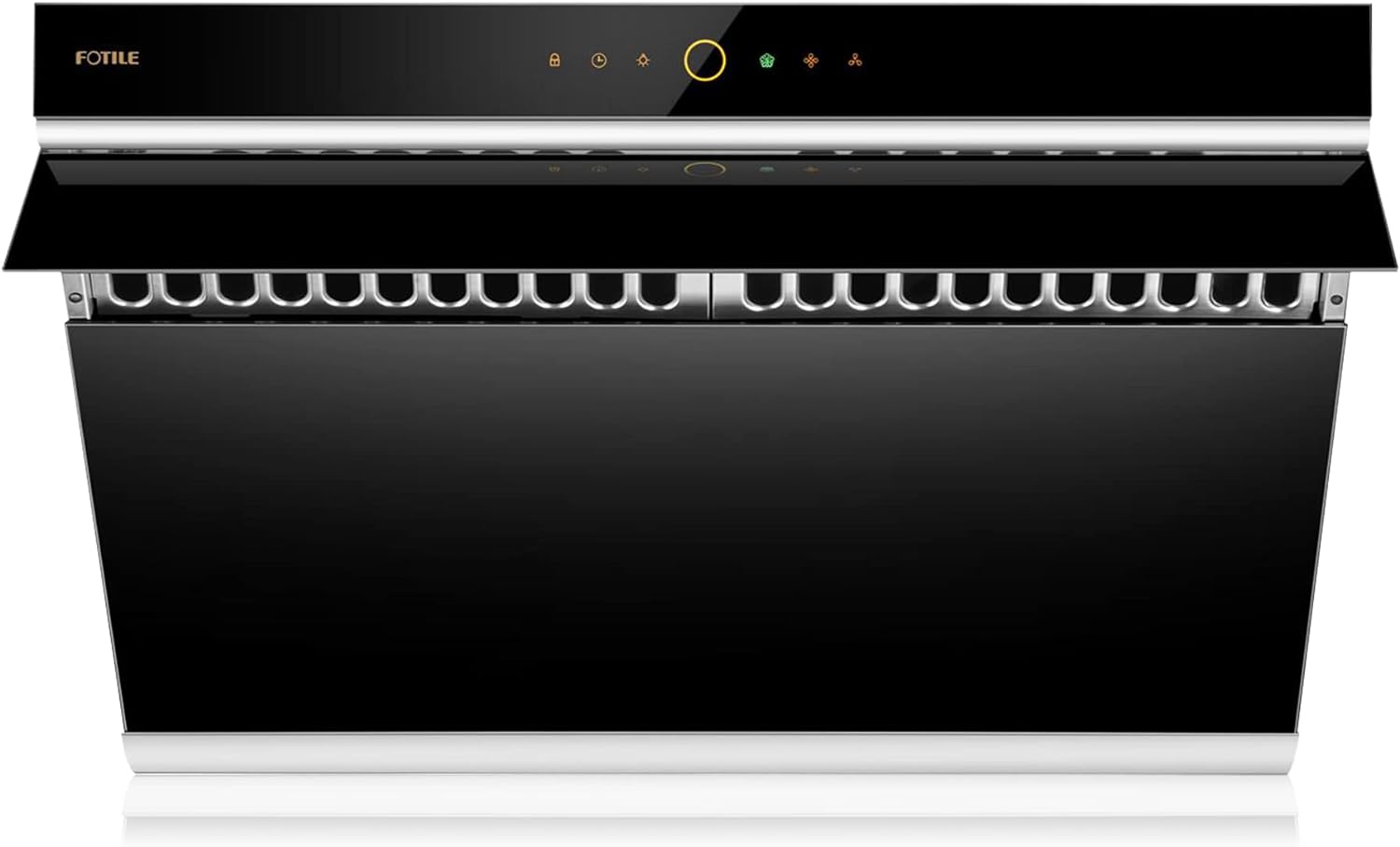
If your culinary style involves heavy stir-frying, deep-frying, blackening spices, or cooking heavily aromatic dishes, standard chimneys will simply choke. You need industrial-grade extraction power, and the FOTILE JQG7505 is the undisputed king of the hill. This isn’t just a chimney; it’s a meticulously engineered smoke extraction system.
The FOTILE utilizes a unique 90-degree automatic open baffle plate. Instead of sitting flat above the stove, the dual-DC motors draw smoke from a side-slant angle. This closer proximity to the pans prevents smoke from spreading horizontally across your kitchen. Generating a massive 850 CFM, it creates a “smoke safe zone” that captures fumes before they even reach your face. Furthermore, despite its hurricane-like suction, the dual-centrifuge motor is shockingly quiet, maxing out at just 54 dB on normal settings. It also features futuristic motion-activated controls—just wave your hand in front of the unit to power it on when your hands are covered in dough or oil.
- Suction Power: 850 CFM (Dual DC Motors)
- Noise Level: Max 54 dB (Whisper-quiet for its class)
- Filter Type: Filter-less design with an oversized grease collection tray
- Features: Infrared Motion Activation, Touchscreen Lock
- Design: 30-inch Side-Draft / Slant Design
Pros
- Unrivaled suction power; literally catches smoke before it spreads
- Motion gesture controls are incredibly convenient and keep the glass clean
- Slanted design prevents you from bumping your head while cooking
- Oversized oil cup reduces maintenance frequency
Cons
- Premium price point (an investment piece)
- Requires precise installation; professional help is recommended due to its weight
3. Broan-NuTone 413004 Non-Ducted Under-Cabinet Hood
Not every kitchen has the architectural capability to vent air through the roof or out a side wall. For apartment renters, condo owners, or anyone with a kitchen located on an interior wall, running ductwork is either impossible or prohibitively expensive. Enter the Broan-NuTone 413004—the absolute best ductless (recirculating) value on the market today.
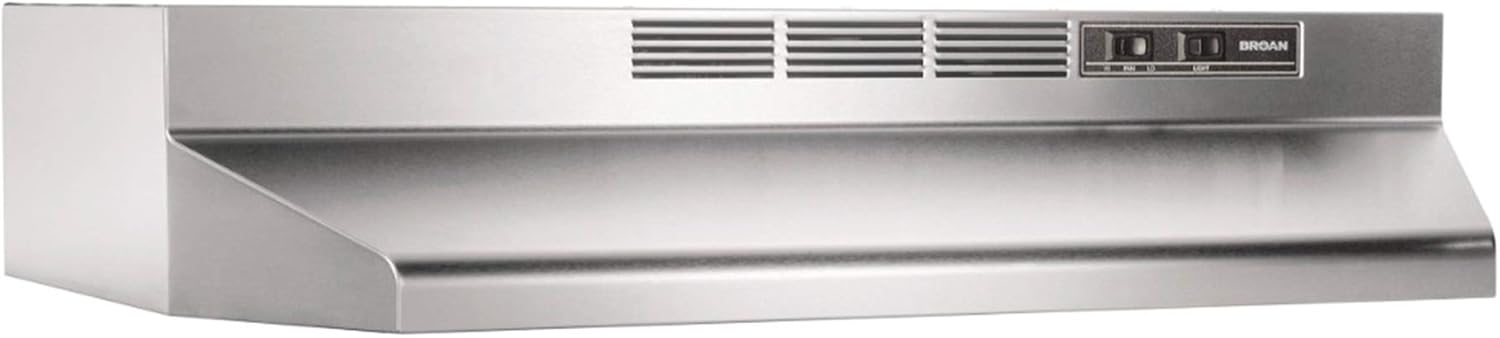
Broan-NuTone is a legendary name in home ventilation, and this 30-inch under-cabinet unit provides reliable, no-frills performance. Since it doesn’t vent outside, it utilizes a highly effective charcoal filter system. The internal fan pulls the greasy, smoky air upward, passes it through a combination aluminum mesh and carbon filter matrix (which chemically neutralizes odors and traps grease), and recirculates the freshly scrubbed air back into the kitchen. While it won’t remove heat or moisture like a ducted unit, it is incredibly effective at eliminating lingering cooking smells and preventing grease buildup on your cabinetry.
- Installation Type: Ductless / Non-Vented (Recirculating)
- Lighting: Incandescent (Bulb not included, fits up to 75W)
- Filter Type: Replaceable Charcoal/Aluminum Mesh Combo
- Size: 30-inch (Fits standard cabinet widths)
- Switch: 2-Speed Rocker Switch
Pros
- Extremely budget-friendly price point
- Incredibly easy DIY installation; simply mount to the cabinet and plug it in
- Slim profile doesn’t eat up valuable head space over the stove
- Durable stainless steel finish matches modern appliances
Cons
- Does not remove heat or humidity from the room
- Charcoal filters must be actively replaced every 3-6 months
- Not suitable for heavy frying or indoor grilling
Deep Dive: The Anatomy of Kitchen Chimneys
To truly understand which chimney fits your needs, you must understand the underlying technology. A kitchen hood isn’t just a fan in a metal box; it is a complex intersection of aerodynamics, filtration science, and motor engineering.
Types of Kitchen Chimneys Explained
Your kitchen’s layout dictates the structural style of the chimney you must purchase. Attempting to force the wrong type of chimney into your kitchen design will result in poor performance and a disastrous aesthetic.
- Wall-Mounted Chimneys: The most prevalent design. If your cooktop sits against a bare wall, this is your go-to. They feature a wide canopy to catch smoke and a tall vertical “flue” that hides the ducting going up to the ceiling. They make a grand, modern statement in the kitchen.
- Under-Cabinet Hoods: Ideal for compact kitchens where storage space is at a premium. These units mount directly to the bottom of the cabinetry positioned above your stove. The ductwork is either routed up *through* the cabinet (sacrificing some storage) or vented directly out the back wall.
- Island Mount Chimneys: If your stove is located on a central kitchen island, wall mounts are useless. Island chimneys are suspended directly from the ceiling. Because there are no walls to help guide the smoke upward, island chimneys must have significantly higher CFM (suction power) to catch drafts that might blow the smoke sideways.
- Downdraft Extractors: A hidden, minimalist marvel. These are built directly into the countertop behind or beside the stove. When you cook, they pop up mechanically and pull the smoke *downward* into a vent hidden beneath the floor. They are aesthetically stunning but generally less efficient than overhead hoods because heat naturally rises.
The Great Debate: Ducted vs. Ductless Chimneys
This is the most critical structural decision you will make. It determines how the polluted air is ultimately handled.
Ducted (Vented) Chimneys: The Gold Standard
A ducted chimney connects to heavy-gauge aluminum or PVC piping that runs through your walls or ceiling, exhausting the air entirely out of your house.
The Advantage: It is 100% effective. It removes smoke, microscopic grease particles, pungent odors, and most importantly, it removes the intense heat and humidity generated by boiling pots and open flames.
The Disadvantage: Installation can be highly invasive and expensive. You have to cut holes in your home’s exterior, and the routing must adhere to strict local building codes.
Ductless (Recirculating) Chimneys: The Problem Solver
If you live in a high-rise apartment or renting a space where modifying the exterior wall is forbidden, ductless is your only option.
The Advantage: Zero exterior venting required. You can install them anywhere. They pull air in, pass it through dense carbon filters to scrub the grease and odors, and blow the cleaned air right back into the kitchen.
The Disadvantage: They are fundamentally incapable of removing heat or moisture. Furthermore, the suction power is slightly reduced because the air faces heavy resistance pushing through the dense charcoal blocks. Maintenance costs are also higher, as carbon filters cannot be washed—they must be thrown away and replaced 2-3 times a year.
The Expert Buying Guide: Technical Specifications Decoded
When you browse for kitchen chimneys, you will be bombarded with technical jargon. Here is how to translate those specifications into real-world performance metrics so you can buy exactly what you need without overpaying.
1. Calculating Your Required Suction Power (CFM)
CFM stands for Cubic Feet per Minute. It measures the raw volume of air the chimney’s motor can displace in 60 seconds. Buying a chimney with too low CFM is like trying to drain a swimming pool with a straw. Buying one with too much CFM will suck the heated or air-conditioned air out of your home, raising your energy bills, and may require a “makeup air” system by law.
Here are the exact formulas the professionals use to calculate the perfect CFM:
| Stove Type | The Professional Formula | Example Calculation |
|---|---|---|
| Electric / Induction Cooktop | Measure the width of your stove in inches. Multiply that number by 10. | A standard 30-inch electric stove requires: 30 x 10 = 300 CFM minimum. |
| Gas Range / Gas Cooktop | Gas produces far more heat. Find the total BTU (British Thermal Units) output of all burners combined. Divide that total by 100. | A gas stove with four burners producing a total of 60,000 BTUs requires: 60,000 / 100 = 600 CFM minimum. |
| Kitchen Size Rule (Alternative) | The chimney should be able to exchange the entire air volume of the kitchen 15 times per hour. Formula: (Room L x W x H) / 4. |
A 10ft x 10ft kitchen with 8ft ceilings: (10 x 10 x 8) = 800 cubic feet. 800 / 4 = 200 CFM absolute minimum base line. |
Expert Tip: Always buy a chimney with a maximum CFM slightly higher than your calculation. It is better to run a powerful chimney quietly on its “Low” setting than to run a weak chimney loudly on its maximum setting.
2. Filter Type: The Battle of Baffle vs. Mesh vs. Carbon
The filter is the frontline soldier of your chimney. If the filter fails, grease reaches the motor, significantly shortening the appliance’s lifespan and creating a massive fire hazard.
- Cassette / Aluminum Mesh Filters: These look like multiple layers of aluminum window screens sandwiched together. As air passes through the microscopic holes, grease gets snagged on the aluminum threads.
Best for: Light cooking.
Drawback: The tiny holes clog incredibly fast with thick grease, suffocating the motor’s suction. They require weekly soaking in hot soapy water and degreaser. - Baffle Filters: This is the modern standard for high-quality hoods. Instead of holes, baffle filters use heavy stainless steel curves (U-shaped panels). The air is forced to rapidly chop and change direction. Because grease is heavier than air, it cannot make the sharp turns; it gets flung against the steel walls and slides down into a collection tray.
Best for: Heavy cooking, Indian cooking, frying.
Drawback: They are heavier, but they rarely clog completely and are 100% dishwasher safe. - Carbon / Charcoal Filters: Used exclusively in ductless models. They look like thick black sponges. They contain activated charcoal, a highly porous material that chemically binds with odor molecules and grease particles.
Best for: Eliminating smells in ductless setups.
Drawback: They cannot be washed. Once the pores are full, the filter is useless and must be thrown away and replaced.
3. Auto-Clean Technology: Is it a Gimmick?
If you despise cleaning greasy appliances, Auto-Clean chimneys are a revelation. But how do they work? They are not entirely “magic,” but they do utilize clever engineering to drastically reduce your manual labor.
Over time, even with the best baffle filters, some vaporized oil makes its way to the internal turbine/motor housing. In a standard chimney, this oil solidifies, slowing down the motor and creating a foul smell.
Thermal Auto-Clean: When you press the auto-clean button, a dedicated heating element wrapped around the internal motor housing activates for about 10 to 15 minutes. It heats up to a specific temperature that liquefies the stubborn, sticky, solidified grease. Centrifugal force then spins this liquid grease outwards, where it travels down a specialized funnel into a removable oil collector tray located at the bottom of the chimney. All you have to do is empty and wash the small plastic tray once a month. It vastly extends the life of the motor.
4. Sizing the Chimney to the Cooktop
A common mistake is buying a chimney that matches the exact width of the stove. Smoke does not travel straight up; it expands outward in a cone shape as it rises. To capture all the fumes, your chimney should ideally be one size larger than your stove.
- If you have a 30-inch cooktop, buy a 36-inch chimney.
- If you have a 36-inch cooktop, buy a 42-inch chimney.
- If space does not permit a larger size, ensuring you have a highly rated CFM capacity becomes doubly important to compensate for the lack of canopy width.
Pro Maintenance Guide: How to Clean Your Chimney Filters at Home
Neglecting your filters not only ruins your indoor air quality but puts undue strain on the suction motor, leading to premature failure. If you don’t have an auto-clean model, follow this simple DIY cleaning method every 3-4 weeks.
- The Hot Water Soak: Remove the baffle or mesh filters from the hood. Find a container large enough to lay them flat (your kitchen sink or a large plastic tub). Fill it with boiling hot water. The extreme heat is vital for loosening the polymerized grease.
- The Magic Solution: Add half a cup of baking soda and a generous squirt of heavy-duty dish soap (like Dawn) into the hot water. Swirl it around.
- Submerge and Wait: Submerge the filters completely. Let them soak for a minimum of 30 minutes. You will see the water turn cloudy and brown as the grease separates from the metal.
- The Scrub: For mesh filters, use a soft-bristled brush. Be gentle, as aluminum mesh can bend and tear. For stainless steel baffle filters, you can use a stiffer nylon brush to get inside the curves.
- Rinse and Dry: Rinse thoroughly with hot running water. **Crucial Step:** Let the filters air dry completely before re-installing them. Turning on the chimney with wet filters can draw moisture directly into the electrical motor components.
Frequently Asked Questions (FAQs)
Our experts answer the most common questions homeowners have before making their final purchase decision.
For optimal performance and fire safety, the distance between your cooktop and the bottom of the chimney is critical. For electric cooktops, the ideal height is between 24 and 28 inches. For gas cooktops, which generate an open flame, the chimney must be placed slightly higher, between 26 and 30 inches. Installing it any lower poses a severe fire hazard and can damage the chimney’s electronics. Installing it higher than 30 inches will cause the smoke to disperse into the room before the fan can capture it.
Absolutely not. This is a severe building code violation. Kitchen exhaust contains high levels of moisture, vaporized grease, and sometimes carbon monoxide. If you vent this into an enclosed space like an attic or garage, the moisture will immediately cause massive black mold growth on your wooden rafters. The vaporized grease will coat the surfaces, creating a terrifying hidden fire hazard. Ducted chimneys must always be vented completely to the outside of the house, either through the roof or a side exterior wall.
This is almost entirely an aesthetic choice. Curved glass chimneys look lighter, more elegant, and give the kitchen a spacious, modern feel. The slight curve can theoretically help funnel smoke towards the center suction plate. However, glass requires significantly more daily maintenance; grease splatters and dust are highly visible on glass, requiring frequent wiping with glass cleaner. Flat stainless steel hoods hide grease better and are generally considered more rugged and industrial.
High-CFM chimneys push a massive volume of air, making some noise unavoidable. However, if your chimney sounds like a jet taking off, check your ducting. The most common cause of excessive noise is using duct pipes that are too small (e.g., forcing a 600 CFM chimney through a 4-inch pipe instead of the required 6-inch or 8-inch pipe). Rigid, smooth galvanized steel ducting is also significantly quieter than flexible, ribbed aluminum ducting, as the smooth walls reduce air turbulence.
If you purchase a highly powerful chimney (typically anything over 400 to 600 CFM, depending on your local building codes), you are sucking a massive amount of air out of your house. This creates negative air pressure inside the home. To balance this, a “makeup air system” is required by law in many modern, tightly sealed homes. It is a motorized damper connected to your HVAC system that automatically opens to let fresh air into the house whenever your high-power chimney is turned on. Without it, your chimney might struggle to pull air, or worse, it could pull dangerous carbon monoxide down your furnace or fireplace chimney and into your living room (backdrafting).
If it is a ductless (recirculating) model, yes, a competent DIYer can easily install it using basic tools. However, if you are installing a ducted model that requires cutting a 6-to-8-inch hole through your home’s exterior wall or roof, navigating electrical wiring, and ensuring proper weatherproof sealing on the exterior vent cap, it is highly recommended to hire a licensed general contractor or HVAC professional. A botched exterior vent installation will lead to catastrophic water leaks during the next rainstorm.