Why Is My Fireplace Smoking? Common Causes & What to Check
By Chimney Insight Editorial Team
Posted on March 1, 2026
Disclosure: This page contains affiliate links. We may earn a commission from qualifying purchases at no extra cost to you. As an Amazon Associate I earn from qualifying purchases.
The Harsh Reality of a Smoking Fireplace
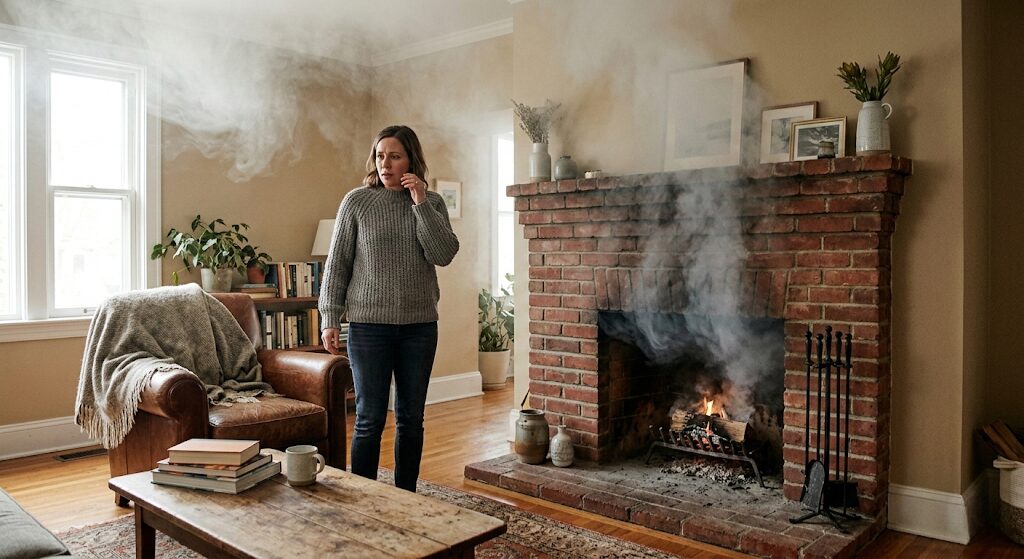
You’ve gathered the family, poured the hot cocoa, and struck the match. The kindling catches, the logs begin to pop, and you settle back to enjoy the mesmerizing glow. But within minutes, the romance is violently interrupted. An acrid, burning smell fills the room. Your eyes begin to water, the smoke alarm shrieks from the hallway, and suddenly, your cozy living room resembles a disaster zone.
A fireplace that smokes into the house (often referred to as backdrafting) is one of the most frustrating and potentially dangerous issues a homeowner can face. Beyond the ruined aesthetic and the lingering odor embedded in your furniture, wood smoke contains a toxic cocktail of fine particulate matter, carbon monoxide, and volatile organic compounds (VOCs). Breathing it in a confined space poses severe respiratory risks.
The crucial thing to understand is that a chimney is not merely a hollow tube; it is a complex engine powered by thermodynamics. When a fireplace smokes, it means the engine has stalled. In this exhaustive, master-level guide, we are going to tear down the mechanics of your hearth. We will explore every conceivable reason why smoke is entering your home—from simple user errors to complex home-pressure dynamics—and provide you with actionable, proven solutions to restore the perfect, upward-flowing draft.
1. Understanding the Physics: The “Chimney Effect”
Before you can fix a broken draft, you must understand how a draft is generated in the first place. A chimney operates on a core principle of physics: hot air is less dense (lighter) than cold air.
When you light a fire, the intense heat warms the air molecules inside the firebox. These heated molecules expand, become buoyant, and race upward through the flue to escape into the freezing winter sky. As this massive volume of hot air rushes up the chimney, it creates a powerful vacuum (negative pressure) in the firebox below. This vacuum aggressively sucks fresh, oxygen-rich room air into the fire, feeding the combustion process and pushing even more hot air up the flue.
This continuous, self-sustaining cycle of rising hot exhaust and incoming cold combustion air is known as the draft. If you want to dive deeper into the exact thermodynamic science behind this phenomenon, our dedicated guide detailing exactly what the chimney effect is explains it perfectly.
When your fireplace smokes, it simply means this thermodynamic engine has been disrupted. The rising column of hot air has been blocked, overpowered, or starved, forcing the toxic exhaust to take the path of least resistance: straight into your living room.
2. User Error: The Most Common (and Easily Fixed) Culprits
Before you call a structural engineer or tear open your walls, check your own operational habits. In over 60% of cases, fireplace smoke is caused by simple, easily correctable user errors.
The Closed or Partially Opened Damper
It sounds painfully obvious, but it happens to the best of us. The damper is a metal plate (usually located in the throat of the chimney, just above the firebox) that seals the chimney when not in use to prevent conditioned home air from escaping. If you forget to open it—or if soot buildup prevents it from opening *fully*—the smoke hits a solid wall and immediately billows back into the room. Always visually verify the damper is wide open with a flashlight before striking a match.
The “Cold Air Plug” (Failing to Prime the Flue)
If your chimney is built on an exterior wall, the masonry gets incredibly cold during the winter. Cold air is heavy and dense. When the fireplace is not in use, this freezing, dense air sinks down the flue and sits heavily in the firebox. This is known as a cold air plug.
If you build a fire directly beneath this heavy plug of cold air, the initial, weak heat of the kindling is not strong enough to push the heavy air out of the way. The smoke hits the cold air, stalls, and spills into the room. The Solution: Priming the Flue.
- Open the damper completely.
- Roll up a newspaper into a tight wand or cone.
- Light the tip of the newspaper wand.
- Hold the burning wand as high up into the throat of the damper as safely possible for 1 to 2 minutes.
- You will feel the freezing air drop, followed by the warm air pulling the flame upward. Once the draft reverses and pulls upward, immediately light your kindling.
Burning Unseasoned (Wet) Firewood
Wood is essentially a bundle of microscopic straws that hold water. When a tree is cut down, it holds a massive amount of internal moisture. If you attempt to burn “green” or unseasoned wood, the fire must expend a tremendous amount of thermal energy just to boil that water out of the wood before combustion can even begin.
This results in a cool, smoldering fire that produces vast amounts of thick, heavy smoke and very little heat. Because the exhaust is not hot enough, it lacks the buoyancy to rise up the chimney. For a comprehensive look at how moisture ruins combustion, review our guide on how to assess firewood seasoning and its impact on smoke and efficiency. Firewood must be dried for 6 to 12 months and have a moisture content below 20%.

Tavool Digital Firewood Moisture Meter
Stop guessing if your wood is ready to burn. Wet wood is the leading cause of heavy smoke and dangerous creosote buildup. This highly accurate, pin-type moisture meter instantly tells you the exact water content of your logs. If it reads above 20%, do not burn it indoors.
3. The Negative Pressure Dilemma (Modern Home Syndrome)
If your damper is open, the flue is primed, and the wood is bone dry, yet you still get smoke in the house, you are likely battling a modern architectural issue: negative air pressure.
Older homes were “leaky.” They had drafty windows and poorly insulated doors, allowing plenty of fresh air to seep inside to replace the air being sucked up the chimney. Modern homes, however, are built incredibly tight to maximize energy efficiency. They are wrapped in vapor barriers, sealed with spray foam, and feature double-paned windows.
When you light a roaring fire in a tightly sealed modern home, the chimney acts like a giant vacuum, sucking hundreds of cubic feet of air out of the living room every minute. Because the house is sealed, no fresh air can enter to replace it. This creates a vacuum (negative pressure) inside the house.
Eventually, the vacuum in the house becomes stronger than the upward draft of the chimney. The laws of physics demand equalization, so the house literally sucks air down the chimney, dragging the toxic smoke with it. This is a complex issue, thoroughly detailed in our guide on diagnosing negative airflow and fireplace draft problems.
The “Competing Appliance” Test
Are you running a high-CFM kitchen range hood, a bathroom exhaust fan, or a clothes dryer while the fire is burning? All of these appliances mechanically exhaust air out of your house, drastically accelerating the negative pressure problem. Turn them all off. If the fireplace stops smoking, you have diagnosed a negative pressure competition.
Solutions for Negative Pressure:
- The Crack-a-Window Trick: The simplest diagnostic fix. Crack a window located near the fireplace about 2 inches. If the smoke immediately reverses and goes up the chimney, your house is starving for makeup air.
- Install an Outside Air Kit (OAK): A permanent solution where a dedicated duct is installed through the floor or wall directly into the firebox, providing the fire with exterior combustion air so it stops stealing the air from your living room.
- Chimney Draft Inducers: An electric exhaust fan installed at the very top of the chimney that mechanically forces the smoke upward, overcoming any negative pressure in the home.

Enervex Chimney Draft Inducer Fan
If negative house pressure or complex wind conditions make drafting impossible, a mechanical draft inducer is the ultimate cure. Mounted atop the flue, this high-temperature exhaust fan physically pulls the smoke out of the firebox and ejects it outside, guaranteeing a smoke-free living room regardless of atmospheric conditions.
4. Structural Issues & Chimney Blockages
Sometimes, the draft mechanics are perfect, but the physical pathway is obstructed. A blocked chimney is not just an annoyance; it is a critical fire hazard.
The Creosote Chokehold
When wood burns, it releases vaporized oils and tar. As this hot exhaust travels up the cooler chimney walls, condensation occurs, leaving behind a sticky, highly flammable substance called creosote. Over years of neglect, creosote builds up in thick, crusty layers. This buildup physically narrows the diameter of the flue, restricting the volume of smoke that can escape. Eventually, the flue chokes, and smoke backs up into the house. Understanding proper chimney cleaning frequency based on usage is vital for preventing this exact scenario.
Animal Incursions and Debris
Chimneys are warm, secure, and elevated—the perfect real estate for wildlife. Birds (specifically Chimney Swifts), squirrels, and raccoons frequently build massive, dense nests inside un-capped flues during the spring and summer. Additionally, overhanging trees can drop leaves, twigs, and branches directly into the chimney opening. A single dense nest can entirely block the flue.
Improper Chimney Height (The 3-2-10 Rule)
If your chimney is too short, it simply cannot generate enough draft. Furthermore, a short chimney is susceptible to wind turbulence bouncing off the roofline and pushing down the flue. Building codes strictly enforce the 3-2-10 Rule:
- The chimney must extend at least 3 feet above the point where it penetrates the roof.
- AND it must be at least 2 feet higher than any part of the building (or adjacent trees/structures) within a 10-foot radius.
If your chimney violates this rule, a masonry extension or an extended metal flue pipe is required to reach clean, unturbulent air.

VEVOR Rotary Chimney Sweep Kit (33FT)
Don’t let dangerous creosote narrow your flue and choke your draft. This professional-grade, drill-powered rotary sweeping kit allows you to aggressively clean your own chimney from the bottom up, removing dense soot blockages and restoring maximum airflow safely.
5. Firebox Design Flaws
In some unfortunate cases, the fireplace was simply built wrong. Masonry fireplaces rely on precise mathematical ratios between the opening of the firebox, the size of the smoke chamber, and the diameter of the flue.
The Lintel is Too High (Opening Ratio Error)
The lintel is the horizontal metal bar supporting the bricks at the top edge of the fireplace opening. If the fireplace opening is too large (specifically, too tall) relative to the diameter of the flue pipe, the chimney cannot physically exhaust the massive volume of air entering the firebox. The smoke rolls up, hits the flat wall above the fire, and curls outward into the room.
The Fix: You can permanently lower the opening by installing a course of brick or heat-resistant glass across the top. A simpler, non-permanent solution is installing a Smoke Guard—a sleek, black metal strip that attaches to the lintel, lowering the opening by 4 to 6 inches and dramatically increasing draft velocity.
The Firebox is Too Shallow
If the firebox is exceptionally shallow, placing the grate and the burning logs too close to the front of the hearth, the smoke will inevitably spill out before it has a chance to be sucked backward and up into the smoke shelf. Pushing the grate as far back against the rear wall of the firebox as possible often solves this immediately.
7. The Ultimate Troubleshooting Checklist
When the smoke alarms trigger, work through this step-by-step diagnostic checklist to identify the exact cause of your backdrafting issue:
| Step | Action / Diagnostic Test | If Yes, The Solution Is: |
|---|---|---|
| 1. Visual Check | Is the damper fully, 100% open? Shine a flashlight up the flue. | Open the damper. If it is rusted shut, schedule a repair. |
| 2. The Air Test | Before lighting, reach up near the damper. Do you feel a heavy rush of freezing air falling down? | You have a cold air plug. Prime the flue with a burning newspaper wand before lighting the fire. |
| 3. The Moisture Test | Does the wood hiss, bubble water out the ends, or sound dull when two logs are smacked together? | Your wood is unseasoned/wet. Stop burning it immediately and switch to kiln-dried or properly seasoned hardwood. |
| 4. The Pressure Test | While the fire is smoking, crack a window in the room 2 inches. Does the smoke stop instantly? | Negative home pressure. Turn off exhaust fans, or install a permanent Outside Air Kit (OAK). |
| 5. The Depth Test | Are the logs positioned right at the edge of the hearth opening? | Push the fireplace grate as far against the back brick wall as possible. |
| 6. The Blockage Check | Has it been more than a year (or a cord of wood) since your last professional chimney sweep? | Hire a CSIA-certified chimney sweep immediately. You likely have severe creosote buildup or an animal nest. |
Frequently Asked Questions
Why does my fireplace smoke only when it’s windy?
Wind-induced downdrafts occur when heavy gusts of wind blow over the roofline and are forced directly down the chimney flue. This acts like an invisible piston, pushing smoke back into the house. This is often solved by installing a specialized wind-directional chimney cap (like a Vacu-Stack) that uses the wind’s velocity to actually increase the upward draft, or by extending the chimney height.
Can a dirty chimney cause smoke to come into the house?
Absolutely. It is one of the leading causes. As creosote (unburned wood particles and tar) builds up on the walls of the flue liner, it physically narrows the passageway. This restricts the volume of exhaust that can escape. When the volume of smoke generated by the fire exceeds the restricted capacity of the dirty flue, it backs up into the living room.
Why does smoke come down my chimney when I use the bathroom exhaust fan?
Bathroom exhaust fans, kitchen range hoods, and clothes dryers are mechanical exhaust appliances; they aggressively pump air out of your house. If your house is tightly sealed, these fans create negative air pressure. The path of least resistance for makeup air to enter the house is often down the wide-open chimney flue, bringing soot and smoke smells with it.
What is a fireplace smoke guard?
A smoke guard is a heat-resistant metal strip (usually 4 to 6 inches wide) installed along the top edge of the fireplace opening (the lintel). It is used to correct a structural flaw where the fireplace opening is too large for the diameter of the flue. By slightly lowering the height of the opening, it increases the velocity of the draft and prevents smoke from rolling out the top.
Is it safe to sleep with a fire burning if it smokes occasionally?
No. It is never safe to sleep while a fire is actively burning, but it is exceptionally dangerous if the fireplace has a history of smoking or backdrafting. Wood smoke contains deadly Carbon Monoxide (CO), an odorless, colorless gas that can be fatal in enclosed spaces. Always ensure fires are fully extinguished before bed and maintain active, tested Carbon Monoxide detectors in the room.
Conclusion & Final Verdict
A smoking fireplace is a frustrating disruption to your winter comfort, but it is rarely a mystery. Whether it is a simple user error like forgetting to prime a freezing flue with a newspaper torch, an environmental battle against negative home pressure, or a critical structural blockage caused by years of creosote neglect, the mechanics of the chimney draft obey the strict laws of physics.
By methodically working through the diagnostic steps outlined above—checking your wood moisture, assessing your home’s airflow, and visually inspecting your damper and flue—you can pinpoint the exact failure in your thermodynamic engine. Do not tolerate a smoke-filled room. Address the issue, implement the solutions, and reclaim the safe, warm, and inviting hearth your home deserves.
Don’t Suffer Through Another Smoky Winter
If you’ve identified the problem but need the right tools to fix it, stop waiting. From high-tech draft inducers to simple moisture meters, upgrading your hearth accessories is the fastest way to a clean burn.