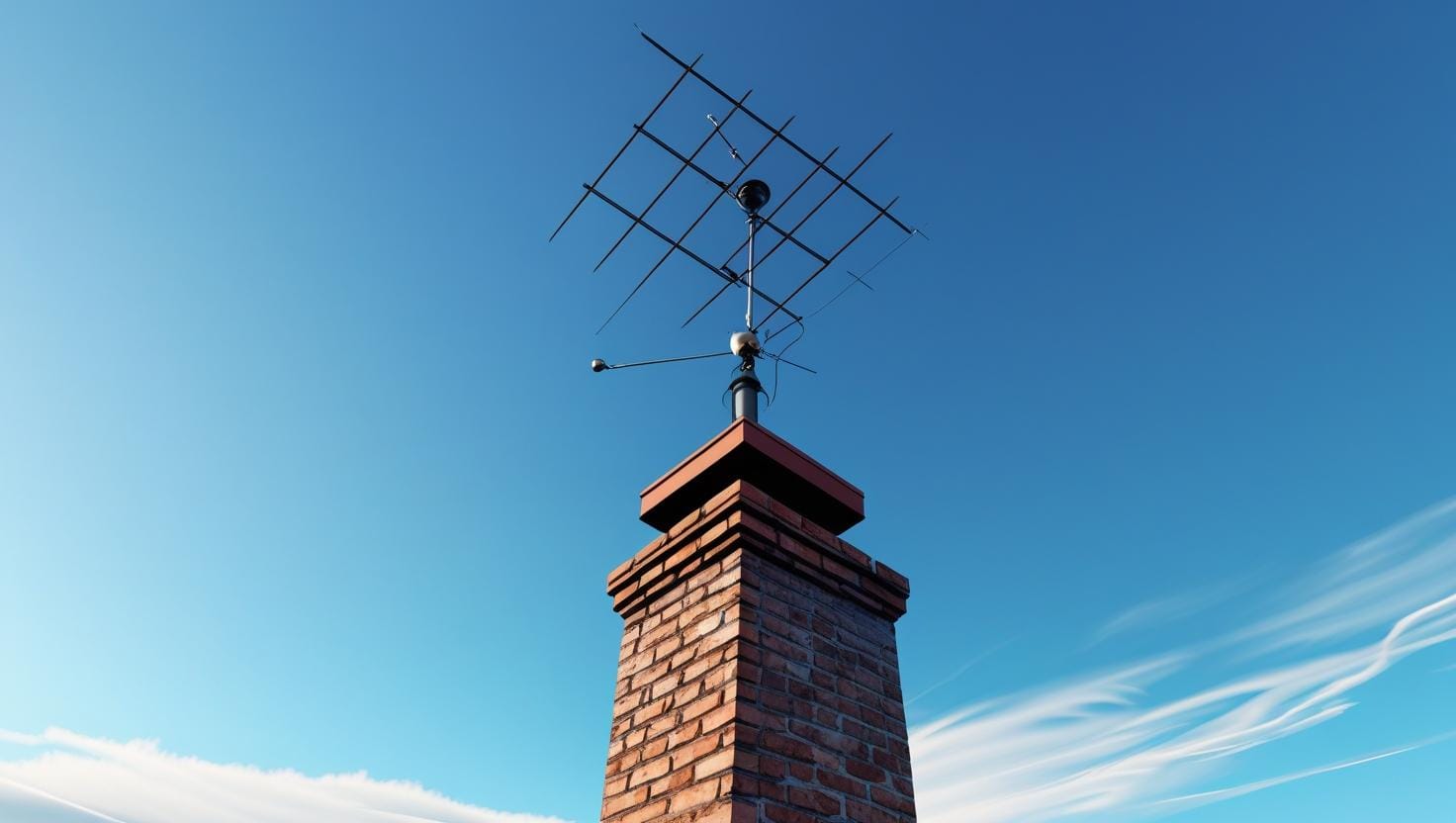
The Definitive Guide to Chimney Antenna Mounts
Achieving crystal-clear, free over-the-air television starts with a stable, secure antenna. This guide provides a comprehensive analysis of the best chimney mounts available — plus everything you need to plan, install, and maintain a setup that’s safe, secure, and built to outlast the elements.
The Channel Master 9032is the best overall chimney antenna mount for most homeowners — galvanized steel, complete hardware kit, and rock-solid reputation. For large antennas or high-wind areas, upgrade to the Stellar Labs Heavy Duty Mount with its 12-gauge steel and 18-foot straps.
Before buying anything: measure your chimney’s full perimeter and add at least 12 inches. Choosing the wrong strap length is the #1 installation mistake.
- Why Mount Your Antenna on the Chimney?
- Safety Before Everything
- Our Top-Rated Chimney Mounts: Full Reviews
- Side-by-Side Comparison Table
- In-Depth Buying Guide
- Chimney Type Compatibility Guide
- Complete Step-by-Step Installation Guide
- Antenna Grounding: The Critical Step Most People Skip
- Mast Height, Guy Wires & Wind Load
- Coaxial Cable Routing from Roof to TV
- Troubleshooting: Common Problems After Installation
- Seasonal Maintenance Checklist
- Choosing the Right Antenna to Pair with Your Mount
- Frequently Asked Questions
Why Mount Your Antenna on the Chimney?
For cord-cutters and broadcast TV enthusiasts, a high-quality outdoor antenna is the gateway to free, uncompressed high-definition channels. But where you mount that antenna is just as critical as the antenna itself. The chimney is almost always the best available mounting location on a residential roof, and understanding why helps you make the most of it.
Maximum Height
The chimney is typically the highest point on the house, giving your antenna the best possible line-of-sight to distant broadcast towers.
Solid Structure
Masonry chimneys provide a dense, heavy anchor point that resists wind movement — far more stable than a roof tripod on plywood sheathing.
No Roof Penetrations
Strap-style chimney mounts require zero drilling into roof shingles, eliminating leak risk and preserving your roofing warranty.
Signal Clearance
Elevation above the roofline clears obstructions like trees, neighboring structures, and the roof ridge itself that degrade signal reception.
Grounding Convenience
The chimney’s proximity to the roofline makes grounding rod installation and coax routing to entry points straightforward.
Clean Appearance
A chimney mount keeps the antenna tucked against an existing structure rather than floating on a visible roof tripod or wall bracket.
The chimney also offers an important practical advantage over roof-penetrating mounts: when a chimney strap mount is installed correctly, it can be removed and reinstalled without leaving any permanent mark on the structure. This makes it ideal for rental properties or homes where future owners may not want an antenna installation.
📌 When a Chimney Mount Is NOT Ideal
A chimney mount may not be the right choice if your chimney is in severe disrepair (crumbling mortar, spalling bricks, structural cracks), if it is a prefabricated metal or chase-cover chimney that cannot bear strap tension, or if the chimney is located on the opposite side of the house from your target broadcast towers. In these cases, a non-penetrating roof mount or wall mount may serve you better.
Safety Before Everything
Working at height on a residential roof is one of the most hazardous DIY activities a homeowner can undertake. Falls from ladders and roofs are among the leading causes of severe DIY injury. This section is not boilerplate — please read it carefully before proceeding with any part of this installation.
⚠️ Your Safety is Non-Negotiable
- Ladder Safety: Ensure your ladder is on stable, level ground. Use a ladder that extends at least 3 feet above the roofline. Maintain three points of contact (two feet and one hand, or one foot and two hands) at all times. Never overreach — reposition the ladder instead.
- Weather Conditions: Never attempt to work on a roof in windy, icy, wet, or foggy conditions. A sudden gust while holding a large antenna is genuinely life-threatening. Check the forecast and wait for a calm, dry day.
- Power Lines: Be acutely aware of all overhead power lines before beginning. Never allow your ladder, antenna, mast, or any part of your body to approach within 10 feet of a power line. The risk of fatal electrocution is severe and instantaneous.
- Work With a Partner: Never perform a roof installation alone. A partner on the ground stabilizes the ladder, hands up tools, calls for help if needed, and provides an extra set of eyes on hazards you may not see from above.
- Roof Condition: Inspect your roof from the ground before ascending. Never walk on damaged, brittle, or steep sections. Wear rubber-soled footwear with good grip.
- Inspect the Chimney First: Before installing any mount, visually inspect the chimney from the ground and close-up from the roof. Do not install a mount on a chimney with loose bricks, crumbling mortar, or any structural damage — strap tension will accelerate that damage and may cause a catastrophic failure.
Our Top-Rated Chimney Mounts: Full Reviews
After analyzing dozens of models and thousands of verified installer and homeowner reviews, we’ve selected the best chimney mounts available. Our selections are based on material quality, corrosion resistance, installation ease, hardware completeness, and long-term field performance.
Best Overall: Channel Master 9032 Antenna Mount
The Channel Master 9032 is the undisputed industry standard, and for good reason. It strikes the perfect balance between strength, ease of installation, and value — making it the ideal choice for the vast majority of homeowners installing standard-sized OTA antennas. It comes as a complete kit, meaning everything you need to secure your mast arrives in a single box.
The construction uses heavy-duty galvanized steel, which is essential for resisting rust and corrosion over years of exposure to rain, UV, temperature cycling, and ice. The kit includes two 12-foot straps, sufficient for most standard residential chimneys. The mounting brackets are robust, the included hardware is high quality, and the assembly is straightforward enough for a first-time installer to complete without professional help. For a reliable, no-fuss installation of a small to medium antenna, Channel Master’s decades-long reputation in the broadcast antenna industry is your assurance of quality.
Key Specifications:
- Material: Heavy-Duty Galvanized Steel
- Strap Length: Two 12-foot straps
- Mast Compatibility: Fits masts up to 1.5 inches in diameter
- Best For: Standard TV antennas in typical weather conditions, chimneys up to ~11 ft perimeter
✅ Pros
- Complete hardware kit — nothing extra to buy
- Industry-leading galvanized steel construction
- Straightforward installation for first-timers
- Channel Master’s proven track record
- Excellent value for the quality
❌ Cons
- 12-ft straps won’t fit larger chimneys
- Max 1.5″ mast diameter may not suit oversized masts
- Not designed for very large or heavy antennas in high-wind zones
Best for Large Antennas: Stellar Labs Heavy Duty Mount
If you live in an area prone to sustained high winds, coastal exposure, or severe winter ice loading — or if you’re installing a larger, heavier deep-fringe antenna to capture signals from 60+ miles away — upgrading to a heavy-duty mount is not optional; it is prudent engineering. The Stellar Labs kit is built to handle these demanding conditions with a level of structural integrity that standard-gauge mounts cannot match.
The critical difference is the 12-gauge steel used in the brackets — thicker, heavier, and substantially more resistant to bending under load than the lighter gauges found in economy mounts. The 18-foot strap length makes it compatible with large chimneys where 12-foot straps would simply not reach. Hardware is equally scaled up, with the bracket assembly rated for masts up to 1.75 inches in diameter. For anyone installing a large directional antenna or living in a region where annual ice storms or sustained winds above 60 mph are routine, this mount provides the peace of mind that your significant antenna investment is going to stay exactly where you put it — season after season.
Key Specifications:
- Material: 12-Gauge Heavy-Duty Galvanized Steel
- Strap Length: Two 18-foot straps
- Mast Compatibility: Fits masts up to 1.75 inches in diameter
- Best For: Large antennas, high-wind/coastal areas, larger chimneys
✅ Pros
- 12-gauge steel — measurably stronger than standard mounts
- 18-ft straps handle large or unusually shaped chimneys
- Wider mast compatibility (up to 1.75″)
- Superior wind and ice load resistance
❌ Cons
- Slightly higher price than standard kits
- Heavier hardware makes solo installation more awkward
- Longer straps require more careful wrapping on small chimneys
Side-by-Side Comparison Table
| Feature | Channel Master 9032 | Stellar Labs Heavy Duty |
|---|---|---|
| Best For | Standard antennas, most homes | Large antennas, high-wind zones |
| Steel Gauge | Standard gauge | 12-gauge (thicker) |
| Strap Length | Two × 12 ft | Two × 18 ft |
| Max Mast Diameter | 1.5 inches | 1.75 inches |
| Corrosion Resistance | Galvanized ✓ | Galvanized ✓ |
| Complete Kit? | Yes ✓ | Yes ✓ |
| High-Wind Suitable? | Moderate winds | Yes — high wind rated |
| Large Chimney Suitable? | Up to ~11 ft perimeter | Up to ~17 ft perimeter |
| DIY-Friendly? | Very easy | Easy (2-person recommended) |
| Relative Price | Budget-friendly | Mid-range |
In-Depth Buying Guide: How to Choose the Right Mount
While the products above represent the best in their class, choosing the right one for your specific situation requires a bit of homework. Consider every one of these factors before purchasing.
1. Measure Your Chimney First (Strap Length)
This is the single most common mistake first-time installers make, and it results in a wasted purchase and an extra trip to the hardware store. Before you browse for mounts, get a flexible measuring tape and measure the full perimeter of your chimney at the height where you plan to install the top strap. Add at least 12–15 inches to this measurement for overlap and workable slack. If your chimney’s perimeter is 11 feet, a 12-foot strap kit will work. If it is 13 feet, you must use an 18-foot kit — or the strap will not reach and you cannot complete the installation.
2. Check Your Mast Compatibility
Most standard antenna masts are 1.25″ or 1.5″ in diameter, and virtually all chimney mounts accommodate these sizes. However, if you are reusing an existing non-standard mast, or pairing with a heavy-duty large-diameter antenna mount, verify the bracket’s mast opening specification against your actual mast diameter before purchasing. A mast that is even marginally too wide will not seat properly in the bracket, creating a dangerous unsecured installation.
Equally important is mast height. The mount itself provides lateral stability at two fixed points on the chimney. For masts taller than 10 feet above the top bracket, the leverage effect of wind on the unsupported upper section creates significant torque on the mounting hardware. For masts over 10 feet, guy wires are not optional — they are a structural necessity. See the Mast Height & Guy Wires section below for full detail.
3. Understand Material Quality and Corrosion Resistance
Any hardware installed outdoors must withstand the elements for ten, fifteen, or twenty years without structural failure. The industry standard for antenna mounts is hot-dip galvanized steel. In this process, steel is immersed in molten zinc, which bonds metallurgically to the steel surface rather than sitting on top of it like paint. The zinc layer corrodes sacrificially — it degrades before the underlying steel, actively protecting it from rust. This means a quality galvanized mount will remain structurally sound long after a painted or epoxy-coated mount of the same gauge would have rusted through.
Critically, avoid any mount that does not specify its material and coating, or that is described only as “rust-resistant” without specifying the protection method. Powder-coated steel is acceptable but not ideal — the coating is subject to chipping from installation impacts, and once the base steel is exposed, corrosion begins. For coastal installations or areas with high rainfall and humidity, stainless steel hardware for the nuts and bolts is worth the additional cost, even if the brackets themselves are galvanized.
4. Consider Your Local Wind Load
Wind loading on an antenna installation is not just about whether your antenna stays upright on a windy day — it’s about cumulative fatigue stress on your mount hardware over years of repeated wind cycles. The larger and more aerodynamically resistive your antenna, the greater the wind load on both the mount and the chimney structure. As a general rule:
- Small compact antennas (wingspan under 24 inches): Standard-gauge mount is adequate in most climates
- Medium directional antennas (wingspan 24–48 inches): Standard-gauge mount in low-wind areas; heavy-duty in moderate-to-high wind zones
- Large deep-fringe antennas (wingspan over 48 inches): Heavy-duty mount required; consider professional installation and structural chimney assessment
5. Assess the Physical Condition of Your Chimney
A chimney mount is only as secure as the chimney it is attached to. Before any installation, carefully inspect the masonry at close range. Look for:
- Loose, missing, or crumbling mortar between brick courses (known as spalling)
- Cracked, chipped, or shifting bricks
- Cracks in the chimney crown (the concrete cap at the top)
- Any visible lean or tilt in the chimney structure
- Evidence of past water damage such as staining, efflorescence (white mineral deposits), or freeze-thaw cracking
If you find significant masonry deterioration, the chimney must be repaired before any mount is installed. Strap tension on a compromised chimney can accelerate brick displacement and, in extreme cases, cause a section of the chimney to collapse. This is not a hypothetical risk — it is a documented failure mode. Address all masonry issues first, and only mount on a structurally sound chimney.
Chimney Type Compatibility Guide
Not all chimneys are the same construction, and the type of chimney you have significantly affects which mount — and which installation approach — is appropriate.
| Chimney Type | Mount Compatible? | Notes |
|---|---|---|
| Solid Brick Masonry | Best choice ✓ | Ideal. Dense, heavy, excellent strap grip. Industry standard use case. |
| Concrete Block Masonry | Suitable ✓ | Works well. Ensure blocks are fully intact — hollow cores can compress under strap tension. |
| Stone Masonry | Caution ⚠ | Irregular surface can prevent even strap contact. Use heavy-duty kit with wider brackets for best grip. |
| Prefab Metal Chase | Not recommended ✖ | Thin sheet metal walls cannot safely bear strap tension. Use a dedicated roof tripod or wall mount instead. |
| Stucco-Covered Chimney | Caution ⚠ | Depends on substrate. Inspect carefully — stucco applied over sound brick is fine; stucco over deteriorating masonry is not. |
| Decorative / Thin Veneer | Not recommended ✖ | Veneer brick is typically only 1″ thick and not load-bearing. Never use a chimney mount on a veneered chimney. |
Complete Step-by-Step Installation Guide
The following is a comprehensive installation walkthrough for a standard two-bracket strap chimney mount. These steps apply to both the Channel Master 9032 and the Stellar Labs Heavy Duty kit. Read the entire guide before beginning any work.
Tools and Materials You Will Need
- Extension ladder (rated for your weight, extending 3+ feet above roofline)
- Adjustable wrench or socket set (typically 7/16″ or 1/2″)
- Flexible measuring tape
- Work gloves (sharp metal edges on brackets and straps)
- Safety glasses
- N95 dust mask (chimney mortar debris during bracket positioning)
- A second person to assist from the ground
- Mast (separate purchase — typically 10-foot galvanized steel, 1.25″ or 1.5″ OD)
- Coaxial cable and weatherproof sealant for cable entry
-
Pre-Installation Chimney Inspection Before ascending the ladder, inspect the chimney visually from the ground with binoculars if needed. Look for crumbling mortar, loose or displaced bricks, cracked crown, or structural lean. Physically inspect at close range from the roof. Do not proceed if the chimney shows any signs of structural compromise.
-
Measure and Plan Bracket Placement Measure the chimney perimeter at the installation height to confirm your strap length is sufficient. Plan your bracket locations: the top bracket should be positioned as high on the chimney as safely reachable, ideally within 2 feet of the top. The bottom bracket should be spaced no less than 18–24 inches below the top bracket — this spacing creates the leverage that keeps the mast vertical. Mark both locations with chalk or tape.
-
Assemble the Brackets Loosely Before going onto the roof, loosely assemble both strap-and-bracket units at ground level. This lets you familiarize yourself with the hardware and identify any missing pieces while both feet are firmly on the ground. Thread the strap through the bracket plate and attach the bolt loosely — tight enough to hold together but loose enough to wrap around the chimney.
-
Install the Top Bracket First Carry the top bracket assembly to the roof and wrap the strap around the chimney at your marked top position. Ensure the strap lies flat against the masonry on all four sides — no twisting, no diagonal runs. Hand-tighten the nut to hold it in position while you check alignment.
-
Install the Bottom Bracket Repeat for the bottom bracket at your lower marked position. The mast-cradle portion of both brackets must be perfectly aligned vertically — use a level if available. A misaligned bracket will cause the mast to lean, placing uneven stress on both the mount and the antenna connection.
-
Tighten Both Brackets Firmly Using your wrench, tighten both bracket bolts firmly and evenly. Alternate between the two, increasing tension gradually to ensure even strap pressure around the chimney. The final result should have zero play or movement when you grip the bracket and attempt to rock it. A loose bracket is a failed installation — do not proceed until both are completely immobile.
-
Insert and Secure the Mast Slide the antenna mast through both bracket cradles from the top. Most masts have a locking bolt on each bracket that pinches the mast in place — tighten these firmly. Give the mast a firm lateral push in multiple directions to verify it does not move or rotate.
-
Mount the Antenna Attach the antenna to the top of the mast following the antenna manufacturer’s instructions. Point the antenna in the direction of your target broadcast towers — use a tool like AntennaWeb.org or TVFool to determine the correct bearing from your address before going onto the roof.
-
Run and Secure the Coaxial Cable Attach the coaxial cable to the antenna’s F-connector. Route the cable down the mast and along the exterior wall to your entry point, securing it with UV-resistant cable clips every 18–24 inches. Apply weatherproof sealant (coax seal putty or self-amalgamating tape) over the antenna F-connector connection to prevent water ingress.
-
Ground the System Before Use Before connecting the antenna cable to your TV or tuner, install a grounding block at the cable entry point and run a copper ground wire from the block to an approved ground rod or your home’s existing grounding electrode system. This is not optional — see the grounding section below for full detail.
Antenna Grounding: The Critical Step Most People Skip
Antenna grounding is the most universally skipped step in DIY antenna installation, and it is also the most important safety provision in the entire system. A metal antenna on a metal mast on a metal mount on the highest point of your home is an ideal lightning conductor — but without proper grounding, the resulting electrical surge has nowhere to go except through your coaxial cable and directly into your television, your home wiring, and potentially anyone touching electronics inside the house during a storm.
⚡ NEC Code Requirement — Not Just a Recommendation
The National Electrical Code (NEC) Article 810 explicitly requires that outdoor antennas be grounded. This is a building code requirement in most jurisdictions, not a suggestion. Insurance companies have denied lightning-damage claims when the antenna system was found to be improperly grounded. Install the ground before the first time you use the antenna.
How to Ground Your Antenna System Correctly
-
Install a Grounding Block on the Coaxial Line Mount a coaxial grounding block (also called a surge protector or discharge unit) at the point where the cable enters the building. This block interrupts the coax path and provides a grounding terminal. Route the cable from the antenna into one side of the block and out the other toward your TV.
-
Run a Copper Ground Wire Connect a minimum 10 AWG solid copper ground wire from the grounding block’s ground terminal. This wire must run in as straight and direct a path as possible to the grounding point — sharp bends and long runs reduce its effectiveness.
-
Connect to the Grounding Electrode System The copper wire must terminate at your home’s existing grounding electrode system — this is typically the ground rod that is already serving your electrical panel. You can attach to this rod directly, or to your home’s water main grounding clamp if permitted by your local code. Do not create a separate isolated ground rod — NEC requires connection to the existing system.
-
Ground the Mast Itself In addition to the coaxial grounding block, the antenna mast itself should be bonded to ground with a separate ground wire if it is not electrically continuous with the grounding block circuit. Check NEC Article 810.21 for specific requirements applicable to your installation.
Mast Height, Guy Wires & Wind Load
The height of your antenna mast above the chimney mount directly determines how much wind force is transferred to your mounting hardware. Understanding this relationship is essential for choosing a safe and stable installation.
A chimney mount secures the mast at two fixed points. The section of mast above the top bracket acts as a cantilever — a beam supported at one end, with force applied along its length by wind. The taller that unsupported section, the greater the bending moment at the top bracket. With a small antenna and a mast extending 3–4 feet above the top bracket, this force is manageable by the mount hardware alone. With a large antenna and a mast extending 6–8 feet above the top bracket, the leverage can exceed what the mounting hardware is rated to withstand.
When Are Guy Wires Required?
As a general guideline based on antenna installation industry standards:
- Mast height 0–10 feet: Chimney mount alone is typically adequate for small to medium antennas in moderate wind areas
- Mast height 10–15 feet: Guy wires strongly recommended, especially for medium or large antennas
- Mast height over 15 feet: Guy wires are required; professional engineering assessment recommended in high-wind zones
- Any height in sustained winds over 60 mph: Guy wires are required regardless of antenna size
How to Install Guy Wires
Guy wires are tensioned cables that run from a point on the mast (typically 2/3 to 3/4 of the way up) to anchor points on the roof or chimney structure. A typical three-wire configuration uses three wires spaced 120 degrees apart around the mast, providing triangulated stability in all wind directions. Use galvanized steel cable or stainless steel cable for all outdoor guy wire installations — never use standard wire or rope, which will stretch, corrode, or fail under sustained tension.
Coaxial Cable Routing from Roof to TV
The path your coaxial cable takes from the antenna to your television is a critical factor in both signal quality and weather protection. A poorly routed cable can introduce signal loss, allow water ingress, and create entry points for pests. Here is the complete best-practice routing guide.
✅ Use RG-6 Coaxial Cable for All Outdoor Runs
Always use RG-6 quad-shield coaxial cable for outdoor antenna installations. Its thicker shielding provides superior rejection of radio frequency interference (RFI) from nearby electronics, and its weather-rated jacket resists UV degradation, moisture, and temperature cycling. Never use RG-59 outdoors — its thinner construction provides inadequate shielding and degrades rapidly in outdoor exposure.
Routing Best Practices
- Minimize total cable length: Signal loss accumulates at roughly 6 dB per 100 feet on RG-6 at UHF frequencies. Every unnecessary foot of cable costs you signal. Plan the most direct practical route from antenna to tuner.
- Secure the cable every 18–24 inches: Use UV-stabilized cable staples or standoff clips rated for outdoor use. Never use standard indoor staples — they puncture the cable jacket and damage the shielding layer.
- Create a drip loop at the entry point: Before entering the building, route the cable downward and then back up — this U-shaped drip loop prevents water from running along the cable and into the entry hole.
- Seal the entry point thoroughly: Use a weatherproof cable entry kit or apply exterior-grade silicone caulk around the cable where it passes through the wall. Any unsealed gap is a path for water, drafts, and insects.
- Avoid sharp bends: A coaxial cable bent at an angle tighter than approximately 90 degrees (a sharp right angle) compresses the internal dielectric and permanently degrades signal transmission at that point. Maintain gentle curves throughout the run.
- Keep away from electrical wiring: Route the coaxial cable at least 6 inches away from any household electrical wiring to minimize induced interference.
Cable Loss and Amplifiers
If your coaxial run is longer than 100 feet, or if you are splitting the signal to multiple TVs, you will likely need a preamplifier or distribution amplifier to compensate for the signal loss. A preamplifier mounts at the antenna itself and boosts the signal before it travels down the long cable run — this is the most efficient placement because it amplifies before the loss occurs. A distribution amplifier mounts at the splitting point and compensates for the loss introduced by the splitter.
Troubleshooting: Common Problems After Installation
| Symptom | Likely Cause | Solution |
|---|---|---|
| Pixelation / signal dropout | Antenna not pointed correctly | Use AntennaWeb.org bearing and realign in small increments |
| No signal at all | Loose coax connector or water in connector | Inspect all F-connectors; apply coax seal putty at antenna connection |
| Some channels, not others | Towers in multiple directions | Consider an omnidirectional antenna or an antenna rotator |
| Signal worse than indoor antenna | Amplifier overloading near towers | Remove amplifier — too-strong signals cause overload artifacts |
| Signal fine then suddenly weak | Wind moved antenna direction | Retighten mast mounting bolts; inspect all bracket bolts for loosening |
| Antenna fell / mast leaning | Insufficient strap tension or chimney masonry failure | Inspect chimney before re-installing; consider professional masonry repair |
Seasonal Maintenance Checklist
A properly installed chimney antenna mount requires minimal ongoing maintenance, but an annual inspection — ideally in spring after the winter’s ice and wind loads — is essential for catching issues before they become failures.
- Visually inspect all bracket bolts for corrosion, loosening, or displacement from the ground using binoculars
- Check all strap tightness — re-tighten any that have lost tension due to thermal expansion cycling
- Inspect the coaxial cable along its full run for UV jacket cracking, rodent chewing, or water pooling at any low point
- Check and reseal the cable entry point if caulk has cracked or shrunk
- Inspect all coaxial F-connectors for corrosion — white or green oxidation at connectors causes measurable signal loss
- Verify that the antenna is still pointed in its original bearing — strong storms can move even a well-secured antenna
- Inspect the chimney masonry immediately around the strap contact points for signs of compression cracking or mortar displacement
- Check guy wire tension if installed — re-tension any that have gone slack
- After any severe ice storm: check that ice loading has not bent the mast or shifted the antenna bearing
Choosing the Right Antenna to Pair with Your Mount
The chimney mount is only half of the outdoor antenna equation. Selecting the right antenna for your specific reception scenario is equally important. Here is a practical framework for making that choice.
Determine Your Distance from Broadcast Towers
The single most important variable in antenna selection is your distance from the broadcast towers you want to receive. Use AntennaWeb.org or a similar tool to enter your address and see a precise map of tower locations, distances, and signal paths from your location. This takes two minutes and eliminates all guesswork.
- Under 25 miles from towers: A compact omnidirectional or small directional antenna will receive all available channels without amplification. A standard mount is more than adequate.
- 25–50 miles from towers: A medium-sized directional Yagi-type antenna with a preamplifier provides reliable reception. Standard or heavy-duty mount depending on antenna size and wind zone.
- 50–80 miles from towers: A large deep-fringe directional antenna with a high-gain preamplifier is required. Heavy-duty mount required. Consider a rotator if towers are in multiple directions.
- Over 80 miles from towers: Reception is possible but highly dependent on terrain, atmospheric conditions, and antenna quality. Professional consultation recommended before investing in equipment.
Directional vs. Omnidirectional
Directional antennas (Yagi-type, bow-tie arrays) concentrate their reception pattern in one direction, providing higher gain toward the pointed bearing at the cost of rejection from other directions. They are ideal when all your target towers are clustered in roughly the same direction from your home. Omnidirectional antennas receive from all directions simultaneously, providing convenience at the cost of gain — they are best suited for locations close to towers or for homes surrounded by towers in multiple directions. If your towers are more than 45 degrees apart in bearing, a directional antenna will require a rotator or you will need to compromise reception on some channels to optimize others.
Frequently Asked Questions
How tight should I make the straps?
The straps should be as tight as physically achievable with a wrench. The goal is zero movement — no wobble, no rotation, no slippage in any direction. Tighten the bolts evenly by alternating between them in small increments, the same way you’d tighten lug nuts on a wheel. A good test before inserting the mast: grip each installed bracket firmly with both hands and attempt to rock it. If you can detect any movement at all, continue tightening. Strap steel will stretch slightly under final tensioning, which is normal and expected.
Will a chimney mount damage my chimney?
When installed correctly on a structurally sound chimney, a strap-style mount distributes pressure evenly around the entire perimeter without concentrating stress at any single point — and causes no permanent damage. It is critically important, however, to inspect the chimney’s masonry before installation. Installing a mount on a chimney with loose bricks, crumbling mortar, or any pre-existing structural damage will exacerbate those issues under strap tension and may result in brick displacement. Repair the chimney first, then mount. A well-maintained masonry chimney will bear a properly installed antenna mount for decades without any adverse effect on the structure.
Do I need a permit to install a chimney antenna mount?
In most U.S. jurisdictions, the Federal Communications Commission’s “Over-the-Air Reception Devices” (OTARD) rule preempts local ordinances and HOA rules that would prevent or unreasonably restrict the installation of an antenna for OTA broadcast reception. However, building permits may still be required for antenna installations in some municipalities, particularly for masts above a certain height. Check with your local building department before proceeding. In most residential neighborhoods with no HOA, a standard chimney mount installation requires no permit.
Can I use a chimney mount on a prefabricated metal chimney?
No — this is a critical safety consideration. Prefabricated metal chimneys (chase chimneys) have thin sheet-metal walls that cannot safely bear the lateral compressive force of strap tension. Attempting to use a strap-style chimney mount on a prefab metal chimney risks deforming or puncturing the metal wall, which can compromise the chimney’s structural and fire-safety integrity. For homes with prefab metal chimneys, use a non-penetrating roof mount, a gable-end wall mount, or a dedicated freestanding mast installation instead.
My antenna signal is fine on sunny days but degrades at night or in rain. Why?
This is a classic symptom of a water-infiltrated coaxial connection. Water ingress at any F-connector — particularly at the antenna end, which is the most weather-exposed — dramatically increases the cable’s signal attenuation and causes exactly the intermittent, weather-correlated reception issues you are describing. Remove the coaxial cable from the antenna’s F-connector, inspect for moisture or corrosion, re-make the connection with a new connector if necessary, and apply coaxial seal putty (self-amalgamating tape is also excellent) to completely seal the connection from weather exposure.
How do I aim my antenna without someone to watch the TV signal meter?
The cleanest solution is to use the signal meter on your TV or tuner’s channel scan screen. Most modern TVs display a signal strength bar during scanning. Have your partner watch this screen while you slowly rotate the antenna in small increments from the roof, communicating via phone. Alternatively, use a dedicated signal strength meter that attaches directly to the antenna port at the mast — these devices display signal strength locally without requiring a second person inside. Most hardware and electronics retailers carry affordable UHF signal meters that are invaluable for this task.
What’s the difference between RG-6 and RG-59 coaxial cable for antenna installations?
RG-6 is the current standard for residential television antenna coaxial cable and should be used for all outdoor installations. It has a thicker center conductor (18 AWG vs. RG-59’s 20 AWG), a larger dielectric, and — critically for outdoor use — substantially more shielding. RG-6 quad-shield provides four overlapping shielding layers that reject RFI from nearby electrical sources. RG-59 is an older, thinner cable that provides insufficient shielding at UHF television frequencies and degrades more rapidly outdoors. For new installations, always use RG-6 quad-shield with solid copper center conductor.
How far apart should the two mounting brackets be?
The minimum recommended bracket spacing is 18 inches, and most professional installers use a spacing of 24–36 inches where chimney height allows. The wider the spacing between brackets, the greater the leverage resistance against lateral wind force — a mast secured at two points 36 inches apart is substantially more stable against tipping than the same mast secured at two points only 12 inches apart. Place the top bracket as high on the chimney as safely reachable, and the bottom bracket at least 18 inches below it. For tall masts, maximize this spacing as much as the chimney structure permits.