Best Inspection Camera: See the Unseen in Walls, Pipes, and Engines
By Asphalt Legend
Posted on July 22, 2026

A clean, smoke-free kitchen isn’t just a luxury — it’s an absolute necessity for a healthy home environment and an enjoyable cooking experience. Every time you sear a steak, fry spices, or boil pasta, you release a cocktail of grease, airborne particulate matter, steam, and even harmful VOCs into your breathing space. Without proper ventilation, this microscopic grime settles onto your beautiful cabinets, permanently discolors your walls, and degrades the indoor air quality of your entire house.
This is where the right kitchen chimney — also known as a range hood or exhaust hood — steps in. It serves as the mechanical lung of your culinary space, silently whisking away noxious smoke, pungent odors, and microscopic grease before they can spread. Should you buy a ducted or ductless model? Do you need baffle filters or mesh? What is auto-clean technology, and is it worth the premium? This comprehensive guide cuts through the confusion.
Quick Answer:
Best Overall: Cosmo COS-63175S — 380 CFM, permanent baffle filters, brushed stainless, lifetime warranty-backed construction. Ideal for standard 4-burner gas or electric stoves.
Most Powerful: FOTILE JQG7505 — 850 CFM dual DC motors, slant side-draft design, 54 dB whisper operation, motion-gesture controls. For heavy cooking enthusiasts.
Best Budget / Ductless: Broan-NuTone 413004 — plug-in installation, zero ductwork required, effective charcoal odor filtration. For apartments, condos, and interior kitchen walls.
380 CFM
Minimum for 30″ gas range
850 CFM
FOTILE’s dual-motor max output
54 dB
FOTILE max noise — quieter than conversation
24–30″
Correct hood-to-cooktop mounting height
3–6 mo
Carbon filter replacement interval
Our Top 3 Kitchen Chimney Picks
After rigorous evaluation of dozens of models based on suction power, motor durability, noise levels, filter efficiency, and thousands of verified user reviews, we have narrowed the market to three exceptional picks — each serving a distinct purpose and cooking profile.
Best Overall

1. Cosmo COS-63175S Wall Mount Range Hood
The Cosmo COS-63175S reigns as our Best Overall pick because it hits the sweet spot between high-end performance, striking European aesthetic design, and an incredibly reasonable price. Built with premium 430-grade, 20-gauge brushed stainless steel, this 30-inch wall-mounted chimney is engineered to withstand the harsh realities of daily cooking without showing wear.
At 380 CFM, the Cosmo easily handles standard four-burner gas and electric stoves. Its Arc-Flow® permanent baffle filters — the same style found in commercial restaurant kitchens — force grease-laden air to rapidly change direction, causing heavy grease droplets to condense onto the steel blades while clean air flows through. The filters are 100% dishwasher safe and never need replacing, making total lifetime ownership cost significantly lower than mesh-filter competitors. The convertible design also allows ductless recirculation with a separately purchased carbon filter kit, making it versatile for a wide range of kitchen configurations.
- Suction Power:380 CFM (Ideal for 30″ ranges)
- Noise Level:Max 65 dB (Quiet operation)
- Filter Type:Arc-Flow® Permanent Baffle Filters
- Lighting:2-Watt Energy Efficient LEDs
- Convertible:Can be converted to ductless (carbon filter kit sold separately)
Pros
- Exceptional build quality and brushed stainless finish
- Baffle filters trap grease efficiently, never need replacing
- Push-button controls are tactile and highly durable
- Bright, energy-efficient LED lighting illuminates the cooktop
Cons
- Shipping protective film can be tedious to remove
- Flue cover may not reach ceilings over 9 feet without extension kit
Most Powerful
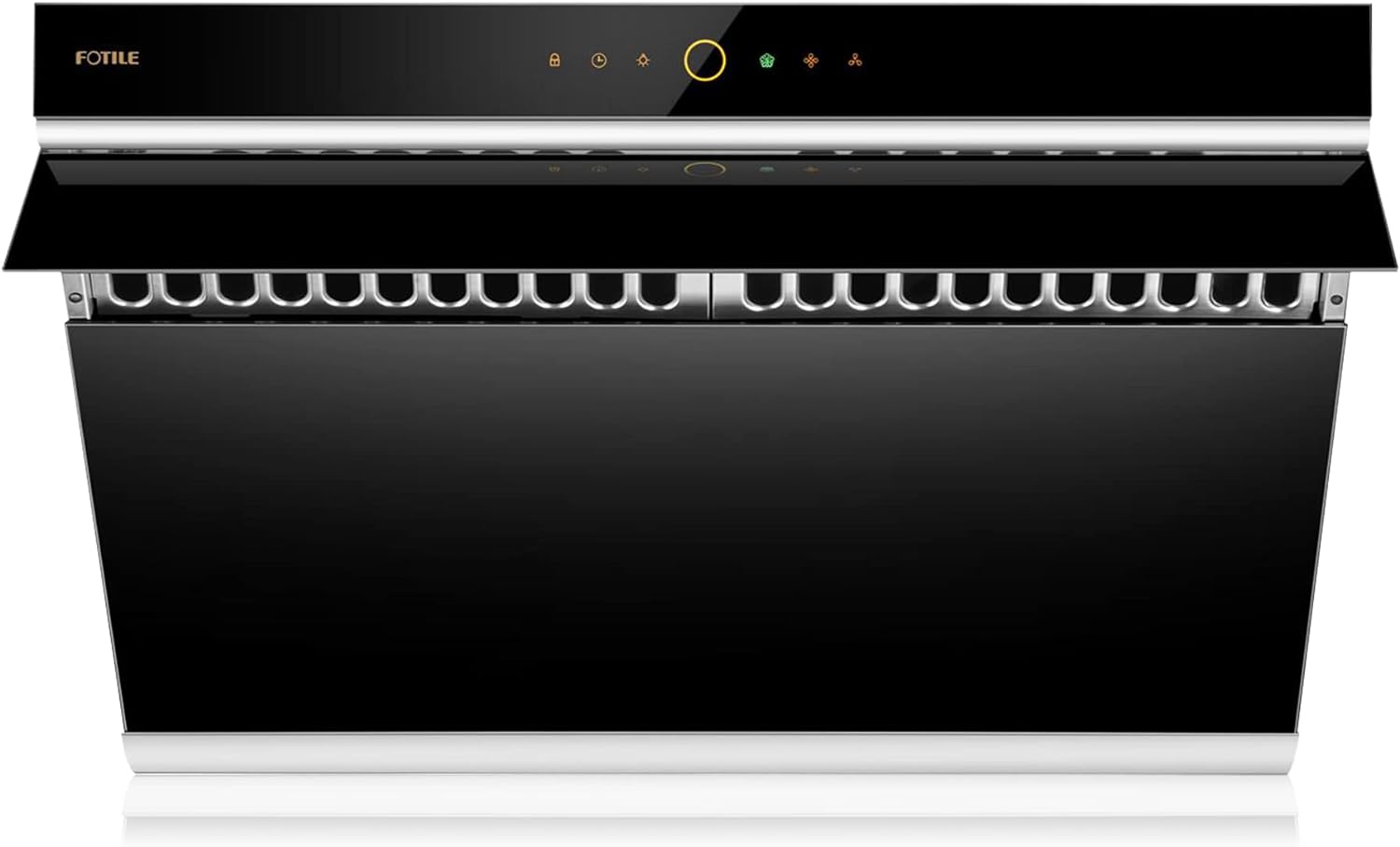
2. FOTILE JQG7505 Under-Cabinet Range Hood
If your culinary style involves heavy stir-frying, deep-frying, blackening spices, or cooking highly aromatic dishes, standard-CFM chimneys will simply choke. You need industrial-grade extraction power, and the FOTILE JQG7505 is the undisputed leader. Its unique 90-degree automatic open baffle plate draws smoke from a side-slant angle — closer proximity to the cooking surface prevents smoke from spreading horizontally before the hood can capture it.
At 850 CFM with dual DC motors, it creates a “smoke-safe zone” that captures fumes before they reach your face. Despite this hurricane-level suction, the dual-centrifuge motor tops out at just 54 dB — quieter than a normal conversation. The infrared motion-activation control is a genuinely practical feature: simply wave your hand in front of the unit to power it on when your hands are covered in dough or oil. The filter-free design with an oversized grease collection tray eliminates filter purchasing costs entirely.
- Suction Power:850 CFM (Dual DC Motors)
- Noise Level:Max 54 dB (Whisper-quiet for its class)
- Filter Type:Filter-less design with oversized grease collection tray
- Features:Infrared Motion Activation, Touchscreen Lock
- Design:30-inch Side-Draft / Slant Design
Pros
- Unrivaled suction captures smoke before it spreads
- Motion gesture controls keep the glass clean and hands-free
- Slanted design prevents head bumping while cooking
- Oversized oil cup reduces maintenance frequency
Cons
- Premium price point — an investment-grade appliance
- Requires precise installation; professional help recommended due to weight
Best Value
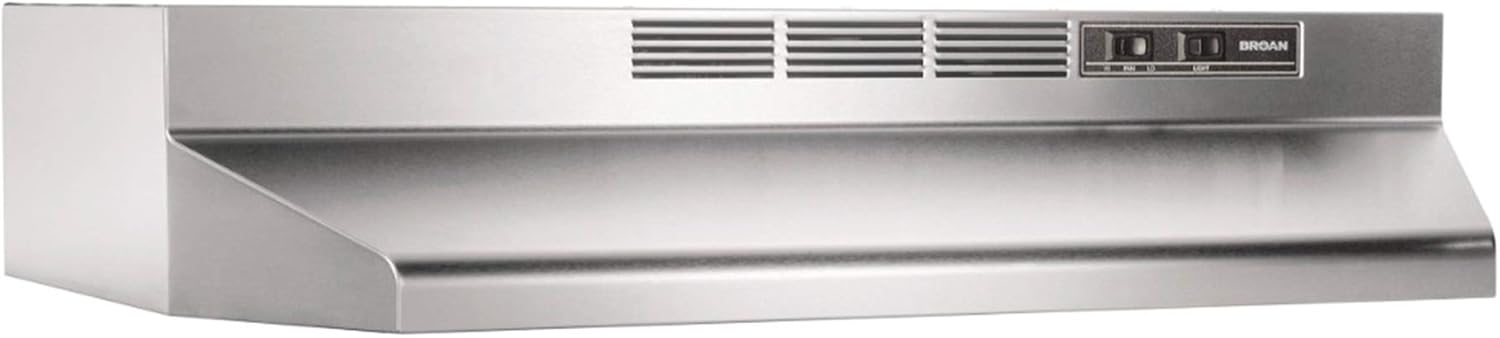
3. Broan-NuTone 413004 Non-Ducted Under-Cabinet Hood
For apartment renters, condo owners, or any kitchen on an interior wall where ducting is impossible or prohibitively expensive, the Broan-NuTone 413004 is the best ductless recirculating value on the market. Since it doesn’t vent outside, it utilizes a highly effective charcoal and aluminum mesh combination filter — pulling greasy, smoky air upward, neutralizing odors through activated carbon chemistry, and recirculating scrubbed air back into the kitchen.
The DIY installation is genuinely straightforward — mount to the cabinet bottom and plug it in. While it won’t remove heat or moisture like a ducted unit, it is highly effective at eliminating lingering cooking smells and preventing the grease buildup on cabinetry that is the number-one cause of early cabinet staining and finish deterioration in ventilation-free kitchens. For the price, the performance-to-cost ratio is unmatched.
- Installation Type:Ductless / Non-Vented (Recirculating)
- Lighting:Incandescent (Bulb not included, fits up to 75W)
- Filter Type:Replaceable Charcoal/Aluminum Mesh Combo
- Size:30-inch (Fits standard cabinet widths)
- Switch:2-Speed Rocker Switch
Pros
- Extremely budget-friendly price point
- Incredibly easy DIY installation — mount and plug in
- Slim profile doesn’t sacrifice head space over the stove
- Stainless finish matches modern appliances
Cons
- Does not remove heat or humidity from the room
- Charcoal filters must be replaced every 3–6 months
- Not suitable for heavy frying or indoor grilling
Side-by-Side Product Comparison
| Feature | Cosmo COS-63175S | FOTILE JQG7505 | Broan-NuTone 413004 |
|---|---|---|---|
| Max CFM | 380 CFM | 850 CFM | Not rated (ductless recirculating) |
| Max Noise | 65 dB | 54 dB | ~55 dB (low speed) |
| Filter Type | Permanent Baffle | Filter-free + tray | Replaceable Carbon |
| Ducted/Ductless | Both (convertible) | Ducted | Ductless only |
| Installation | Wall-mount | Under-cabinet slant | Under-cabinet (plug-in) |
| Best For | Standard 4-burner gas/electric | Heavy frying / stir-fry / aromatics | Apartments / no-duct kitchens |
| Ongoing Cost | Minimal (no filter replacement) | Minimal (no filter) | Moderate (filter ~$15 / 3–6 mo) |
Deep Dive: The Anatomy of Kitchen Chimneys
A kitchen hood is not just a fan in a metal box — it is a complex intersection of aerodynamics, filtration science, and motor engineering. Understanding the components helps you evaluate products accurately rather than relying on marketing terms.
The Motor: Single vs. Dual vs. DC Motors
The motor is the heart of the chimney. Most budget and mid-range hoods use a single induction (AC) motor — reliable and serviceable but typically louder and less energy-efficient at equivalent CFM ratings. Higher-end models like the FOTILE use dual DC motors. DC (direct current) motors are inherently more efficient than AC motors: they consume less electricity for the same output, generate less heat, and can be precisely speed-controlled. This is why the FOTILE achieves 850 CFM at only 54 dB — a combination that would be physically impossible with a conventional single AC motor design.
The Canopy: Width and Geometry
The canopy — the wide metal hood visible above the stove — serves a critical aerodynamic purpose beyond aesthetics. It acts as a capturing zone for rising smoke. Smoke doesn’t travel straight up; it rises in a cone-shaped plume that expands laterally as it climbs. A wider canopy with a lower edge intercepts this plume before it escapes sideways into the room. The geometry of the canopy’s interior also matters — some high-performance hoods incorporate internal baffles and guided channels that direct captured air efficiently toward the central suction inlet rather than allowing it to stagnate in corners.
The Lighting System
Good task lighting over the stove is a genuine safety feature. LED lighting — standard on the Cosmo COS-63175S — provides bright, even illumination of the entire cooking surface with minimal energy consumption and effectively zero heat generation. Incandescent bulb-based hoods (like the Broan-NuTone) can add noticeable radiant heat directly above where you are already dealing with a hot stove, and their bulbs must be replaced periodically. When evaluating any chimney purchase, look for models with 2–4 LED arrays positioned to minimize shadows across the cooktop.
Types of Kitchen Chimneys by Design
Your kitchen’s layout is the primary constraint in selecting the structural type of chimney. Choosing the wrong type for your kitchen geometry results in poor performance, awkward installation, and aesthetic failure regardless of CFM rating.
Wall-Mounted
For cooktops against a bare wall. Grand visual statement with tall flue housing. The most prevalent design in modern kitchens.
Under-Cabinet
Mounts to the bottom of overhead cabinets. Ideal for compact kitchens where vertical space is limited.
Island Mount
Suspended from the ceiling above a center island. Requires significantly higher CFM to compensate for open-air smoke dispersion.
Downdraft
Recessed into the countertop; rises mechanically when cooking. Visually stunning but less efficient — works against the natural upward movement of heat and smoke.
Slant / Side-Draft
The FOTILE design category. Angled close to the cooking surface to capture smoke at the source before it rises and spreads. Excellent efficiency-to-noise ratio.
Insert / Liner
Motor-and-filter assembly only — no exterior housing. Designed for installation inside custom cabinetry or existing hood shells. Maximum design flexibility.
Wall-Mounted vs. Island Mount: The CFM Difference
Island chimneys require notably higher CFM than equivalent wall-mount models. A wall-mounted hood benefits from two “wall effect” sides — the back wall and one side wall create a semi-enclosed capture zone that concentrates rising smoke toward the hood inlet. An island hood has no walls; cross-drafts from HVAC, open windows, and human traffic can blow rising smoke in any direction before the hood captures it. As a practical rule, island mount chimneys should be specified at least 20–30% higher CFM than the calculated minimum for the same cooktop in a wall-mounted configuration.
The Great Debate: Ducted vs. Ductless Chimneys
This is the most critical structural decision you will make. It determines how polluted cooking air is ultimately handled — and the implications extend to installation cost, ongoing maintenance, and long-term performance.
Ducted / Vented
The Performance Gold Standard
Exhausts all cooking air entirely outside the home. Removes smoke, grease, odors, heat, and humidity in a single pass. Requires exterior wall or roof penetration and ductwork routing.
Ductless / Recirculating
The Installation Problem-Solver
No exterior venting required. Pulls air through carbon filters and recirculates back into the kitchen. Cannot remove heat or humidity. Best for apartments, condos, and interior walls.
Ducted: The Gold Standard
A ducted chimney connects to heavy-gauge aluminum or PVC piping that exhausts air completely outside your home. It is 100% effective at removing smoke, grease, odors, and critically — the heat and humidity generated by boiling pots and open flames. In regions with hot summers, the reduction of cooking-generated heat in the kitchen is a meaningful comfort and energy benefit. The disadvantage is installation cost and complexity: cutting through your home’s exterior and routing ductwork to code can require a licensed contractor and involves significant structural work.
Ductless: The Problem-Solver
For high-rise apartments, rental properties, or kitchens located on interior walls where exterior penetration is impossible, ductless is the only option. Modern carbon filter technology is genuinely effective at neutralizing cooking odors — dramatically superior to having no ventilation at all. However, physics cannot be circumvented: carbon filters cannot remove heat, moisture, or ultra-fine combustion particles in the same way that exhausting air to the exterior does. Plan for active carbon filter replacement every 3–6 months — a recurring cost that should factor into your total ownership calculation.
The Hidden Energy Cost of Powerful Ducted Chimneys
Any ducted chimney over approximately 400 CFM is exhausting conditioned air — air your HVAC system already heated or cooled — out of your home at a significant rate. In tightly sealed modern homes, this creates negative air pressure that can cause backdrafting of carbon monoxide from furnaces and water heaters. Local building codes increasingly require a “makeup air system” for hoods exceeding 400–600 CFM. Always verify local code requirements before purchasing a high-power ducted chimney.
The Expert Buying Guide: Technical Specifications Decoded
When browsing kitchen chimneys, you will be bombarded with technical jargon. Here is how to translate those specifications into real-world performance metrics so you can buy exactly what you need without overpaying.
1. Calculating Your Required Suction Power (CFM)
CFM stands for Cubic Feet per Minute. It measures the volume of air the motor can displace per minute. Buying too little CFM is like draining a swimming pool with a straw. Buying excessive CFM wastes energy and may require a makeup air system by code.
| Stove Type | The Professional Formula | Example Calculation |
|---|---|---|
| Electric / Induction Cooktop | Stove width in inches × 10 | 30-inch electric: 30 × 10 = 300 CFM minimum |
| Gas Range / Gas Cooktop | Total BTU output of all burners ÷ 100 | 60,000 BTU total: 60,000 ÷ 100 = 600 CFM minimum |
| Kitchen Volume Rule | (Room L × W × H) ÷ 4 | 10 × 10 × 8 ft kitchen: 800 ÷ 4 = 200 CFM baseline |
| Island Installation Adjustment | Add 20–30% to calculated minimum | 600 CFM wall-mount equivalent → 720–780 CFM for island |
Expert Tip: Buy Slightly More Than Your Calculation
Always buy a chimney with a maximum CFM slightly above your calculated minimum. Running a powerful chimney quietly on its “Low” setting is far superior — both acoustically and energy-efficiently — to running a borderline-adequate chimney on full blast every time you cook.
2. Filter Type: Baffle vs. Mesh vs. Carbon
The filter is the frontline soldier of your chimney. If the filter becomes clogged or fails, grease reaches the motor — shortening the appliance’s lifespan and creating a serious grease fire hazard in your ventilation system.
- Cassette / Aluminum Mesh Filters: Multiple layers of aluminum screen sandwiched together. Grease gets snagged on the aluminum threads as air passes through. Best for light cooking; the microscopic holes clog rapidly under heavy use, suffocating the motor’s suction. Require weekly soaking in hot degreaser solution.
- Baffle Filters: Heavy stainless steel U-shaped panels that force air to rapidly change direction. Grease, being heavier than air, cannot make the sharp turns — it gets flung against the steel walls and collects in a drain tray. Best for heavy cooking, Indian cooking, deep-frying. Rarely clog completely and are 100% dishwasher-safe. This is the gold standard for high-performance residential hoods.
- Carbon / Charcoal Filters: Used exclusively in ductless models. Thick activated charcoal blocks chemically bind with odor molecules. Cannot be washed — once the pores are saturated (typically every 3–6 months), the filter must be discarded and replaced.
Full Filter Comparison Table
| Property | Aluminum Mesh | Baffle Filter | Carbon / Charcoal |
|---|---|---|---|
| Best Cooking Style | Light (pasta, steaming) | Heavy (frying, grilling, stir-fry) | Odor-heavy, ductless only |
| Grease Capture | Good initially | Excellent | Moderate |
| Clog Rate | High — weekly cleaning | Low — monthly | Saturates (not clog) |
| Cleanable? | Yes — soak and scrub | Yes — dishwasher safe | No — discard and replace |
| Replacement Cost | Low (or none) | None (permanent) | ~$10–$25 every 3–6 months |
| Removes Odors? | No | No | Yes (when fresh) |
| Compatible With | Ducted & ductless | Ducted primarily | Ductless only |
Auto-Clean Technology: Is it a Gimmick?
Auto-clean chimneys are a genuine convenience upgrade — not a gimmick — but the technology is frequently misunderstood. They do not clean the external filter surfaces. What they actually do is protect the motor housing.
Over time, vaporized oil migrates past the baffle filters and slowly coats the internal turbine housing and motor enclosure. In a standard chimney, this oil solidifies, slows the motor, and creates a foul burnt-smell when cooking. Thermal auto-clean solves this: a dedicated heating element around the motor housing activates for 10–15 minutes, liquefying the accumulated grease through heat. Centrifugal force then flings this liquid outward through a funnel into a small removable tray at the chimney’s base — all you do is empty and rinse this tray once a month.
The result is measurably extended motor life. Without auto-clean, the typical service life of a mid-range chimney motor is 7–10 years with good filter maintenance. With auto-clean, that figure extends to 12–15 years or more. On an expensive appliance like a range hood, this is a meaningful return on the premium.
Auto-Clean ≠ Hands-Free
Auto-clean chimneys still require you to clean the baffle filters monthly and empty the oil collection tray. The “auto” function cleans the internal motor housing only — not the external filter surfaces that are visible and accessible. Marketing language in this product category is frequently misleading about the scope of the technology.
Sizing the Chimney to the Cooktop
Matching a chimney exactly to the width of your stove is a common mistake. Smoke expands outward in a cone as it rises. To capture all fumes, the chimney canopy should be one size larger than your stove.
- 30-inch cooktop → Buy a 36-inch chimney
- 36-inch cooktop → Buy a 42-inch chimney
- If space prevents upsizing, compensate by specifying a significantly higher CFM model to capture the wider smoke plume despite the narrower canopy.
Noise Levels: What dB Rating Actually Means
The decibel (dB) rating of a kitchen chimney is the specification most homeowners ignore and subsequently regret. A chimney that delivers excellent smoke extraction but sounds like an airplane engine will fundamentally change how you use your kitchen — you will avoid running it on high or avoid turning it on at all, which defeats the purpose entirely.
| dB Range | Sound Level Reference | Chimney Rating |
|---|---|---|
| 40–50 dB | Library quiet / Quiet office | Excellent — barely audible while cooking |
| 50–60 dB | Normal conversation | Very good — present but unobtrusive |
| 60–65 dB | Restaurant background noise | Acceptable — noticeable on high speed |
| 65–75 dB | Busy street / Hair dryer | Loud — must raise voice over it |
| 75+ dB | Vacuum cleaner | Disruptive — avoid for open-plan kitchens |
Why Ducting Design Affects Noise More Than the Motor
The most common cause of a chimney sounding louder than its dB rating is incorrect duct sizing. Forcing a 600 CFM chimney through a 4-inch duct pipe (instead of the required 6–8 inch pipe) creates extreme air turbulence in the ductwork that generates a roaring sound completely separate from the motor. Flexible ribbed aluminum duct also generates more turbulence noise than rigid smooth-wall galvanized pipe. Always size your ductwork to the chimney manufacturer’s specification — not to whatever duct opening is already present in your wall.
Full Installation Planning Guide
Kitchen chimney installation planning begins before you purchase the unit — not after it arrives. The structural and electrical requirements of a new range hood must be confirmed to be feasible in your kitchen before committing to a specific model. Here is the full pre-installation assessment framework.
Step 1: Confirm Your Kitchen Type
Exterior Wall Kitchen
Easiest ducting scenario. Duct can exit horizontally through the exterior wall behind the chimney with a short duct run and a weatherproof exterior cap.
Interior Wall Kitchen
Duct must travel horizontally to the nearest exterior wall or vertically to the roof. Longer duct runs reduce effective CFM. Ductless becomes a practical alternative.
Apartment / Condo
Exterior penetration typically prohibited by building rules. Ductless recirculating is the only viable option in most multi-family buildings.
Island Cooktop
Duct must route vertically through the ceiling and roof. Ceiling height and roof structure significantly affect difficulty and cost.
Step 2: Electrical Requirements
Most residential kitchen chimneys require a standard 120V, 15-amp dedicated circuit. Some high-power models (850+ CFM with dual motors) require a 20-amp circuit. Confirm your kitchen’s existing electrical capacity before purchasing. If a new circuit is required, factor electrician costs into the total project budget. The FOTILE JQG7505 and Cosmo COS-63175S both operate on standard 120V 15A — no special electrical work required for most home installations.
Step 3: Ceiling Height and Flue Extension
Standard wall-mount chimneys include a flue (the vertical metal housing) sized for 8-foot or 9-foot ceilings. If your kitchen has 10-foot or higher ceilings — increasingly common in new construction and kitchen renovations — you must purchase an extension flue kit separately. Confirm ceiling height before ordering. The Cosmo COS-63175S, for example, requires an extension kit for ceilings above 9 feet. Installing without the correct extension kit produces an unattractive gap between the top of the flue and the ceiling.
Ductwork Guide: Pipe Size, Material, and Route Planning
The ductwork connecting your chimney to the exterior is as important as the chimney itself. Incorrect ductwork is responsible for the majority of underperforming range hood installations — and it is rarely the fault of the appliance.
Pipe Size Matters Enormously
- Hoods up to 400 CFM: minimum 6-inch diameter round duct
- Hoods 400–600 CFM: minimum 7-inch diameter round duct
- Hoods 600–900 CFM: minimum 8-inch diameter round duct
- Hoods over 900 CFM: 10-inch round or equivalent rectangular duct area
The relationship between duct diameter and airflow capacity follows the laws of fluid dynamics — reducing duct diameter by one size reduces effective airflow capacity by approximately 30–40%. This means a 600 CFM chimney routed through a 4-inch duct (a very common DIY mistake) may only deliver 200–250 CFM of actual extraction — far below the minimum needed for a gas stove.
Rigid vs. Flexible Duct
Rigid smooth-wall galvanized steel duct is significantly superior to flexible ribbed aluminum duct (sometimes called “flex duct”) for range hood applications. The ribs of flexible duct create turbulence zones along the entire duct run that produce measurably higher noise and reduce effective CFM. Use rigid duct for all straight runs. Flexible duct is acceptable only for the final 1–2 foot connection between rigid sections where precise alignment of a rigid elbow is difficult.
Minimizing Bends and Elbows
Every 90-degree elbow in your duct run reduces effective CFM by approximately 10–15%. Two elbows reduce it by 20–30%. When routing your ductwork, always plan the most direct path to the exterior — straight up through the ceiling and out the roof, or straight back through the wall, is always preferable to a zigzagging route that requires multiple direction changes.
Never Vent Kitchen Exhaust Into the Attic, Crawlspace, or Garage
Kitchen exhaust contains moisture, vaporized grease, and combustion byproducts. Venting into an enclosed space causes immediate mold growth on structural wood, coats surfaces with a flammable grease residue, and can introduce carbon monoxide into the living space through adjoining walls. Always vent ducted chimneys completely to the outside through a weatherproof cap. This is not optional — it is a building code requirement in every jurisdiction.
Filter Cleaning Masterclass
Neglecting your filters puts undue strain on the suction motor and degrades indoor air quality. Without auto-clean, follow this deep-clean method every 3–4 weeks for heavy cooking households, or every 6–8 weeks for light cooking.
1
Remove and Pre-Rinse
Remove the baffle or mesh filters from the hood. Rinse under hot running water to remove loose surface debris before soaking. This prevents contaminating your soaking solution immediately.
2
Prepare the Hot Water Soak
Find a container large enough to lay the filters flat — your kitchen sink or a plastic storage tub works well. Fill with boiling hot water. Extreme heat is essential for breaking down polymerized grease that has hardened onto the metal surface.
3
Add the Degreasing Solution
Add half a cup of baking soda and a generous squirt of heavy-duty dish soap (Dawn or equivalent). Swirl to combine. The baking soda acts as a mild abrasive and pH booster, while the dish soap’s surfactants break the molecular bonds holding grease to metal.
4
Submerge and Soak Minimum 30 Minutes
Submerge the filters completely. Let them soak for at least 30 minutes — 60 minutes for heavily soiled filters. You will see the water turn cloudy and brown as grease separates from the metal surface. This color change is a positive sign, not a concern.
5
Scrub the Surfaces
For mesh filters, use a soft-bristled brush — aluminum mesh is easily bent and torn. For stainless steel baffle filters, use a stiffer nylon brush and work it inside the curves where grease collects. An old toothbrush is excellent for the mortar joints between baffle sections.
6
Rinse Thoroughly and Dry Completely Before Reinstalling
Rinse thoroughly with hot running water until no soapy residue remains. Critical: Allow the filters to air dry completely before reinstalling — at minimum 2–3 hours, ideally overnight. Running the chimney with wet filters draws moisture directly into the motor and electrical components, accelerating corrosion and shortening the appliance’s service life significantly.
Troubleshooting: Common Problems and Fixes
These are the most frequently reported problems with kitchen chimneys — and the diagnostically correct solutions for each.
| Problem | Most Likely Cause | Fix |
|---|---|---|
| Smoke not being captured | Clogged mesh filter starving the motor of airflow | Deep-clean or replace filters immediately. Upgrade to baffle filters if persistent. |
| Excessive roaring noise | Undersized duct pipe creating turbulence | Upgrade duct diameter to match chimney CFM specification. Replace flex duct with rigid duct. |
| Grease dripping from the hood body | Filters saturated — grease bypassing into interior housing | Deep-clean all filters. Clean the interior motor housing with a degreaser. Consider auto-clean model. |
| Odors returning after cooking | Ductless carbon filter saturated and no longer absorbing | Replace carbon filters on schedule (every 3–6 months). Do not wash them — carbon filters are not cleanable. |
| Motor running but no suction | Exterior vent cap flap stuck closed or blocked by debris | Inspect exterior vent cap — remove bird nests, debris, or ice blockages. Confirm the backdraft damper flap opens freely. |
| Smoke filling kitchen even on max speed | Hood CFM too low for cooking style or stove BTU output | Recalculate required CFM. Upgrade to a higher-rated model. For island installations, increase by 20–30% from wall-mount minimum. |
Frequently Asked Questions (FAQs)
Our experts answer the most common questions homeowners have before making their final purchase decision.
What is the ideal height to install a kitchen chimney?
For optimal performance and fire safety, the distance between your cooktop surface and the bottom of the chimney canopy is critical. For electric and induction cooktops, the ideal installation height is between 24 and 28 inches. For gas cooktops, which produce open flames that can reach upward, the chimney must be positioned slightly higher — between 26 and 30 inches. Installing below these minimums creates a fire hazard and can damage the chimney’s electronics through prolonged heat exposure. Installing above these maximums allows smoke to disperse into the room before the fan can capture it, reducing effective extraction efficiency by 30–50%.
Can I vent my kitchen chimney into the attic or garage?
Absolutely not — this is a severe building code violation in every jurisdiction. Kitchen exhaust contains high levels of moisture, vaporized grease, and sometimes carbon monoxide from gas combustion. Venting into an enclosed space like an attic or garage causes immediate and extensive black mold growth on wooden structural members. The vaporized grease coats surfaces and creates a hidden fire hazard. Ducted chimneys must always vent completely to the outside of the house — either through the roof with a weatherproof rain cap or through an exterior side wall with a backdraft-damped wall cap.
Are curved glass chimneys better than flat metal ones?
This is almost entirely an aesthetic choice. Curved glass chimneys have a lighter, more elegant appearance and can help funnel smoke toward the central suction plate. However, glass requires significantly more daily maintenance — grease splatters and dust are highly visible on glass surfaces, requiring frequent cleaning with glass cleaner. Flat stainless steel hoods hide grease accumulation better and are more rugged under the heat and impact conditions of an active kitchen. For high-use kitchens, stainless is the more practical long-term choice. For kitchen-as-showpiece installations, glass provides a more architectural, feature-grade appearance.
How do I reduce the noise of my kitchen chimney?
If your chimney sounds louder than expected, duct sizing is almost always the first place to investigate. Forcing a 600 CFM chimney through a 4-inch duct pipe instead of the required 6–8 inch pipe creates extreme air turbulence that generates roaring independent of the motor. Switching from flexible ribbed aluminum duct to rigid smooth-wall galvanized pipe dramatically reduces turbulence noise. Minimizing the number of 90-degree elbows in the duct run also helps — each elbow creates a turbulence zone. If ductwork is already correct and the motor itself is loud, the chimney may be undersized for the cooking load and running at maximum speed continuously — upgrade to a higher CFM model and run it at a moderate speed instead.
What is a makeup air system, and do I need one?
If you install a high-power chimney — typically anything over 400 to 600 CFM, depending on your local building code — you are exhausting a significant volume of conditioned air from your home. In modern, tightly sealed construction, this creates negative air pressure that must be compensated. A makeup air system is a motorized damper connected to your HVAC that automatically opens to admit fresh outside air whenever your chimney activates. Without it, your chimney will struggle to achieve its rated CFM, and more critically, the negative pressure can cause dangerous backdrafting of combustion gases — including carbon monoxide — down your furnace flue or fireplace chimney. Check with your local building department whether a makeup air system is required before purchasing any chimney rated above 400 CFM.
Can I install a wall-mounted kitchen chimney myself?
For ductless (recirculating) under-cabinet models like the Broan-NuTone, yes — a competent DIYer can complete the installation in under an hour using basic tools. For ducted wall-mount models like the Cosmo COS-63175S, a confident DIYer with basic carpentry and electrical skills can manage it if the duct route is straightforward (straight back through an exterior wall). However, if installation requires cutting through the roof, routing through multiple walls, navigating wall insulation, or establishing a new 20-amp electrical circuit, hiring a licensed contractor and/or electrician is strongly recommended. A poorly installed exterior vent cap will allow water infiltration through the wall on the first heavy rainstorm, and the resulting water damage repair will far exceed the cost of professional installation.
How long does a kitchen chimney motor typically last?
With proper filter maintenance, a quality residential kitchen chimney motor should last 10–15 years. The primary causes of premature motor failure are: (1) clogged filters that starve the motor of airflow, causing it to overheat; (2) grease accumulation on the motor housing from infrequent filter cleaning; and (3) drawing moisture into the motor by reinstalling wet filters after cleaning. Auto-clean chimneys extend motor life to 12–18 years on average by preventing the internal grease buildup that is the leading cause of motor degradation over time. Running the chimney on the lowest effective speed for routine cooking — rather than always using maximum speed — also meaningfully extends bearing and motor life.
What happens if I don’t use a kitchen chimney at all?
Cooking without ventilation causes a range of compounding problems. Grease vapor from frying and sautéing settles on every surface in the kitchen — cabinets, walls, ceilings, and appliances — forming a sticky film that attracts dust, discolors finishes, and is extremely difficult to remove once it polymerizes (hardens). Over months and years, this grease accumulates on cabinet hinges, inside drawers, and on electrical outlets, creating fire risk. Beyond the physical kitchen, unvented cooking smoke contains fine particulate matter (PM2.5), VOCs, and in the case of gas stoves, nitrogen dioxide — all of which degrade indoor air quality to levels that would be unacceptable outdoors. For household members with asthma or respiratory sensitivities, unvented cooking is a direct and measurable health hazard.